Original author: Long Yue
Original source: Wall Street News
A financial product that has only been online for a month and a half has put South Korea's highest economic decision-making body into an emergency state.
The "F4" high-level coordination mechanism of South Korea will hold a meeting this Thursday to study response plans regarding the impact of single stock leveraged ETFs on the stock market. This marks the first time this issue has formally entered the highest level of economic coordination platform involving the Ministry of Finance and Economy, the Financial Services Commission, the Bank of Korea, and the Financial Supervisory Service.
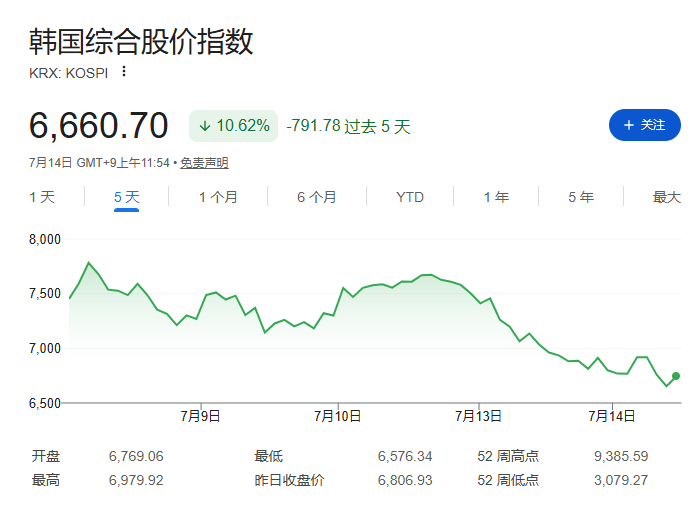
The trigger for the event is clear: the KOSPI crashed by more than 8% in a single day this past Monday, triggering the seventh circuit breaker of the year, with the market pointing to single stock leveraged ETFs as the culprit. These products amplify the daily fluctuations of individual stocks, accelerating price divergence during extreme market volatility, thus creating a "boost when rising, and amplify the decline when falling" effect. Single stock leveraged products were officially launched on May 27, allowing investors to make 2x bets on the price movements of Samsung Electronics and SK Hynix. The returns on these products are tied to the multiples of daily price movements of the underlying assets, requiring daily buying or selling of the underlying assets to achieve return matching, thereby further intensifying market volatility.
Before the Thursday meeting, South Korean securities firms and asset management companies had planned to convene an industry meeting on Tuesday to discuss issues related to leveraged ETFs and overall market conditions, to gauge the situation ahead of the government meeting.
Regulators' Language Escalates, "Regret" Rarely Spoken
The regulators' statement has escalated from "concern" to "self-blame," directly stating that they are facing a structural dilemma.
On July 13, Lee Chan-jun, the head of the Financial Supervisory Service, hosted a closed-door meeting attended by representatives from 20 asset management companies at the Yeouido Financial Investment Association. He candidly stated at the meeting: "There are structural issues, making it unlikely to provide a clear answer." He further expressed, "Given the current situation, this issue cannot be resolved in one go; it requires continuous monitoring, revision, and improvement." This reflects the deep dilemma that financial authorities face when proposing specific solutions.
Regarding the so-called "structural issues," Lee Chan-jun did not provide further details. External interpretations generally suggest: First, individual investors have net bought nearly 10 trillion won of the aforementioned products, making forced liquidation almost impossible; second, these products were only launched after being jointly revised and implemented by the Blue House, the Financial Services Commission, and the Korea Exchange, and if forced delisted, it would undermine the legal credibility of relevant regulations.
He also stated: "This does not seem to be an area that one person can unilaterally decide. The authorities (Financial Services Commission) may also need to conduct extensive reviews. We (Financial Supervisory Service) will do our best, but we are currently in a position to bear criticism. Asset management companies should honestly share their actual demands and suggestions at the institutional level, as this will become an important reference for policy decisions."
Lee Chan-jun, the head of the Financial Supervisory Service, explicitly said at a routine press conference on the 22nd of last month: "Regarding the launch of single stock leveraged ETFs, I regret not doing everything I could to stop it." This phrasing is extremely rare in the context of South Korean financial regulation. However, the day after he made this statement, the KOSPI plummeted by 10%. From the 22nd of last month to the 13th of this month, the KOSPI has dropped by more than 25% cumulatively.
Earlier this month, he further stated that the regulators are "seriously reviewing the unexpected consequences that have arisen since these products were launched."
Koo Yun-cheol, South Korea's Deputy Prime Minister and Minister of Finance and Economy, also stated at a Congressional meeting last week, "Given that various parties have raised multiple issues, we are currently negotiating solutions to remedy and minimize the related problems."
Kim Yong-beom, head of the Blue House policy office, further clarified at a press conference that the F4 meeting is conducting in-depth research on the issue of single stock leveraged ETFs exacerbating market volatility, "If there is a need for remedial measures, a decision will be made at the F4 market condition review meeting."
Three Pathways Progressing Simultaneously: Raising Margins, Limit Up Restrictions, Adjusting Leverage Ratio Limits
Prior to the Thursday meeting, regulators have been advancing various pathways for countermeasure research simultaneously.
According to news from the South Korean financial investment industry, financial authorities have formally requested asset management companies to propose specific improvement recommendations regarding the market volatility that single stock leveraged ETFs may cause. The authorities will compile industry opinions and then initiate formal plan formulation.
Possible measures currently being discussed in the market include three categories: raising margin requirements, limiting daily price fluctuation ranges, and adjusting leverage ratio limits.
The Financial Services Commission will convene experts from major securities firms and asset management companies on the 14th to discuss supplementary measures for single stock leveraged products, with specific proposals including raising the minimum margin requirement (i.e., the threshold of funds investors must deposit into the account) and strengthening pre-investment education.
However, regulatory officials also admitted that the aforementioned solutions "may only be temporary fixes and not address the structural root causes of market volatility." This means that even if a decision is made at the Thursday meeting, subsequent policies may still face further adjustments.
Data Confirms Impact: Circuit Breaker Incidents Reach Historic Records
From a data perspective, the contrast in market volatility before and after the launch of single stock leveraged ETFs is striking. According to statistics from NH Investment & Securities, during the 96 trading days before the product's launch, the proportion of days when the KOSPI had daily fluctuations exceeding 3% was 27% (26 days); in the 33 trading days from the launch until the 13th, this proportion soared to 52% (17 days). In contrast, the S&P 500 index in the United States has not yet experienced a single day of fluctuations reaching 3% this year.
Data from the Korea Exchange shows that as of the 13th, the securities market has triggered the "circuit breaker" (temporary trading suspension mechanism, including 17 times triggered by buyers and 18 times triggered by sellers) 35 times this year, far exceeding the three times triggered in the entire previous year, and has already surpassed the historic record of 26 times set during the 2008 global financial crisis, even before July has ended. The circuit breaker mechanism, which fully suspends market trading, has triggered 7 times this year, exceeding half of the total of just 13 triggers since the mechanism was introduced in 2000.
The Wall Street Journal also pointed out: "The volatility of the South Korean stock market has been further amplified by leveraged products linked to Samsung Electronics and SK Hynix."
One and a Half Months After Product Launch, Highest Decision-Making Body Intervenes
Single stock leveraged ETFs have been listed in South Korea for about one and a half months, and regulatory pressure has rapidly escalated from the level of the Financial Supervisory Service to the highest economic decision-making body.
Kim Yong-beom pointed out at the press conference that "the operation of related products has been about one and a half months now, and the F4 will carefully assess their actual impact on the market."
Currently, expectations for stricter restrictions on these products continue to rise — tightening of leverage ratios, higher investor access thresholds, or other structural constraints are all within the scope of discussion. As the market continues to experience severe fluctuations, external criticism of the hasty launch of these products in less than five months is also growing.
The direction of subsequent policies will depend on the assessment conclusions of the F4 meeting in South Korea on Thursday.
免责声明:本文章仅代表作者个人观点,不代表本平台的立场和观点。本文章仅供信息分享,不构成对任何人的任何投资建议。用户与作者之间的任何争议,与本平台无关。如网页中刊载的文章或图片涉及侵权,请提供相关的权利证明和身份证明发送邮件到support@aicoin.com,本平台相关工作人员将会进行核查。


