Original|Odaily Planet Daily (@OdailyChina)
Author|Wenser (@wenser2010)
In 2026, the cryptocurrency industry will enter its 17th year, and the exchange industry is also experiencing its "moment of divergence" — should it continue to be content with its corner and stick to the fundamentals of crypto; or should it follow the trend and join the global wave of financial innovation? It now seems this is no longer an elective, but a mandatory question.
The tides of the era are surging, and industry self-competition can only lead step by step into a dead end of development; only by breaking out and reaching the global financial market can a second spring for the industry be opened.
In this regard, Binance, as the largest cryptocurrency exchange in the world, shows the strongest determination. Previously, it spectacularly launched over 7000 US stocks, a remarkable feat in the industry. As a giant with a stablecoin reserve of $53 billion and a market share of 57%, Binance is also exploring the direction of the industry in its own way, seeking a new ecological position within the global financial system — "the super financial platform of the next currency era."
Starting from a grassroots cryptocurrency exchange in 2017, Binance has become a global hub for asset liquidity. Perhaps Binance has always been answering that difficult question of the industry — how far are we from a world of financial equity in the age of technological explosion?
Looking Back at Binance's 9-Year Journey: From grassroots to protagonist, from marginal to central, from singular to diversified
Today, after 9 years of development, Binance has over 320 million global users in 180 countries and regions, with client assets exceeding $128 billion. It is undoubtedly the leading currency financial platform in the cryptocurrency industry and even globally; but it all started from an unremarkable grassroots exchange 9 years ago, from the wild era of a nascent industry, beginning with bold innovations and courageous attempts to be a pioneer in the industry. Looking back, Binance's development can be briefly divided into the following 4 major stages:
Binance 1.0 Era: Pioneer of the Cryptocurrency Wild West (2017-2018)
On July 14, 2017, as the cryptocurrency industry was still in its growth phase, Binance officially set sail.
It is said that the English name Binance derives from “Binary Finance,” which means dual financial (Odaily Planet Daily Note: similar to binary options, it's a simplified financial tool where investors only need to judge the direction of price movements of the underlying asset without considering the magnitude of changes), aiming to provide users with an efficient and low-cost crypto trading platform based on native utility tokens.
At the time, the cryptocurrency industry was in the late stage of the ICO boom, and the emergence of BNB became one of the phenomenal ICO public offerings of that year; cryptocurrency exchanges were on the edge of regulatory scrutiny with no unified market standards or excellent user experience trading platforms; everything was still in its early stages.
However, soon the rampant "air coins," numerous P2P explosion incidents, and the chaotic ICO environment drew the attention of regulatory authorities. On September 4 of that year, a notice from Chinese regulators triggered a "wave of cleanups" in the crypto industry, and many domestic exchanges faced severe crises.
In this industry devastation, the emerging Binance instead seized the opportunity, swiftly moving its servers to Japan, embracing global operations, and later relocating its headquarters to Malta. In just a few short months, Binance surged to become the top exchange in trading volume.
The crypto bear market of 2018 also became a period of patience and construction for Binance.
That year, Binance's user count exceeded 6 million, and investment institutions such as Binance Labs (now Yzi Labs), Binance Academy, Binance Research, and Binance Charity Foundation were successively established, further enriching the ecosystem created around Binance exchange alongside Trust Wallet and BNB.
Binance 2.0 Era: Builder of the Open Cryptocurrency Ecosystem (2019-2021)
After experiencing the bear market of 2018, Binance entered a phase of rapid development.
In 2019, Binance successively opened credit card deposit channels and expanded into the U.S. market and the stablecoin market represented by BUSD, as well as the BSC ecosystem, further broadening its participation in global financial construction.
That year, despite the platform encountering a theft of 7000 BTC, it ultimately leveraged its robust platform reputation and quick response, resulting in Binance fully compensating users for their losses. The crisis became an opportunity to validate Binance's reliability.
The subsequent launch of perpetual contracts and DEX ultimately became key drivers propelling Binance's rapid ascent, attracting countless users, capital, and liquidity, which provided ample fuel for Binance's soaring trading volume. Following that, Binance continuously launched IEO, Launchpad, Launchpool, DeFi staking, Binance Liquid Swap, and other products and features, opening one wealth door after another for BNB holders. Binance Labs (now Yzi Labs) investment projects began to gain recognition in the industry, and "Binance Labs funded projects" gradually became a golden sign in the cryptocurrency industry; the BSC ecosystem also attracted more users through wealth creation, with crypto KOLs and "Binance Angels" around the world becoming super nodes in the Binance ecosystem, which in turn helped Binance achieve the milestone of "spot monthly trading volume surpassing $1 trillion" in January 2021.
Similarly, that year, Binance founder CZ joined the ranks of the world's top ten billionaires with a net worth of $94.1 billion.
In just four years, Binance gradually transformed from a singular crypto exchange to an indispensable on-chain infrastructure in the crypto market.
Binance 3.0 Era: Embracer of Cryptocurrency Compliance and Regulation (2022-2024)
As 2022 arrived, following DeFi Summer, GameFi Summer, and NFT Summer, the crypto industry faced another winter.
With the Terra&Luna&UST debacle, Three Arrows Capital collapse, Silicon Valley Bank failure, and FTX downfall, the crypto industry was seen by traditional financial markets as a pariah, with external ridicule and disputes reaching unprecedented heights.
Nevertheless, the unique resilience of the crypto market still supported Binance's forward momentum — by October 2022, Binance's share of the global cryptocurrency spot trading market surged to 62%, firmly occupying its position as the industry's leader. From that point, the requirements and scope of trust from the crypto market and users expanded beyond the industry itself, gradually spreading to the global financial ecosystem.
This time, Binance was once again at the forefront.
In 2022, Binance became one of the first exchanges to publish proof of user asset reserves; in 2023, as Binance founder, CZ proactively accepted a compliance investigation from the U.S., concluding with “CZ sentenced to four months in prison, Binance reached a $4.3 billion settlement agreement with the U.S. Department of Justice,” marking the largest corporate settlement case in U.S. history involving criminal charges against executives.
From this point onward, actively embracing crypto regulation, Binance gradually entered the “post-CZ era,” with co-founder He Yi and new CEO Richard Teng jointly guiding Binance into a new compliance epoch.
2024 is expected to be a major year for cryptocurrency mainstreaming, with Bitcoin spot ETFs and Ethereum spot ETFs being approved, and Bitcoin finally breaking through its previous high of $69,000. The crypto industry is entering a period of competition for existing market, with traditional financial markets and cryptocurrency markets accelerating their convergence.
By the end of 2024, Binance's registered user count is expected to reach 250 million; cumulative trading volume is expected to exceed $100 trillion; annual revenue could reach $16.8 billion, making it one of the strongest financial platforms in the world in terms of profitability. Meanwhile, the Abu Dhabi sovereign investment company MGX invested $2 billion as a strategic investment in Binance, setting one of the largest single investments in cryptocurrency history.
For Binance, which has already reached the industry's ceiling, compliance is the final piece of the puzzle towards becoming a global super financial platform.
Binance 4.0 Era: Super Entrance and Super Application for Global Financial Assets (2025-2026)
Over the past two years, Binance has gradually begun to unfold its vision of becoming a super entrance and super application for global financial assets.
With the accelerated convergence of traditional financial markets and crypto markets, RWA assets represented by U.S. stocks, publicly traded companies, and payment methods represented by stablecoins have become investment choices and value benchmarks for an increasing number of people. However, facing the world’s 8 billion people, there are not only the obstacles of asset certification thresholds and fiat currency circulation systems but also the lack of a unified application addressing finance, life, investment, and payment all at once.
This is precisely the direction Binance is currently striving to breakthrough. In June this year, Binance officially opened trading for over 7000 U.S. stocks and ETFs, and then directly supported the on-chain trading of tokenized assets through bStocks, thereby opening a new chapter in the global financial ecosystem.
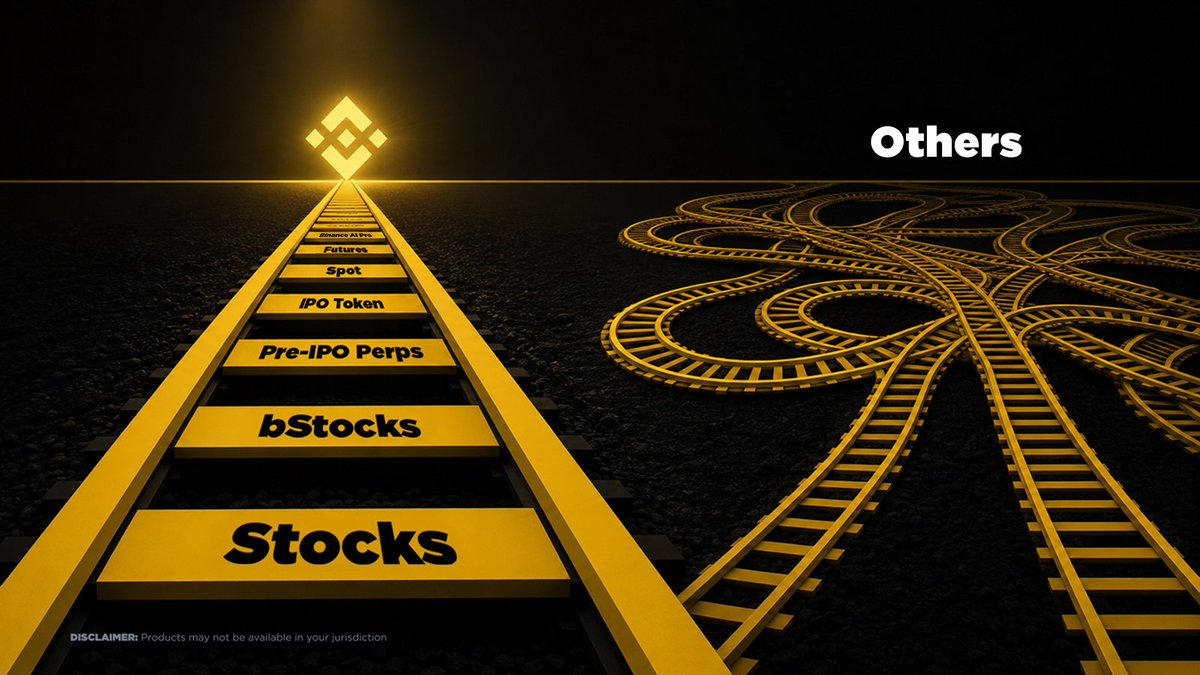
Firstly, Binance has achieved "one account, diversified assets" for asset equity. Workers in inflation-stricken Argentina can spend $10 to buy U.S. stock assets; digital nomads in Bali, Southeast Asia, can easily use cryptocurrencies to pay for coffee or restaurant bills; Muslims in the Middle East can freely trade crude oil price fluctuations and gold volatility; qualified investors globally can participate in diverse asset trading and applications. Recent data shows that it took just one month for the asset management scale for stocks on the Binance platform to exceed $1 billion.
Secondly, Binance has achieved "global 24/7 trading" for time zone equity. No matter where you are in the world, in which hemisphere or time zone, you can participate in the hottest asset trading, investment, and volatility, truly achieving "365 days online." The launch of the bStocks product filled the last significant category of asset types on the Binance platform, also opening the door to flexible global compliant investment portfolios.
Lastly, Binance has realized "reserve fund mechanisms and AI safety compliance" for risk control equity. For many, on-chain finance faces challenges and risks such as hacking attempts, social engineering attacks, and asset protection; leveraging Binance's mature security risk control mechanisms, user assets are tightly safeguarded, and the AI safety compliance system maximizes asset protection capabilities. According to official data, from 2025 to date, Binance’s AI security risk control system has cumulatively prevented over $10.5 billion in fraudulent risks.
Focusing on AI smart applications and blockchain technology infrastructure, Binance truly achieves a holistic approach to financial equity, quantitative equity, asset equity, time zone equity, and risk control equity. Balancing CeFi and DeFi construction, today's Binance has become an undeniable "one-stop financial application platform," effectively becoming a global hub for financial liquidity.
According to official information, as an "all-in-one super app," the Binance platform now encompasses the following four functional layers:
- Infrastructure layer: Pre-IPO Perps, Stocks, Tokenized Stocks (bStocks), Spot, Futures, Margin, Options, Alpha, Wallet, Fiat Gateway, Loans, VIP.
- Community and social layer: Chat, Binance Square, C2C, etc.
- Growth and yield layer: Earn, Launchpool, Megadrop, HODLer Airdrops, Simple Earn, Mining Pool, etc.
- Smart application layer: Binance Ai Pro, Binance Pay, Card, and other functionalities.
As a result, over 320 million global users can complete various experiences such as merchant payments, friend transfers, investment trading, fractional stock purchases, and wealth management returns all within the same account. Furthermore, Binance's "super application journey" has expanded from crypto to the U.S. stock sector, rapidly progressing towards a target of 3 billion global users.
Conclusion: Binance Accepts the Role of Answering the Questions of the Era
Nine years ago, facing challenges such as "user transactions, user experience, asset types" in the crypto industry, Binance provided its answers through step-by-step innovative approaches, becoming a leader in the industry; nine years later, the issues facing Binance are similar, but the affected user base has expanded worldwide, namely — how to allow everyone to enjoy the dividends of financial equity in this era and participate in the free flow of global assets?
The answers Binance provides have both changed and remained unchanged; the changes lie in the industry environment, asset types, and financial ecosystems; the unchanging aspect is the focus on users, determined to overcome past financial bottlenecks and create a new financial system that is open and empowering for all globally.
Basing on the global market accumulated over time, native crypto technologies, market reputation, and AI logistical infrastructure, combined with the self-organizing ecosystem co-built with the community and ecosystem over the past nine years, Binance has moved from the edge of the era stage to the center, transforming from a grassroots startup platform into a global super financial platform.
The next step for Binance remains those eight words — financial equity, empowering users.
免责声明:本文章仅代表作者个人观点,不代表本平台的立场和观点。本文章仅供信息分享,不构成对任何人的任何投资建议。用户与作者之间的任何争议,与本平台无关。如网页中刊载的文章或图片涉及侵权,请提供相关的权利证明和身份证明发送邮件到support@aicoin.com,本平台相关工作人员将会进行核查。


