Two days ago, $CASHCAT once approached a market cap high of 230 million USD, but it has now pulled back to around 150 million USD, a drop of nearly 35%.
As $CASHCAT retraced, the market on the Robinhood chain began to trend towards chaos and cooling. Yesterday, the token $1 surged from around an 800,000 USD market cap to approximately 15 million USD due to rumored purchases by the Robinhood CEO's address. But soon, this rumor was debunked, and the token has now fallen back to just over 1 million USD in market cap.
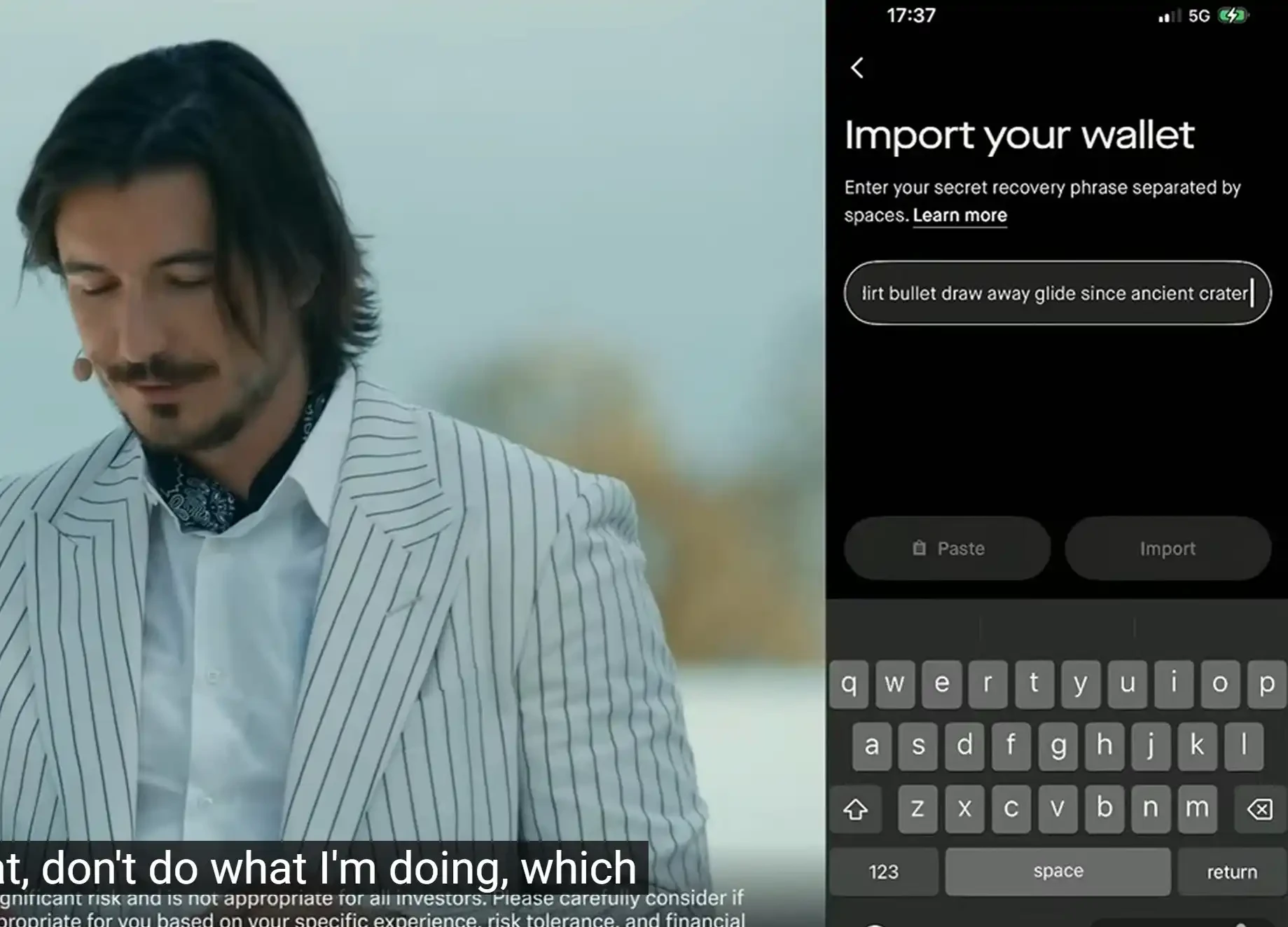
This address was previously used by the Robinhood CEO for a live demonstration, during which 9 out of 12 mnemonic phrases were leaked. Due to the partial leak of the mnemonic phrases, this address was already compromised a year ago.
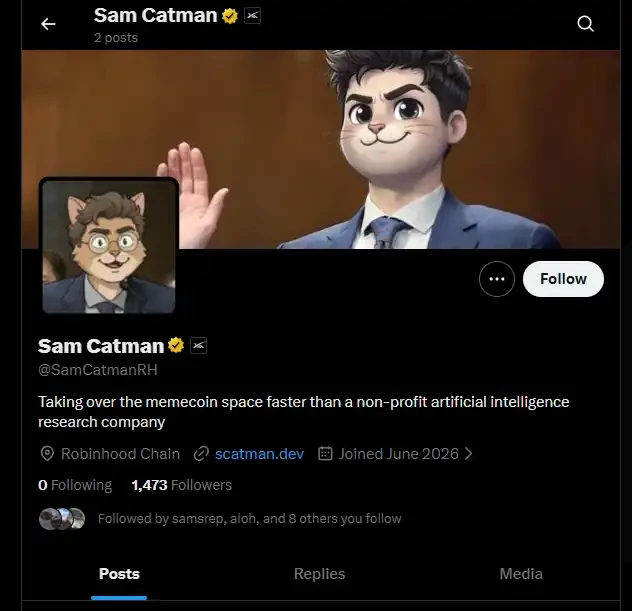
Another coin that experienced wild fluctuations yesterday was $SCATMAN. A hacker stole SpaceXAI's official Twitter account, added an official verification badge to this coin mocking Sam Altman, and retweeted posts. At its peak, this coin's market cap exceeded 2.5 million USD, but it is currently down to less than 100,000 USD.
Due to the pullback of $CASHCAT, the overall sentiment on the Robinhood chain has already decreased. With reports of suspected wallet purchases and hackers stealing social media accounts to conduct rug pulls — situations viewed as "signs of doom" — some players have begun to voice that "the Robinhood market is over."
Has it really ended? To answer this question, we need to consider several market trends from this year to provide both short-term and long-term answers.
Short-term: Normal Retracement
If we review the most direct catalyst for $CASHCAT's surge, one of them is this tweet from Robinhood CEO Vlad Tenev:
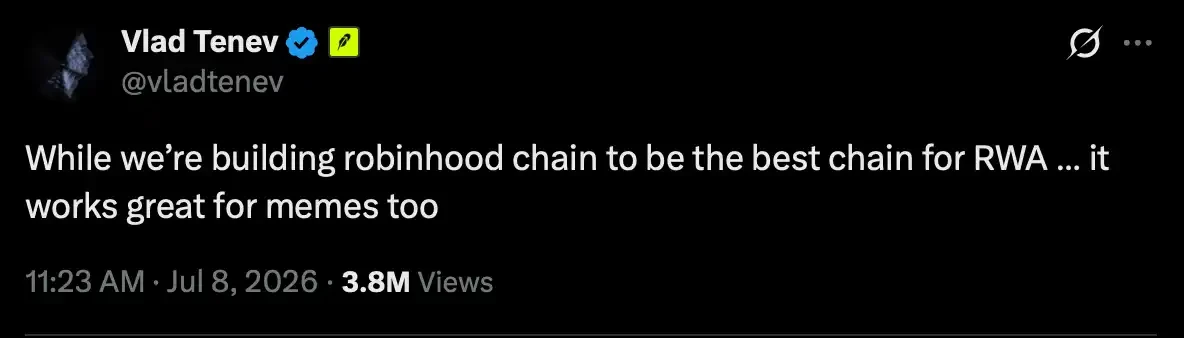
"When we build the Robinhood chain into the best RWA chain, it will be fantastic for memes too"
Also on the morning of July 8, Vlad followed the official Twitter of $CASHCAT on X, causing the coin's market cap to spike from 10 million USD to nearly 50 million USD instantly, and it continued to rise further.
These two catalysts are indispensable. One conveyed the "Robinhood CEO supports creating meme coins on their own chain" attitude, while the other indicated that "CASHCAT is the Robinhood's chosen leader."
Back on July 2, when the Robinhood mainnet was just launched, there were some players paying attention to this new chain, but not many. Most were following the "new chain gold rush" logic, and no one could have predicted that just a week later, the Robinhood CEO would personally step in and raise everyone’s expectations to a very high level.
Because of this unexpected shift in expectations, the market began to revise its expectations for the Robinhood chain significantly. For example, "The Robinhood chain can bring retail investors trading stocks onto the chain," "With CASHCAT, Robinhood can replicate DOGE and SHIB," etc. The rapid surge of $CASHCAT further exacerbated the market's FOMO sentiment.
However, the market on that day also buried some hidden dangers; the risk lies in the fact that besides $CASHCAT, there was no very obvious 'second leader' emerging, which easily reminds us of situations in other markets this year:
The "Space Dog" $ASTEROID took off the ETH mainnet market, but there was no 'second leader'; fortunately, there were narrative projects like $UPEG, $SATO, etc., serving as market supplements.
The $ANSEM boosted Solana's market, but there was no 'second leader', only some tokens related to Ansem reaped some gains.
In both cases, everyone hoped the leading tokens could reach a market cap of 1 billion USD, allowing liquidity to overflow to other narratives and expand the scope of PvE tokens, but none achieved that. The main reason is still the insufficient funds within the market; reaching a 1 billion USD market cap in the current market environment is incredibly difficult. Furthermore, the explosive price increases of these leading tokens were driven by unexpected attention events; "Space Dog" surged because Musk agreed to make it the SpaceX mascot, and $ANSEM was driven by Ansem's claim. The price increases stemmed from attention events, while subsequent rises needed larger events to act as catalysts, but neither of these tokens had further catalysts for FOMO-inducing attention events.
The inability to sustain and amplify attention events led to a market nature of "arbitrage" rather than "long-term holding." As nearly all active players on the chain flocked to the Robinhood chain to seek profit, everyone began to excavate various angles from Robinhood's tweets, from the Robinhood CEO's interactions with their favorite meme character $JUGGERNAUT, to the $GME market that Robinhood personally destroyed by "pulling the cable," to the seemingly personally deployed $WALLET by a Robinhood employee, etc. In reality, such behavior signifies the spread of the feeling of missing out on $CASHCAT, reminiscent of many years ago in Japan when the nuclear leak caused many people to rush to supermarkets to stock up on salt, regardless of whether they needed it; they grabbed anyway. If it's useful, profit can be made, if not, that's fine.
Everyone chases the next potential target that might interact with Robinhood and bets on the unknown, which significantly reflects the current meme coin market as almost entirely an "attention prediction market." The short-term retracement is, therefore, understandable, as the leading token $CASHCAT has experienced a pullback, and Robinhood has nothing more to excite people. Projects with "conspiracies," like $JUGGERNAUT and $HOODRAT, have also been unable to break through and maintain a market cap of 20 million USD, further confirming that until now, the Robinhood chain market is not much different from the markets of $ASTEROID and $ANSEM.
At this stage, aside from conspiracies, projects that are able to maintain relative stability are those that are seen as more likely to interact with Robinhood over a more extended time frame or can attract attention even without direct interaction from Robinhood. For instance, $GME maintains a market cap in the range of 2 to 3 million USD, with the expectation that Robinhood will likely mention $GME again in the future, or events involving GameStop's stock price volatility or the sudden return of the roaring cat may catalyze price increases. Similarly for $JUGGERNAUT, after all, Robinhood's CEO has previously mentioned it as his favorite meme character; if he mentions it again, it could trigger considerable price increases.
However, such positioning is very "left-sided," betting on potential attention, which has no relation to traditional meme coin community building. Including expectations that Robinhood will continue to support the meme coin ecosystem or launch meme coins on its own chain in the future is too early and overly optimistic. Nevertheless, it is precisely through such optimism that one can achieve massive gains like those seen with $CASHCAT. If you don’t buy a lottery ticket, you won’t win.
Long-term: The Existence of Competition Fuels Expectations
With the conclusion of the "Space Dog" market, players are returning to Solana. The brief "token brawl" on BSC has ended, and everyone is heading back to Solana. Solana’s advantage in the meme coin market has touched upon user habits to some extent; going to Solana for memes has begun to become a habit or culture.
With such foreseeable competition, the newly launched Robinhood chain now evokes a long-term anticipation: "What if the Robinhood chain becomes the next Base, Solana, or even surpasses them, resulting in a full return of the meme bull market happening on it?"
This is not impossible, as the trend of meme-ification of stocks has intensified, and Robinhood was once the base for retail investors and the site of the GameStop incident. Their user base consists of those who have accepted, adapted to, and even enjoy meme-based trading; if the $GME meme coin on the Robinhood chain rises steadily alongside channels that can reach traditional investors, a similar situation could indeed bring users and funds onto the chain.
Meme coins, or trading around memes, is an unstoppable trend. Both good and bad sentiments revolve around the market's emotional fluctuations; meme coins simply make everything more direct and enjoyable. As the scale of the market expands, negative memories like fragmentation and scams will naturally fade away, as players will no longer need to snatch food from a limited pond.
The long-term expectation for the Robinhood chain is one of deep ongoing support from Robinhood for meme coins, alongside a broader audience for meme coins.
免责声明:本文章仅代表作者个人观点,不代表本平台的立场和观点。本文章仅供信息分享,不构成对任何人的任何投资建议。用户与作者之间的任何争议,与本平台无关。如网页中刊载的文章或图片涉及侵权,请提供相关的权利证明和身份证明发送邮件到support@aicoin.com,本平台相关工作人员将会进行核查。


