What is system analysis rToken?
Recently, I studied the rToken issued by Reality under Bitget from beginning to end.
Many friends see rToken and immediately think of tokenized stocks, but the real aspects worth watching are how orders are executed, how underlying stocks are custodied, how dividends and stock splits are handled, and whether the assets can still be used for margin, lending, and derivatives after purchase.
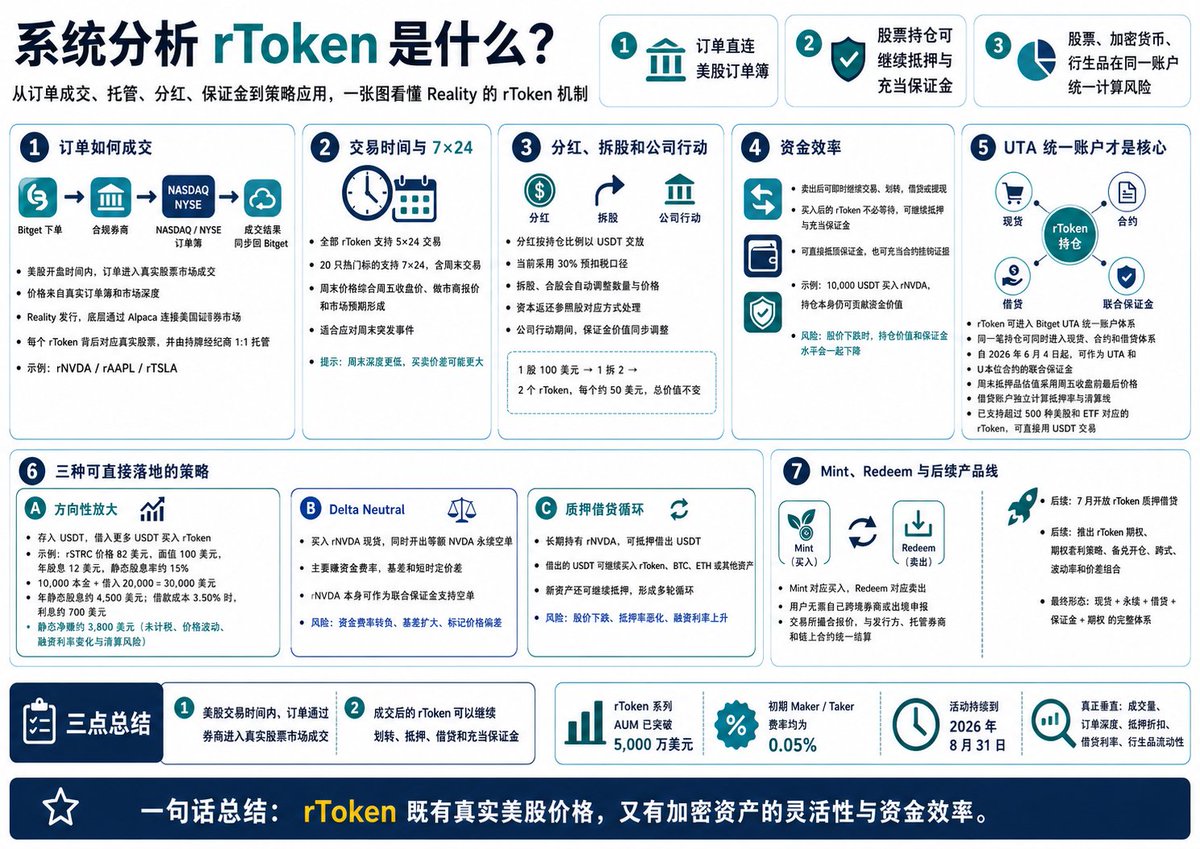
The entire mechanism can be broken down into seven parts.
1. Orders are executed directly in the US stock market
During US market opening hours, including pre-market, intraday, after-hours, and night trading, the rToken spot orders submitted by users on Bitget will be sent to liquidity pools in the US stock market such as NASDAQ and NYSE through compliant brokers.
The execution takes place in the US stock market, and the execution results are then synchronized back to Bitget.
So the price users receive comes from the real US stock order book and market depth at the time.
rToken is issued by Reality, and the underlying is connected to the US securities market through Alpaca, where each rToken corresponds to a real stock, custodied by licensed brokers on a 1:1 basis.
The tokens users see in Bitget, such as rNVDA, rAAPL, rTSLA, correspond to stock holdings in NVIDIA, Apple, and Tesla.
The most important aspect of this structure is that the transaction price and liquidity come from the US stock market. Even for relatively obscure assets, it will not completely depend on a very small crypto order book for pricing.
2. Full support for 5×24, 20 popular assets support 7×24
Currently, all rTokens support trading five days a week, twenty-four hours a day, covering pre-market, regular trading, after-hours, and night trading in the US stock market.
20 popular assets such as rNVDA, rAAPL, rTSLA also support weekend trading.
During the weekend, the US stock market is closed, and NASDAQ and NYSE no longer match orders. The prices during this time will be based on the Friday closing prices, market maker quotes, and market expectations.
The direct value of this feature is that users can handle their positions in advance when unexpected events occur over the weekend.
For example, if a war, sanctions, major policies, company accidents, or industry regulatory changes occur over the weekend, traditional stock accounts often have to wait for the market to open on Monday, whereas rToken allows for earlier position reductions, increases, or hedging.
Of course, the trading depth on weekends will be lower, and the bid-ask spread may also be larger, making it more suitable for responding to sudden risks.
3. Dividends, stock splits, and corporate actions will be handled automatically
Long-term stock holdings, in addition to price fluctuations, will also encounter dividends, stock splits, consolidations, and capital returns.
These matters will be handled synchronously by rToken.
After stock distributions, users will receive the corresponding USDT dividends according to their holdings, without needing to apply themselves or execute additional operations.
Dividends will be taxed at the applicable rate for foreign investors, currently using a 30% withholding tax standard.
If a company splits or consolidates stocks, the number and price of rToken will also be automatically adjusted.
For example, if a $100 stock performs a split into two, the holding will change from one rToken to two, each priced at approximately $50, with the total holding value remaining unchanged.
More importantly, during corporate actions, rToken can still continue to serve as margin assets; the system will adjust the number of holdings and margin value synchronously, preventing the split from suddenly affecting the account's collateral rate.
Capital return type income will also be taxed or refunded according to the corresponding US stock handling method.
4. Fund efficiency: instant settlement, free transfer, pledgable at any time
rToken preserves the characteristics of instant settlement and free transfer of crypto assets.
After selling, the funds can immediately continue to be traded, transferred to sub-accounts, participate in contracts, lend, or withdraw, without having to wait for the stock settlement period to end.
After purchasing, rToken does not need to just sit idly in the account.
This holding can be transferred to different accounts, pledged to borrow USDT, or serve as margin for contracts and other derivatives.
After buying stocks with the same funds, the stock holding itself can continue to provide funding value.
For example, if a user uses 10,000 USDT to buy rNVDA, and the account already has an exposure to NVIDIA's price, this rNVDA can still act as margin, supporting other positions.
Funding utilization will indeed increase, but the risks will also be amplified. If the stock price falls, both the holding value and margin level will decline, and if there are also loans and contracts, the liquidation distance will shorten significantly. But there are solutions, which will be discussed in point six.
5. UTA unified account is the core of rToken
For market makers, quantitative teams, and institutions, the real value of rToken lies in its ability to enter Bitget's UTA unified account.
The same rToken holding can simultaneously enter the spot, contract, and lending systems, with US stocks, cryptocurrencies, and derivatives positions uniformly calculated for risk and margin value in one account.
Starting from June 4, 2026, rToken can already be used as joint margin for UTA and U-denominated contracts.
For instance, if the account holds rNVDA, this asset not only provides exposure to NVIDIA stock but can also contribute margin value to support BTC, ETH, or other contract positions.
Users do not need to sell rNVDA first, nor do they need to transfer funds to another margin account.
The weekend margin calculation has also been handled separately.
Even if some rTokens can still be traded over the weekend, when the system calculates the collateral value, it will still use the last price before Friday's close.
Market price fluctuations over the weekend will not directly change the valuation of the collateral, nor will an abnormal transaction during low weekend liquidity suddenly trigger a liquidation of the entire account.
Pledging and lending will use independent risk calculations.
When users pledge rToken to borrow, the lending account will calculate the pledge rate and liquidation lines separately, without directly putting other positions in the UTA main account into the same lending liquidation pool.
Institutions can also continue to use sub-accounts to split different strategies, managing directional positions, arbitrage positions, and high-leverage positions separately.
Currently, Bitget supports over 500 types of rTokens corresponding to US stocks and ETFs, allowing users to trade directly with USDT without needing to first convert to USD, nor requiring transfers back and forth between cryptocurrency exchanges and securities accounts.
6. Three strategies that can be implemented directly
The first is to amplify directional exposure in US stocks.
Users can deposit USDT into the UTA account, and then use leveraged trading to borrow more USDT to buy rToken.
The rToken purchased will continue to enter the joint margin system, and its holding value and unrealized gains can continue to support other positions.
Taking rSTRC as an example.
Assuming the price of rSTRC is $82, par value $100, with a fixed annual dividend of $12 per share, corresponding to a static dividend yield of nearly 15%.
If a user invests 10,000 USDT of principal and borrows 20,000 USDT, they can establish a $30,000 rSTRC position, yielding about $4,500 in annual static dividend income.
Assuming the borrowing annual cost is 3.5%, the interest for the $20,000 loan for one year is about $700, leaving $3,800 after financing costs are deducted.
But this is just a static estimate.
Withholding taxes on dividends, changes in STRC prices, financing rate changes, and liquidation risks haven't been accounted for. If rSTRC continues to decline, the holding loss may exceed the dividend income.
The second strategy is Delta Neutral, which is a long position in the spot market plus a perpetual short position.
Users can buy $10,000 nominal value of rNVDA while simultaneously opening a $10,000 nominal value of NVDA perpetual short.
rNVDA provides positive exposure, while the perpetual short provides an equivalent negative exposure. As the two sides scale closely, the impact of NVIDIA's price increase or decrease on the net value of the portfolio will significantly decrease.
This type of strategy primarily earns from perpetual contract funding rates, the basis between spot and contracts, and short-term pricing differences across different markets.
rNVDA can also serve as joint margin, directly supporting the perpetual short position without needing to prepare an additional equivalent margin.
Of course, all strategies carry risks.
Funding rates may turn negative, basis may widen, and the marked price may deviate from the spot transaction price. A directional exposure close to zero does not mean that earnings and liquidation risks will also approach zero.
The third strategy is the pledge and lending cycle.
If the user holds rNVDA long-term but doesn't want to sell, they can use rNVDA as collateral to borrow USDT.
The borrowed USDT can continue to buy rNVDA or allocate to other rTokens, BTC, ETH, or participate in other trades.
The newly purchased assets can continue to be pledged, forming multiple rounds of cycles.
This structure can continuously release funds without selling the original holdings.
If the underlying stock price falls, the value of the collateral will decline, and the distance to liquidation in the lending account will get closer. If financing rates rise, the long-term holding costs will also quickly increase.
7. Mint, Redeem and subsequent product lines
Mint within the rToken system corresponds to buying, while Redeem corresponds to selling.
Users do not need to convert rToken into stocks themselves, nor do they need to submit separate subscription and redemption requests to Alpaca or other brokers.
After completing the transaction on Bitget, the tokens and funds on the user end will be instantly settled.
The exchange will conduct a unified settlement with the issuer, custodian broker, and on-chain contracts based on daily trading volume and net holding changes, and then complete the corresponding minting or burning of rToken.
The entire underlying process is hidden from ordinary users, and the operational method is largely the same as trading other crypto assets.
rToken staking and lending will open in July, and the lending accounts will independently calculate risks from the UTA main account.
In the future, rToken options will also be launched.
Once options are online, users can perform protective puts, covered calls, straddles, strangles, and spreads around rToken.
At this stage, rToken will provide more than just exposure to stock spot; spot, perpetual, lending, margin, and options will gradually form a complete trading system.
Overall, there are three important changes with rToken.
During US stock trading hours, orders are executed through brokers in the real stock market.
The rToken after execution can continue to be transferred, pledged, lent, and used as margin.
Stocks, cryptocurrencies, and derivatives can be uniformly calculated for funding value and risk in the same account.
Since Reality went live in June this year, the rToken series AUM has surpassed $50 million, with initial Maker and Taker rates both set at 0.05%, with the promotion lasting until August 31, 2026.
The real focus moving forward is on actual transaction volume, order depth, collateral discounts, lending rates, and derivatives liquidity.
In summary, rToken offers the complete trading experience of stocks along with the flexibility and funding efficiency of crypto assets.
For institutions, the key to judging this product is not "another stock token," but rather three things: direct connection to the US stock order book (no de-pegging risk), UTA joint margin (asset efficiency), and weekend collateral valuation anchored by Friday's closing prices (controllable risk). Since Reality launched in June, the rToken series AUM has surpassed 50 million USD, and the initial Maker/Taker rates are both 0.05% (until August 31, 2026).
Of course, with actual transaction volumes, order depth, collateral discounts, lending rates, and derivatives liquidity stabilizing, only then will rToken complete its evolution from a gateway for buying US stocks to a fully integrated cross-asset trading tool for institutions.
免责声明:本文章仅代表作者个人观点,不代表本平台的立场和观点。本文章仅供信息分享,不构成对任何人的任何投资建议。用户与作者之间的任何争议,与本平台无关。如网页中刊载的文章或图片涉及侵权,请提供相关的权利证明和身份证明发送邮件到support@aicoin.com,本平台相关工作人员将会进行核查。


