Foreign capital continuously exits the South Korean stock market, high leverage and financing funds spark fluctuations
Recently, the South Korean stock market has officially entered a technical bear market stage. Many friends believe that the downturn in the Korean market is due to the cooling of semiconductors, but those who have seen my recent posts should know that the biggest problem in South Korea is not the unpopularity of semiconductors, but rather the significant issues with funding in the Korean stock market.
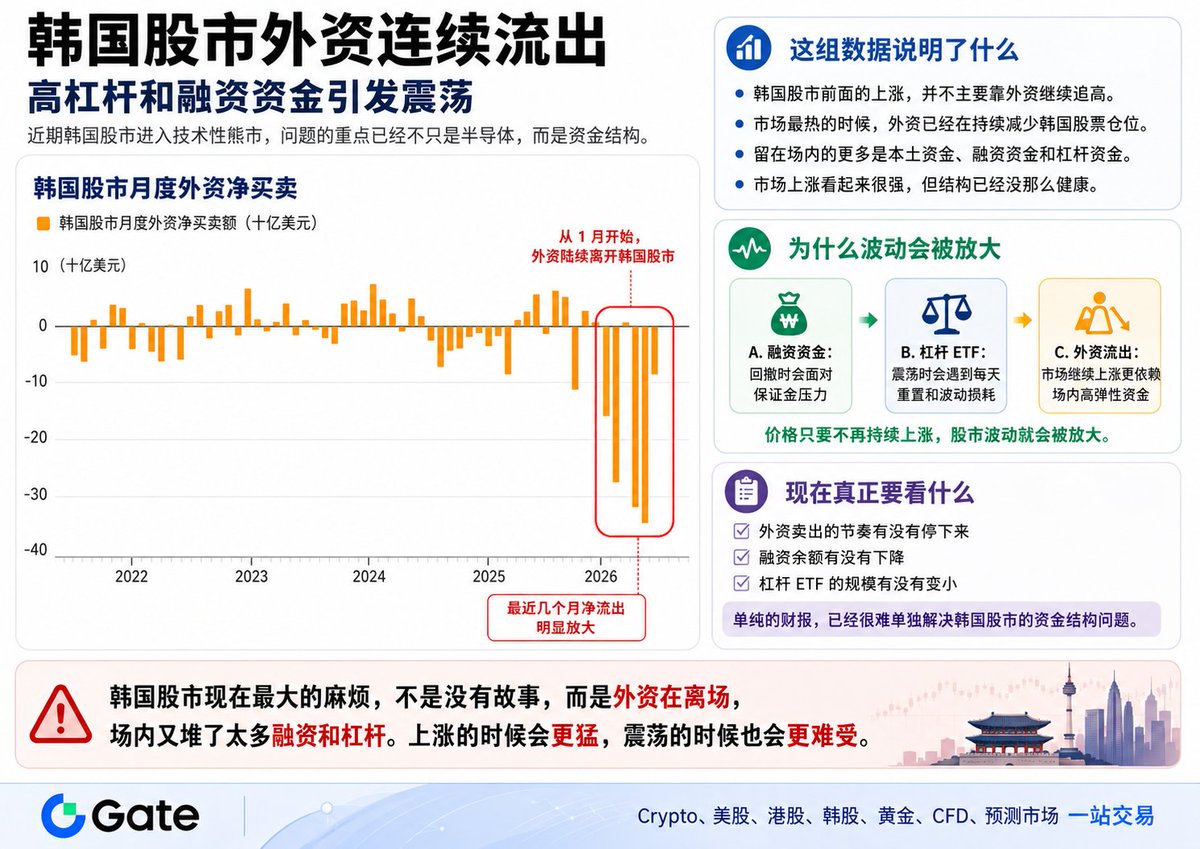
We have previously introduced in several articles that the South Korean stock market is currently in a situation of both financing and high leverage, which not only amplifies the funds but also increases the risk of market fluctuations. Today, we have seen another set of data that shows a large amount of overseas funds continuously leaving the South Korean stock market, and this has not just started in the past two months but has been happening since January.
Therefore, in the recent period, what has largely supported the rise of the South Korean stock market is almost entirely domestic investment funds leverage and financing, rather than overseas funds. This also indicates that during the hottest times in the Korean market, foreign capital did not keep buying, but instead continually reduced their positions in Korean stocks. What remains in the market is mostly local Korean investors.
While these local users are not necessarily buying at high prices, when foreign capital exits, those who remain in the market to some extent play the role of supporting buyers for foreign capital, which makes the rise of the South Korean stock market less healthy.
When leveraged funds enter the market, they can indeed replace some of the exits of foreign capital, even driving the market to new heights. However, this process is most likely to mislead investors into viewing it as purely a fundamental market, because stock prices rise, industry narratives emerge, and funds flow in simultaneously.
A characteristic of leveraged funds is that they are very strong when the market is favorable, but very urgent when the market is unfavorable.
If prices continue to rise, financing accounts are safe, leveraged ETFs look good, and the profit effect continues to attract funds in. However, as soon as prices start to fluctuate, problems arise. Financing accounts will watch margins, and leveraged ETFs will face daily resets and volatility losses; the market does not need to immediately crash, but as it fluctuates back and forth for some time, many positions will begin to feel uncomfortable.
So right now, the South Korean market cannot only focus on the earnings reports of Samsung or SK Hynix.
Good earnings reports are indeed useful, but they can only prove that industry logic is still in place, and they cannot resolve issues with the funding structure. Previously, expectations for semiconductor recovery, AI demand, and rising storage prices have already been traded, and stock prices have risen significantly. At this time, foreign capital continues to sell, and there is a substantial amount of financing and leveraged ETFs in the market, making it difficult for earnings reports to solely support the entire market.
What the South Korean stock market truly needs to watch now is whether the pace of foreign capital selling has stopped, whether the financing balance has decreased, and whether the scale of leveraged ETFs has shrunk.
Pure earnings reports are now hard to save the South Korean stock market; what can save it is mainly the funding structure. Either it relies on Korean investors themselves to continue tightening their belts to finance, leverage up, and push higher the "fake prosperity," or it reduces positions and lowers leverage, waiting for the market to naturally repair, or it waits for the return of overseas capital.
In particular, the return of overseas capital may be more helpful to the South Korean stock market than earnings reports.
@Gate Crypto, US stock market, Hong Kong stock market, Korean stock market, gold, CFD, one-stop trading for prediction markets
免责声明:本文章仅代表作者个人观点,不代表本平台的立场和观点。本文章仅供信息分享,不构成对任何人的任何投资建议。用户与作者之间的任何争议,与本平台无关。如网页中刊载的文章或图片涉及侵权,请提供相关的权利证明和身份证明发送邮件到support@aicoin.com,本平台相关工作人员将会进行核查。


