Written by: Gandalf, Techub News
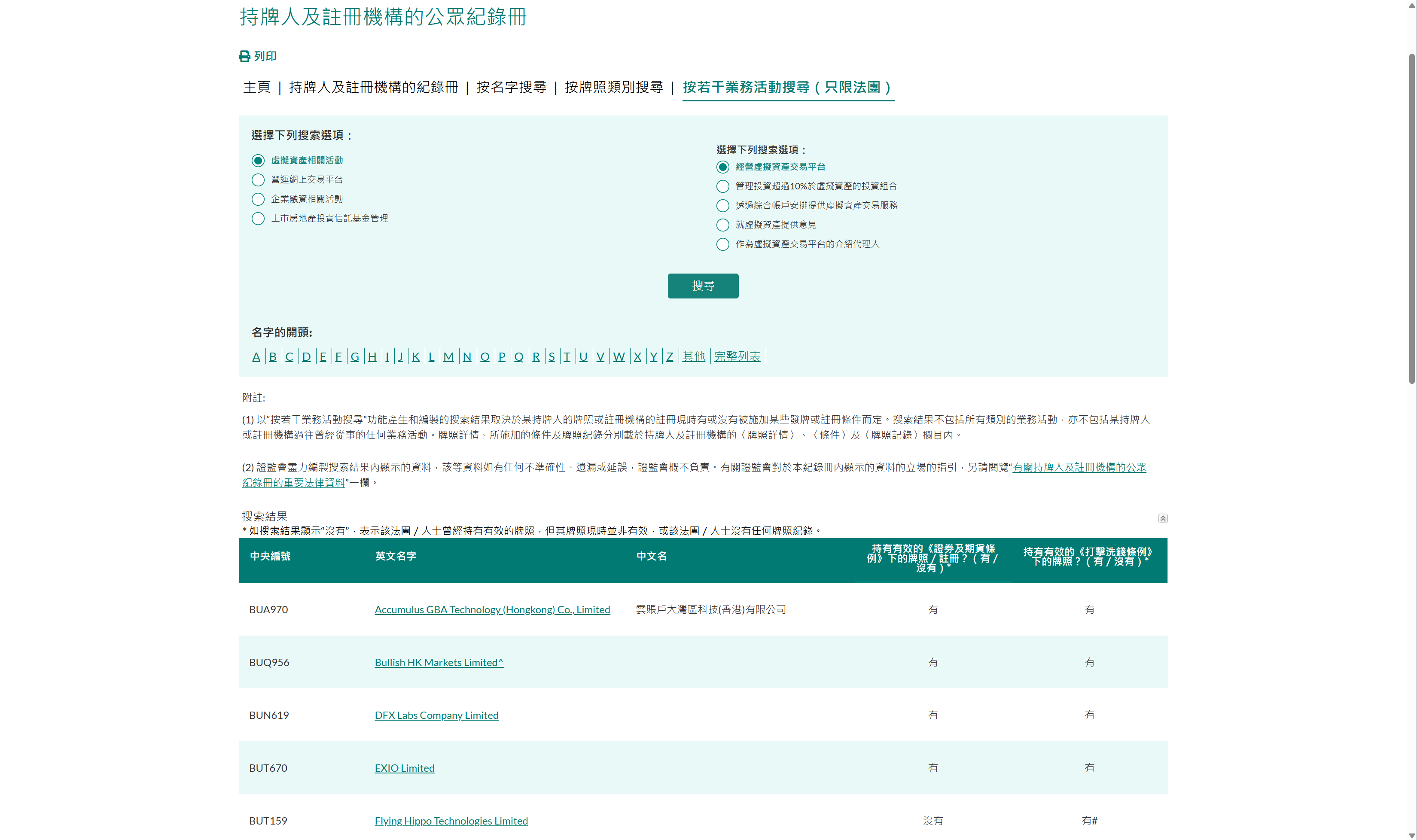
The most essential entry point in the Hong Kong virtual asset market has always been trading platforms. The list shows that there are a total of 16 institutions listed under the category of operating virtual asset trading platforms; among them, 13 are marked as "yes" under the Securities and Futures Ordinance, while 3 are marked as "no." Under the Anti-Money Laundering Ordinance, 16 are marked as "yes." Additionally, 4 institutions have a professional investor restriction label, and 3 institutions have a “#” status explanation. This group of information indicates that Hong Kong's regulation of platform business is not a blanket approval, but rather places market entry into a more detailed institutional framework through different statuses, restrictions, and transitional arrangements.
For market participants, the importance of this list lies not in whose brand has a louder voice, but in who is truly within a verifiable regulatory system. Once a platform becomes the first point of contact for customers dealing with virtual assets, regulatory authorities are concerned not only with the trading function itself but also with customer identity verification, suitability arrangements, anti-money laundering controls, risk disclosures, and ongoing internal controls. Indeed, the platform list is not a mere directory of enterprises; it is a map reflecting the boundaries of market infrastructure.
Why Platform Business Remains a Key Focus of Observation
In the virtual asset industry, platforms serve the front-end market connection function. Whether investors want to buy and sell tokens, allocate related products, or engage with virtual assets through brokerage or wealth management channels, it often leads to a specific trading execution node. Who owns this node holds the customer entry, data entry, and liquidity entry. Listing platforms separately indicates that this segment has higher public significance and regulatory sensitivity than typical services.
More directly, platforms are the layer most easily perceived by the public and also the layer that can most easily convert market enthusiasm into real business. Past industry discussions often centered around the speed of listing, transaction volume, and marketing moves, but this list shows that Hong Kong is shifting its focus to verifiability. Whether a platform can exist, expand, or offer services to specific customer groups increasingly depends more on regulatory status rather than solely on market promotion.
This change will reshape the competitive logic of platforms. In the future, what truly determines a platform's position will not just be whether the product interface is smooth, or whether activities are dense, but whether the compliance structure is solid, whether service boundaries are clear, and whether institutional identity withstands scrutiny. For any institution intending to enter the Hong Kong market, this is far more realistic than short-term visibility.
The True Meaning Behind Two Sets of Columns
Compared to other categories, the most noteworthy point of the platform list is that it simultaneously lists the two status columns of the Securities and Futures Ordinance and the Anti-Money Laundering Ordinance. This is not just a formal juxtaposition, but a layering of business responsibilities. It means that the platforms are placed in a framework not just answering "can they operate a certain business" but also "how to identify customers, how to monitor transactions, how to handle suspicious activities, how to fulfill ongoing obligations" – a longer chain of responsibilities.
This dual presentation also means that the platform status can no longer be simply understood as "approved" or "not approved." Even if they appear on the same list, the actual business boundaries, customer scope, and institutional requirements faced by different institutions may still differ significantly. For the market, this kind of stratification serves as a risk prompt; for investors, this stratification serves as the basis for judging service boundaries.
From the perspective of industry development, this indicates that Hong Kong does not see platforms merely as technology products, but rather as part of financial market infrastructure. Once platforms are incorporated into this perspective, the criteria for assessing them will also change accordingly: from whether functions are sufficiently rich to whether governance is sufficiently stable; from whether growth is sufficiently fast to whether responsibilities are sufficiently clear.
What Professional Investor Restrictions and Transitional Status Mean
The “” and “#” in the list are the pieces of information that are easiest to overlook but should not be ignored. Institutions marked with “” mean that the related services are limited to providing only to professional investor clients. This restriction alerts the market that simply appearing on the platform list does not mean that they can conduct the same range of business for all investors. Ignoring this layer of difference can easily lead to misjudging restricted services as being fully open.
Institutions with “#” status are in a position that needs to be understood with greater caution. This reflects not an already settled conclusion but a transitional regulatory status. For the market, this status means that the relevant entities have entered the institutional perspective, but the final licensing arrangements still have undecided space. For investors, this means that one should distinguish between “on the list” and “exactly matching status.”
These annotations are significant because they directly determine the boundary of the relationship between institutions and clients. Whether they can only serve professional investors or are still in a transitional period will affect account opening expectations, business promotion, and market understanding. Any attempts to simplify these differences are likely to cause information distortions.
What Changes Are Happening in Hong Kong's Platform Competition
As the list gradually becomes clear, competition among Hong Kong platforms is shifting from extensive expansion to structural competition. In the past, platforms competed on who entered first, who had more products, and who had greater community visibility; now platforms need to answer who can operate stably under continued regulation, who can synchronize compliance with business, and who can establish credible interfaces between traditional financial institutions and crypto-native users.
This also explains why the value of market entry is rising. Platforms are not only the places where transactions occur, but also the places where customer relationships are sustained under regulatory frameworks. Those who occupy clearer positions on the list have better opportunities to attract institutional collaborations, channel partnerships, and long-term user retention. Conversely, entities with unclear statuses and vague boundaries, even if they gain short-term attention, find it challenging to establish long-term trust.
From a broader perspective, the competitive focus of the Hong Kong platform market will continue to shift from "are there platforms" to "do platforms have sustainable institutional capabilities." In this process, the public presentation of the list itself is part of market maturity. Platforms are no longer understood solely through commercial language, but also compared through institutional language.
What Investors Most Need to Understand
For ordinary investors, the most practical judgment method is not to just look at brand awareness but first to verify the institution's category, status, and annotations on the list. At the very least, one needs to clarify three things: whether they are on the platform list, what the two status columns say, and whether they have professional investor restrictions or transitional explanations attached. If these three points are not clear, many promotional statements in the market can easily be misread.
For institutional clients and professional investors, the value of this list lies in providing a starting point for due diligence. The list itself cannot replace complete due diligence but at least provides a publicly verifiable foundational framework: which entities are in a formal regulatory context, which face stricter limitations, and which are still in the process of further confirmation. For institutions that need long-term cooperation, this public information is more valuable than short-term market sentiment.
By publicly presenting the platform list, Hong Kong is essentially telling the market that the entrance to virtual assets should not remain in ambiguous narratives but should be placed as much as possible within a verifiable, distinguishable, and accountable institutional structure. The real differentiation in the platform industry is likely to occur here.
Notes
- ^ Restricted to services only available to professional investor clients
- # This applicant is only considered for the issuance of a license to provide virtual asset services. The Securities and Futures Commission has not issued a license to this applicant under the Anti-Money Laundering Ordinance. The license application of this applicant is still pending decision.
Company List (Updated as of 2026.7.8)
The following table is organized according to the original list, fully retaining the institution names and corresponding status information under this business category, without subjective reduction.
Central Number | English Name | Chinese Name | Securities and Futures Ordinance License/Registration | Anti-Money Laundering Ordinance License |
BUA970 | Accumulus GBA Technology (Hongkong) Co., Limited | 雲賬戶大灣區科技(香港)有限公司 | Yes | Yes |
BUQ956 | Bullish HK Markets Limited^ | — | Yes | Yes |
BUN619 | DFX Labs Company Limited | — | Yes | Yes |
BUT670 | EXIO Limited | — | Yes | Yes |
BUT159 | Flying Hippo Technologies Limited | — | No | Yes# |
BUT252 | Foris DAX HK Limited | — | No | Yes# |
BPL992 | Hash Blockchain Limited | — | Yes | Yes |
BSI739 | Hong Kong BGE Limited | — | Yes | Yes |
BPO721 | Hong Kong Digital Asset EX Limited | 香港数字资产交易集團有限公司 | Yes | Yes |
BPW549 | Hong Kong Virtual Asset Exchange Limited^ | 香港虚拟资产交易所有限公司^ | Yes | Yes |
BUY737 | NewBX Limited | — | Yes | Yes |
BPJ213 | OSL Digital Securities Limited | OSL数字证券有限公司 | Yes | Yes |
BUY578 | Panthertrade (Hong Kong) Limited | 獵豹交易(香港)有限公司 | Yes | Yes |
BTF116 | Victory Fintech Company Limited^ | 勝利數碼科技有限公司^ | Yes | Yes |
BUT499 | Whalefin Markets Limited^ | — | No | Yes# |
BUT913 | YAX (Hong Kong) Limited | — | Yes | Yes |
免责声明:本文章仅代表作者个人观点,不代表本平台的立场和观点。本文章仅供信息分享,不构成对任何人的任何投资建议。用户与作者之间的任何争议,与本平台无关。如网页中刊载的文章或图片涉及侵权,请提供相关的权利证明和身份证明发送邮件到support@aicoin.com,本平台相关工作人员将会进行核查。