Original author: Bao Yilong
Original source: Wall Street Insights
xAI releases Grok 4.5, challenging Anthropic with "Opus-level" capabilities, while targeting Chinese open-source model routes with a cost-effective strategy.
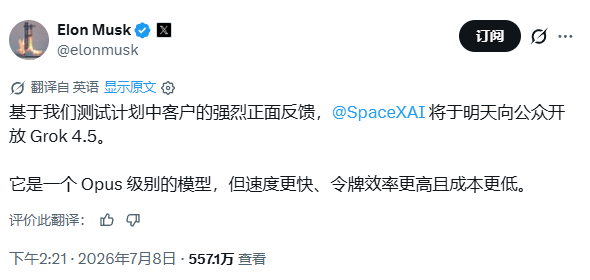
On Wednesday, Musk's xAI released the latest model Grok 4.5, claiming to achieve similar intelligence levels at less than one-fifth the output token price of Anthropic's flagship model.
This pricing strategy closely aligns with the previous low 82% pricing of Zhipu's GLM-5.2, which leveled the playing field against closed-source leading models, prompting market observers to declare that top Silicon Valley labs have begun to adopt cost-effective strategies akin to those of Chinese open-source vendors. Musk himself stated on the X platform:
Grok 4.5 is an Opus-level model, but faster, more token efficient, and lower cost.
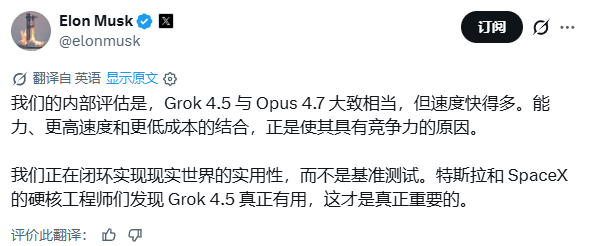
He further noted that internal evaluations show Grok 4.5's overall capabilities are roughly equivalent to Opus 4.7, but with "much faster" speeds. The combination of capability, speed, and low cost forms the core competitive logic of this model.
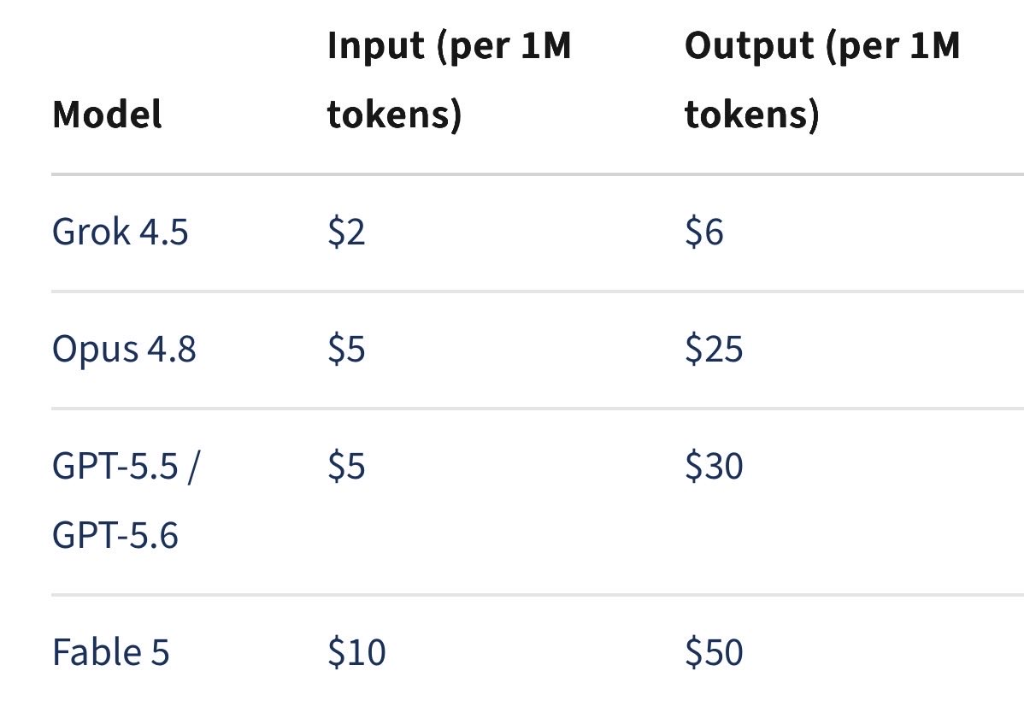
According to the pricing announced by xAI, Grok 4.5 is priced at $2 per million input tokens and $6 per million output tokens. In contrast, Anthropic's Opus 4.7 is priced at $5 per million input tokens and $25 per million output tokens, showing a significant price disparity.
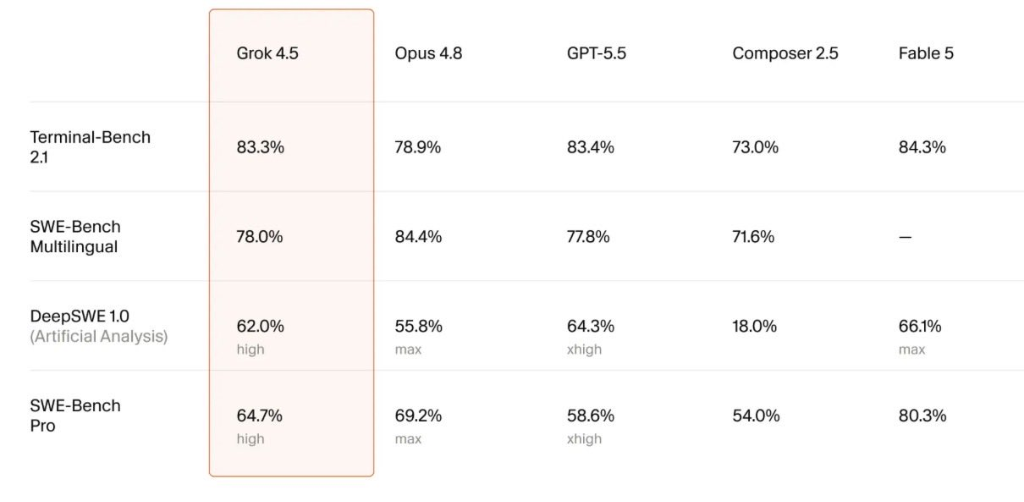
If this pricing strategy can deliver on its promised capabilities, it will have a direct impact on the purchasing decisions of AI enterprise customers. Meanwhile, OpenAI plans to release its latest flagship model GPT 5.6 this Thursday, making this week a concentrated window for AI model releases.
Cost-effective route, token efficiency as the core selling point
xAI revealed in a blog that Grok 4.5's token efficiency is double that of other leading models.
If this metric is realized in practical applications, it will directly lower inference costs for enterprises, which is of direct appeal to corporate users concerned about rising token expenditures becoming a core worry in AI procurement.
In a horizontal comparison, OpenAI's tiered pricing system charges $5 and $30 per million input/output tokens for its highest-tier Sol version, while the lowest-tier Luna version charges $1 and $6.
Grok 4.5's pricing is significantly lower among main competitors and correlates to capabilities approaching that of Anthropic's flagship models within Musk's narrative framework.
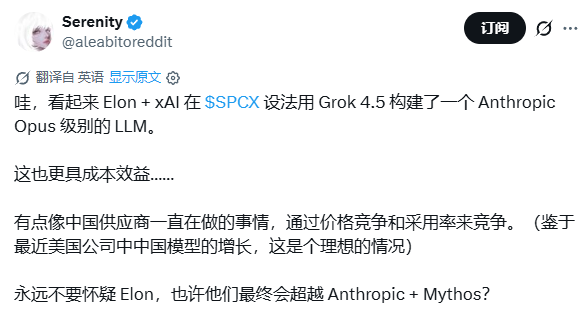
"White-haired stock god" Serenity commented on X that xAI's move is somewhat reminiscent of what Chinese AI vendors have been doing all along, competing through pricing and adoption rates.
Just weeks ago, Zhipu released its open-source model GLM-5.2 at a pricing of approximately 72% to 82% lower, achieving a score of 74.4 on the leading programming benchmark FrontierSWE, which is less than 1 percentage point behind Anthropic's Opus 4.8 score of 75.1, and surpassing GPT-5.5's score of 72.6.
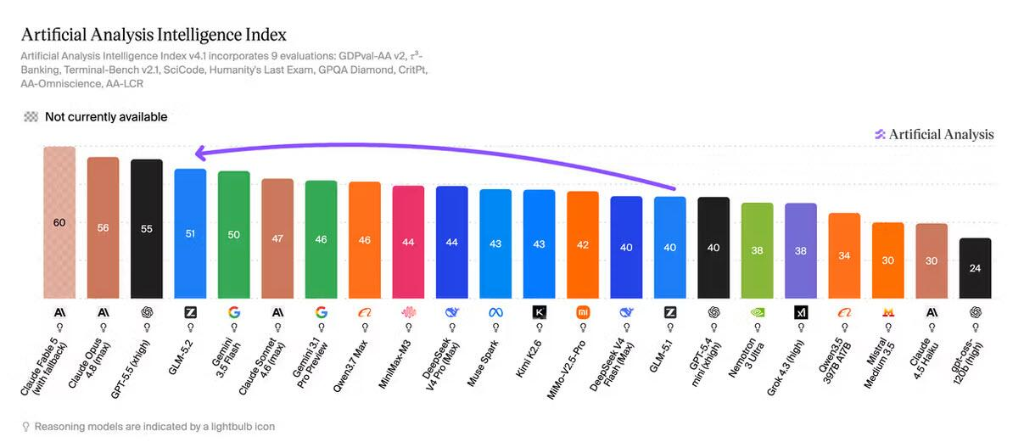
JPMorgan summarized this phenomenon in a subsequent report: mature intelligence continues to compress pricing, but advancements in cutting-edge capabilities can still support a premium; the monetization logic at the layer of AI models is now showing structural differentiation.
The emergence of Grok 4.5 further complicates this competitive landscape: as leading labs in the U.S. begin to enter the market with pricing strategies closer to open-source models, institutions like Anthropic that rely on high-priced closed-source models will face pressure on both capability and cost dimensions.
In the programming agent market, Cursor's acquisition logic comes to light
In terms of product positioning, xAI describes Grok 4.5 as a "main model" for everyday knowledge work, covering scenarios such as programming and application development, office documentation, research, and content writing. This echoes its earlier strategic logic behind the acquisition of the code editing tool Cursor.
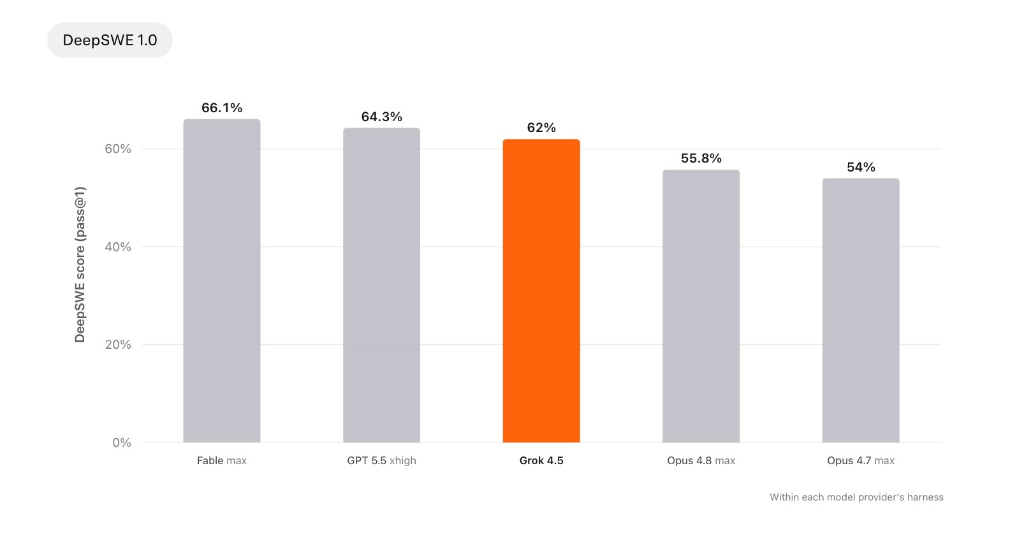
Analyst Jukan from investment research firm Citrini Research noted in a comment that at the recent ICML conference, he heard a noteworthy Grok multi-head logic: Claude Code currently leads the programming agent market, not purely based on model quality advantages, but rather on a large user base accumulated from being the first mover, where more users bring in more real programming data, which in turn feeds back into improving model quality, creating a flywheel effect.
Jukan believes the core value of xAI's acquisition of Cursor lies in this:
Cursor likely has a larger real user base and code dataset than OpenAI Codex; if xAI can effectively train and leverage this data, surpassing Codex may just be a matter of time.
免责声明:本文章仅代表作者个人观点,不代表本平台的立场和观点。本文章仅供信息分享,不构成对任何人的任何投资建议。用户与作者之间的任何争议,与本平台无关。如网页中刊载的文章或图片涉及侵权,请提供相关的权利证明和身份证明发送邮件到support@aicoin.com,本平台相关工作人员将会进行核查。


