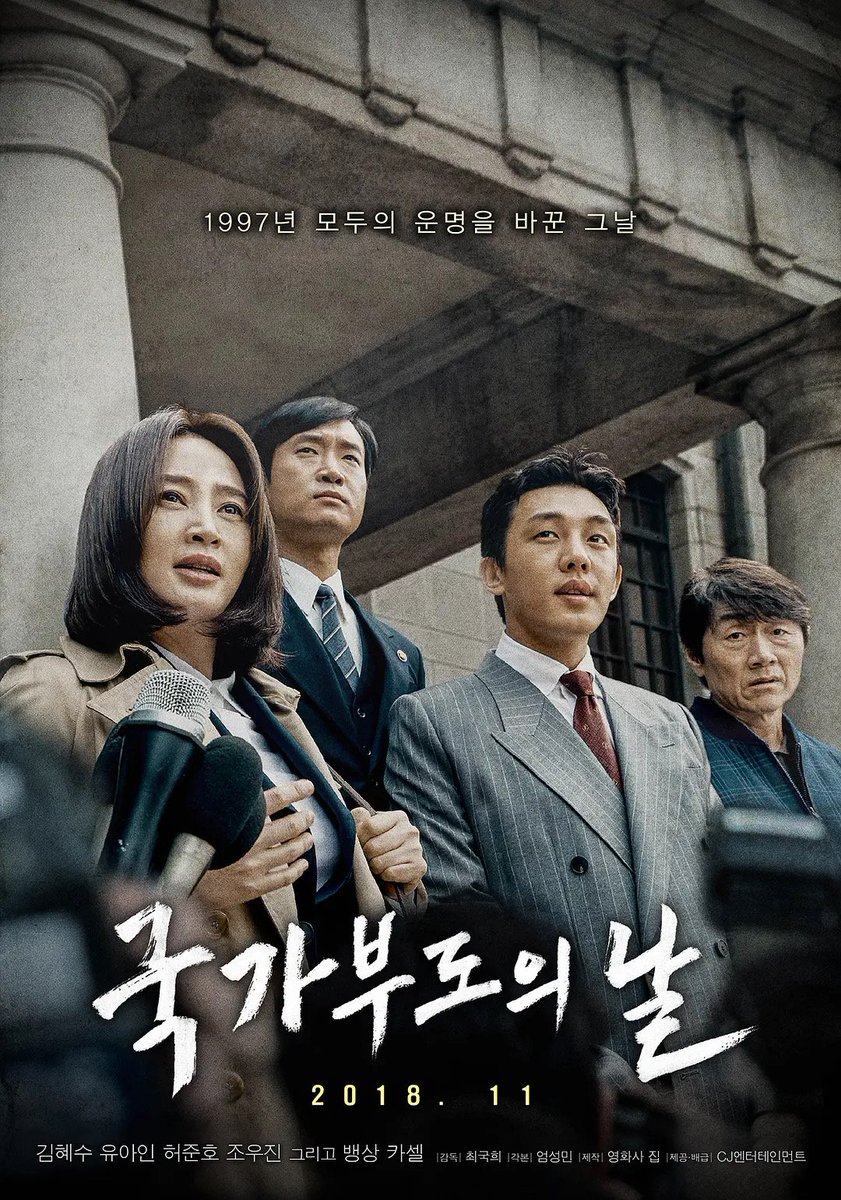
🔔 I spent an afternoon watching "The Day the Country Went Bankrupt," and I have to say South Korea is really adept at depicting political darkness!
Let me share some of my thoughts on the film—
The three parallel storylines in the movie are quite interesting, representing three different groups of people in the market:
Han Si-hyun is one of the few within the system who truly understands the crisis; she sees that the foreign exchange reserves are about to collapse, that short-term debt and dollar liquidity are spiraling out of control, but she cannot change the inertia of the entire system;
Yoon Jung-hak is a short seller in the market; he does not believe in the prosperity portrayed on television, nor does he trust the government's official statements; he only believes in the underlying logic behind asset prices;
Jia Xiu is an ordinary small business owner, who follows the bank's advice to take a loan, believing that the economy will continue to improve, and ultimately becomes the one who bears the real consequences when the system collapses.
As someone who has experienced several bull and bear markets in the crypto world, I felt no unfamiliarity watching this film; instead, there was a strong sense of reflective resonance:
Every financial collapse is essentially the same script; ordinary people are always the last to realize the risks.
1⃣ "Credit" is always a luxury.
At its core, any credit asset is fundamentally a margin game.
When LUNA collapsed, UST maintained its peg through an arbitrage mechanism, essentially using LUNA's market capitalization as margin;
South Korea maintained its exchange rate, fundamentally using its foreign exchange reserves as margin.
The so-called "national credit," in the face of extreme runs, is no different in essence from a whitepaper of a scam project — both are fragile products of consensus.
As long as a system relies on constant new funds, continuous confidence, and ongoing external financing to maintain its facade, what it calls stability is very likely just a state that has not yet been liquidated.
2⃣ Leverage is the original sin of all crises; there is no free lifeline in the world.
The most poignant scene in the film is when the bank proactively approaches small business owner Jia Xiu to persuade him to take a loan, telling him that the economy is so good, expanding production will surely profit. The small boss believes it, borrows money, and goes all in, waiting to make more.
Then the crisis hits, and the first thing the bank does is withdraw and cut loans, leading countless Jia Xius to experience a downfall, returning to poverty.
So did the $57 billion bailout from the IMF really save South Korea?
South Korea exchanged its economic sovereignty, chaebol equity, and the unemployment of its people for a breath of fresh air, but where is the free liquidity? All the injected lifeline funds will ultimately be taken back with interest.
3⃣ Information asymmetry is the top harvesting tool; class always precedes stance.
Inherent disadvantages dictate that ordinary people will always be at the lower end of the information spectrum and will inevitably become targets for harvesting.
Internally, the fiscal system already knows the severity of the problems; the conditions of the IMF are already being discussed at the negotiating table, while the chaebols and large enterprises have already received information in advance, preparing to transfer assets and buy small businesses at the bottom.
Meanwhile, the grassroots people are watching "the economy is improving" news on television, selling their possessions to expand production, waiting for the collapse.
Han Si-hyun, as a technical insider, knows the truth but is powerless to change it, ultimately becoming a sober bystander.
This happens daily in the crypto world; the barrier of information is harder to cross than the barrier of capital. If you choose to believe this news, you must pay the corresponding price.
Besides entering that class, ordinary people have no better way out.
4⃣ Short sellers are not the creators of disaster; they are merely the poppers of the bubble.
Many people criticize Yoon Jung-hak as a "speculator profiting from the nation's hardships," but traders who have experienced complete bull and bear cycles know:
The bubble is not inflated by short sellers; it is built up by greedy leverage, incompetent regulation, and self-deceiving consensus.
Short sellers just see the essence of the Ponzi scheme earlier than most.
Just like those who shorted UST in 2022, it was not they who brought LUNA down; the Ponzi structure of the algorithmic stablecoin was destined to die, and the short sellers merely accelerated the bubble's collapse.
There is a scene in the film: Yoon Jung-hak watches as bankrupt individuals jump off buildings, his expression complex, filled with a heavy mix of emotions—
He picked up bloody chips, which means that ordinary people will certainly be crushed.
But he also knows that even if he doesn’t earn that money, the bubble will still burst, and those destined to go bankrupt will still go bankrupt; history will not stop its wheels because of one person's goodwill.
5⃣ In the end: People will always forget; cycles will always repeat.
The film concludes years later on the bustling streets of Seoul, where no one remembers the harsh winter of 1997. Han Si-hyun looks at the recovering market and softly says, "It seems that people have forgotten."
This is the most terrifying part:
After each crisis, survivors will forget, newcomers will flood in, and new narratives, new hot topics, and new leverage will inflate new bubbles.
This was true for the Asian financial turmoil of 1997, true for the subprime mortgage crisis of 2008, and true for the crypto bear market of 2022.
The outer shell of finance keeps changing, but human greed and impulsiveness remain unchanged, the stratification of information persists, and the market continues into the next brutal cycle!
免责声明:本文章仅代表作者个人观点,不代表本平台的立场和观点。本文章仅供信息分享,不构成对任何人的任何投资建议。用户与作者之间的任何争议,与本平台无关。如网页中刊载的文章或图片涉及侵权,请提供相关的权利证明和身份证明发送邮件到support@aicoin.com,本平台相关工作人员将会进行核查。


