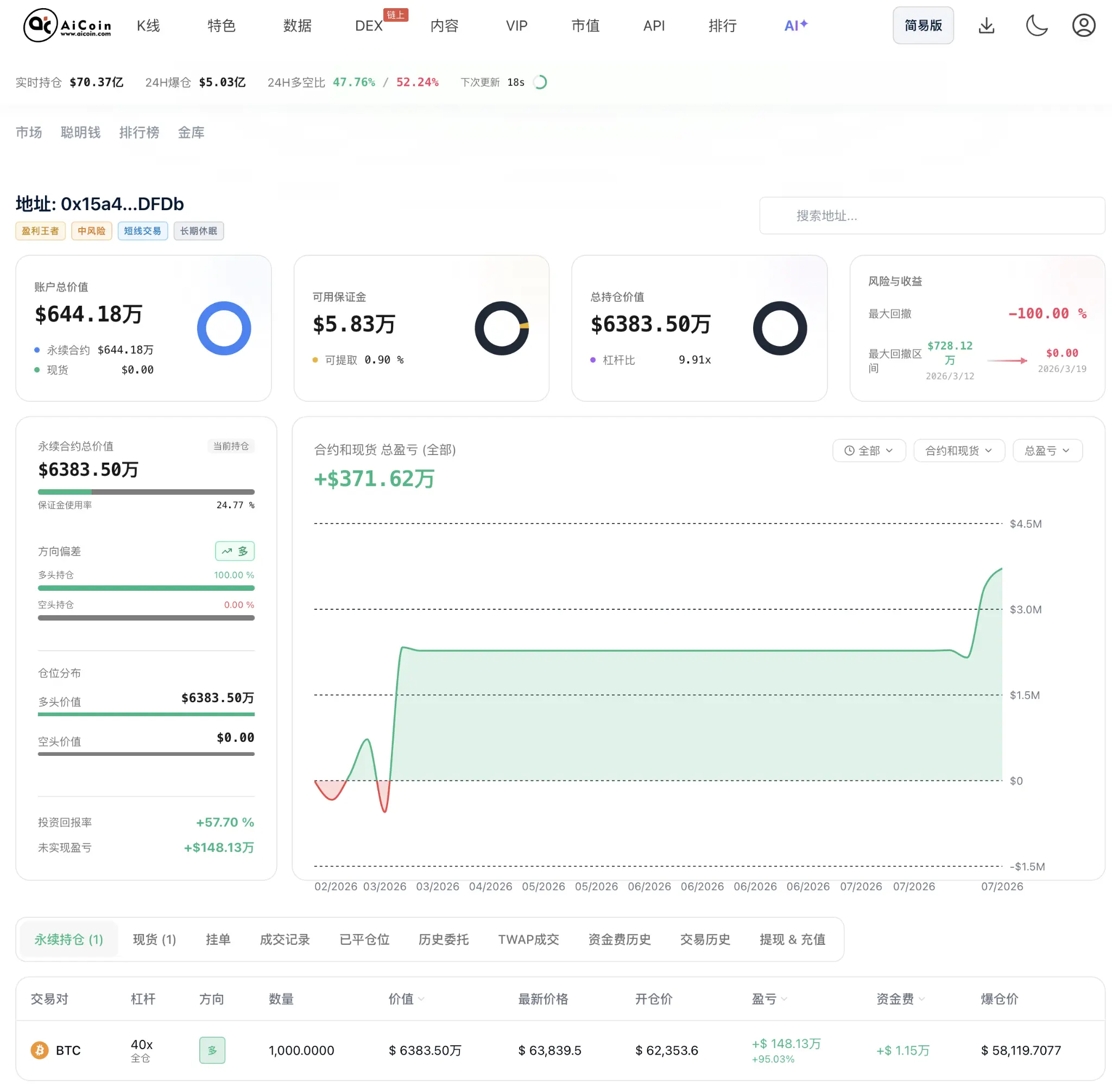
In recent years, Strategy has almost been the most representative "BTC long-term holder" in the crypto market.
From MicroStrategy's rebranding to Strategy, to continuously buying BTC through financing, this company and Michael Saylor have been seen as benchmarks for corporate Bitcoin treasury strategies. This is also why the market's reaction becomes particularly sensitive when Strategy is reported to sell BTC.
According to multiple media reports, Strategy sold 3,588 BTC between June 29 and July 5, raising about $216 million. After the sale, the company still holds around 843,775 BTC, remaining one of the largest corporate BTC holders in the world.
On the surface, this is just a reduction in position by a giant whale. But what is truly noteworthy is not "whether Strategy is bearish on BTC," but the change revealed behind it: corporate BTC treasury strategies are transitioning from the simple "buy and never sell" to a more complex stage of fund management.
Why is this sale being amplified by the market?
The reason is simple: Strategy used to represent a very clear narrative.
This narrative can be summarized as: companies treat BTC as a long-term reserve asset, buying BTC through capital market financing, and then using BTC holdings to enhance company valuation and market attention. In a bull market, this model works very smoothly. As BTC rises, company assets increase, stock prices receive premiums, financing capabilities improve, and then they continue to buy BTC.
This resembles a positive loop.
But the problem is, once the BTC price falls, or the company's own financing tools come under pressure, that loop becomes less easy.
The reason for Strategy's sale of BTC is not merely "wanting to escape the top" or "losing faith." A more direct reason is that the company needs funds for preferred shareholder dividends, dollar reserves, and capital structure stabilization. In other words, Strategy is not just a wallet that exists on-chain; it is also a publicly traded company that must face shareholders, preferred stocks, cash flow, financial statements, and market confidence.
This is also a point that ordinary investors are likely to overlook: when BTC is put on a corporate balance sheet, it is no longer just a "faith asset" but is also bound by traditional financial rules.
Selling BTC does not necessarily equal bearishness, but it indicates that pressure truly exists
From the size of its holdings, the 3,588 BTC sold by Strategy is not significant compared to its total holdings of over 840,000 BTC. It has not exited BTC, nor has it changed its fundamental positioning as a BTC treasury company.
However, this action still carries signal significance.
First, it breaks the market's psychological expectation of "Strategy only buying and never selling."
Second, it indicates that when financing tools, preferred stock dividends, and dollar reserves come under pressure, BTC holdings may also be used for corporate cash management.
Third, it prompts the market to reassess the sustainability of the "leveraging to buy BTC" model during bear markets or volatile markets.
Moreover, it is reported that Strategy's average BTC cost is higher than the current market price, indicating that part of the sale may come with the pressure of unrealized or actual losses. For a publicly traded company with BTC as its core asset, this will directly affect investors' judgments on its valuation model.
Therefore, this matter should not be simply interpreted as "BTC is finished," but it also cannot be downplayed as "it has no effect." A more accurate judgment is: the long-term narrative for BTC is still intact, but the financial model for corporate holding of BTC is undergoing a stress test.
There is also a larger background: capital is rotating
The timing of Strategy's BTC sale is also noteworthy.
Recently, U.S. spot BTC ETFs experienced a significant outflow of funds. CoinDesk reported that $4.06 billion net flowed out of U.S. spot BTC ETFs in June, setting a record for monthly redemptions. Although there was a single-day inflow of $221.7 million at the beginning of July, ending previous consecutive outflows, this also indicates that institutional capital's attitude towards BTC is becoming more cautious, shorter-term, and increasingly focused on trend confirmation.
Meanwhile, attention in the U.S. stock market is being drawn back to narratives around AI, chips, data centers, SpaceX, NVDA, and others. The capital has not disappeared; it is simply migrating between different risk assets.
This serves as an important reminder for the crypto market: BTC is no longer solely related to "emotions within the crypto circle"; it is increasingly being priced in the same framework as U.S. stocks, interest rates, ETFs, corporate financing, and AI risk appetite.
In other words, today's BTC market is no longer the early market that only looked at on-chain narratives. It is becoming a part of the global risk asset system.
What should ordinary investors truly understand?
For ordinary investors, the most valuable lesson from Strategy's sale of BTC is not to follow the panic, nor to blindly try to catch the bottom, but to understand three things.
First, long-term holding does not mean never managing positions.
Even the most steadfast BTC treasury company must deal with cash flow and capital costs.
Second, the single asset narrative is weakening.
In the past, one could assess market sentiment solely by looking at the BTC price, but now it is also necessary to watch ETF fund flows, U.S. tech stocks, dollar liquidity, and corporate financing environments.
Third, risk control is more important than shouting slogans.
When the market is doing well, "faith" is very contagious; when the market is under pressure, what truly determines survival is cash reserves, position management, and strategy flexibility.
This is why this event is actually worth serious attention from new users. It does not tell everyone "do not touch BTC," but rather reminds everyone: before entering the crypto market, one must establish a more complete market perspective.
From BTC to U.S. stocks: trading entry points are also changing.
As market hot topics switch from BTC ETF to AI U.S. stocks, from on-chain assets to traditional finance, users may no longer need just a single cryptocurrency trading entry point but a platform that observes opportunities across various asset types.
For example, Bitget has been promoting products such as UEX, Stock+, and U.S. stock options, integrating crypto, U.S. stocks, gold, forex, commodities, and other assets into a more unified trading view. For newcomers in the market, learning to observe the linkage between BTC and U.S. stocks, AI stocks, and ETF funds may be more important than hastily judging the ups and downs of a single coin.
Strategy's sale of BTC appears to be a crypto news item on the surface, but at a deeper level, it is a market education: when even one of the largest BTC holders has to consider cash flow and asset rebalancing, ordinary investors should learn to look at the market from a multi-asset perspective.
The market has never lacked hot topics; what is truly scarce is understanding the logic behind these trends.
If you also want to start with BTC while observing opportunities across various asset types like U.S. stocks, AI stocks, and gold, you can establish a multi-asset trading perspective through Bitget.
🔗 Registration link:
https://jump.do/zh-Hans/xlink-proxy?id=6
Registering through this link will give you 10% commission rebate, suitable for new users to start small with experience and market observation.
免责声明:本文章仅代表作者个人观点,不代表本平台的立场和观点。本文章仅供信息分享,不构成对任何人的任何投资建议。用户与作者之间的任何争议,与本平台无关。如网页中刊载的文章或图片涉及侵权,请提供相关的权利证明和身份证明发送邮件到support@aicoin.com,本平台相关工作人员将会进行核查。