The industry growth dividend is slowly drifting away from retail investors.
Amazon took 3 years to go public, Airbnb took 12 years, and SpaceX took a full 24 years.
This is a concerning trend.
In the 1980s, the median time from a company’s founding to its IPO was about 6 years; today, this figure has stretched to 10 to 12 years.
▌Why are companies reluctant to go public?
The reasons are quite realistic; private capital markets have become sufficiently mature.
Before going public, companies often boost their valuations through multiple rounds of financing. With the high regulatory costs of the public markets, more and more companies are choosing to "wait a bit longer" until they are large enough and their stories are stable enough to enter the public eye.
▌But who bears the cost behind this?
It is the retail investors.
When a company is valued at tens of billions during its D and E rounds, by the time it goes public, the steepest growth curves (from 0 to 1, from 1 to 10) have already been fully consumed by institutional investors. What retail investors take over is often a "public market version" that has been fully priced.
Look at today’s most attractive companies: OpenAI, Anthropic, Databricks, Figure AI… They represent the cutting edge of AI, robotics, and biotechnology, yet almost all of them are still not public. Retail investors' involvement with them is limited to discussions on social media.
▌Who will shatter this wall?
The stock tokenization products on the market only solve the convenience of buying and selling, still targeting already listed companies. The high walls of unlisted companies remain unshaken.
Until @OpenstockInc appeared.
OpenStock was built by the former Polynomial team, and its logic directly targets the core: to connect mature cryptocurrency channels to real-world capital events.
Opportunities with explosive potential in AI, semiconductors, hard tech, etc., often explode before they reach the public market. OpenStock’s vision is to build the on-chain private market infrastructure, allowing retail investors to transform from "observers" of growth stories to "participants."
▌The practice has already begun
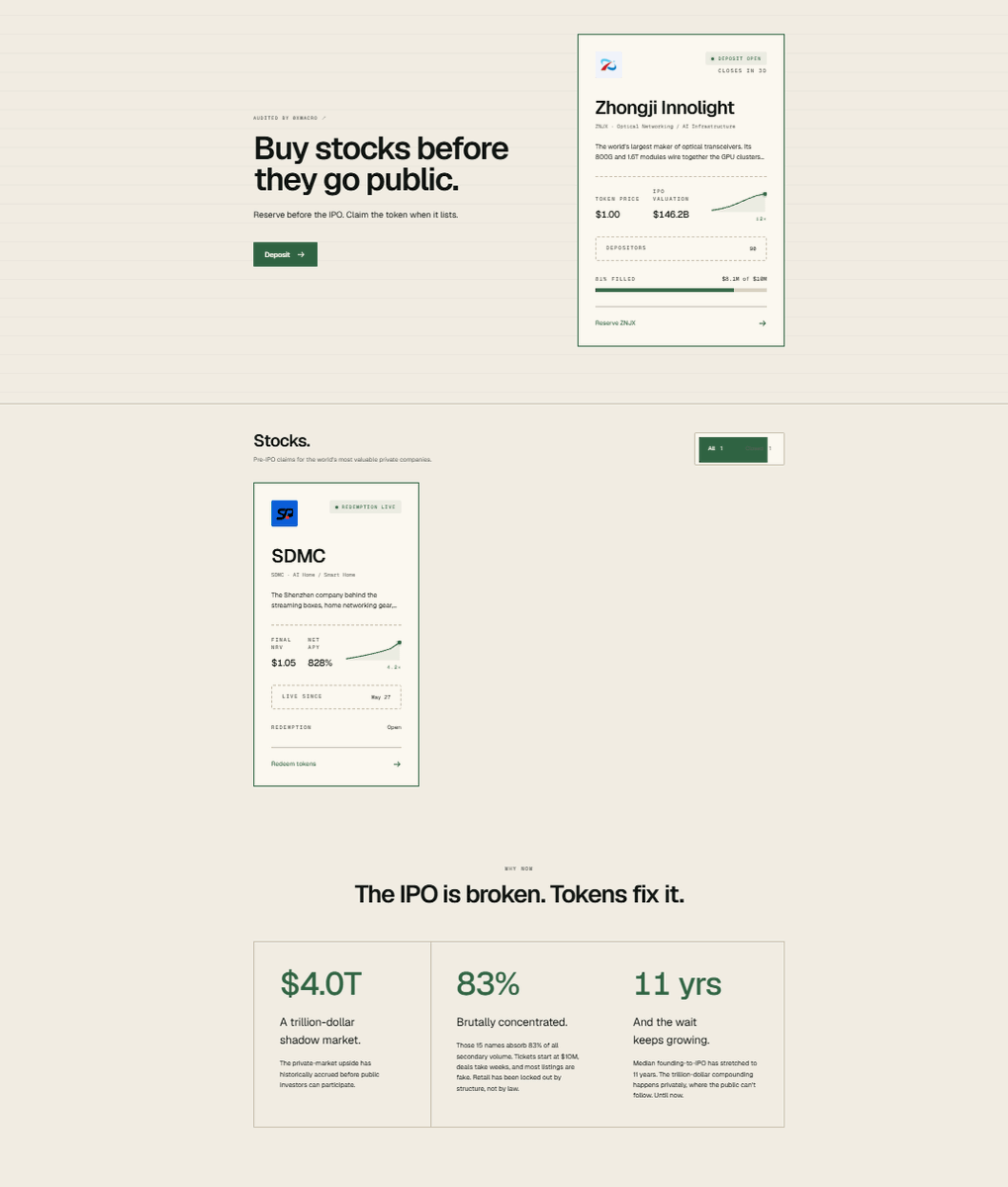
Taking advantage of the Hong Kong listing of the leading optical communication company in A-shares, Zhongji Xuchuang, OpenStock launched its first vault. Users deposit USDC to obtain vault tokens, which can be redeemed for net profits after the target goes public. The entire process is frictionless, requiring no additional operations.
The growth dividend should not only belong to institutions and big sharks.
What OpenStock is doing is breaking down that wall.
免责声明:本文章仅代表作者个人观点,不代表本平台的立场和观点。本文章仅供信息分享,不构成对任何人的任何投资建议。用户与作者之间的任何争议,与本平台无关。如网页中刊载的文章或图片涉及侵权,请提供相关的权利证明和身份证明发送邮件到support@aicoin.com,本平台相关工作人员将会进行核查。


