Triple Leverage ETF and Triple Contracts Difference — Both amplify returns, but the sources of risks are completely different
Earlier, we talked about Triple Leverage ETF and triple contracts, many friends wonder if it is just a liquidation issue, Triple Leverage ETF will not liquidate, but triple contracts will liquidate, yes, this is indeed the biggest difference.
But actually, there are more detailed differences.
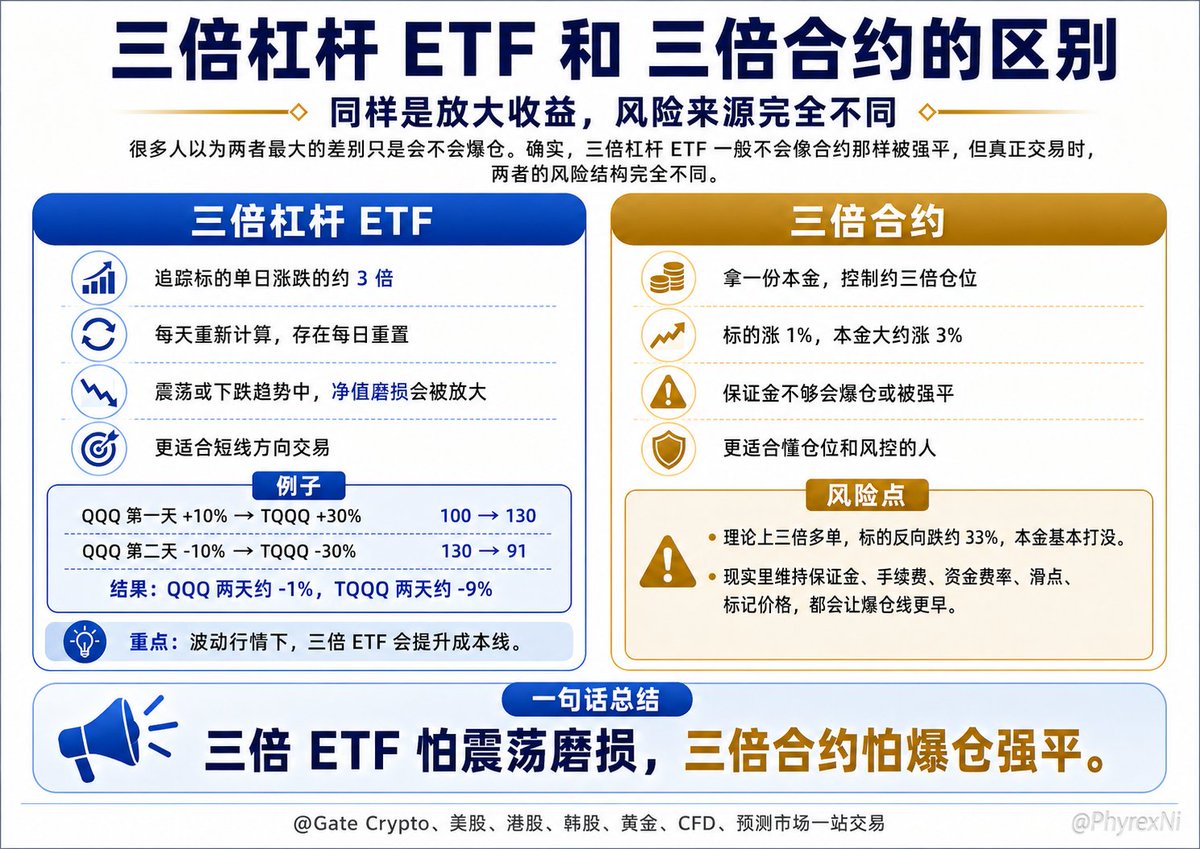
The triple in Triple Leverage ETF refers to the fund's aim to achieve three times the daily rise and fall of the underlying asset. For example, if the Nasdaq rises 1% today, TQQQ will theoretically rise 3%, if the semiconductor index falls 2% today, SOXL will theoretically fall 6%.
This triple leverage is recalculated daily, so the core issue of the triple ETF is the cost loss brought about by the daily reset. Of course, it is best when there is a unilateral rise, but if there is a fluctuating or downward trend, the erosion of the triple ETF will be amplified.
To give a simple example, on the first day $QQQ rises 10%, $TQQQ rises 30%, 100 becomes 130. On the second day, QQQ falls 10%, TQQQ falls 30%, so 130 becomes 91. QQQ has only fallen 1% over two days, TQQQ has lost 9%.
In simple terms, using a triple leverage ETF in a volatile market actually raises the cost line.
This is what many friends holding triple ETFs easily overlook, which is simply multiplying the long-term rise and fall of the underlying asset by three, but recalculating every day is more important.
Triple contracts are really simple. Take a principal amount, open a triple position, essentially using $10,000 to control a position of $30,000. If the underlying rises 1%, the principal gains approximately 3%, if the underlying falls 1%, the principal loses approximately 3%.
Contracts are simpler, but harsher; insufficient margin will lead to liquidation. Theoretically, with triple longs, if the underlying falls by one-third, the principal is almost gone. In reality, due to maintenance margin, transaction fees, funding rates, and slippage, as well as the marked price, the liquidation line usually comes even earlier.
Therefore, triple ETFs are more suitable for short-term directional plays, such as observing the Nasdaq, semiconductor, gold, or crude oil trends for one or two days or for a short period. The advantage is convenient trading, no need to keep an eye on the margin, and no sudden liquidation problems like contracts.
But if you treat triple ETFs as a long-term investment, especially holding them long-term in a highly volatile market, it is easy to end up with the index not falling much while the ETF has already fallen a lot. Many investors lose money on TQQQ and SOXL not because they misread the direction, but because the volatility in between was too large, eroding the net value and raising costs.
@Gate Crypto, U.S. stocks, Hong Kong stocks, Korean stocks, gold, CFD, prediction market one-stop trading
免责声明:本文章仅代表作者个人观点,不代表本平台的立场和观点。本文章仅供信息分享,不构成对任何人的任何投资建议。用户与作者之间的任何争议,与本平台无关。如网页中刊载的文章或图片涉及侵权,请提供相关的权利证明和身份证明发送邮件到support@aicoin.com,本平台相关工作人员将会进行核查。


