Written by: Nectar Gan & James Mayger, Bloomberg
Translated by: Gandalf, Techub News
With the surge in trade driven by the global artificial intelligence boom, Hong Kong is increasingly becoming a key hub for the entry and exit of Chinese high-tech products, occupying an important node in a $2 trillion Asian trade network.
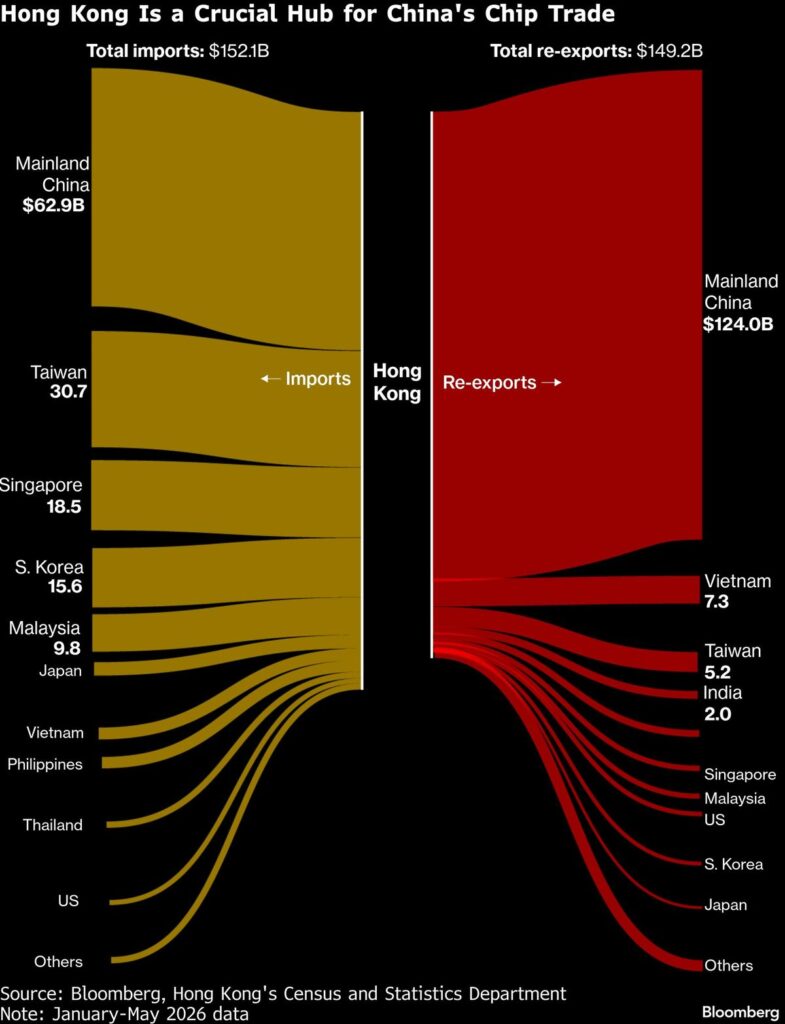
An analysis of official data by Bloomberg shows that in the first five months of 2026, Hong Kong accounted for more than half of China's $239 billion in chip imports, setting a historic high. A decade ago, this ratio was only about one-third.
After a substantial influx of Chinese capital led Hong Kong to recently surpass Switzerland as the world's largest offshore wealth center, the city is carving out a new economic positioning for the age of artificial intelligence. The latest official data shows that Hong Kong's trade with mainland China increased nearly 50% year-on-year in May, marking the largest increase since 1992 (excluding the pandemic period).
Gary Ng, a senior economist at Natixis, stated: “Hong Kong's well-established air cargo network and free port status make it an ideal hub for semiconductor trade. These goods are high in value, light in weight, and have high time sensitivity, allowing businesses to conduct high-frequency stable transport through Hong Kong or to store flexibly for sale.”
As a long-term gateway connecting China and the world, Hong Kong implements a free port policy and has no capital controls, making the flow of funds and goods smoother compared to the mainland. This makes Hong Kong a crucial link in the emerging Asian commercial system, which is primarily driven by the construction of artificial intelligence infrastructure.
Economists at HSBC have pointed out that this technology is “tightly connecting Asia into a production whole,” with expectations that by 2025, the scale of AI-related trade in the region may double from pre-pandemic levels to nearly $2 trillion.
However, this “intermediary” role also brings risks. Hong Kong lacks chip manufacturing capabilities similar to those of Taiwan and South Korea, and has no large market scale like mainland China, making it susceptible to geopolitical changes.
In the Sino-American trade conflict, Hong Kong has been affected. During Trump’s first term, the U.S. revoked Hong Kong’s special tariff treatment, no longer considering it as a trading entity independent of China. With Trump potentially returning to power and tightening restrictions on China’s access to advanced U.S. chips, Hong Kong has increased its procurement of U.S. chips—mainly acquiring products not subject to restrictions through third countries.
This uncertainty has prompted Hong Kong to actively explore new markets, with Chief Executive John Lee leading a delegation to the Middle East, Central Asia, and Southeast Asia to promote economic diversification.
However, at present, artificial intelligence remains the main driving force for growth. Despite the limited local industrial base, Hong Kong exported nearly $159 billion in AI-related products last year, ranking fifth in Asia, even surpassing Japan.
Almost all of Hong Kong’s semiconductor trade is re-export trade, with over 80% (by value) flowing to the mainland. About 40% of the chips come from China itself, 20% from Taiwan, followed by Singapore and South Korea.
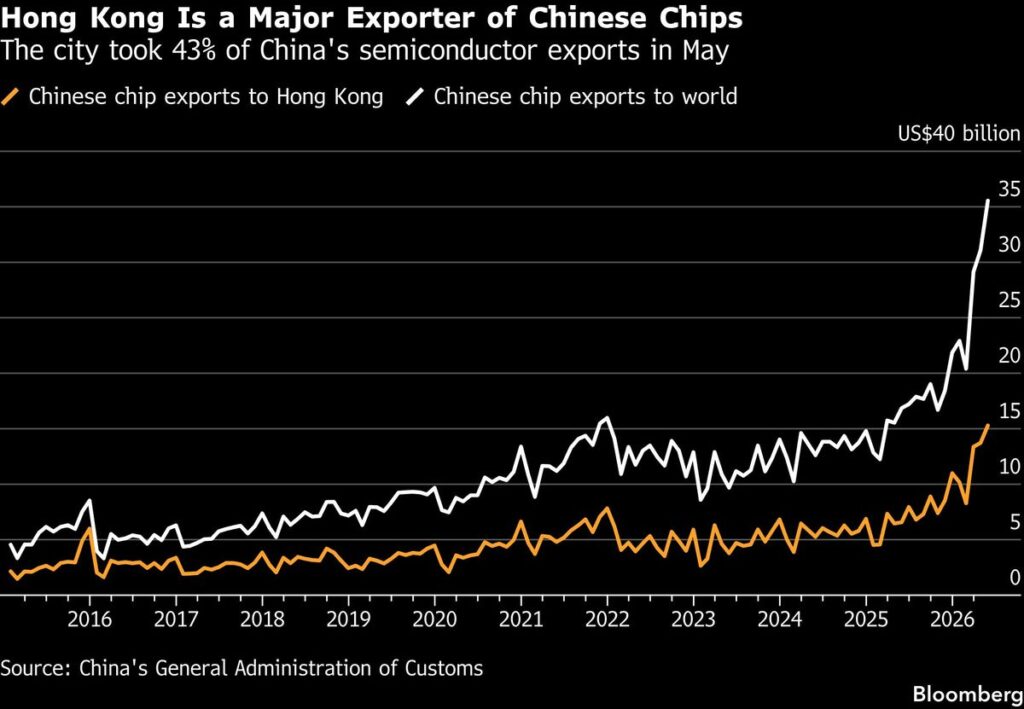
From January to May 2026, Hong Kong re-exported $124 billion worth of semiconductors to the mainland, accounting for 52% of China's total chip imports.
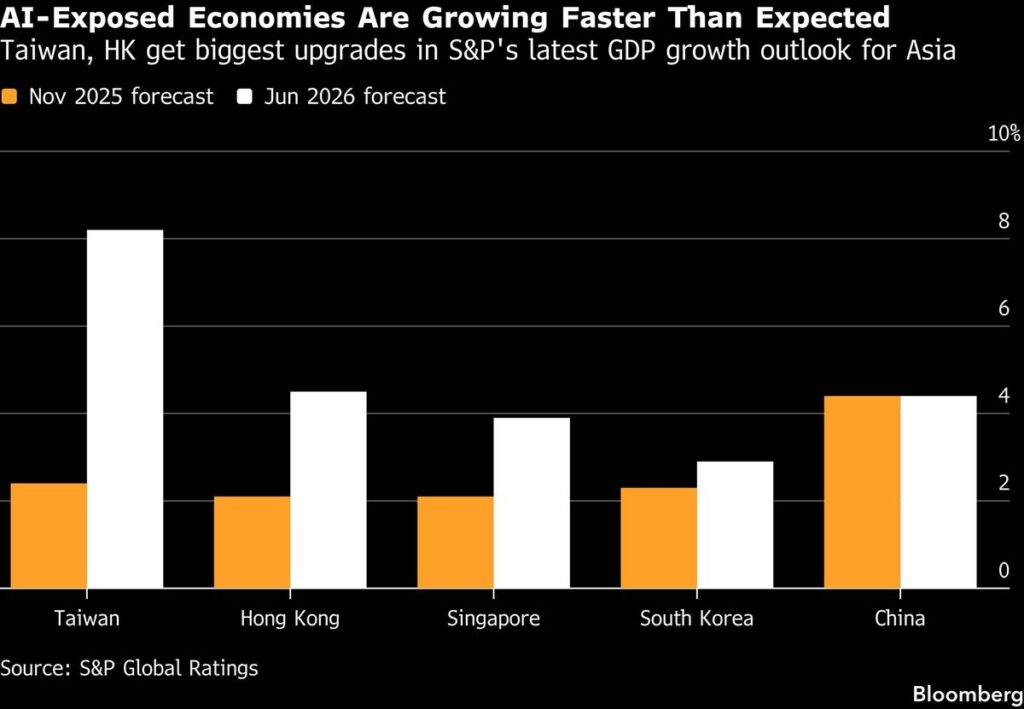
This prosperity has driven Hong Kong's economy to achieve its fastest growth in nearly five years in the first quarter, despite global energy shocks triggered by the war in Iran during the same period.
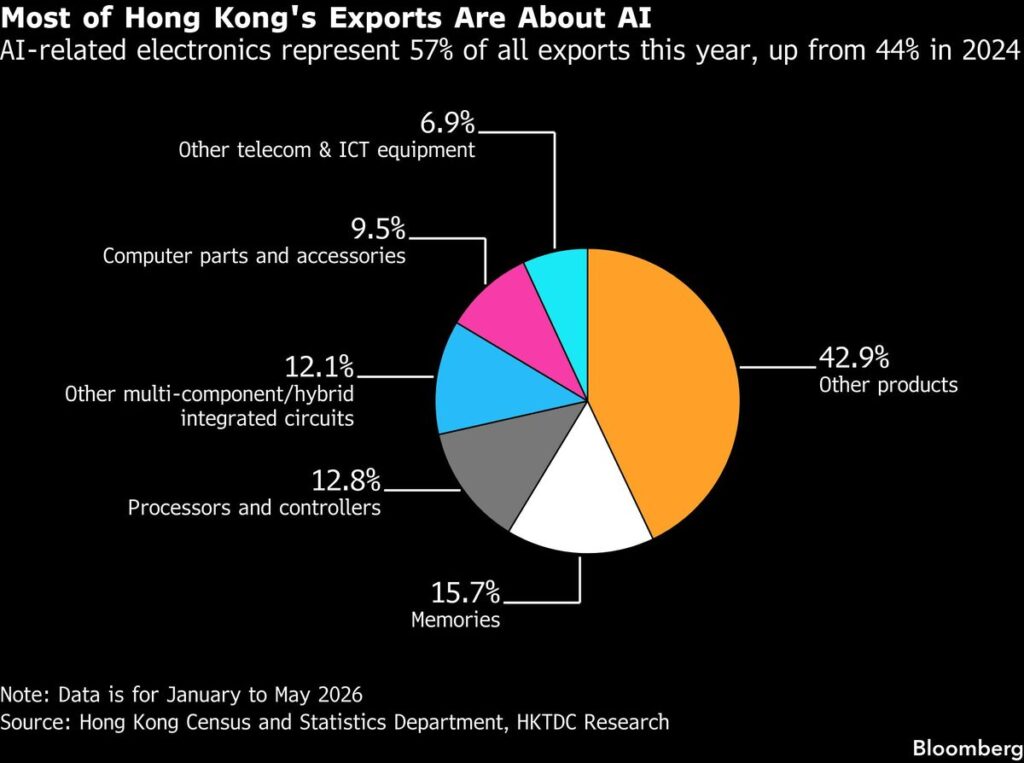
The Hong Kong Trade Development Council recently significantly raised its forecast for export growth in 2026 to over 20%, calling it a “technology upcycle” driven by artificial intelligence.
Data shows that AI-related electronic products now account for 57% of Hong Kong's exports, up from 44% in 2024; Barclays Bank estimates this ratio could be as high as 70%.
Hong Kong exempts import goods from tariffs, which has become an advantage amidst Sino-U.S. trade friction. However, goods re-transported to the mainland still require payment of Chinese taxes and fees.
Even so, mainland companies still prefer to transact through Hong Kong companies, as it offers greater convenience in payment and currency exchange. Former Hong Kong Legislative Council member and current Stanford University research scholar Ma Nai Guang stated: “As an intermediary, Hong Kong has found ways to handle payment issues, making it easier for mainland buyers to operate.”
Hong Kong has surpassed mainland China to become the largest export market for Taiwanese chips, while South Korea's chip exports to Hong Kong have also achieved triple-digit growth.
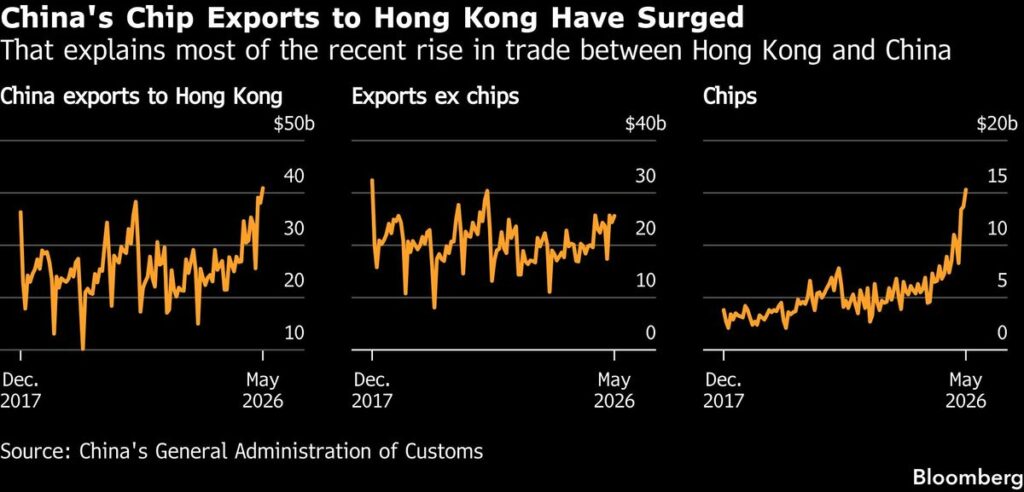
Meanwhile, China has become the world's largest supplier of AI-related products, although it still relies on imports for advanced chips. In May 2026, China's semiconductor exports grew 111% year-on-year, the fastest growth since 2013.
This trend has driven trade between Hong Kong and the mainland to historic highs. In May alone, Hong Kong imported over $40 billion worth of goods from the mainland, the highest level since 2015, roughly three to four times that of mainland exports to Japan or Germany, with semiconductors accounting for more than one-third.
In the maritime trade sector, as mainland Chinese ports (such as Shanghai, Ningbo, and Shenzhen) rise, Hong Kong's transshipment role has weakened in recent years, but it still maintains an advantage in high-value-added trade.
Heiwai Tang, an economics professor at the University of Hong Kong, pointed out: “For products with extremely high intellectual property content, Hong Kong still plays an important role in quality assurance, standard certification, and intellectual property protection, and its institutional advantages remain.”
The common law system used in Hong Kong is still trusted by international investors, despite Beijing's strengthening of control over Hong Kong in recent years.
Furthermore, Hong Kong's status as an international aviation hub is also a key advantage. In contrast, mainland China's regulations on the air transport of electronic products are stricter.
Li Zhifeng, vice chairman of the Southern and Northern Trade Association, stated: “Hong Kong, with its geographical advantage next to the mainland, can seamlessly connect air transport with land transport, becoming a distribution center, which is difficult for transshipment hubs like Singapore to achieve.”
免责声明:本文章仅代表作者个人观点,不代表本平台的立场和观点。本文章仅供信息分享,不构成对任何人的任何投资建议。用户与作者之间的任何争议,与本平台无关。如网页中刊载的文章或图片涉及侵权,请提供相关的权利证明和身份证明发送邮件到support@aicoin.com,本平台相关工作人员将会进行核查。


