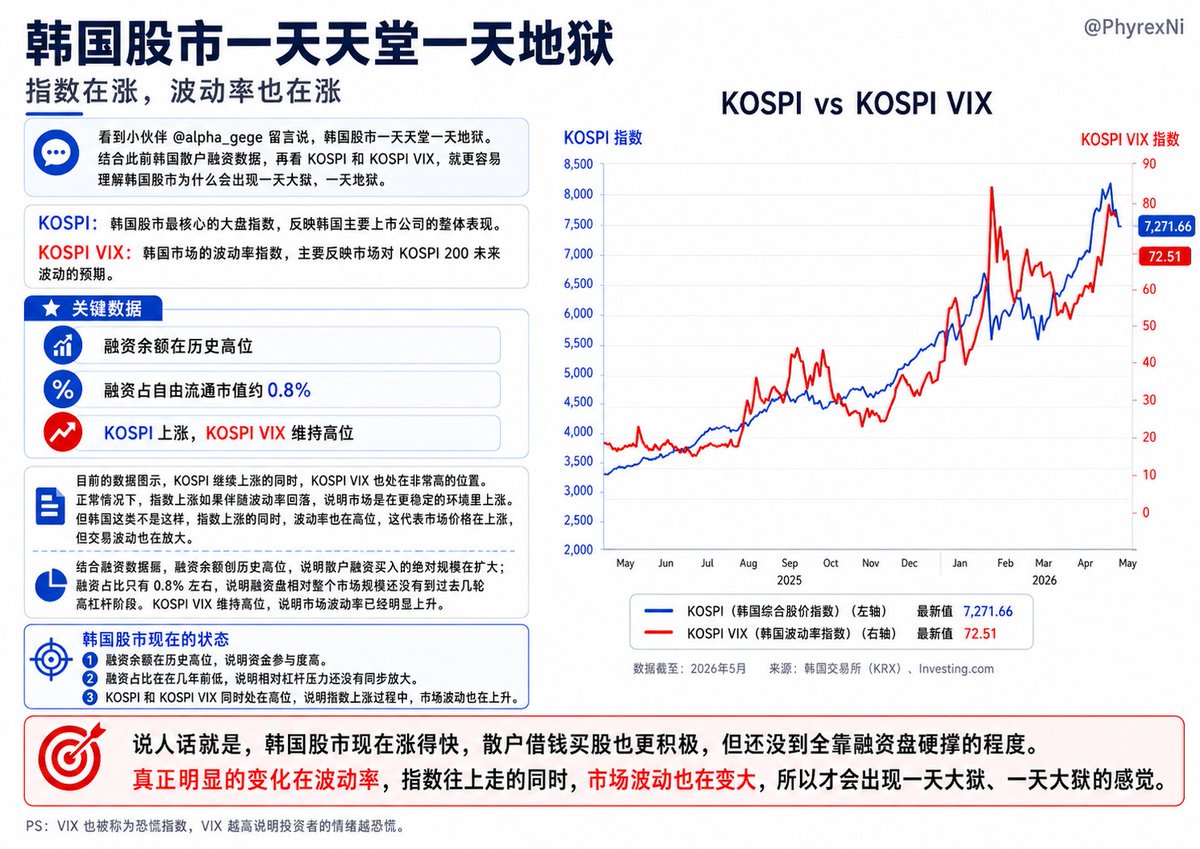
The South Korean stock market is a paradise one day and a hell the next — the index is rising, and volatility is also rising.
Today I saw a comment from my friend @alpha_gege, saying “Watching the South Korean stock market clearly shows that it’s a paradise one day and a hell the next, with daily circuit breakers,” which reminded me of a tweet I wrote last week about retail investor financing in Korea. Today I found some more information, and I see why it’s a paradise one day and a hell the next.
Today I mainly looked at the data for KOSPI and KOSPI VIX.
KOSPI is the core index of the South Korean stock market, comparable to Korea’s version of the S&P 500 or CSI 300, reflecting the overall performance of major listed companies in Korea.
KOSPI VIX is the volatility index of the South Korean market (similar to the VIX in the US stock market), mainly reflecting market expectations of future volatility for KOSPI 200. In simple terms, KOSPI represents price direction, while KOSPI VIX represents market expected volatility.
Current data shows that while KOSPI continues to rise, KOSPI VIX is also at a very high level.
Under normal circumstances, if the index rises while accompanied by a decline in volatility, it indicates that the market is rising in a more stable environment. However, this time in Korea is not the case; the index is rising while volatility is also high, which indicates that market prices are increasing, but trading volatility is also amplifying.
When viewed alongside the financing data, it becomes clearer. The financing balance has reached a historical high, indicating that the absolute scale of retail investor financing is expanding, with the financing proportion being only about 0.8%, suggesting that the relative leverage of the financing positions has not yet reached the high leverage stages seen in previous rounds.
KOSPI VIX at a high level indicates that although the market is not yet completely dominated by the financing positions, volatility has clearly increased.
Thus, the current state of the South Korean stock market appears to be a combination of contradictions:
1. The financing balance is at a historical high, indicating high participation of funds.
2. The financing proportion is at a recent low, indicating that the relative leverage pressure is not yet amplified.
3. Both KOSPI and KOSPI VIX are at high levels, indicating that during the index rise, market volatility is also increasing.
When these three pieces of data are considered together, the core of the South Korean stock market is that market enthusiasm is rising, retail financing is active, but the relative leverage ratio is not extreme; the index rise is already accompanied by high volatility, and the market has entered a phase of higher volatility increases.
In straightforward terms, the South Korean stock market is currently rising quickly, retail investors are more aggressive in borrowing to buy stocks, but it is not yet at the stage where the financing positions are solely propping it up. The truly noticeable change is in volatility; as the index moves upward, market fluctuations are also increasing, leading to the feeling of significant rises one day and significant falls the next.
PS: VIX is also known as the fear index; the higher the VIX, the more panic there is among investors.
#Bitget has arrived as VIP! Crypto, US stocks, CFD, your one-stop layout for global opportunities.
免责声明:本文章仅代表作者个人观点,不代表本平台的立场和观点。本文章仅供信息分享,不构成对任何人的任何投资建议。用户与作者之间的任何争议,与本平台无关。如网页中刊载的文章或图片涉及侵权,请提供相关的权利证明和身份证明发送邮件到support@aicoin.com,本平台相关工作人员将会进行核查。


