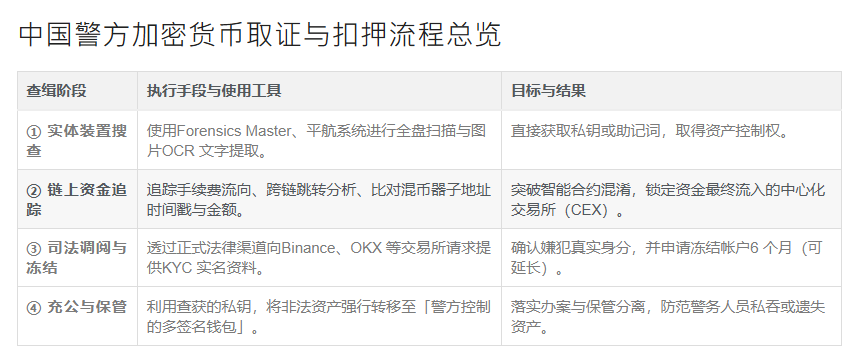
😂 The Public Security Department of Zhejiang Province and the Wenzhou Municipal Public Security Bureau jointly released a technical report, revealing the procedural workflow of domestic police handling Crypto-related cases.
Generally, it is reliable, but sometimes media reports exaggerate cross-chain tracking as if one could just input an address and automatically restore the entire funding path of the universe.
In reality, it is not that godly; most real Crypto law enforcement in the country still follows the old routine: arresting people, seizing equipment, and checking transaction flows.
Mobile phones, computers, hard drives, chat records, memos, screenshots, cloud drives, exchange apps, email verification codes, OTC conversations— as long as they can find mnemonic phrases, private keys, wallet addresses, and exchange accounts, many cases are basically half solved.
Moreover, law enforcement does not require every step to be perfectly cracked; it only needs to piece together the on-chain path, timestamps, amount characteristics, and device evidence into a closed loop, which is generally sufficient.
This is also where many misunderstandings about Crypto anonymity arise.
In reality, the most challenging part is not the investigation, but the subsequent handling.
Crypto enthusiasts often shout "Not your keys, not your coins," but the reality is:
Not your phone, not your privacy.
Image source: @BlockTempo
免责声明:本文章仅代表作者个人观点,不代表本平台的立场和观点。本文章仅供信息分享,不构成对任何人的任何投资建议。用户与作者之间的任何争议,与本平台无关。如网页中刊载的文章或图片涉及侵权,请提供相关的权利证明和身份证明发送邮件到support@aicoin.com,本平台相关工作人员将会进行核查。


