Well-known trader Lightcrypto has not spoken for a year, and when he does, it’s explosive: he says that the company with the largest Bitcoin holding, Strategy, has already started selling coins.
According to the address he provided, 491 Bitcoins have been sold, which roughly amounts to under $30 million at around $60,000 per coin. In the context of Strategy's approximately 847,000 BTC holdings, it’s hardly significant.
Of course, some say that the behavior of this address does not align with the operational logic of Strategy’s publicly known addresses and is likely not Strategy. However, Lightcrypto is quite famous for tracking addresses, and indeed a considerable number of people believe him.
There is certainly a possibility of selling, as Strategy just announced their new coin-selling channel. On June 29, Strategy released the "Digital Credit Capital Framework," authorizing the company to sell up to $1.25 billion in BTC to replenish USD reserves, pay preferred stock dividends and debt interest, repurchase preferred stock, and buy back MSTR common stock.
We need to consider the next steps: if the 491 coins have indeed been sold, what does it mean for the Bitcoin market and Strategy's stock mechanism?
Are 491 Bitcoins a lot?
First, let’s look at the ratio.

From the perspective of the spot market, 491 Bitcoins is quite small. It represents only about 0.058% of Strategy's total holdings. If we think of Strategy’s holdings as a 100-liter tank, 491 coins are roughly equivalent to scooping out 58 milliliters.
So, if the market is only concerned with "selling pressure," the 491 coins are not the focus.
The real comparison is with the other two pillars. At the end of May, Strategy sold 32 Bitcoins for about $2.5 million. That time felt more like a temporary measure to meet preferred stock distribution needs. A month later, the company formalized the coin sale into an official framework, authorizing a maximum of $1.25 billion, which roughly equates to about 20,000 Bitcoins at $60,000 each.
In other words, if the 491 coins are indeed real, it does not mean "Strategy has crashed the market." It’s more like this pipeline has started to drip.
Why does it need to sell?
The answer lies in STRC.
STRC is Strategy's perpetual preferred stock, with a target par value of $100. Its buyers are not typical crypto players but rather funds seeking stable cash flow returns. The original narrative of this product was straightforward: investors buy STRC, Strategy takes the money to buy BTC, BTC supports the company’s assets, and STRC continues to trade closer to par.
The problem is that STRC has not remained close to par.
On June 30, Yahoo Finance reported that STRC’s closing price was $84.86. At the same time, Strategy raised the annualized dividend yield of STRC to 12% starting in July. This created an unsightly spread. The lower the price, the less confidence the market has, and the higher the company must pay.
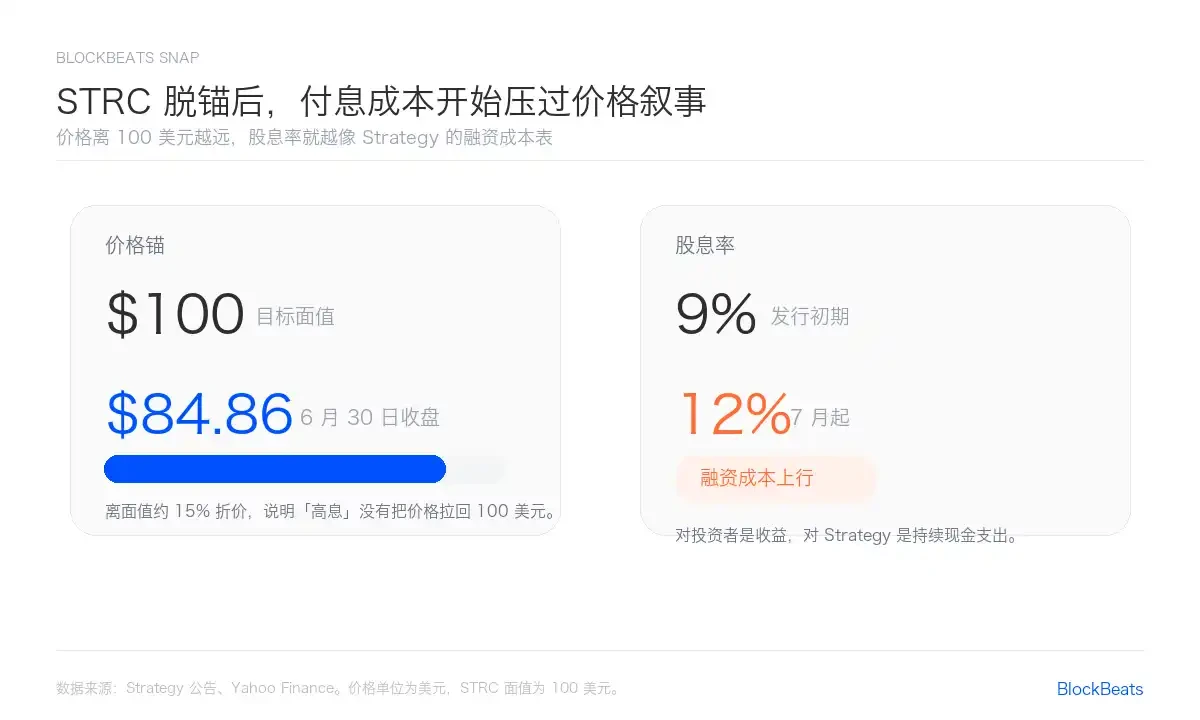
Here, the 12% is not only the yield for investors but also a cost for Strategy.
According to Strategy's announcement on June 29, the company's current annualized preferred stock dividend and debt interest payments are approximately $1.76 billion. In simpler terms, the company needs to prepare about $4.8 million daily to sustain this capital structure.
This does not mean that Strategy cannot pay. The company disclosed a USD reserve of about $2.55 billion, which covers approximately 17.4 months based purely on reserves. But this explains why the coin-selling framework was established. Selling BTC is not to flood the market but to provide cash to support the entire structure of stocks and preferred shares.
Is 491 coins a positive or negative for MSTR?
This needs to be viewed from two angles.
In the short term, the market may view it as a positive. After the framework was announced on June 29, MSTR rose nearly 7% pre-market. This reaction is not contradictory. The market dislikes disorderly sell-offs but appreciates clarity in liquidity arrangements from the company.
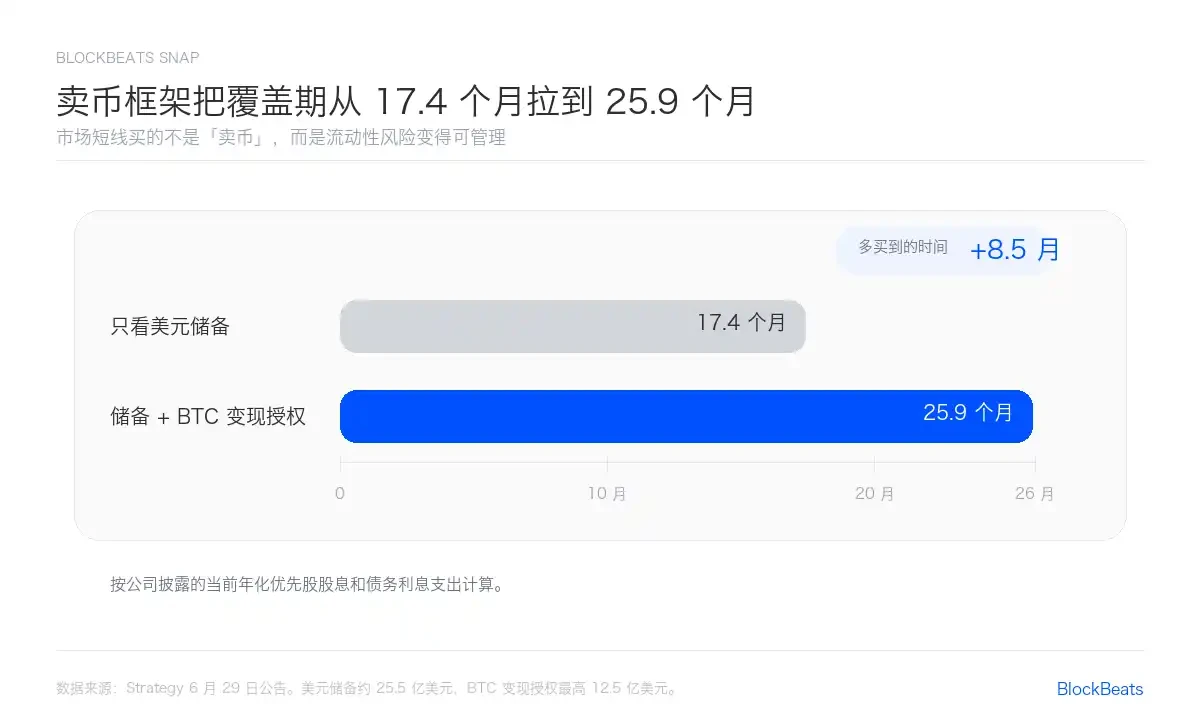
This chart explains why MSTR was able to rise at that time. Based solely on USD reserves, Strategy has a coverage period of about 17.4 months. Adding the $1.25 billion BTC liquidation authorization extends the coverage period to about 25.9 months.
The market is not buying into "coin sales."
The market is buying into "at least not an immediate crisis."
But in the medium term, this constitutes a downgrade in terms of MSTR's valuation narrative. The strongest past story for MSTR was unilateral accumulation: financing, buying BTC, increasing BTC per share. Now there is a reverse action: selling BTC, replenishing reserves, paying interest, repurchasing at a discount.
This is not necessarily wrong; it might even be what a mature public company should do. But it changes MSTR from being "the perpetual marginal buyer" to "someone who sometimes has to manage liabilities."
The key mechanism for the stock lies in mNAV, which is the multiple of MSTR's market cap relative to net asset value of their holdings. When mNAV is above 1, Strategy’s issuance of new stock to buy BTC will be perceived as enhancing BTC per share. However, once mNAV falls below 1, further issuances resemble discount selling of their Bitcoins.
At that point, selling BTC may actually become a cleaner way to finance.
This doesn’t necessarily mean immediate bad news for common stock. If the company uses the funds from selling coins to repurchase discounted STRC, it can alleviate future dividend pressure, potentially benefiting common stock. But the market will also revisit a question: since the strongest buyer must also sell coins, how much BTC premium should MSTR still enjoy?
What does it mean for the BTC market?
The 491 coins will not change the spot supply and demand.
But it will alter the psychological chart of traders. In the past, during market declines, Strategy was often imagined as the last buyer. ETFs flowed out, miners sold coins, retail investors did not purchase, and there was Saylor.
If the 491 coins are real, this perception will fracture. Strategy may still be a long-term holder and may continue buying. But it is no longer an account that only has the buy button.
What is more troublesome is that the coin-selling framework is tied to STRC. As long as STRC remains below par for an extended period, Strategy will have to choose between several actions: raising dividends, repurchasing discounted preferred stock, replenishing USD reserves, or utilizing BTC. Each choice is not a disaster, but each shifts the focus of "Bitcoin faith" back to cash flow.
If the 491 coins hold up, it’s just the first small ticket.
What really needs to be observed is whether the market will continue to treat every ticket as an exception in the future.
免责声明:本文章仅代表作者个人观点,不代表本平台的立场和观点。本文章仅供信息分享,不构成对任何人的任何投资建议。用户与作者之间的任何争议,与本平台无关。如网页中刊载的文章或图片涉及侵权,请提供相关的权利证明和身份证明发送邮件到support@aicoin.com,本平台相关工作人员将会进行核查。

