TL;DR
- After researching five Chinese technology hardware companies, UBS found that the demand for AI infrastructure remains a common theme.
- Shenghong Technology plans a fixed asset investment of no more than 18 billion yuan in 2026, with the Rubin platform being the focus of PCB growth.
- Many key figures come from management communications; realization will depend on mass production, certification, and external restrictions.
In a research report released on June 26, UBS provided more specifics on the demand for China's AI hardware chain: the demand for AI infrastructure remains strong, expanding beyond just GPUs to also include PCBs, optical interconnects, liquid cooling, SiC substrates, and optical communication materials.
The key news in this report is not just the order changes of a single chip company but that multiple segments are offering more positive timelines and capacity goals. Birun Technology has scheduled its GPU roadmap until 2028, Shenghong Technology plans a fixed asset investment of no more than 18 billion yuan in 2026, and Tianyue Advanced’s management stated that SiC orders are saturated, selectively increasing prices for some urgent orders from small clients.
This information mainly derives from management exchanges and company guidance within UBS's research, rather than formal profit forecasts. They act more like a thermometer for the demand in the AI hardware chain, reflecting industry heat but not directly equating to realized revenues and profits.
Domestic GPU Scheduled Until 2028, Shenghong Technology Bets on Rubin PCB
The timeline provided by Birun Technology is one of the most direct signals of domestic AI computing power in the research materials.
The company told Caijing that the BR20X is expected to be commercially launched in 2026, while the BR30X/BR31X is expected to be launched in 2028. Management communications in the UBS materials further noted that the BR20X series GPUs are planned for launch in the second half of 2026, upgraded in terms of computing power, memory capacity, and interconnect bandwidth compared to previous generations.
The race to catch up with domestic GPUs is not only based on the computing power of a single chip but also on whether memory, interconnect, packaging, and software ecosystems can keep pace together. For AI training and inference clusters, the bottleneck often occurs between chips, between servers, and at the system scheduling level, rather than just in theoretical computing power.
The limitations are also quite clear. Advanced processes, advanced packaging, customer mass production rhythm, and software ecosystem adaptation will all impact the subsequent landing of BR20X and BR30X. External export restriction environments will still affect the pace of the domestic AI hardware supply chain.
Closer to short-term orders and capital expenditures is Shenghong Technology's PCB guidance.
Management stated that the overall raw material costs for AI PCBs remain stable, and the cost transfer of the new generation of products is relatively smooth, expecting the gross margin in the fiscal year 2026 to be roughly on par with 2025. The revenue proportion from AI is anticipated to rise from below 50% to 60%-70%.
The Rubin platform is the most watched increment. The research materials stated that Shenghong Technology maintains the majority share in Nvidia's Rubin compute tray HDI, consistent with the GB300 platform situation, with an overall customer share target of about 50%. Since this figure has yet to be publicly validated, it is better understood as a management goal and seller research information. If realized later, the iteration of Nvidia's new platform will continue to drive China's high-end PCB supply chain.
Expansion figures also need to be more precise. Public information shows that Shenghong Technology's total investment in 2026 will not exceed 20 billion yuan, of which fixed asset investment will not exceed 18 billion yuan, primarily directed at Huizhou Factory 10-13. This scale indicates that AI server PCBs have been positioned by management as a core capacity direction for the coming years.
The material solution required for the Rubin Ultra's orthogonal backplane has not yet been finalized. The company stated that related adoptions have not been delayed but are still evaluating various material and supplier combinations, including Q-glass and PTFE. Order directions are relatively clear, while processes and material routes are still being screened.
Optical Interconnect and Liquid Cooling, Starting to Become Supporting Demands for AI Clusters
As AI clusters continue to grow, the importance of interconnects and cooling rises. Xizhi Technology and Lens Technology provided two supporting pieces of evidence.
UBS research materials indicate that Xizhi Technology has about 88% market share in the independent scale-up optical interconnect solutions, focusing on LPO, NPO, and other solutions, serving large-scale GPU and ASIC clusters. Its optical computing processor employs 3D TSV vertical stacking of electronic ICs and silicon photonics, offloading some computing tasks to the silicon photonics layer, thereby reducing latency and dependence on advanced manufacturing processes.
The focus of such solutions is not on "optical computing replacing GPUs," but rather that as AI clusters grow larger, interconnect bottlenecks become more pronounced. If LPO, NPO, and silicon photonics packaging can achieve stable mass production, they may provide incremental space in bandwidth, power consumption, and latency for large-scale clusters.
Lens Technology's layout in AI infrastructure is driven by optical communications and liquid cooling. Public reports indicate that Lens Optoelectronics strategically acquired a controlling stake in Shenzhen Tongsheng Optoelectronics Co., Ltd. in June 2026, entering the hollow core fiber cable-related field. Management goals in the UBS research indicate that the optical communication business is expected to make a more meaningful contribution to the profit and loss statement starting in 2027, with revenue potential of about 10 billion yuan.
In terms of liquid cooling, the management goal is to become the largest shareholder of Yuans Tech, with liquid cooling business revenue expected to reach several billion yuan in fiscal year 2026. The value per unit for cold plates, manifolds, and UOD machines is about 40,000-50,000 USD. These figures lack public announcement validation and should still be understood at the level of goals and guidance.
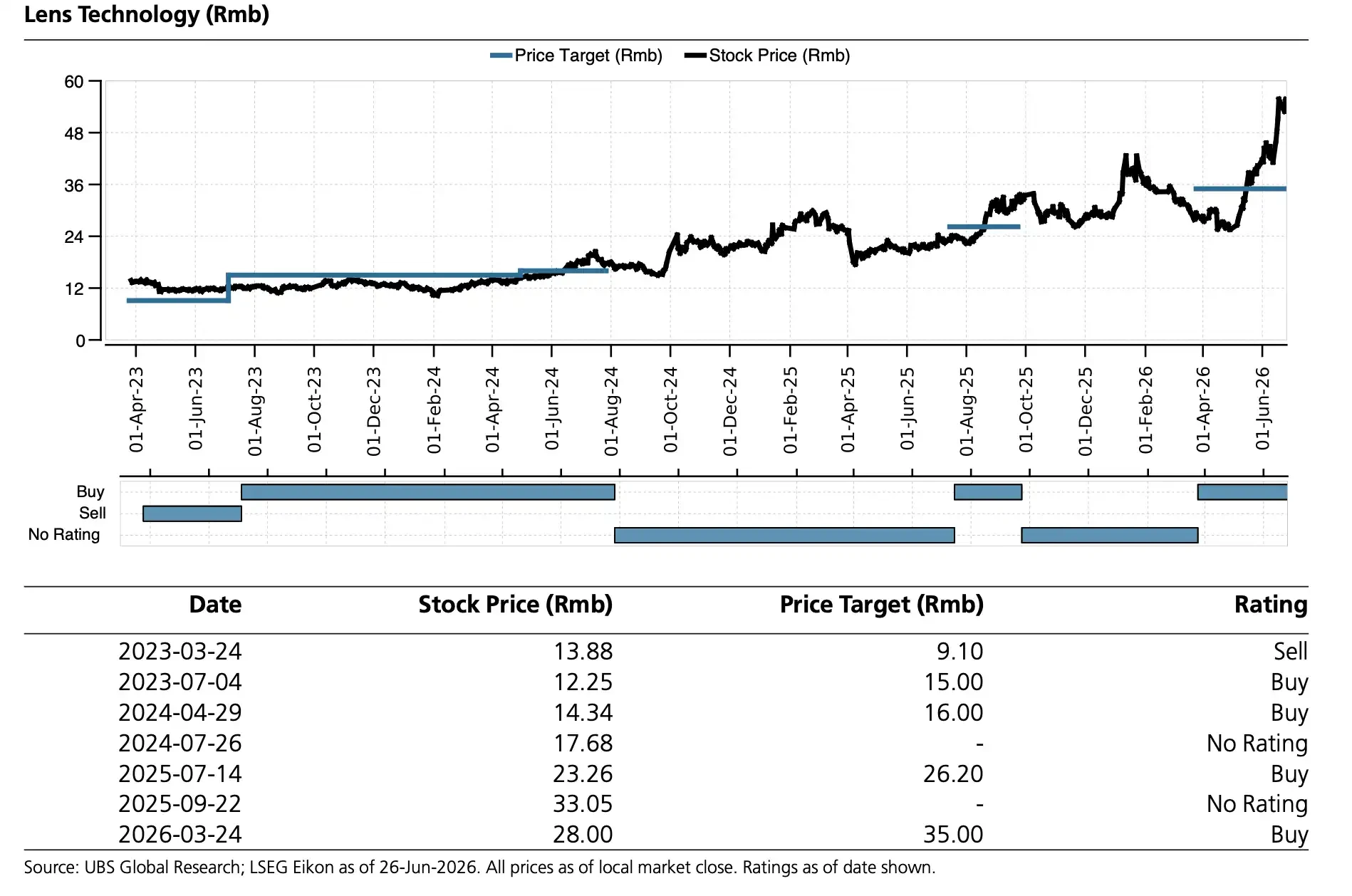
Historical price chart of Lens Technology stock with target price history and adjustments.
SiC Orders Saturated, 8-Inch Shipment Target Raised to 50%
On the power device chain, Tianyue Advanced's signals are closer to "tight supply and demand are already affecting some prices."
The company's press release cited Fuji Economic data indicating that in 2025, its global SiC substrate, 6-inch, and 8-inch share would be first, with the 8-inch share at 51.3%. Management communications in the UBS research materials further stated that current demand is strong and orders are saturated, with overall prices stable in the first quarter of 2026, but selectively increasing prices for urgent orders from small customers.
The management target is to have 50% of shipments come from higher-margin 8-inch SiC substrates by 2026 to drive gross margin expansion. If this goal is realized, it will directly affect the company's product structure and profitability.
SiC has previously been primarily driven by electric vehicles, photovoltaics, and energy storage. Now, high-power AI servers and data center power systems are also starting to become sources of new demand. HVDC, SST, AI glasses, and advanced packaging are also listed as potential drivers.
The key here is not that SiC demand has suddenly shifted from automobiles to AI, but rather that AI data centers continue to expand the demand boundaries for power semiconductors. The saturation of orders and selective price increases indicate that, in some customer and urgent order scenarios, supply tightness has begun to impact prices.
Whether prices can continue to rise will still depend on the 8-inch capacity ramp, customer validations, and downstream demand rhythms. If capacity release exceeds order growth, price elasticity may be weakened. If the realization of data center demandis faster than expected, Tianyue Advanced's gross margin improvement potential will be clearer.
Order Direction is Clear, Challenges Remain in Mass Production and Constraints
This set of research information points to a change: AI hardware demand is expanding along the lines of GPUs, PCBs, optical interconnects, liquid cooling, and SiC, with the Chinese supply chain providing more positive capacity and product routes across multiple segments.
However, it is not suitable to be written as "domestic AI hardware fully breaking through." Birun Technology's GPU roadmap is still subject to process and ecosystem constraints. Shenghong Technology's related share in Rubin still awaits platform mass production and material solution implementation. Xizhi Technology's optical interconnect and optical computing need large-scale customer validation. Lens Technology's optical communication and liquid cooling contributions will mainly depend on 2026-2027. Whether Tianyue Advanced's selective price increases can continue will depend on the 8-inch capacity and the realization of data center demand.
Greater external constraints still exist in advanced processes, advanced packaging, high-end GPUs, and capital expenditures from cloud vendors. The closer the AI hardware chain is to these points, the more susceptible it is to the impact of policies and supply chain constraints.
The most valuable aspect of these figures is that they show that AI infrastructure orders are spreading to more hardware segments. The boundaries that need to be retained are also clear: most metrics remain as management goals and research information, and true realization will still depend on customer mass production, material finalization, and the external environment.
免责声明:本文章仅代表作者个人观点,不代表本平台的立场和观点。本文章仅供信息分享,不构成对任何人的任何投资建议。用户与作者之间的任何争议,与本平台无关。如网页中刊载的文章或图片涉及侵权,请提供相关的权利证明和身份证明发送邮件到support@aicoin.com,本平台相关工作人员将会进行核查。


