On June 30, 2025, U.S. President Trump submitted his annual financial disclosure report to the Office of Government Ethics. This document is 927 pages thick. According to CNN, similar documents from Obama and Biden totaled less than 20 pages combined.
What is in those 927 pages? Cryptocurrency. During the first year of his second term, Trump earned over $1.4 billion from cryptocurrency-related businesses. This figure includes three different types of money from two different entities, flowing into the Trump family's accounts through at least three layers of legal structure.
This is not a story about "how much the president made from trading cryptocurrencies." Not a single cent of that $1.4 billion was earned by Trump himself trading on exchanges. It is more like a report on brand business revenue, only the product being sold is the president's name and likeness.
Where does the $1.4 billion come from?
The $1.4 billion in crypto income is divided into three major parts. The largest chunk is $635 million, from meme coin licensing fees.
The second part is $515 million, from the token sale of World Liberty Financial (WLF). The third part is $65 million, from the equity sale of WLF Holding Company.
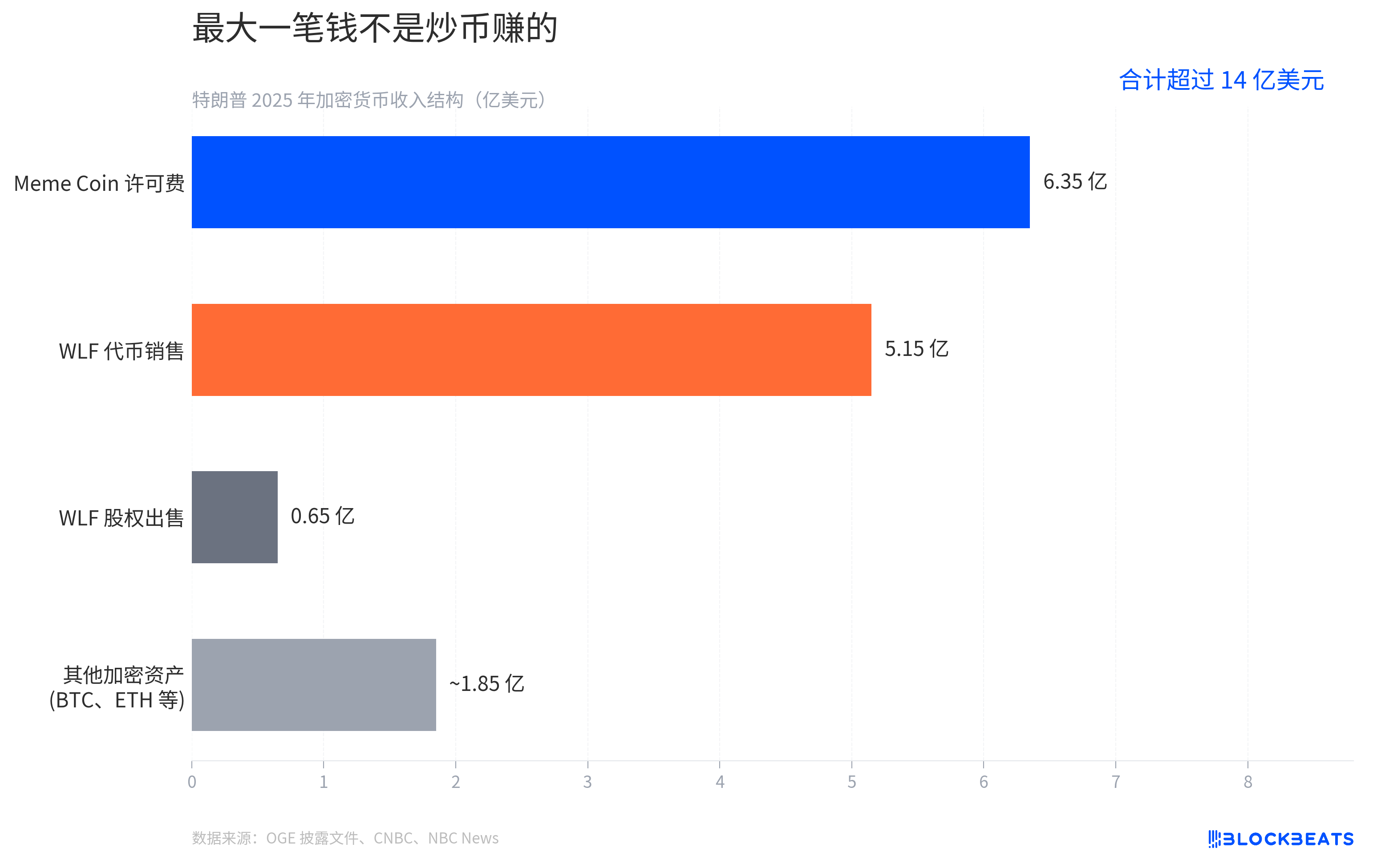
The three amounts combined exceed $1.2 billion, with the remaining portion spread across Bitcoin holdings (over $50 million according to Bitcoin Magazine), Ethereum holdings ($5 million to $25 million), and other smaller crypto asset projects.
All three income streams share a common feature. Trump himself and his immediate family did not directly operate any crypto projects. What they did is closer to brand licensing. Understanding this is the key to comprehending the entire ledger.
What are the business models behind each income stream?
$635 million in meme coin licensing fees. According to NBC News, the disclosure documents show a recorded royalty income of $635,068,835 under CIC Digital LLC, associated with an entity called Celebration Coins. CIC Digital is held by the Donald J. Trump Revocable Trust.
Here's how it works. On January 17, 2025, just three days before Trump took office, the $TRUMP meme coin was issued on the Solana blockchain. A total of 1 billion coins were produced, with only one-fifth available for public sale, while the remainder is held by Trump-affiliated companies. The issuers are a joint venture between CIC Digital and Celebration Cards LLC, called Fight Fight Fight LLC.
Trump does not issue coins or operate trades. What he does is license his name and likeness to entities along this issuance chain, receiving fees proportionate to this usage. The $635 million is this brand usage fee.
According to CoinDesk, by May 2025, the transaction fees from the $TRUMP coin generated over $320 million in additional income for its creators. During the same period, the coin's value dropped by 87% from its peak. How much buyers lost and how much the issuers earned are two parallel numbers.
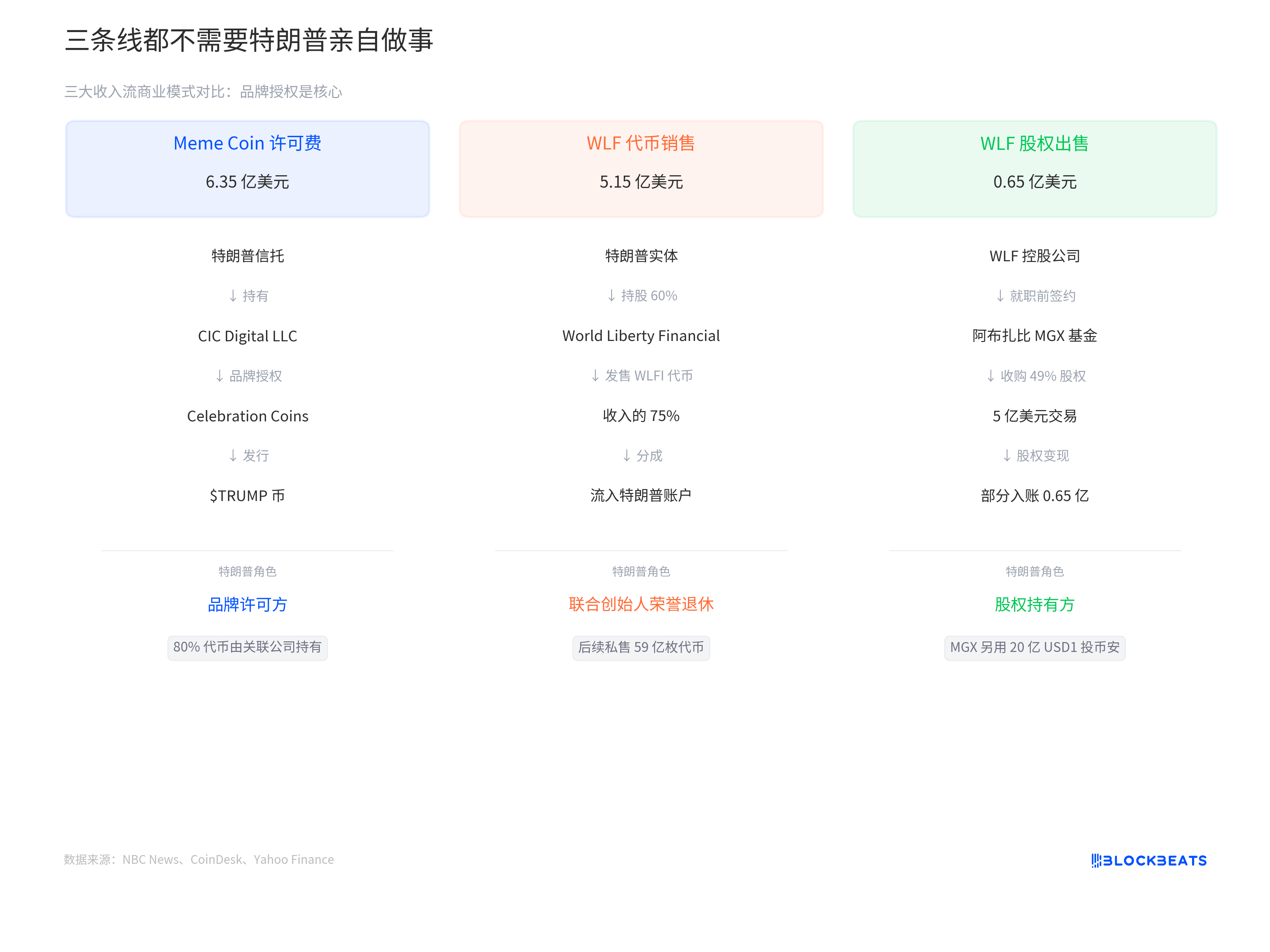
$515 million in WLF token sales. World Liberty Financial is a DeFi platform co-founded by the Trump family and partners in 2024. According to Yahoo Finance, Trump entities hold 60% of WLF shares, and Trump personally owns 70% equity in this entity.
WLF issued a governance token, WLFI, with a total of 100 billion coins, of which one-quarter was made available for public sale. According to CoinMarketCap, the token sale ultimately raised about $550 million.
The key detail is the profit-sharing ratio. WLF's disclosure documents reveal that three-quarters of the token sale revenue went directly to Trump's entities, with the remainder distributed to the Witkoff family and co-founders Zak Folkman and Chase Herro.
The $515 million is the figure cut to Trump's side based on this ratio.
The management list of WLF is also noteworthy. The CEO is Zach Witkoff, son of Steve Witkoff, the White House Middle East envoy. Trump's three sons, Eric, Donald Jr., and Barron, are all co-founders. Trump himself and Steve Witkoff hold honorary co-founder titles, nominally no longer participating in daily operations.
According to Unchained Crypto in May 2026, WLF later privately sold 5.9 billion WLFI tokens, while 80% of the holdings from early public buyers remain locked.
$65 million in WLF equity income. According to CNBC, this money comes from the equity sale of WLF Holdings Company. As reported by CoinDesk in February 2026, an Abu Dhabi affiliate secretly signed a deal before Trump's inauguration to acquire nearly half of WLF's equity for $500 million.
The $65 million recorded in the disclosure documents is not entirely clear as to its connection to that deal, but it is part of the capital realized from WLF equity.
WLF also issued the USD1 stablecoin in March 2025, pegged to the dollar and supported by U.S. Treasuries and cash equivalents. According to Phemex, by the end of the first quarter of 2026, the circulation of USD1 approached $4.5 billion. According to ABC News, the Abu Dhabi sovereign fund MGX used $2 billion of USD1 to participate in an investment transaction with Binance.
Lost in the first term, fully regained in the second term
$1.4 billion is a figure that needs to be understood in a historical context.
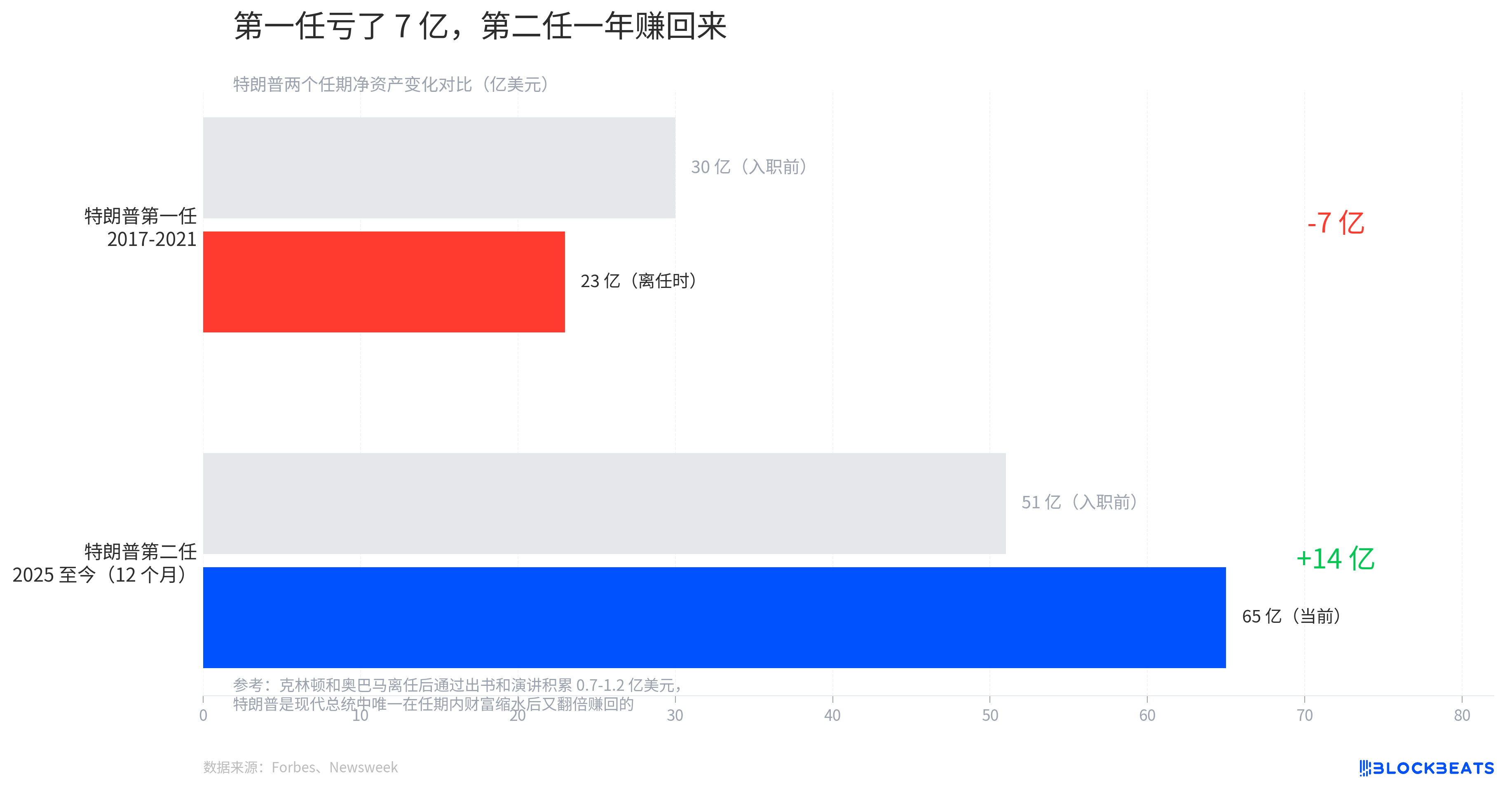
According to Forbes, Trump's net worth rose from about $5.1 billion in 2025 to $6.5 billion by February 2026. The crypto business is the core engine of this growth.
The wealth changes of past U.S. presidents during their terms provide a reference point. Clinton entered the White House with a net worth of about $1.3 million and accumulated about $120 million through books and speaking engagements after leaving. Obama's trajectory was similar, starting in the millions and taking over a decade to reach tens of millions. Bush started at a higher point, but his growth was slower.
The commonality among these former presidents is that their wealth growth mainly occurred after leaving the White House, relying on memoir royalties and six-figure speaking fees. Trump's $1.4 billion occurred during his term, in just 12 months.
An even more notable comparison comes from Trump himself. His first term experience contrasts completely. According to Newsweek, when he took office in 2017, his net worth was about $3 billion, which shrank to about $2.3 billion by the time he left office in 2021. He is the only modern U.S. president whose wealth decreased during his term.
In the first year of his second term, he doubled the losses from the first term. The difference is not in his business acumen but in the monetization tools used. The last round was hotels and golf courses; this round is tokens and licensing fees.
There is another detail in the 927-page document. According to the disclosure document, on July 18, 2025, Trump signed the GENIUS Act, establishing the first federal regulatory framework for stablecoins. The signer operates one of the fastest-growing stablecoins on the market.
Trump's 927-page disclosure document makes one thing very clear. Cryptocurrency has now become the largest single source of income for this president, surpassing real estate, golf courses, and any traditional business line.
免责声明:本文章仅代表作者个人观点,不代表本平台的立场和观点。本文章仅供信息分享,不构成对任何人的任何投资建议。用户与作者之间的任何争议,与本平台无关。如网页中刊载的文章或图片涉及侵权,请提供相关的权利证明和身份证明发送邮件到support@aicoin.com,本平台相关工作人员将会进行核查。


