What did @saylor do last week in the face of difficulties? Is my prediction correct? Are hidden topic preferred stocks worth buying?
History always seems remarkably similar. Strategy has once again begun defensive actions, and I am pleased that my prediction was correct. After the latest announcement, Strategy has essentially implemented almost all the methods I organized over the weekend.
The core change is that Strategy's current focus has shifted from continuing to buy BTC unconditionally to stabilizing its financing capacity and dollar cash payment ability first.
Let's first look at what Strategy did last week.
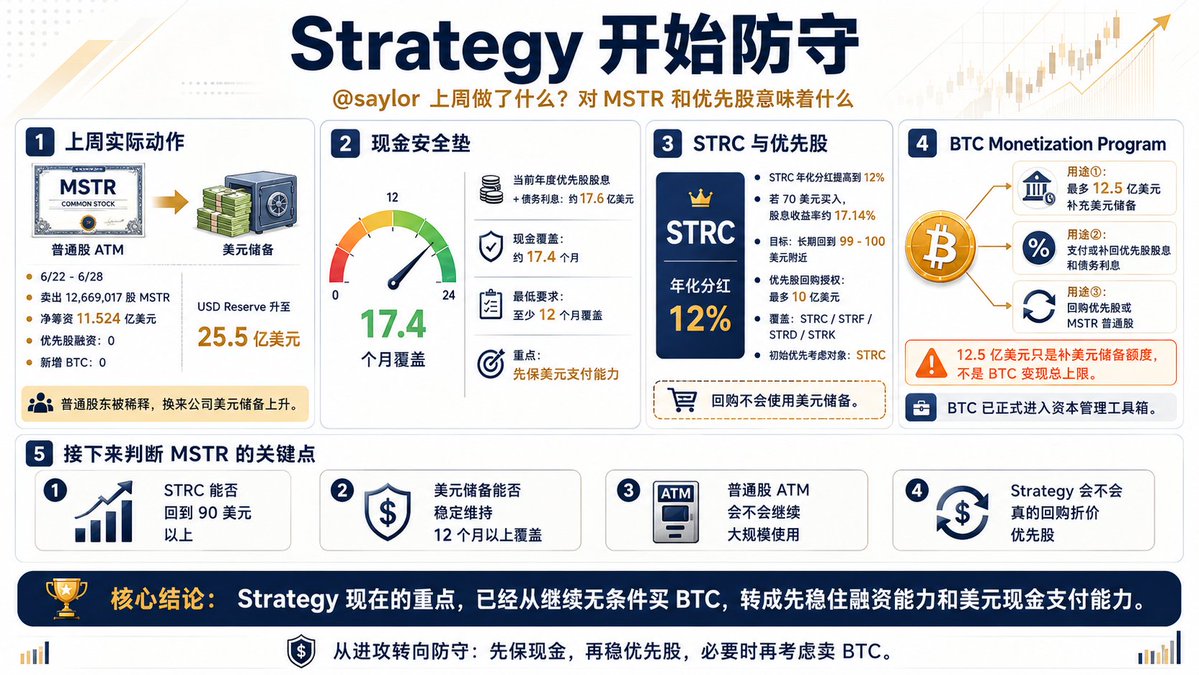
From June 22 to June 28, Strategy sold 12,669,017 shares of MSTR through common stock ATM, raising approximately $1.1524 billion in net funds. The money from this ATM was not used to continue buying BTC, nor was it financed through preferred stock; it was simply selling the least risky common stock ATM, with all funds raised serving as dollar reserves, totaling $2.55 billion.
This represents the dilution of common shareholders in exchange for the increase in the company's dollar reserves.
This action represents a shift from an "offensive" approach to a "defensive" stance, preparing to curl up for the winter.
This is what I mentioned a couple of days ago: Strategy now doesn't lack ways to break the situation, but every method is becoming more expensive. I am glad that Strategy chose the relatively "cheapest" method.
The common stock ATM is the most flexible for Strategy, as there are no fixed dividends for common stock, and no repayment issues upon maturity. However, for MSTR common shareholders, the lower the stock price, the more shares need to be sold for the same amount of money, which makes dilution more apparent.
More importantly, the Strategy common stock ATM can still obtain money from the market, indicating that the market believes in the value of Strategy's Bitcoin strategic reserves, and that the price of bitcoin:native will rise!
Last week, we were still calculating how long Strategy could hold out; now with $2.55 billion in cash, based on current annual preferred stock dividends and debt interest expenses of about $1.76 billion, it can cover approximately 17.4 months.
Moreover, Strategy indicated that it will maintain a dollar reserve coverage of at least 12 months moving forward, and any reduction below this level would require board approval. Therefore, the preferred stocks represented by $STRC began to rise, with STRC jumping up 10%. This is what I mentioned last week — as long as Strategy is ready to enter winter, STRC can be purchased.
Additionally, Strategy raised the annual dividend rate for STRC to 12%. Although this is only an increase of 50 basis points, it is highly appealing at around $70, as the actual annual yield is 17.14%.
Of course, Strategy has also kept a backup plan. The announcement stated that in the future, it will evaluate the STRC dividend rate monthly, considering STRC's trading price, market yields, credit spreads, BTC prices and volatility, dollar reserve coverage, capital market conditions, and overall capital structure. It also clearly stated that it will not simply continue to increase dividends just because STRC falls below par value.
This aligns with what I said last week: the higher the dividend rate, the greater the cash pressure in the future. If STRC can only return to $100 through continuous rate hikes, it would be a significant burden for Strategy in the long term.
Next is the buyback.
Strategy authorized up to $1 billion to repurchase STRC, STRF, STRD, and STRK preferred stocks, with STRC being the initial priority. This action is also quite reasonable because if the preferred stocks drop too deeply, buying them back at a low price allows the company to reduce future par value and dividend pressure at a discount.
For example, for a preferred stock with a par value of $100 and a 10% dividend, if it can be bought back for a little over $50, the company essentially uses just over half of that amount to eliminate the $100 par value and the corresponding future dividends. This represents a very direct financial repair for the company.
However, there is a key point here: The buyback of preferred stocks will not use dollar reserves. Dollar reserves are specifically meant for paying preferred stock dividends and debt interest. If Strategy truly intends to conduct a large-scale buyback of preferred stocks, it will either need to rely on new capital market financing or sell Bitcoin.
This is the most sensitive and hotly discussed topic among friends today.
Strategy has officially authorized a Bitcoin liquidation plan, allowing BTC to be sold when needed, primarily to supplement a maximum of $1.25 billion in dollar reserves. It can also be used to pay or replenish preferred stock dividends and debt interest, as well as to repurchase preferred stocks and MSTR common stock.
This does not mean that Strategy will immediately sell BTC, but it indicates that BTC has officially entered the capital management strategy. Previously, the market understood Strategy as financing to buy BTC; now, Strategy is actually financing to first supplement dollar reserves while retaining the option to sell BTC when necessary.
A question arises: Is the total amount of Bitcoin to be sold limited to $1.25 billion?
The BTC liquidation plan mentioned in the announcement has three types of uses:
First, to sell BTC to generate a maximum of $1.25 billion to supplement dollar reserves.
Second, when management believes it is more cost-effective than issuing common stock or using other financing methods, BTC may be sold additionally to pay preferred stock dividends and debt interest, or to replenish dollar reserves after payment.
Third, BTC may be additionally sold to repurchase preferred stocks or MSTR common stocks, including relevant taxes, fees, and transaction costs.
Therefore, if we only consider the "supplement dollar reserves" aspect, it is indeed capped at $1.25 billion. However, if we add in paying dividends and interest, replenishing reserves, repurchasing preferred stocks, and repurchasing MSTR common stocks, theoretically, the BTC liquidation amount could exceed $1.25 billion.
Of course, exceeding these authorized uses or the authorized limit will require further board approval.
This has a complex impact on MSTR common stocks.
The benefit is that Strategy now has an additional cash tool. If the common stock ATM cost is too high, the preferred stock financing cost is too high, and the debt market conditions are too poor, Strategy can supplement cash, pay interest, and repurchase discounted securities by selling BTC. This can reduce short-term cash flow pressure and avoid being forced into worse prices for financing at the worst times.
The downside is that the core narrative of MSTR has been weakened. Previously, investor confidence in the market was centered around Strategy continuously financing to buy BTC with high elasticity. Now, Strategy has made it clear that the funds obtained from financing can first be used to supplement dollar reserves, and BTC can be liquidated if necessary.
This will lead the market to reassess what premium MSTR should appropriately command.
Therefore, the key point for evaluating $MSTR moving forward lies in whether STRC can return to above $90, and whether dollar reserves can be stably maintained for more than 12 months. Will the common stock ATM continue to be used on a large scale? Will Strategy really begin to buy back discounted preferred stocks?
If the common stock ATM can continue to be used, it indicates that the market still recognizes Strategy's model, and the common stock ATM is also the least pressuring financing model for Strategy.
#Bitget has arrived, enjoy VIP status! Crypto, US stocks, CFD, seize global opportunities all in one place
免责声明:本文章仅代表作者个人观点,不代表本平台的立场和观点。本文章仅供信息分享,不构成对任何人的任何投资建议。用户与作者之间的任何争议,与本平台无关。如网页中刊载的文章或图片涉及侵权,请提供相关的权利证明和身份证明发送邮件到support@aicoin.com,本平台相关工作人员将会进行核查。


