Original|Odaily Planet Daily (@OdailyChina)
Author|Wenser(@wenser2010)
Have you ever wondered how much profit from selling an iPhone is distributed to various component manufacturers?
Recently, overseas technology blogger @BluthCapital, speaking in the tone of Micron's CEO, mocked the "business secrets" behind the iPhone: “For more than a decade, Apple has been buying chips from us (MU) for $5, putting them in metal boxes, and then selling them to consumers for $99; when we tried to raise prices to $7, they went into mockery mode. But now, when we want to charge them $50, they have raised the product price by $250.” This criticism reflects disdain for Apple's recent price hike and scapegoating of memory manufacturers.
This post quickly sparked discussions on social media. This morning, @BluthCapital continued this topic by posting a detailed cost structure diagram of the iPhone 18 to support his viewpoint:
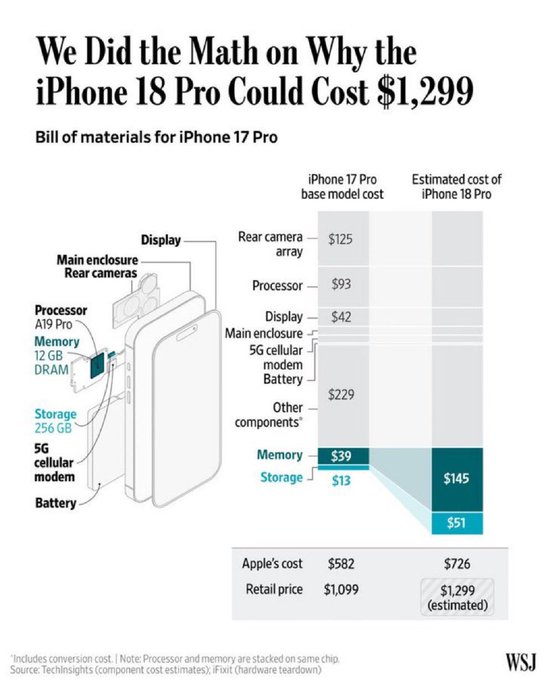
Previously, Micron's Chief Business Officer Sumit Sadana stated in an interview with The Wall Street Journal, “During the memory industry's downturn, some customers took the opportunity to depress prices, resulting in negative profits for the company.” Now, due to strong demand from AI and the tech industry, the memory sector has become the one holding the power. This has caused the entire supply chain to enter a cycle of “30 years in the east, 30 years in the west.”
The Profit Structure of an iPhone: Apple Takes Nearly 25%, Memory Manufacturers Like Micron Only Account for Less Than 3%
It is estimated that Apple takes about a quarter of the profits from an iPhone, while memory giants only manage to take about a thirty-third, and TSMC, due to its monopoly position, takes about 4%-5% in profits; the rest is covered by other hardware suppliers, distribution, R&D, and taxes.
Looking Back at Apple's Financial Reports: Net Profit Margin Consistently Above 24%, Capturing 75% of Industry-Wide Total Profits
According to data from organizations like Counterpoint, Apple has long held nearly 50% of the global mobile phone market's operating profits. In 2025, IDC data showed that it took about 75% of the industry's total profit with an 18% market share.
Based on Apple's latest Q2 data for 2026, iPhone revenue was $57 billion, net profit was $34 billion, with estimated shipments of about 61 million units. This allows us to infer that Apple’s net profit per iPhone is around $320-$340, with a net profit margin reaching 33%-36%.
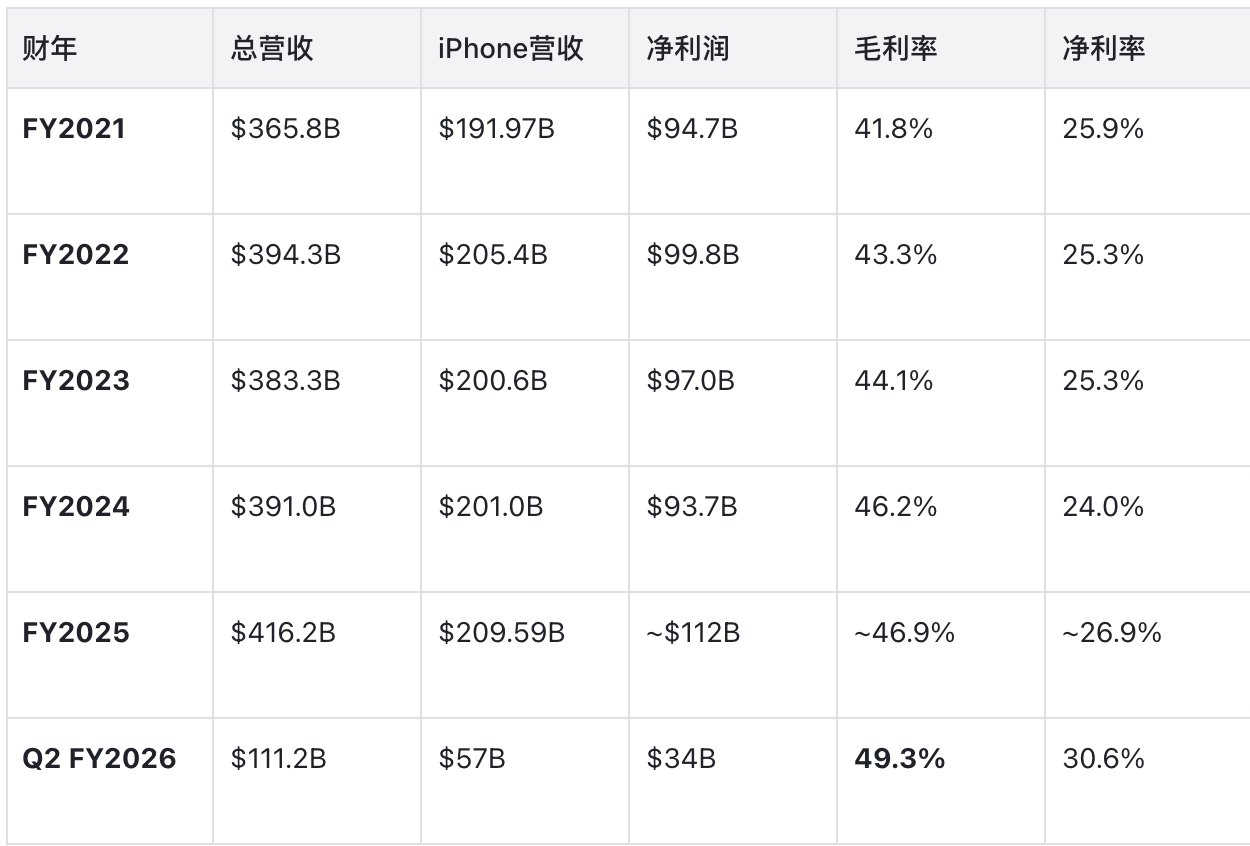
From comparisons of financial report data over the past five years, it is clear that the overall revenue performance of iPhones has been relatively stable; the scale of net profits has gradually increased from about $94 billion in 2021 to about $112 billion in 2025; net profit margins have remained relatively stable, typically at around 25%.
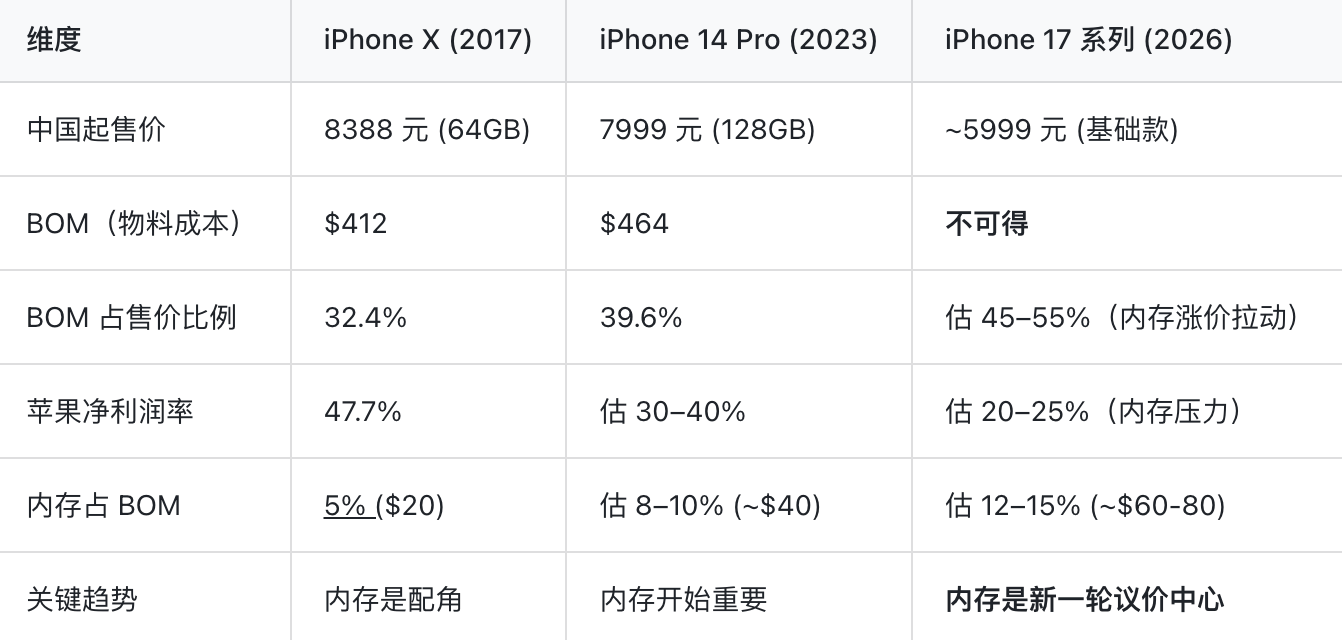
Looking at different models such as the 2017 iPhone X, the 2023 iPhone 14 Pro, and the 2026 iPhone 17 series, their profit structures have changed significantly due to variations in memory costs.
From iPhone X to iPhone 17: Memory Costs Have Doubled
Memory costs in iPhones have undergone three historical stages: from the initial “scrap”, to later becoming an “important component”, and now a “key part”.
2017 iPhone X Era: Memory “Scrap” Period
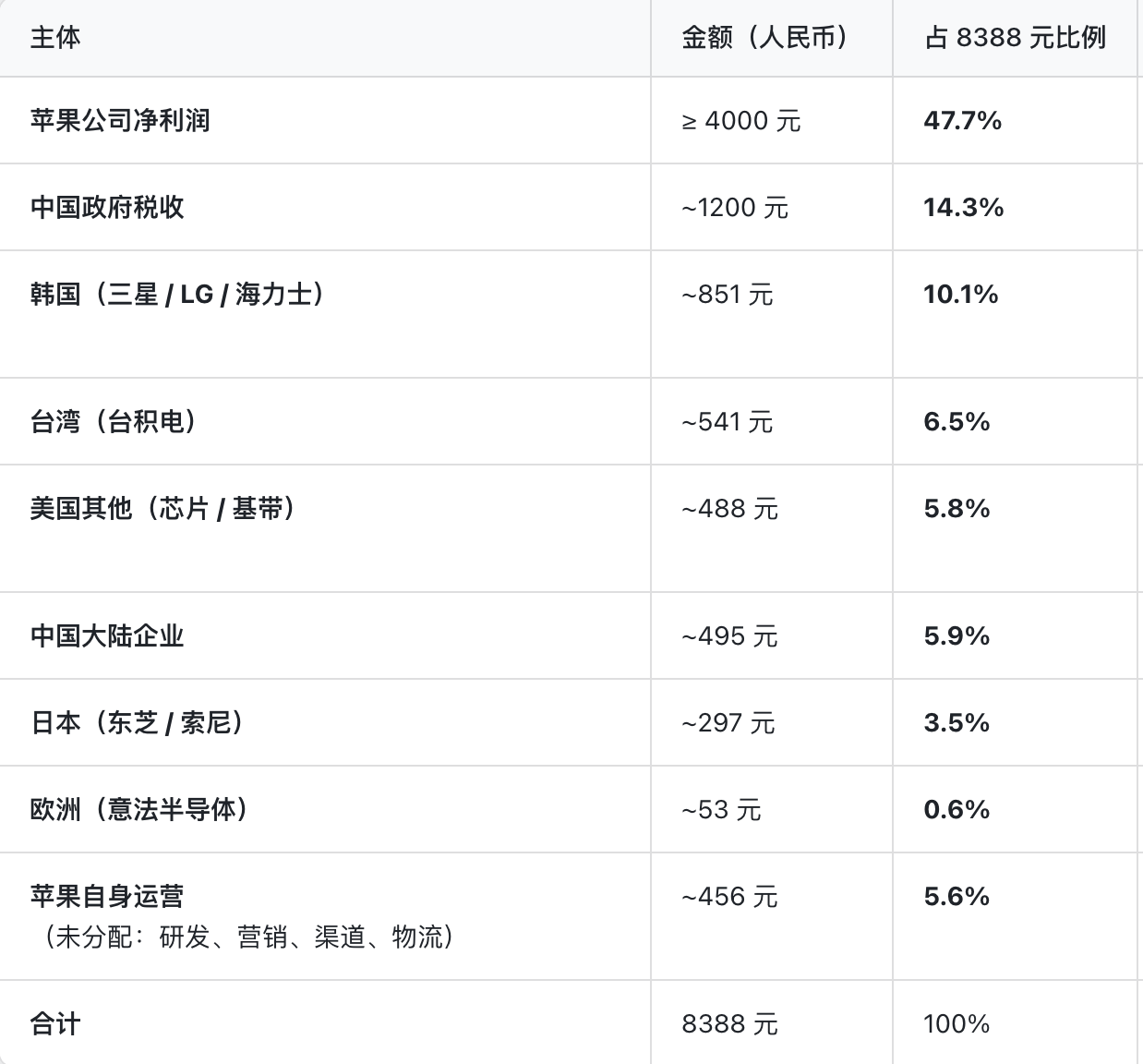
According to data from that year's Counterpoint teardown report, during the iPhone X era, thanks to its long-standing brand advantage and upstream ecological position, Apple's net profit reached nearly 50%; while Korean manufacturers like Samsung and Hynix accounted for only about 135–195 yuan of profit; around 1.6%–2.3% of the total selling price of 8388 yuan.
This is the "memory" weight during the iPhone X era: about 2% of costs, making it the least concerning component for Apple.
2023 iPhone 14 Pro Era: Memory “Important Component” Period
In 2023, when the iPhone 14 series was launched, Apple's material costs saw a slight increase; for example, the BOM material cost for the Pro version reached about $464 (approximately 3170 RMB), accounting for nearly 40% of the selling price, but Apple's net profit remained around 40%.
Feedback from a tech media at that time indicated that these figures were only for the 128GB version, and the cost increase for the more expensive memory versions was not high, but the selling prices were significantly higher. At that time, it was during the “camera and processor price hike period,” so the overall profit for the iPhone 14 Pro was 3.7% lower than that of the iPhone 13 Pro.
2026 iPhone 17 Era: Memory “Key Component” Period
By 2025-2026, the iPhone 17 series became Apple's main model, with memory costs having doubled compared to a few years ago; currently, it is estimated that memory costs account for 12%-15% of the BOM material cost, around $60-$80.
In summary, the following are the cost and memory cost ratio data for iPhones in different periods.
It is worth mentioning that TrendForce data indicates that the contract price for general-type DRAM rose by 93% to 98% in the first quarter of 2026. Citi predicts that the average price increase for DRAM will reach 88% throughout 2026. This aligns with the rising trend of memory costs. This phenomenon has also garnered recognition from Apple CEO Cook and Musk.
Cook: Memory Price Hike Is a Once-in-40-Years Event
On June 17, Apple CEO Cook (Odaily Planet Daily Note: He will step down as CEO in September this year, to be succeeded by John Ternu, former Senior Vice President of Hardware Engineering) mentioned the cost pressures from rising memory prices in an interview with The Wall Street Journal. He said: “When consumers need devices, supply has decreased, and memory manufacturers are passing on tremendous price increases. We absolutely need memory pricing and supply to return to reasonable levels for consumer products. That is the bottom line.”
However, less than a week later, he quickly changed his tone.
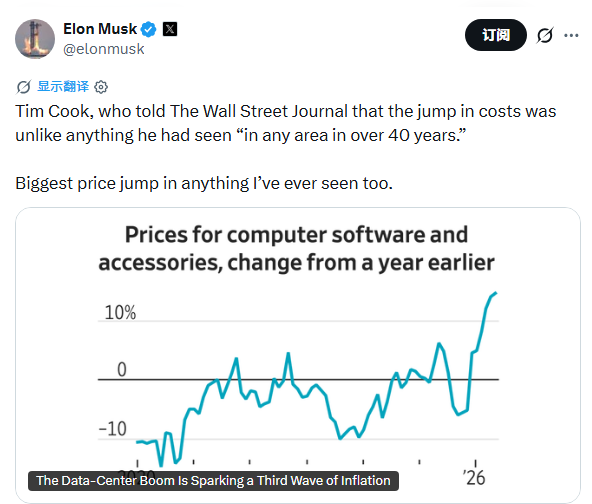
On June 25, Cook was interviewed again by The Wall Street Journal, referring to the cost shock issue as a “once-in-a-century flood,” saying: “In over 40 years, I have never seen a situation like this in any field.” Subsequently, Apple announced price increases across all products including Mac, iPad, HomePod, Apple TV, Vision Pro, etc.
As soon as the news broke, Apple's stock price fell by 6%, evaporating $263 billion in market value; marking the largest decline since April 2025.
Musk: I've Never Seen This Scene
Cook's words also received strong agreement from Musk. Recently, he also posted, stating: “Cook told The Wall Street Journal that this cost surge is something he 'has never seen in over 40 years in any field'. I have never seen a price jump as drastic as this either.”
Thanks to AI Data Centers and HBM, Memory Has Gained Strength
A closer look at the "memory bull market" that started last year shows that the key driving force is still the strong demand from the AI industry.
It is generally estimated that compared to ordinary servers, each AI server requires 8 times more DRAM and 3 times more NAND.
Based on such market demand, the three major storage giants, Samsung, SK Hynix, and Micron, will naturally shift more advanced process capacity towards the highly profitable HBM (High Bandwidth Memory) and high-end DDR5 products, actively cutting back on consumer-grade production lines like DDR4, resulting in a shortage of general DRAM.
Public information shows that the DRAM capacity on AI servers is 8 to 10 times that of traditional servers, combined with the demand for replenishing general servers and the proliferation of AI PCs, the supply and demand gap for storage chips continues to widen.
Previously, Micron's Q3 financial report showed an astonishing gross profit margin of 84.6% and a year-on-year revenue growth of 346% to $41.46 billion, demonstrating the monopolistic capacity of memory manufacturers to generate profit. Meanwhile, SK Hynix recently announced plans to list in the United States, seeking to raise about $29 billion to further capitalize on memory demand.
It is no exaggeration to say that the demand for memory from the AI industry is squeezing and even devouring the memory supply for consumer electronics. Data shows that the memory used in an Nvidia Vera Rubin AI server is equivalent to approximately 14,500 MacBook Neos, a 1:14,500 ratio, highlighting the current imbalance in memory supply and demand.
For memory manufacturers who have previously suffered from price suppression by giants like Apple, this is their era. It is no wonder that there are reports indicating that Apple is actively lobbying the Trump administration to seek approval to purchase memory chips from the Chinese chip company Changxin Storage.
As for whether Changxin Storage can replicate the wealth-generating miracles of star companies like SK Hynix and Micron in the capital market, perhaps the answer will be revealed next month.
Related Reading
Super Invincible Spiral Explosion, Micron's Financial Report Revives Semiconductor Long Bull
免责声明:本文章仅代表作者个人观点,不代表本平台的立场和观点。本文章仅供信息分享,不构成对任何人的任何投资建议。用户与作者之间的任何争议,与本平台无关。如网页中刊载的文章或图片涉及侵权,请提供相关的权利证明和身份证明发送邮件到support@aicoin.com,本平台相关工作人员将会进行核查。