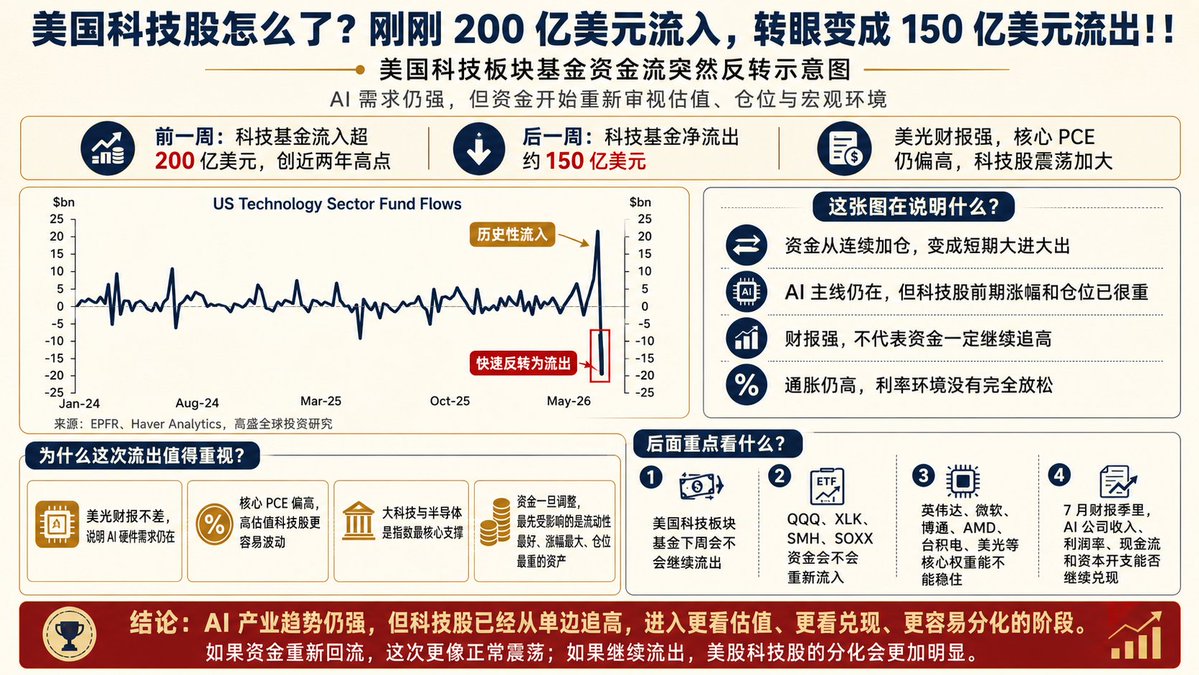
What happened to American tech stocks? Just now, 20 billion dollars flowed in, but in the blink of an eye, it turned into 15 billion dollars flowing out!!
When I just saw this chart, I was also a bit stunned. Isn't AI's development exceptionally vigorous now? In the past week, funds flowing into U.S. tech sector funds exceeded 20 billion dollars, an absolute high for the past two years, but just a week later, there was a net outflow of 15 billion dollars.
This reversal came too quickly. Just the previous week, there were historic buying levels, and suddenly, selling began.
Of course, this is weekly data, and this week saw two major events: one is Micron's earnings report, and the other is the U.S. May core PCE data. Both events saw volatility in the U.S. stock market, so we cannot rule out that some investors are avoiding risks, but indeed, from the current perspective, the outflow of funds needs to be taken seriously.
I think the focus moving forward will be whether this outflow continues.
If the outflow only occurred this week, it might just be a cautious move around Micron's earnings report and core PCE data, or perhaps it was just an exaggerated inflow the week before, with some funds cashing in profits first. After all, AI has been rising for a long time; Nvidia, Broadcom, AMD, TSMC, semiconductor ETFs, and the tech-heavy Nasdaq have many positions that are already quite substantial. When faced with an intensive release of data and earnings reports, it is normal for funds to seek safety for part of their investments.
But if U.S. tech funds continue to flow out in the next week or two, then the nature will be different.
This would indicate that the market's attitude towards AI and tech stocks has shifted from "blindly chasing highs" to gradually becoming "taking profits." Previously, as long as it was AI, the market was willing to give valuations in advance; sectors like data centers, power, chips, cloud services, and computing power could all rise together. But if funds no longer continue to flow in, the market will start to be more selective.
The impact on the future will be very direct. Tech stocks are likely to shift from a broad rise to differentiation. Real leaders with profits, cash flow, and pricing power can continue to advance, but companies that rely solely on AI hype, valuation expansion, and thematic fund driving may not be as comfortable.
When Micron's earnings report was poor, the outflow of funds was easy to understand since poor performance naturally leads to selling. But if the earnings report is not bad and funds still flow out, it indicates that the problems may not just be looking at a single company's performance, but rather at the entire tech sector's current valuation, positions, and macro environment.
Micron's earnings report indicates that the demand for AI hardware is still there, while the core PCE suggests that the interest rate environment has not completely relaxed. The fund flows from tech funds indicate that some funds have started to exit. Considering these three aspects together should help explain why U.S. tech stocks experienced such fluctuations this week.
The industrial trend of AI remains strong, but the stock market trades on price.
No matter how good the trend is, if it has risen too quickly, valuations have gone too high, and positions have become too concentrated, there can also be cases where funds cash in first. Especially now that tech stocks have become the core support of the U.S. stock index, many funds and ETFs have concentrated positions in large tech and semiconductors. Once funds begin to adjust, the first assets impacted will certainly be those with the best liquidity, the largest rises, and the heaviest positions.
So, moving forward, I will focus on several directions.
First, I will look to see if U.S. tech sector funds continue to flow out next week.
If the outflow only happens this week, then it seems more like a cautious measure around the earnings report and inflation data, as well as a pullback after a significant inflow the previous week.
Second, I will observe whether funds flow back into ETFs like QQQ, XLK, SMH, and SOXX, which focus on tech and semiconductors.
With tech stocks right now, it's not just about looking at the rise or fall; the key is whether there are new funds continuing to come in.
Third, I will check if core weights like Nvidia, Microsoft, Broadcom, AMD, TSMC, and Micron can stabilize.
The strong performance of U.S. stock indices over the past two years was mainly supported by these large tech and semiconductor weights. If these weights stabilize, then the index probably won't look too bad. If these weights weaken together, both the Nasdaq and S&P will be significantly affected.
Fourth, I will watch if upcoming AI companies can continue to deliver on earnings reports.
Micron has already provided a satisfactory answer, indicating that the demand for AI hardware is still there. But moving forward, the market will also look at revenue, profit margins, cash flow, and capital expenditures. Especially capital expenditures are very important; AI can certainly continue to burn money for construction, but in the end, the market has to see whether that money can be turned into profits.
Particularly, the upcoming July is earnings season.
If funds flow back in next week and the tech leaders can stabilize, then this outflow would be just a normal fluctuation.
If there is continued outflow next week, and semiconductors and big tech continue to weaken, then it indicates that the sentiment towards U.S. tech stocks has changed, and the U.S. stock market may enter a more obvious period of differentiation.
免责声明:本文章仅代表作者个人观点,不代表本平台的立场和观点。本文章仅供信息分享,不构成对任何人的任何投资建议。用户与作者之间的任何争议,与本平台无关。如网页中刊载的文章或图片涉及侵权,请提供相关的权利证明和身份证明发送邮件到support@aicoin.com,本平台相关工作人员将会进行核查。


