Recently, BIT launched the U.S. stock financing feature, and I researched it seriously, feeling that this matter is more important than many friends imagine.
Currently, U.S. stock trading platforms in the familiar cryptocurrency field already support stablecoin purchases of U.S. stocks, but financing accounts have not been opened until now. The fact that BIT officially launched the financing function for public testing means that the entire product is starting to move closer to traditional brokerage firms.
When many people hear about financing for the first time, their first reaction is the leveraged contracts in the cryptocurrency space. In fact, the two are completely different in logic.
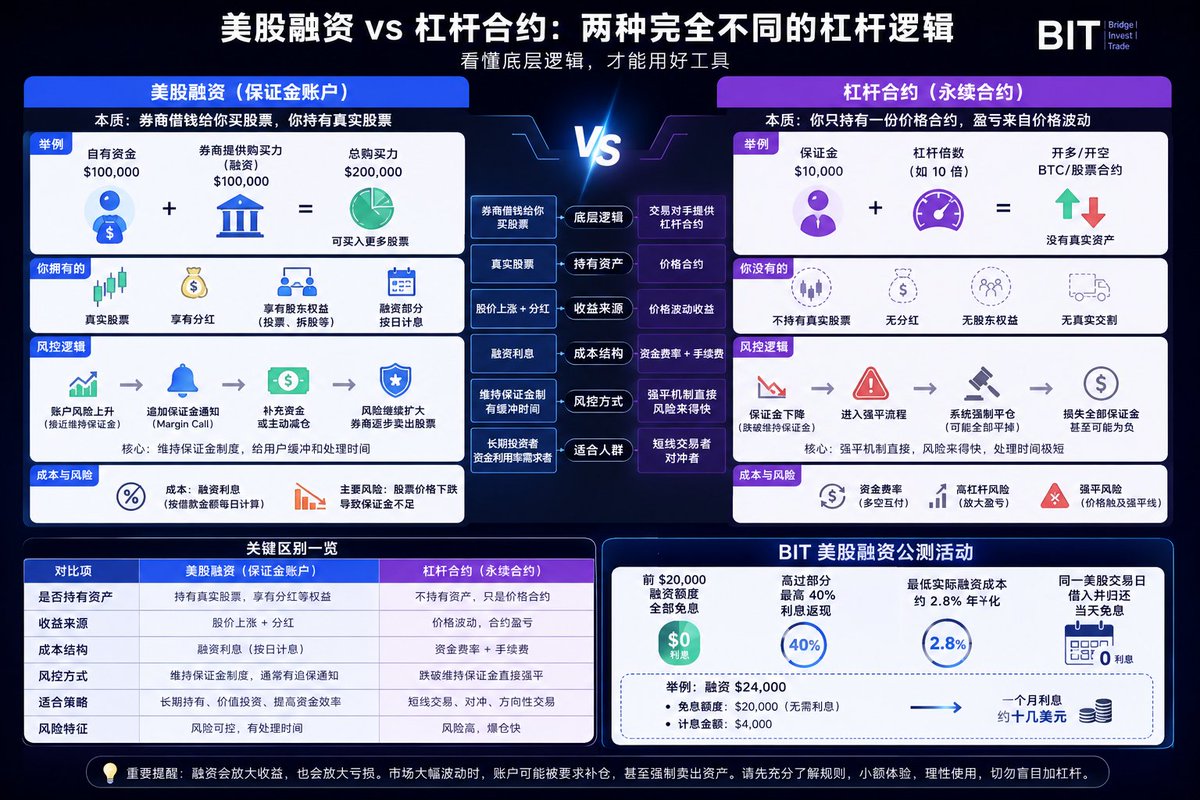
1. U.S. stock financing essentially involves brokers lending money to investors to buy stocks. With leveraged contracts, the focus is primarily on price exposure.
Assuming you have $100,000, the broker will lend you a portion of funds based on margin rules, allowing you to purchase more stocks. What you hold in your account are real stocks, giving you rights to dividends, stock splits, and other economic benefits, while the financing part incurs interest calculated daily based on the borrowed amount.
Leveraged perpetual contracts are entirely different. In reality, investors do not buy stocks; they only agree on a price contract with their trading counterpart. Profits and losses come from price changes, and funding rates are exchanged between positions; there are no dividends, and no actual stock delivery takes place.
2. The risk control logic behind financing and leveraged contracts is also significantly different.
U.S. stock financing adopts a maintenance margin system. As account risk gradually increases, brokers typically first issue a margin call notification, reminding investors to add funds or proactively reduce positions. If the risk continues to escalate, only then will brokers gradually sell some stocks to restore the account to a safe level.
The risk control for perpetual contracts is much more direct. Once the margin falls below the maintenance margin, it will enter the liquidation process, and in cases of high leverage, all positions may be liquidated within a short time.
3. The sources of risk for both also differ.
The biggest cost of U.S. stock financing comes from financing interest and the decline in the stock's price itself.
Perpetual contracts, aside from price volatility, also face risks from funding rates, leverage multiples, and liquidation prices.
Therefore, U.S. stock financing is more suitable for investors who wish to hold quality assets long-term and want to improve capital utilization. Perpetual contracts are more suitable for short-term trading, hedging risks, and directional trading.
This is also why I think BIT's launch of U.S. stock financing is quite important.
Because once the financing function appears, it is no longer just as simple as using stablecoins to buy U.S. stocks. The platform needs to handle financing purchasing power, margin ratios, financing interest rates, maintenance margins, risk statuses, margin calls, and liquidation mechanisms—all of which are the core aspects of traditional brokerage margin accounts.
From this perspective, the financing function will become a new standard for the crypto platform's U.S. stock business. This is a test of the underlying brokerage capabilities, risk control systems, capital efficiency, and product completeness.
Additionally, this public testing activity is also quite attractive. The first $20,000 of financing is completely interest-free, and the portion above that has up to 40% cashback on interest. During the event period, the actual financing cost can be as low as about 2.8% annualized. If borrowed and repaid on the same U.S. stock trading day, no financing interest will accrue that day.
For example, if you finance $24,000, only the excess $4,000 will be subject to interest calculations, which amounts to about a dozen dollars in interest for a month. For investors who already have financing needs, this cost falls within the normal range of traditional brokerage firms.
Although financing can amplify profits, it can also amplify losses. Especially when U.S. stocks encounter significant volatility, insufficient account margin may still require additional funding or even force the sale of assets. Therefore, such functions are suitable for those who first understand the rules, then try small amounts; they are not suitable for treating financing as a risk-free arbitrage.
免责声明:本文章仅代表作者个人观点,不代表本平台的立场和观点。本文章仅供信息分享,不构成对任何人的任何投资建议。用户与作者之间的任何争议,与本平台无关。如网页中刊载的文章或图片涉及侵权,请提供相关的权利证明和身份证明发送邮件到support@aicoin.com,本平台相关工作人员将会进行核查。


