The Neglected Ten Billion Dollar Track
Since 2024, RWA (Real World Assets) has become one of the most promising narratives in Web3. However, the market's attention is almost entirely focused on "traditional financial assets" such as U.S. Treasuries, real estate, and private credit.
Very few people have noticed that there is a category of assets that possesses strong consensus, strong liquidity, and strong emotional value, yet has long been trapped in an inefficient offline market—Trading Card Games (TCG).
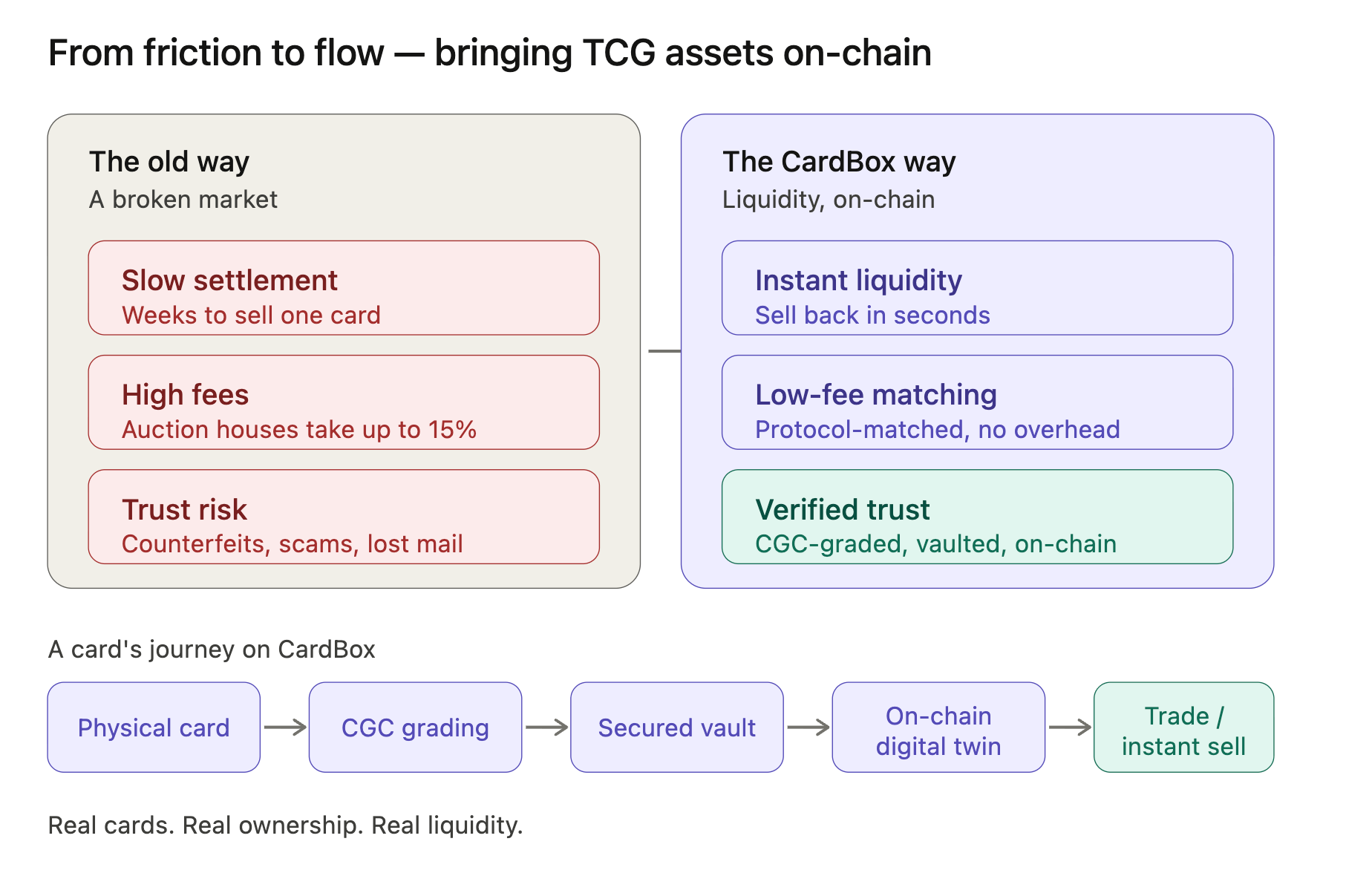
According to various market research organizations, TCG collectibles, represented by Pokémon cards, make up a global market of approximately 13 billion dollars, which is expected to grow to over 20 billion dollars in the next decade. Over the past twenty years, the return rates of top blue-chip cards have far outperformed mainstream financial assets, but this market has always been hampered by three major ailments: poor liquidity, high cross-border friction, and lack of transparency.
It may take weeks for a card to go from listing to transaction; auction houses charge fees of up to 15%; P2P transactions are always shrouded in the shadow of counterfeits and scams. This ten billion dollar cultural asset market has never truly entered the track of digital finance.
What CardBox aims to do is to move it onto the blockchain.
What is CardBox: Not a Blind Box Store, but a TCG RWA Infrastructure
Official website: https://cardbox.io/
On the surface, CardBox offers blind box card pulls, card trading, and instant repurchase services. But its long-term positioning is not that of a retail platform selling cards.
CardBox's goal is to become the world's leading TCG RWA infrastructure platform—connecting asset providers, liquidity providers, and global collectors to provide underlying services such as physical custody, digital rights verification, liquidity networks, and trade matching for the trading card market.
In simple terms: The value of CardBox lies not in how many cards it owns, but in building an open network that allows global collectible assets to achieve digitization, circulation, and globalization.
How It Can Be Done: Making "Trust" into Infrastructure
Bringing cultural assets onto the blockchain is not about technology; it is about trust—why should users believe that there is a corresponding physical card behind that certificate on the blockchain?
CardBox answers this question with a complete infrastructure:
- CGC Officially Authorized Broker: Collaborating with the authoritative grading agency CGC to directly embed institutional-grade authentication into the Web3 process, each card is professionally graded and authenticated.
- Distributed Bank-Level Vault: Establishing distributed vaults in the U.S., Japan, and South Korea for local custody of physical cards with full insurance, enabling global circulation of digital assets.
- Liquidity and On-Chain Verification: Users can receive instant settlement when selling assets, with the physical card remaining in the vault; ownership circulates freely on-chain in the form of digital twins.
- Proven Fair Drawing Mechanism: The probability of blind boxes is guaranteed by smart contracts, and all assets are backed 1:1 by the physical vault.
Physical assets remain physical, while circulation belongs on-chain. This is the core idea behind CardBox's solution for "trust."
Platform Popularity: Behind the Digital is a Real Market Being Validated
CardBox's growth does not rely on narrative stacking but is written in real data. Since the Beta version launched one month ago, the platform has generated a solid set of figures:
- Over 20,000 registered users, with monthly transaction volume reaching hundreds of thousands of dollars—in a Web3 industry where the payment conversion rate is typically only in the single digits, this is an exceptionally rare high conversion. It shows that CardBox is reaching not the "speculators who come to take advantage" but collectors genuinely interested in card assets willing to invest real money.
- The platform has accumulated more than 100,000 on-chain interaction records on the BNB Chain, all publicly verifiable and immutable, with each transaction being a testament to the real circulation of digital card assets.
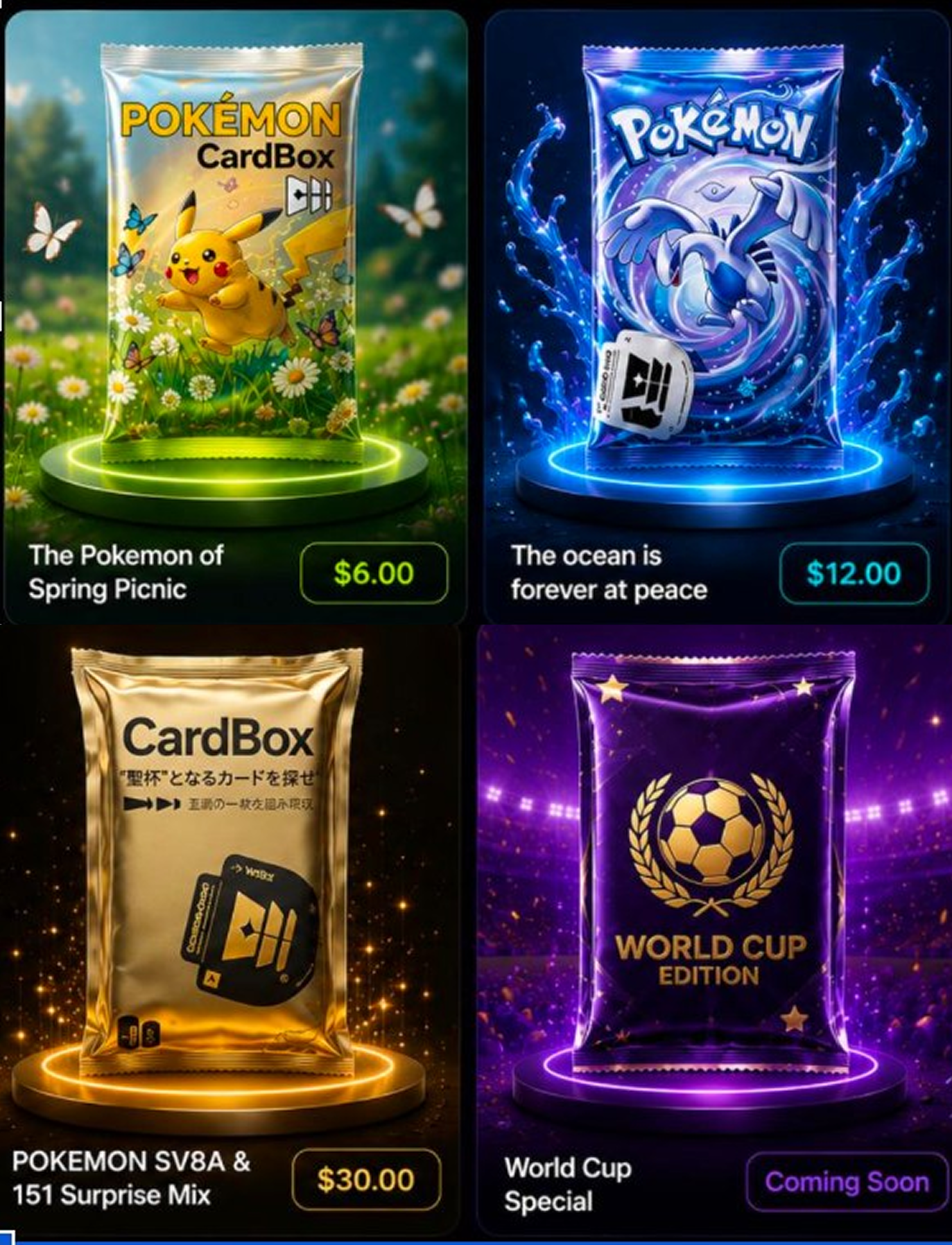
- Over 5000 cards and card box assets, five blind box products (covering Pokémon, star player cards, and One Piece series), have integrated card partners from Japan, South Korea, Hong Kong, and other regions as liquidity providers and offline channels, collectively building an open TCG asset network ecosystem.
In an industry characterized by "heavy on narrative, light on performance," this set of figures answers the fundamental question: Is there really demand in this track? The transactions happening on CardBox every day are the answer.
A Real "Unboxing": A $650 Perfect Card and Its Two Destinations
Beyond the data, real "unboxing moments" are happening daily on CardBox.
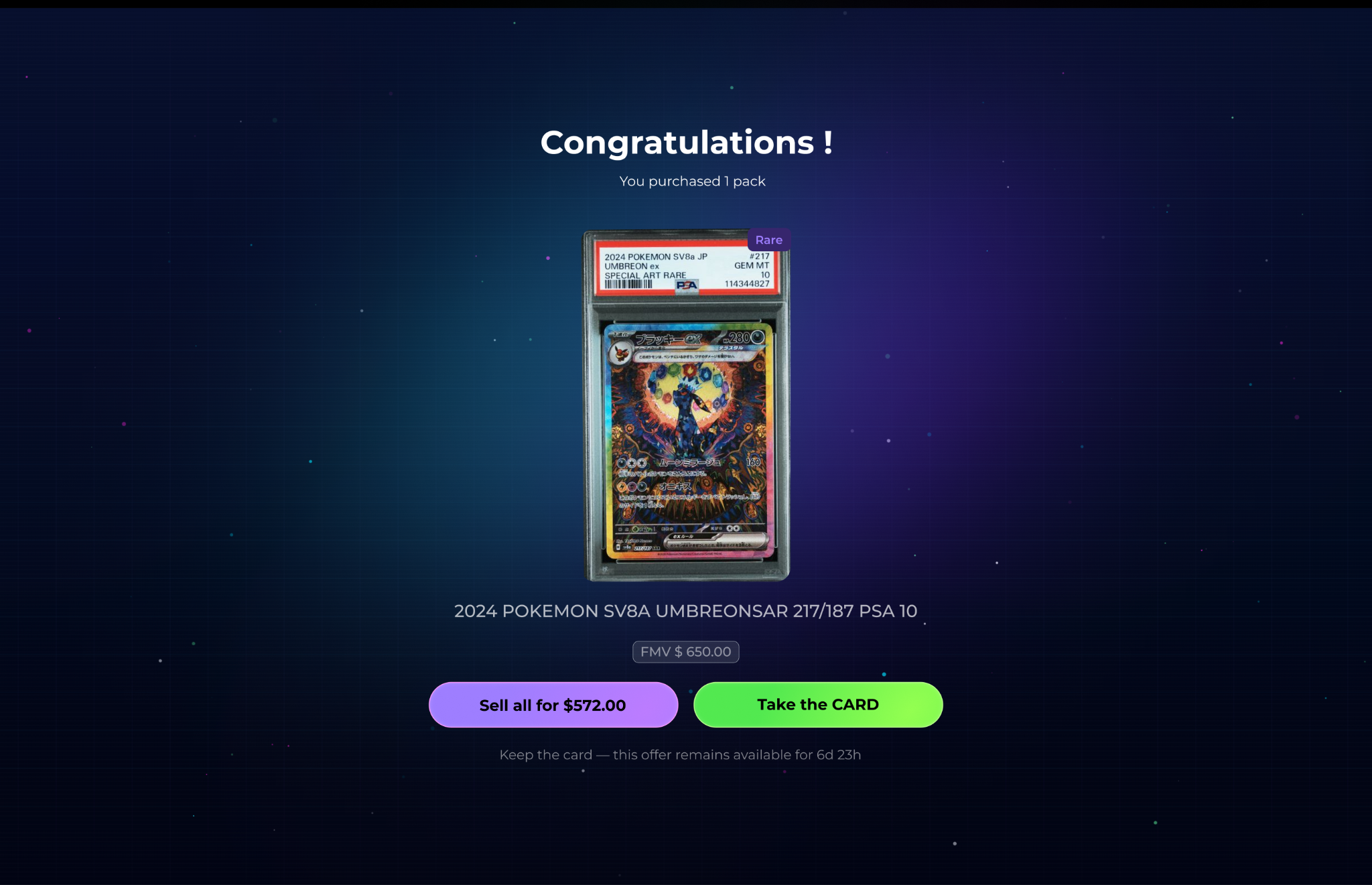
Recently, a user opened a blind box and found a 2024 Pokémon Moonlit Eevee SAR (Umbreon SAR 217/187), rated PSA 10 GEM MT, valued at approximately 650 dollars. Next, he can choose to keep this physical card or instantly liquidate it on the platform with funds arriving immediately—CardBox offers an instant matching and transaction experience without mailing or waiting based on its underlying liquidity network.
This is exactly the core experience CardBox wants to convey: The joy of collecting and the liquidity of assets can now coexist frictionlessly for the first time. Each card you draw has been rated by an authoritative body and backed by a physical vault; its value can be liquidated at any time and can also be held in hand.
CardBox: Making More Assets and More Scenarios Liquid
CardBox's next phase is focused on one core objective—continuously improving asset liquidity and encouraging platform users to participate more actively. This will be advanced along three lines:
First, moving from self-operated to an open asset network. The platform has gradually begun to include external asset providers such as card stores, dealers, and collectible institutions, further bringing in collectible funds and professional investment firms to build an open liquidity network. The asset types will also expand from graded cards to packs and boxes, providing users with richer scenarios and gameplay.
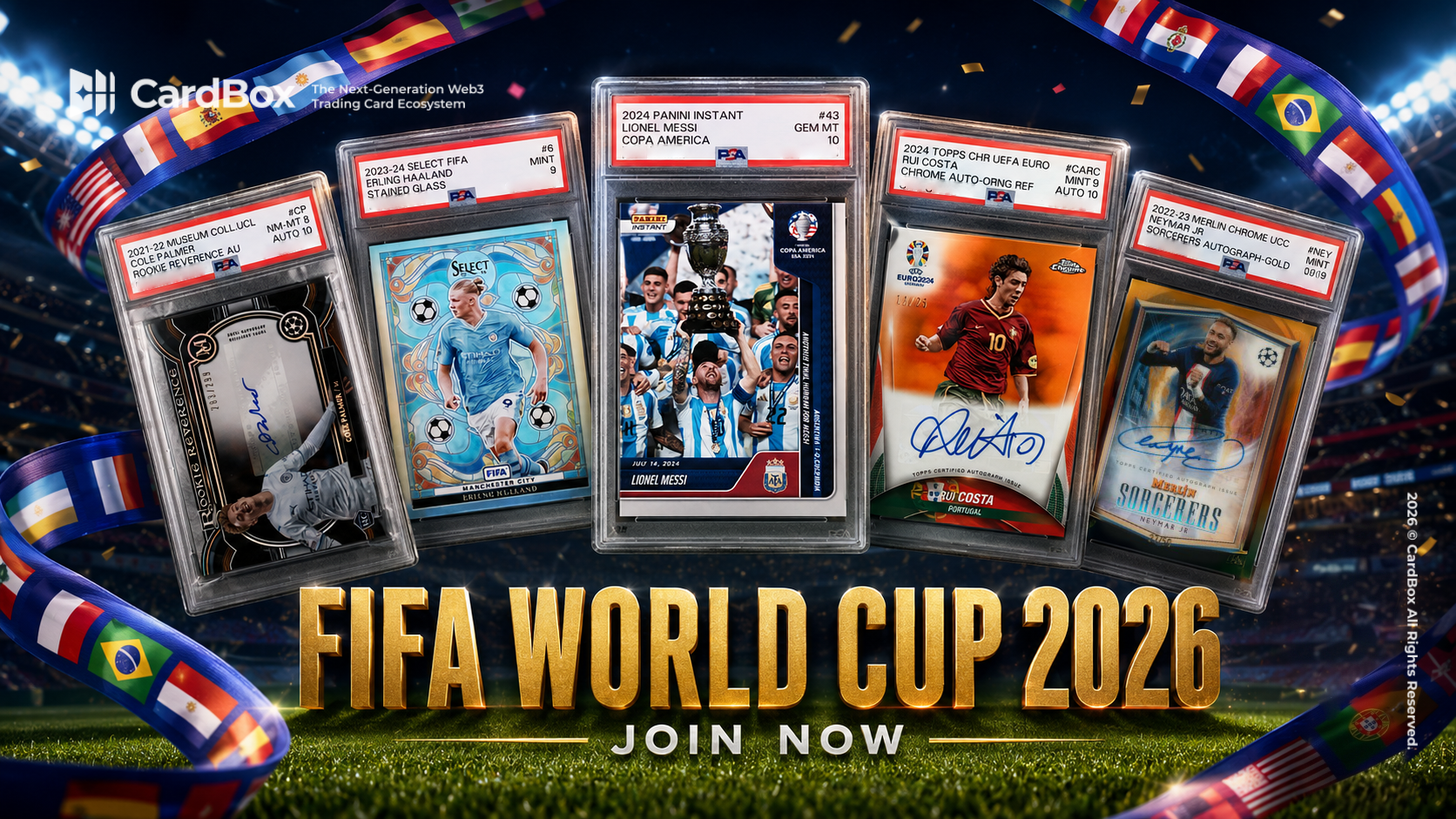
Second, extending from Pokémon to star player cards and more celebrity IPs. As the 2026 World Cup officially kicks off, the global sports collectibles market continues to rise, with significantly increased attention and trading activity for star player cards, event commemorative cards, and other assets. CardBox has officially launched World Cup star player card blind boxes, integrating sports collectibles into a unified custody, verification, and circulation system, providing users with richer collecting and trading experiences.
Third, launching a task system that creates value through participation. CardBox has introduced a task incentive system: users complete tasks through trading, collecting, and participating in the community to earn incentives. Its significance is not just "benefits"—but transforming daily user activity into a continuous driving force for platform liquidity, connecting every action of "browsing, pulling, collecting, and selling" with positive incentives.
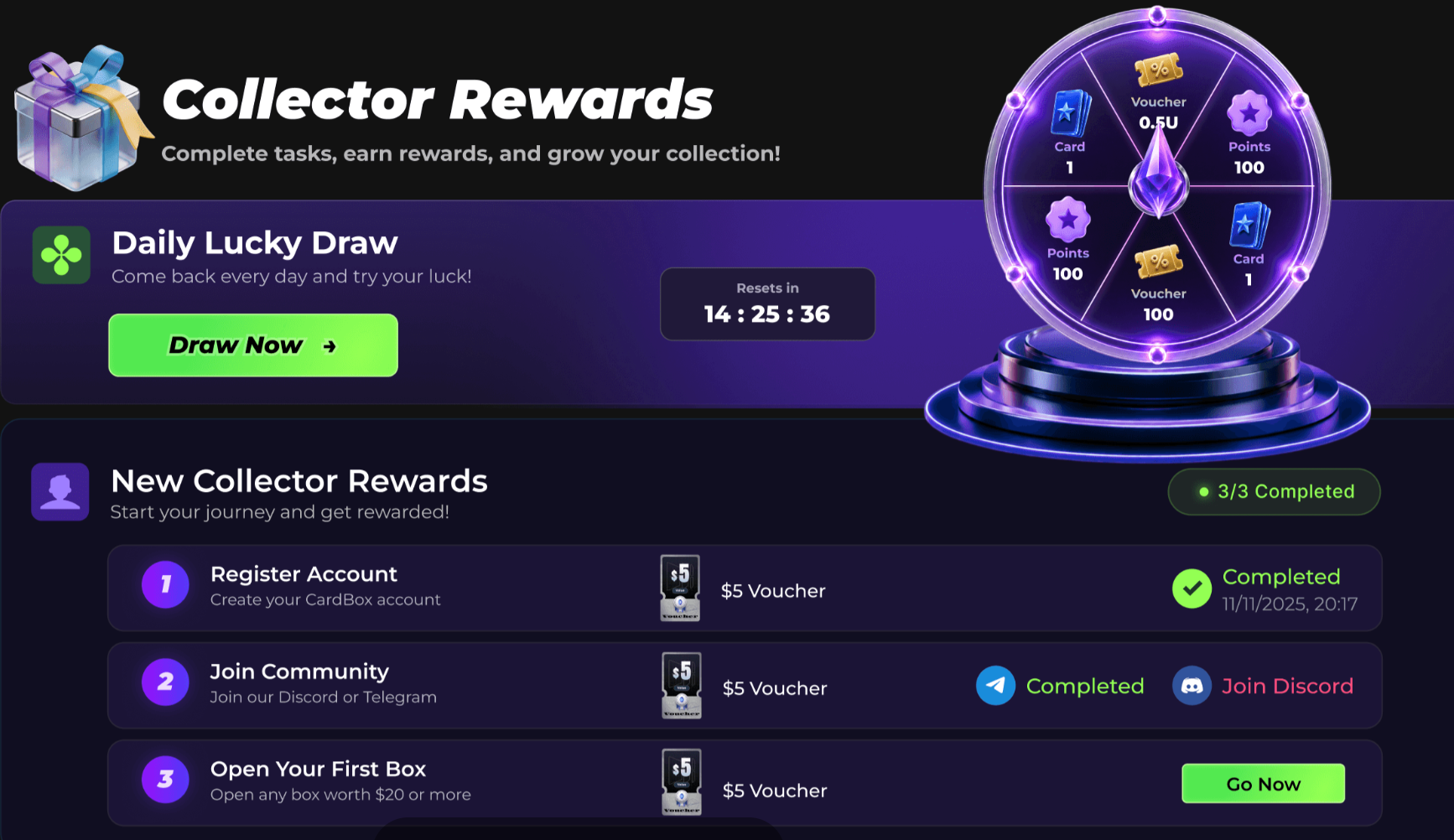
More assets, more scenarios, and higher activity—these three lines point to the same endpoint: a TCG RWA network with continuously thickening liquidity and sustained user activity.
The next station for RWA is not just moving U.S. Treasuries onto the blockchain. When culture also becomes a tradable asset, CardBox aims to be the track that makes it flow.
免责声明:本文章仅代表作者个人观点,不代表本平台的立场和观点。本文章仅供信息分享,不构成对任何人的任何投资建议。用户与作者之间的任何争议,与本平台无关。如网页中刊载的文章或图片涉及侵权,请提供相关的权利证明和身份证明发送邮件到support@aicoin.com,本平台相关工作人员将会进行核查。


