There is an old saying: "A knife that is not sharpened is not sharp."
But if this knife is continually being sharpened on you, it is no longer sharpening, it is tormenting.
As the holiday ends, many people's emotions are not shattered by the accumulated work, but by the market. After being away for a few days, one would expect to return to new stories, but upon opening the trading software: Bitcoin hasn't broken through, Ethereum hasn't taken off, and altcoins have no miracles. It seems as if the market has hit the pause button.
What is most distressing is not the sharp declines, but this state of neither here nor there, neither dead nor alive. According to the AiCoin liquidation heatmap, BTC is clustered around 64,300, and ETH around 1,747, both showing significant green magnet areas (liquidity pools). Although large buy orders point upwards, the price remains stuck in the dense liquidation zone, repeatedly oscillating without an effective breakthrough. A sharp decline at least provides you with an answer, but this entanglement caught by the magnetic area will only continue to drain your patience.
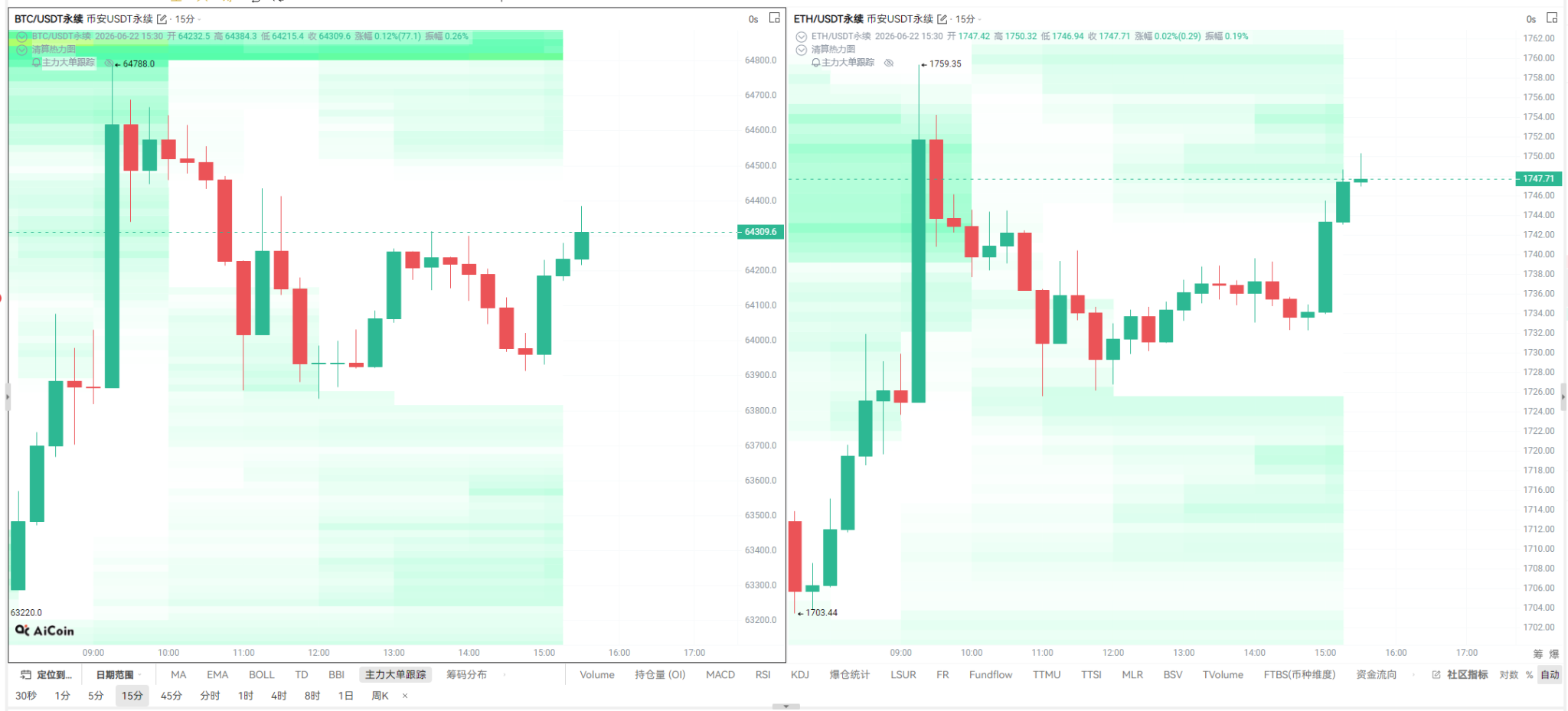
(The image shows AiCoin membership data analysis display)
It’s like a midfield stalemate in a football match: neither side dares to take risks, ball possession exchanges back and forth, the situation appears calm, yet everyone is waiting for that mistake that will decide the contest.
Currently, the cryptocurrency market is in this most patience-draining stage.
1. The market has entered the most challenging phase
If I had to summarize the current market in one sentence: BTC stabilizes the morale, ETH generates anxiety, and altcoins destroy faith.
- BTC is acting as the stabilizer around 64K. It can't rise or fall. The bulls lack enough confidence to launch a full-scale attack, while the bears are also afraid of becoming fuel for the next round of gains. Thus, the market enters a peculiar balance: no one dares to make the first move, and the total market capitalization, around 2.2T, is stuck in limbo, incessantly testing.
- ETH has entered a "vegetative" mode in the range of 1,700 - 1,730. As a core asset among risk assets, it has neither shown sufficient aggressiveness nor demonstrated significant capital inflow, with exchange rates extremely weak.
- As for most altcoins, the situation is simpler: they have been sent straight to the ICU. Trading volume continues to shrink, liquidity is constantly dissipating. Many projects have not crashed yet are slowly losing vitality.
This kind of market condition has a typical characteristic: Prices seem to have not fallen much, yet the accounts get harder to bear day by day. Retail investors are suffocating in the volatility of a Tai Chi push hands, experiencing a dual strangulation of psychology and chips.

2. What truly suppresses the market is not the candlesticks
Many people focus on the charts. In fact, what the main players look at is completely different from what retail investors observe. Retail investors focus on support and resistance levels, while institutions focus on liquidity.
When the market lacks new funds, even the most beautiful technical formation can become ineffective. The biggest variable currently suppressing risk assets still comes from the macro elephant's turnaround. According to the latest macro-financial data as of June 22: the yield on the U.S. 2-year Treasury has risen to 4.22%, while the yield on the 10-year Treasury has shot up to 4.50%. Meanwhile, Brent crude oil futures surged more than 1% at opening, further exacerbating the global energy supply-demand tension.
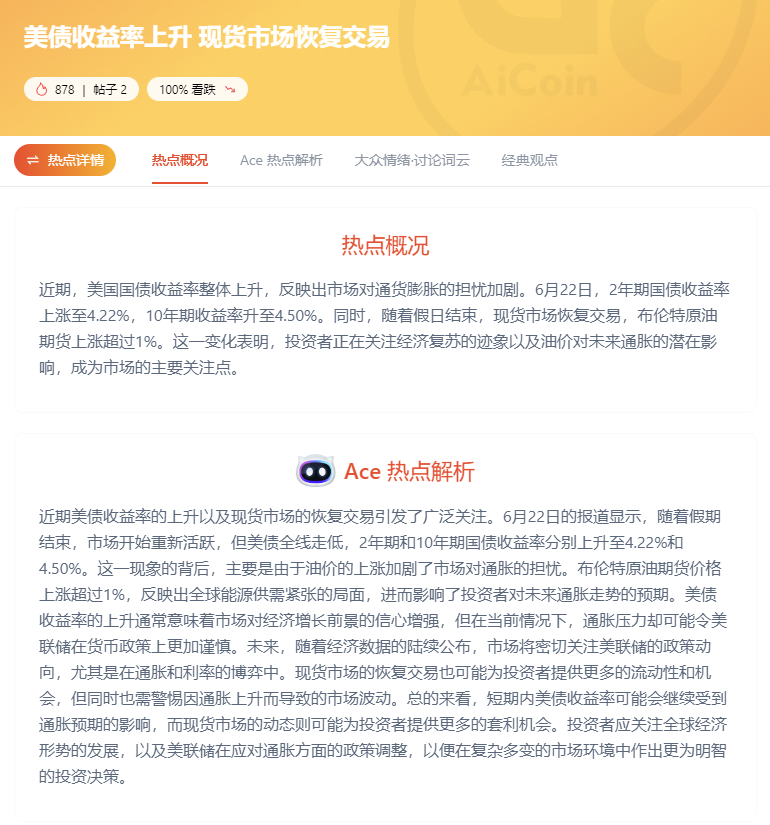
Why is the market so sensitive to these numbers?
Because cryptocurrency assets are essentially liquidity-driven assets. When U.S. Treasuries can steadily offer more than 4% in risk-free returns, large funds have no reason to risk severe volatility by rushing into the altcoin market; meanwhile, when rising oil prices elevate inflation expectations, the market will worry about delayed interest rate cuts. The higher the cost of capital, the more difficult it is for risk assets to attract incremental funding.
Two data points point to a core issue: Main funds are watching the Federal Reserve's cues, and the market's expectations for future liquidity are not optimistic. Until the policy boots hit the ground, no wise main player is willing to blindly unlock the trapped positions in altcoins. It's not that the stories are not compelling enough, but there are simply no buyers.
3. Why is stagnation more painful than sharp declines?
A sharp decline has one advantage: it quickly releases emotions. After panic ends, the market tends to easily find its direction again.
Stagnation, however, is different; it is a continuous mental drain. Every day you wake up, the price is unchanged, the positions are unchanged, hopes are unchanged, but patience diminishes bit by bit.
Many investors don't die in sharp declines but in the stagnation that follows. Because in the long "garbage time," retail investors, due to anxiety over time costs, often fall into a strong "active syndrome trap" — constantly switching positions, chasing hot spots, forcefully using high leverage to seek stimulation. Ultimately, just before the real market starts, they unwisely hand over a large amount of transaction fees and principal, working themselves out of the game.
The market's greatest skill is not to make you lose money, but to make you lose patience.
What is the true purpose of stagnation?
Many think stagnation is waiting for news. More accurately, stagnation is filtering people.
- Sharp declines create panic.
- Sharp rises create greed.
- And stagnation eliminates patience.
The market does not need to wash everyone out; it just needs enough people to give up the correct positions at the wrong time. Once the last batch of the impatient capitulate and completely despair of the market, trends tend to truly begin to emerge.
4. The correct way to open garbage time
Faced with this high-level tug-of-war under the looming inflation storm, our actions must shift from "blind pattern" to "strategic defense." Here is a survival framework to help you survive the winter:
1. Accept the market boredom; be more patient than the main players
When the market lacks a clear direction, not trading in itself is a form of trading. Cash is also a position, staying on the sidelines is also a strategy. Since the main players choose to sit in meditation, the best tactic for retail investors is to be even more of a "slacker" than the main players. Turn off the app, refuse to frequently monitor, in a period of liquidity scarcity, preserving capital means you have outperformed 90% of people.
2. Value liquidity; choose top "safe havens"
During periods of tight liquidity, there is a pattern: the strong remain strong, and the weak become weaker. Funds will prioritize flowing to assets that are easiest to transact and exit. For ordinary investors, rather than constantly searching for the next doubling miracle, it is better to prioritize ensuring the safety and liquidity of assets.
No matter what configuration you choose, there is only one core principle: survive first, then discuss returns. If you need to allocate defensive assets, avoid liquidity risks in small and mid-cap tokens, or manage idle funds for low-risk investment, it is advisable to operate on a top compliant mainstream platform. For safe allocations, you can click the official Binance referral link below:
https://jump.do/zh-Hans/xlink-proxy?id=3
(Invitation code: aicoin668, enjoy a 10% rebate)
Having grain in hand, you won’t panic, and surviving to the next round of market is the truth.
3. Lower expectations and prepare for the worst psychologically
When you think it must break through next week, or surge next month, you are bound to fall into endless anxiety and disappointment. But if you accept that the market may continue to grind for another two to three months, many emotional issues will naturally disappear.
Investment is essentially a patience competition. The time before the market starts is often the most challenging phase that can easily eliminate participants.
5. Conclusion
There are no assets in financial markets that increase indefinitely, nor are there any blue-chip stocks that solve everything at once.
Before every major market event begins, there is always a period of extremely boring "garbage time." It lacks the excitement of sharp declines, and the frenzy of sharp rises, only endless waiting. When the winds of macro liquidity truly change direction, every bullet you've preserved during garbage time will become the sharpest weapon in the next major uptrend.
Bitcoin is still stagnating, and altcoins are still in the ICU. The market has not provided an answer; it keeps repeating the same question:
Are you here to predict the market, or to endure the cycle?
Because those who truly make big money are often not the ones who guess the right direction, but those who still remain at the table during garbage time.
Join our community, let’s discuss together and become stronger!
Official Telegram community:
AiCoin Chinese Twitter:
Binance benefits group:
https://aicoin.com/link/chat?cid=ynr7d1P6Z
Risk Warning: This content is only a market observation shared and does not constitute investment advice. The crypto market is highly volatile; please participate within your risk tolerance.
免责声明:本文章仅代表作者个人观点,不代表本平台的立场和观点。本文章仅供信息分享,不构成对任何人的任何投资建议。用户与作者之间的任何争议,与本平台无关。如网页中刊载的文章或图片涉及侵权,请提供相关的权利证明和身份证明发送邮件到support@aicoin.com,本平台相关工作人员将会进行核查。