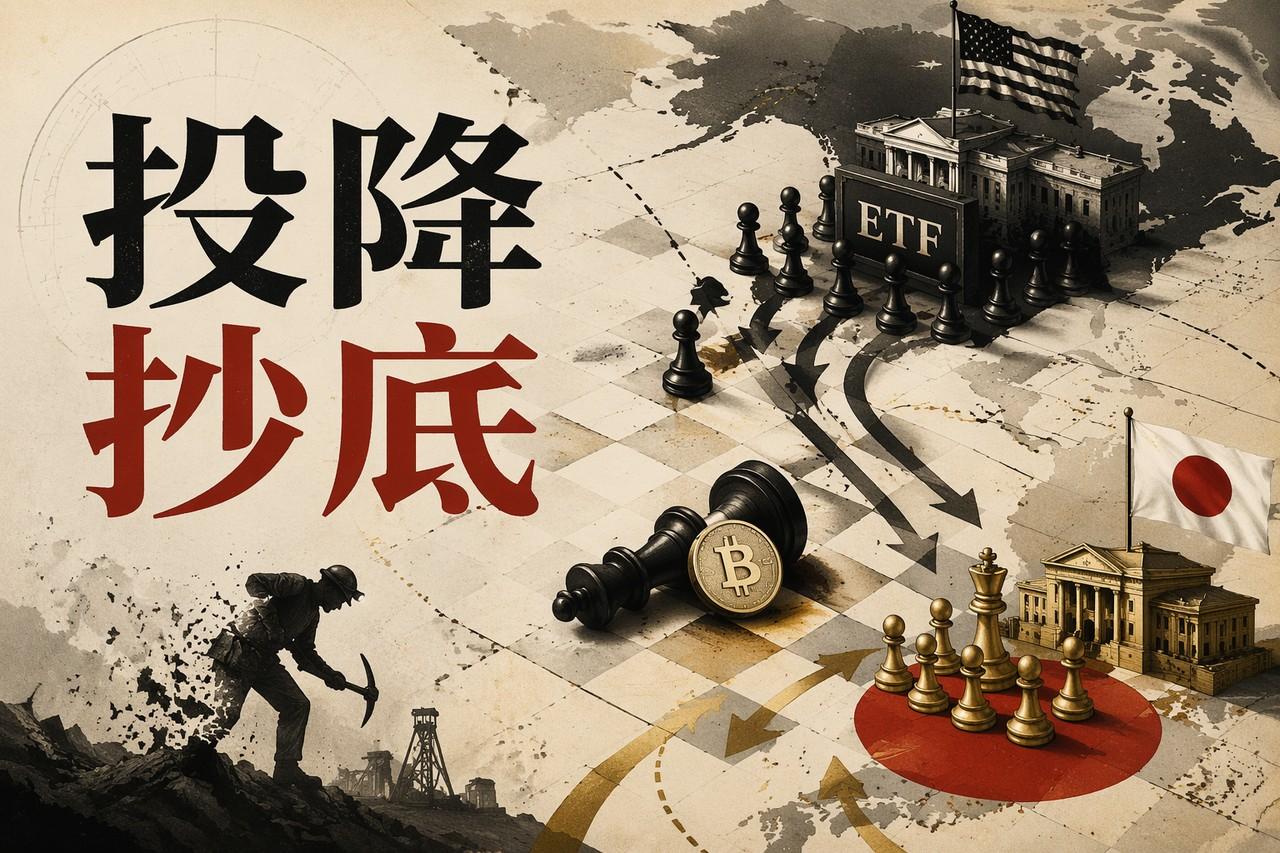
In early summer 2026, Japan's national corporate pension fund quietly adjusted its asset allocation: in this traditional pension organization covering about 1,200 small and medium-sized enterprises, predominantly holding yen assets, the original structure of approximately 80% yen, 15% USD, and 5% other currencies will formally allocate about 1% to a passive multi-cryptocurrency fund managed by a large hedge fund starting from the 2026 fiscal year. This marks a rare step into the world of digital assets for pension funds in Japan, under a gradually established regulatory framework in recent years. Almost simultaneously, on the other side of the ocean, Bitwise CEO Hunter Horsley wrote metaphorically on the X platform: the current cryptocurrency market resembles the valuation frenzy of the internet in the 1990s—when hundreds of companies, lacking mature business models, were valued between $500 million and $1 billion based solely on "future possibilities." He believes this history is repeating in the cryptocurrency market, where the prices of numerous assets are similarly built on future imaginations, except that the leading projects that truly emerge may far exceed current estimations in size and lifecycle. When a traditionally conservative Japanese pension fund commits 1% to bet on such a field filled with expectations and uncertainties, a question looms before everyone: Is this a sign of the market's maturation, or the prologue to a new round of bubbles igniting?
Japan's Pension Fund 1% Trial: A Crack in Conservative Funding
The national corporate pension fund itself is a typical example of “stability first.” It serves around 1,200 small and medium-sized enterprises across the country, with most employers and workers expecting not to seek windfall profits from this fund, but to receive retirement benefits consistently over decades. Therefore, in the asset allocation for the 2025 fiscal year, yen assets are firmly positioned at the core, accounting for about 80%; added to that is approximately 15% in USD assets and around 5% in other currencies, creating a portfolio like a machine calibrated to the slowest setting, minimizing unexpected impacts caused by exchange rate and market fluctuations. Behind this structure lies a long-standing consensus in Japan's pension system: it is better to sacrifice some returns than to maximize volatility.
Because of this, when this machine first explicitly outlined the directive to “allocate about 1% to cryptocurrencies” under the existing regulatory framework, the symbolic significance far outweighed the numerical weight. From a numerical perspective, 1% is merely asset leftovers, easily drowned by any market fluctuation; structurally, it is akin to chiseling a gap in a thick wall—leaving a formalized position for digital assets within a traditionally yen- and USD-dominated portfolio. More crucially, this step represents the first public acknowledgment by Japan's pension system of digital assets as a legitimate investment category on a compliant track, functioning as a “test run” for other institutional observers still on the fence. The regulators did not relax restrictions nor impose a blanket rule, but allowed this small piece of risk budget to exist under a still conservative overall proportion, conveying a cautiously open attitude to the market: the direction has been subtly confirmed, but how far and how fast it will go depends on whether this 1% ultimately brings lessons or gains.
Hedge Fund Channel: Cryptographic Assets Brought into Pensions
The earmarked 1% is not about the fund opening an exchange account to "buy coins," but is encapsulated in a multi-layer shell structure: the planned route is to hand over money to a large hedge fund, which will manage a passive fund containing various crypto assets. Nominally “passive” means it is closer to tracking a particular index or broad market, rather than the fund manager pondering whether to add positions in a hot cryptocurrency before and after trading. Meanwhile, which specific coins are invested in and the names of the corresponding target funds remain undisclosed. This restraint in information disclosure is in itself a stance: publicly admitting “there is an allocation,” but unwilling to expose underlying details to public and media scrutiny.
A passive multi-currency portfolio's most direct significance for such pension funds is its dilution of risk from individual asset blowups. Rather than betting on a specific chain or project, a broadly diversified index-like allocation resembles buying the long-term potential of “the entire track,” rather than gambling on the success or failure of a single heroic story. The hedge fund acts as a bridge, catching this 1% capital pool on one end, while connecting custody, risk control, and compliance reporting on the other, standardizing the entire process; the pension fund only needs to monitor one counterparty and a set of risk parameters, without having to face a variety of trading platforms and asset custody arrangements. Choosing such a complex and closed path essentially writes the risk-return trade-off into the structural design: on the returns side, it enjoys the potential upswing of the entire crypto market; on the risk side, it uses passive multi-asset strategies and the compliance shell of a professional intermediary to keep this 1% within “manageable trial costs.”
Hunter Horsley's Bubble Analogy
While pension funds lock in the “trial costs” with the 1% allocation, an opposing narrative emerges—Bitwise CEO Hunter Horsley recently noted on X that the cryptocurrency market resembles the early days of the internet in the 1990s. Back then, hundreds of companies obtained valuations between $500 million to $1 billion based on mere imagination of the future without mature business models. The capital treated valuation as a “reservation for the future,” leading to inflated prices driven by sentiment, which were subsequently brutally discarded when the bubble burst; after a round of harsh reshuffling, only a few giants made it into the 21st century.
Horsley’s analogy does not obscure the awkward reality that the current crypto world is equally in a “speculation-driven high valuation phase”: the prices of numerous assets are bets on some future that has yet to materialize, rather than present cash flows discounted. Yet what he truly emphasizes is the scale of the few survivors—he believes that what will repeat in history is not just the bubble and liquidation but also the winners rising from the ruins, whose size and lifecycle may far exceed current market estimations, implying that the 1% experiment in the eyes of pension funds may very well plant early chips for a batch of new giants with exceptionally long life cycles.
Institutional Entry or New Bubble Starting Point
When the national corporate pension fund of Japan decides to allocate approximately 1% of assets, through a passive multi-cryptocurrency fund managed by a large hedge fund in the 2026 fiscal year, the market instinctively generates two entirely different narratives: one side expresses excitement about “traditional pensions entering the market, marking the maturation of asset classes,” while the other side echoes the concern resembling Hunter Horsley’s analogy—could this be the launch signal of another cycle of “valuation inflation, reshuffling, and the birth of giants”? The regulatory authorities allow pensions to maintain a highly skewed allocation toward traditional assets like yen and dollars while providing a limited regulatory window for digital assets, resembling an experiment designed with “bearable loss” controls rather than a high-stakes gamble.
The question remains whether this 1% experiment is diversifying risk or merely transferring it to slower-moving long-term capital. During the internet bubble, many institutions and retail investors joined the game late, becoming bearers of high valuation corrections; if the cycle mentioned by Horsley repeats, today's pensions might play a similar role at some point in the future: providing liquidity for early funds while facing subsequent price revaluations. Conversely, another possibility is that these long-term funds, because they do not aim for short-term profits, could serve as a buffer amid extreme volatility, ensuring that projects capable of surviving across cycles are not entirely wiped out during repeated corrections. Institutional entry and bubble warnings do not negate each other; they collectively outline different stages along the same path, with the true determinant of whether this round is a starting point for maturity or a new bubble being the choice of these slow and massive funds to act as risk mitigators or ultimate buyers when volatility arrives.
Bubbles and Giants: Japan's Long-Term Bet
The national corporate pension fund, covering about 1,200 small and medium-sized enterprises, has only allocated about 1% to enter the market via a passive multi-cryptocurrency fund managed by a large hedge fund in the 2026 fiscal year, essentially representing a marginal shift of conservative capital rather than a gamble of everything; rather than igniting a new round of enthusiasm, it acknowledges that a long-cycle game cannot be ignored. By comparing to the internet bubble of the 90s, Horsley points to the same timeline: valuations supported by imagination lead to inevitable bubbles, but true long-term giants often reveal their competitive moats and enduring profitability only after a collapse. He assesses that the size and lifecycle of projects surviving in the future may deviate significantly from current expectations, essentially endorsing the idea that “there is still long-term value after the bubble.” For readers, identifying these long-term winners amid bubbles and reshuffling requires shifting attention from price curves to slower indicators: who can continuously exist and iterate products within a regulatory framework; who can recover users and income after significant pullbacks; whose governance structure can maintain execution power during cyclical transitions. These long-term signals are closer to a pension fund’s perspective than short-term fluctuations. Today, Japan's pension fund has merely written a 1% allocation into its asset list; whether it will increase that ratio or whether more similar pension funds will follow suit remains uncertain, but once this type of long-term capital reserves a fixed proportion for the crypto world in asset allocation, the market structure will be rewritten: sentiment-driven waves will still play out repeatedly, while the power to dictate terms, liquidity, and valuation anchors will increasingly consolidate onto those few projects surviving after bubbles and liquidations.
Join our community to discuss and become stronger together!
AiCoin exclusive Hyperliquid benefits: https://app.hyperliquid.xyz/join/AICOIN88
AiCoin exclusive Aster benefits: https://www.asterdex.com/zh-CN/referral/9C50e2
On-chain Telegram community: https://t.me/AiCoinWhaleData
On-chain community: https://www.aicoin.com/link/chat?cid=N6OVMor5g
AiCoin on-chain Twitter: https://x.com/aicoinwhaledata
免责声明:本文章仅代表作者个人观点,不代表本平台的立场和观点。本文章仅供信息分享,不构成对任何人的任何投资建议。用户与作者之间的任何争议,与本平台无关。如网页中刊载的文章或图片涉及侵权,请提供相关的权利证明和身份证明发送邮件到support@aicoin.com,本平台相关工作人员将会进行核查。