Strategy being sued collectively, is it time to sell Bitcoin for compensation? Bro, don't joke around!!
Although a bit tiring, I really enjoy constructive discussions, thanks to the judge for being diligent. I will continue to educate a bit more. Also, the initial settlement amount was not six hundred million dollars, but that isn't important.
The focus should be on why MSTR was sued collectively back then, and whether a similar situation will arise now.
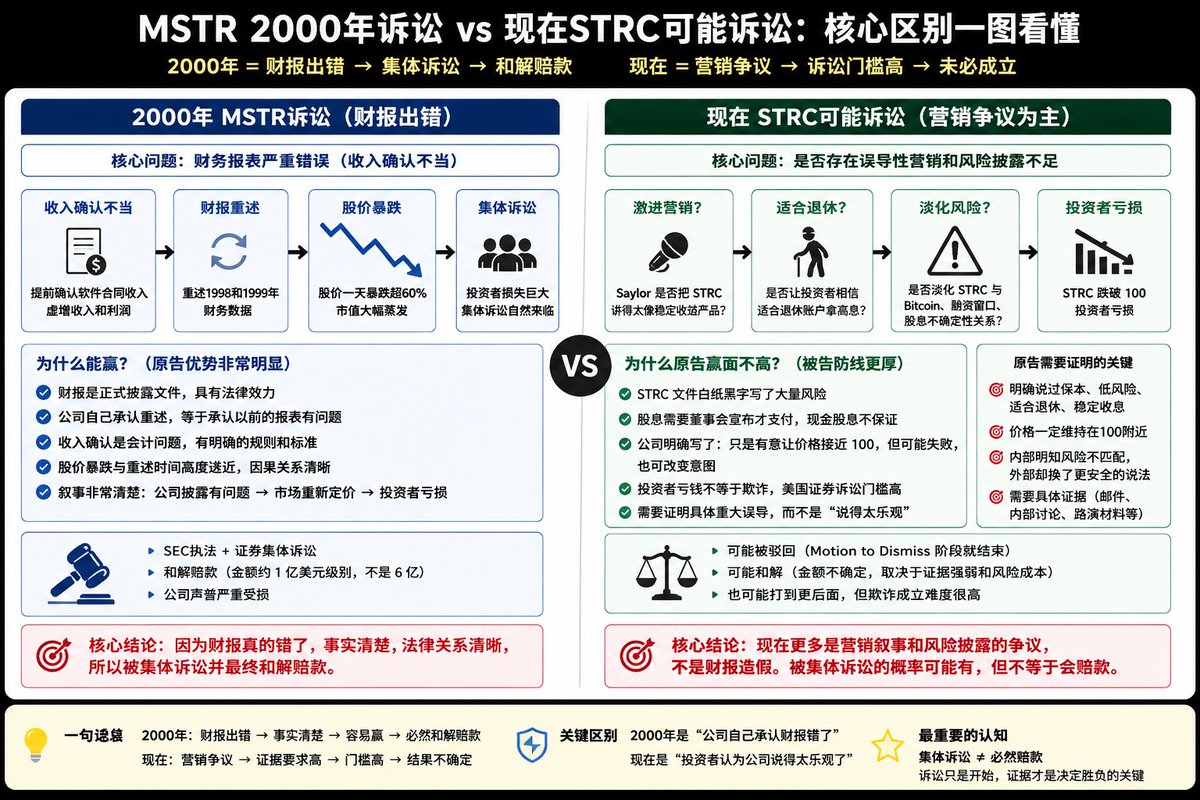
MSTR indeed went through a significant securities lawsuit in 2000, and the core issue of that round wasn't that the stock price fell and investors were unhappy, but rather that there were problems with the financial reports. This is the crux of the problem!! Financial reports!! Financial reports!! Financial reports!!
At that time, MicroStrategy announced a restatement of its financial data for 1998 and 1999, with the issues primarily centered around the recognition of software contract revenue; the company recognized some revenue that should not have been recognized early, leading to previously disclosed revenue and profits being overstated. Once the financial report was restated, the market reacted immediately, and the stock price plummeted over 60% in one day, leading to significant losses for investors and naturally resulting in a collective lawsuit.
This logic is very simple: the company previously told the market that it made this much money, had such high revenue, and experienced such good growth, and the market valued it based on this story. Then it was discovered that the financial report needed to be restated, and the revenue and profits were not as good as originally stated; some profits even turned into losses, leading investors to believe that they were misled by incorrect financial reports at the time of purchase, and losses stemmed from the company’s erroneous disclosures.
By the way, I previously reported that a company was shorting Nvidia, and it made similar statements, saying Nvidia actually had business in China, just obtained through intermediaries, so reopening business with China would not help Nvidia's financial report.
Reporting link: https://x.com/PhyrexNi/status/2054673554336346168?s=20
Back to the point, so regarding the MSTR lawsuit in 2000, the financial report was a formally disclosed document, revenue recognition is an accounting issue, and a restatement is the company admitting that previous statements needed to be amended. The stock price plummeting and the timing of the restatement are also very close. The narrative is very clear: there were issues with the company disclosures, the market re-priced, and investors lost money.
But this is not the same as the controversy faced by STRC or Strategy now.
If someone wants to sue Strategy or STRC now, the core issue is likely not financial fraud, but misleading marketing and risk disclosure. For example, whether Saylor or Strategy has presented STRC too much like a stable income product, whether they have led investors to believe this is a low-risk tool suitable for retirement accounts with high interest, and whether they have downplayed the relationship between STRC and Bitcoin, MSTR financing windows, and uncertainties of preferred stock dividends.
This direction has room for litigation, but it's much harder than in 2000. Because the formal documents for STRC already contain a lot of risk disclosures, dividends need to be announced by the board to be paid, cash dividends are not guaranteed, and Strategy is merely trying to adjust the dividend rate to bring STRC closer to a $100 trading price, which may fail, and the company can change this intention. As long as these contents are clearly written in black and white in the documents, Strategy's defenses are much stronger than those in the income restatement case back then.
So is there a possibility of a collective lawsuit now? I think it's only a possibility. The U.S. market is like this, as long as the product scale is large enough, the investor losses are significant enough, and the company's rhetoric is aggressive enough, plaintiff law firms will definitely find angles. MSTR already has collective lawsuits around Bitcoin treasury strategies, volatility risks, non-GAAP metrics, and related accounting implications; it wouldn't be surprising to see another round around STRC in the future.
But will it replicate the situation of 2000? Not necessarily!!
If STRC just falls below $100, or investors feel they've lost money after buying high-interest preferred stocks, that's not enough. It's very normal for preferred stocks to trade at a discount, and it's also very normal for high dividend products to decrease in price.
Plaintiffs need to prove that Strategy has made specific significant misrepresentations, for example, explicitly stating capital preservation, low risk, suitability for stable income in retirement accounts, and that prices will definitely stay around $100, or internally knowing that target customers and risks do not match but externally using a safer narrative.
If plaintiffs can obtain such evidence, then it is indeed possible; however, the problem is, as previously mentioned, Strategy has already clearly written out all risk points, and even acknowledged the possibility that preferred dividends may not be paid!!!
Therefore, relying solely on "STRC has fallen," "Saylor has been very optimistic," or "investors have lost money," the difficulty of establishing fraud is very high. U.S. securities litigation does not win just because there's a loss, especially in products like STRC where many risks have already been disclosed in the documents, the threshold that plaintiffs need to cross is not low.
Thus, my judgment is that the likelihood of Strategy and STRC facing a collective lawsuit may exist, but this situation is different from 2000. In 2000, there were hard problems with the financial statements and revenue recognition; now, it is more likely to be a dispute over marketing narratives and risk disclosures.
In other words, the settlement in 2000 was due to genuine mistakes, but there are currently no such indications; thus, it's completely wrong to assume that a collective lawsuit will lead to compensation!!!
免责声明:本文章仅代表作者个人观点,不代表本平台的立场和观点。本文章仅供信息分享,不构成对任何人的任何投资建议。用户与作者之间的任何争议,与本平台无关。如网页中刊载的文章或图片涉及侵权,请提供相关的权利证明和身份证明发送邮件到support@aicoin.com,本平台相关工作人员将会进行核查。


