Written by: Joseph Chalom, Sharplink CEO
Translated by: Gandalf, Techub News
Why this milestone represents the true core advantage of blockchain
I just returned from Asia, where I had in-depth conversations with Ethereum developers and leaders of the ecosystem. Special thanks to Nonce Classic, Four Pillars and DSRV in Seoul, as well as SNZ and the newly opened Ethereum Community Center in Hong Kong. This center is the first permanent physical Ethereum community space in Asia, supported by the Ethereum Foundation.
What impressed me most was not just the vibrancy there, but the seriousness and ambition of the builders. I was profoundly inspired and amazed by the quality of projects emerging in the global Ethereum ecosystem, the spirit of experimentation, and the long-term thinking.
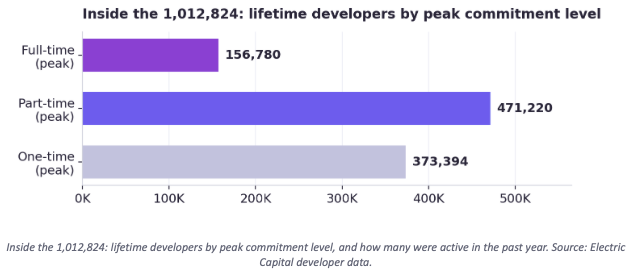
This also brings a number to life: According to Electric Capital data, the total number of Ethereum developers has surpassed one million—more than 1,012,824 different individuals have contributed to the ecosystem. No other ecosystem in the crypto industry comes close to this scale.
A milestone worth stopping to consider
“One million” is a number, but integers can sometimes feel hollow, and this time it is not. Behind this number lies the largest pool of technical talent ever gathered around an open, permissionless blockchain network—and more importantly, this talent pool continues to deepen and expand.
Of these million developers, about 232,000 were active in the past 12 months.
Why Ethereum: The truly critical question
For years, discussions in the crypto industry have revolved around speed, fees, and throughput. Every new chain claims to be “faster than Ethereum.” But the truly important question has never been which chain is fastest, but:
“Where will the best builders choose to build long-term?”
On this question, Ethereum remains unique. This advantage is not just technical; it is also institutional, cultural, economic, and structural—stemming from over a decade of continuous accumulation of developers, infrastructure, standards, tools, liquidity, research, applications, and social cooperation, something other ecosystems have yet to replicate.
Ethereum has become the default operating system for programmable finance and native internet capital formation.
What these million developers are building—and why this deepens the moat
The significance of these million developers lies in the problems they are currently solving. The current focus is on the hardest and most critical areas in the industry: core protocol scalability, privacy, quantum resistance, and autonomous agent systems running on top.
Glamsterdam: Innovating without compromising core values
The Glamsterdam upgrade, scheduled for launch in 2026, showcases how Ethereum safeguards its core principles while advancing. Key changes include the embedded proposer-builder separation (ePBS) and block-level access lists (BALs), which will unlock parallel execution and significantly enhance throughput, along with the potential to raise gas limits. These improvements will greatly increase Layer 1 capacity while ensuring trustworthy neutrality, security, and fairness in MEV—this is a dynamic embodiment of the moat.
Synchronous composability: Enabling multiple Rollups to operate like a single chain
Composability has always been Ethereum’s superpower, and the next step is to extend this to Layer 2. Native and “based” Rollups, combined with synchronous composability, can achieve this: a contract on one Rollup can invoke contracts on the mainnet or another Rollup in a single atomic transaction, without bridging or waiting. Linea, Ethereum Economic Zone, Gnosis, Zisk, and collaboration with the Ethereum Foundation are bringing this design together with real-time proofs. The result is that dozens of Rollups operate not as isolated networks, but as a unified chain—this directly addresses concerns about fragmentation.
Quantum resistance: Ethereum’s clearest leading advantage
No mainstream ecosystem is better prepared for the “post-quantum era” than Ethereum. The “Lean Ethereum” roadmap, the Ethereum Foundation's post-quantum security team formed in early 2026, the pq.ethereum.org platform, and the over ten client teams running weekly post-quantum interoperable development networks together form a coordinated open-source migration plan aimed for around 2029. When quantum risks become tangible, the foremost concern for institutions managing trillions of dollars in assets will be: which chain is prepared earliest and most thoroughly.
The moat beyond developers: Composability, standards, and trust
The reason the developer advantage can sustain compounding growth is due to how Ethereum is built. Its deepest network effect is not liquidity, but the depth of composability: applications operate like interoperable “financial Lego”—lending, stablecoins, exchanges, wallets, tokenized assets, oracles, and Layer 2 Rollups interact through shared standards, allowing developers to build without starting from scratch. EVM has become the application layer of the crypto world, and Solidity skills can be applied across Base, Arbitrum, Optimism, Polygon, zkSync, Scroll, Linea, and hundreds of networks.
Learning the Ethereum technology stack maximizes choice, thus driving a flywheel effect—more developers, more tools, more liquidity, more institutional participation, attracting even more developers to build composable protocols and assets. Liquidity breeds liquidity, and composability breeds composability.
And Ethereum leads where value truly lies, not just in the “busiest” places.
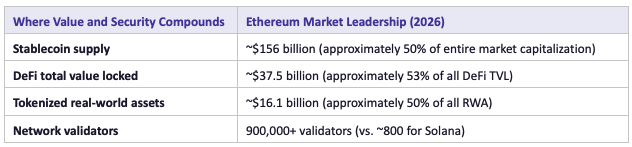
Three forces further reinforce this leading advantage:
Trustworthy neutrality: Ethereum has over 900,000 validators, while Solana has about 800. This degree of decentralization and platform neutrality is a characteristic highly valued by large institutions.
Modularity: Rollups (like Base, Arbitrum, Optimism) have not weakened Ethereum, but rather expanded it into a more tightly connected modular internet economy, while inheriting the security of the mainnet.
Culture: Ethereum attracts a substantial number of top researchers, cryptographers, and EIP standards creators who are setting the direction for the entire industry. This advantage is the hardest to replicate.
There is only one Ethereum
On-chain activity and becoming the long-term coordination layer for internet-native finance are fundamentally different—the latter is the foundational layer trusted by the world's largest financial institutions. Ethereum occupies a dominant position in the minds of large asset holders, and what these institutions value most are trust, security, and liquidity. I witnessed this firsthand during my time at BlackRock.
In the technological marketplace, ecosystems gradually converge over time around standards, liquidity, and developer mindset—which is exactly where Ethereum’s moat lies.
After engaging with these developers, builders, and ecosystem leaders in Seoul and Hong Kong, I am more confident than ever in Ethereum's competitive advantage. I see the talents that are building the next generation of financial infrastructure—they will be the founders of the future and the architects of “agent finance.” These individuals and teams will change the world.
The future of Ethereum is happening right now.
免责声明:本文章仅代表作者个人观点,不代表本平台的立场和观点。本文章仅供信息分享,不构成对任何人的任何投资建议。用户与作者之间的任何争议,与本平台无关。如网页中刊载的文章或图片涉及侵权,请提供相关的权利证明和身份证明发送邮件到support@aicoin.com,本平台相关工作人员将会进行核查。
Selected Articles by Techub News
Related Articles


X
Telegram
CopyLink