Recently reviewed a project, the more I look, the more excited I get, #Unitas ( @UnitasLabs).🧐
It's not because $UP has risen. But because I want to understand, with the market falling like this, how it has continued to rise?
Many people might think it is "just another stablecoin issuer," but if you pay attention to its secondary market token $UP rising against the trend and trading volume skyrocketing, you'll realize that this guy's ambition is not just to make stablecoins.
It is playing a much larger game: to become the income-bearing asset layer of the BNB Chain.
The goal of stablecoins is to "anchor the price," while the goal of the income-bearing asset layer is to "keep money working on the chain continuously." These two things have completely different levels of difficulty.
In simple terms, the income-bearing asset layer takes money on the chain (USD, gold, US stocks) and, through a set of "not betting on market fluctuations, only focusing on arbitrage" stable operations, turns it into a mother chicken that continuously lays eggs.
Next, let’s look at how it plays out, in three steps, layer by layer, each step is very interesting:
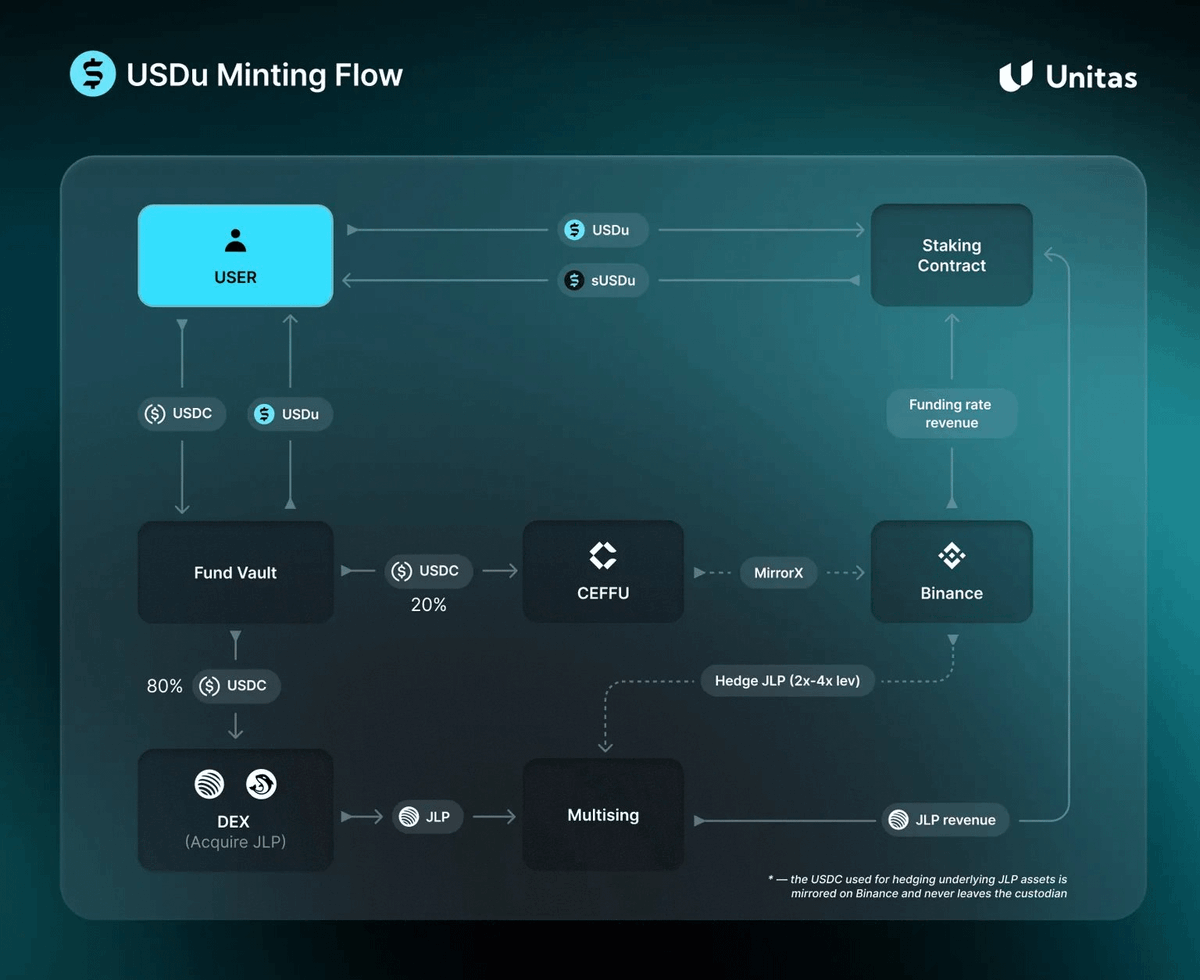
💰First step: USD interest base, using neutral strategies to continuously generate blood (as seen in 👇 image 2)
All income-generating protocols fundamentally revolve around one question: where does the yield come from?
The foundation of Unitas is USDu (USD assets) and sUSDu (income-bearing version). Ordinary stablecoins only focus on anchoring, while Unitas's logic is to leave professional matters to professionals: you give me the money, I'll help you make money, and then distribute the profits to sUSDu.
In the early days, they adopted a Delta neutral strategy, with returns mainly relying on arbitrage from the perpetual funding rates of Crypto. For example, buying JLP to earn transaction fees while shorting to hedge against price risks. Regardless of whether the coin price goes up or down, they purely earn transaction fees and rates, and finally, the profits accumulate to sUSDu. The longer you hold sUSDu, the higher its corresponding USDu value becomes.
But problems arise:
The funding rates in the crypto circle are cyclical. In a bull market, everyone wildly opens long positions, and the rates are terrifyingly high; in a bear market, fewer people use leverage, and rates can even turn negative, leading to a cliff-like drop in revenues.
A single crypto asset pool has too weak a cyclical resistance. So, they moved on to the second step.
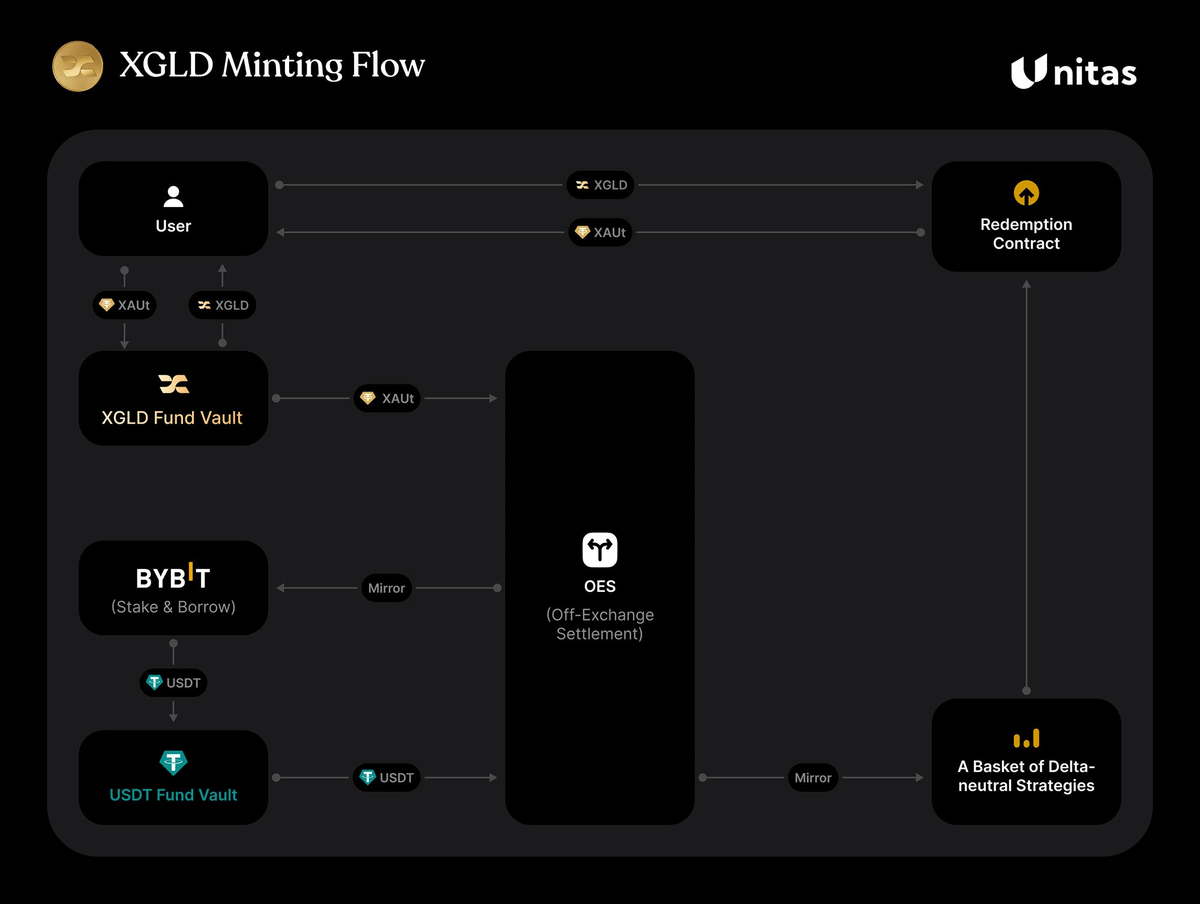
🪙Second step: Bridging to gold #XGLD, turning the assets of the wealthy into "active" ones (as seen in 👇 image 3)
To avoid being hung up on the tree of crypto funding rates, Unitas launched XGLD.
Gold is the most globally recognized safe-haven asset, but it has a fatal flaw: it yields no interest. If you hoard a ton of gold, it will still just be that ton after ten years, bearing no fruit.
How does Unitas do it? They built a Delta neutral income-bearing gold product based on XAUT.
Simplistically, they smooth out the price fluctuations of gold through hedging, so we don't have to bear the risk of a sharp drop in gold prices, while also capturing arbitrage profits from on-chain gold derivatives through their strategy.
This step is brilliant for two reasons:
• Expanding asset categories: bridging from USD to gold, directly opening up demand from traditional capital and conservative institutions.
• Smoothing cycles: the volatility logic of the gold market is completely different from the crypto circle; when the crypto market is cold, gold income products can still provide stable external income supplements.
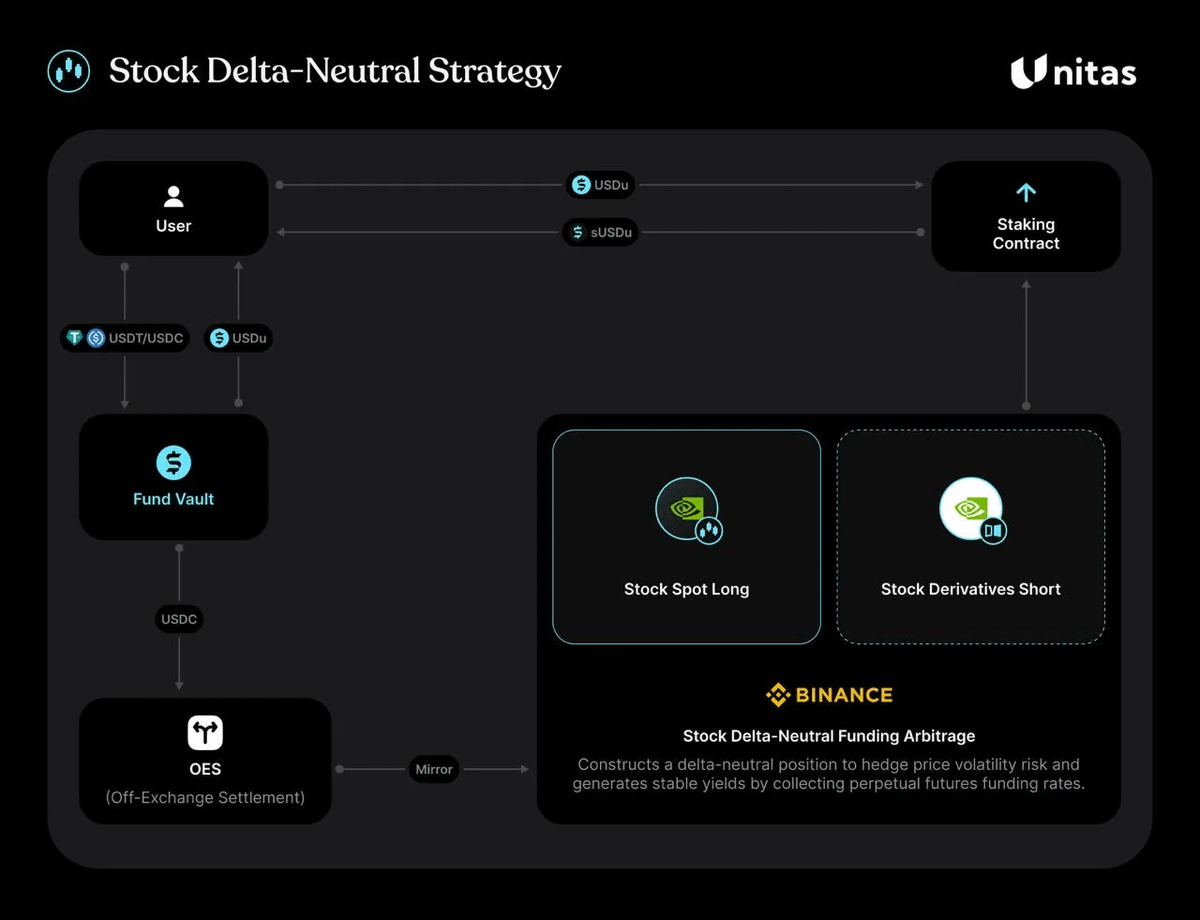
📈Third step: The latest ace Equity Basis Trade, harvesting rates from US stocks (as seen in 👇 image 4)
This is Unitas's recently announced ace strategy, and I believe it is a step that clearly distinguishes it from ordinary stablecoin protocols, such as #Ethena.
Since the perpetual contracts in the crypto circle have funding rates, tokenized US stock perpetual contracts have them too. Many traders go long or short on US stocks on-chain, creating arbitrage opportunities.
Unitas's new strategy:
1. Hold the underlying asset of a certain US stock.
2. Short the corresponding US stock perpetual contract on the exchange (like Binance's US stock spot + futures).
3. The spot and short positions perfectly hedge each other; I am unaffected by US stock price fluctuations, and purely earn the funding rates from the US stock perpetual market.
The brilliance of this strategy lies in the fact that first, the US stock market is large enough for the strategy to accommodate more funds. Additionally, the supply and demand rhythm of the US stock perpetual market is completely misaligned with the Crypto market. When the crypto market is declining, leveraged tails are receding, and crypto funding rates turn negative, trading in the US stock market may be heating up, like the recent AI hardware boom.
By tapping into the funding rates of US stocks, the underlying income pool of sUSDu achieves true multi-asset, multi-strategy, cross-market diversification.
What’s even more impressive is the risk control: the team is extremely restrained, with the initial allocation of the US stock strategy only being $3 million to $5 million. It's purely to serve as a "verification position" to test hedging slippage, non-trading hour mismatches, and other risks. They will expand the scale once real data is proven reliable.
This non-aggressive approach, placing risk control first, is very rare in the crypto world, highly institutionalized, and deserves a big thumbs up.👍
🎯 Ecological game: Why can it scale up in the BNB Chain?
A good strategy alone is not enough; there must be a big table to play on. The external signals Unitas has recently released are quite daunting, almost like being surrounded by stars:
• BNB Chain's official support. BNB Chain has over 700 million+ independent addresses and a massive stablecoin TVL, with low fees and fast block times, naturally fitting this high-frequency hedging strategy.
• The official recommendation of USDT0 under Tether; an exclusive yield event from Binance Wallet is on the way, which is a top traffic entrance, and once launched, it will lead to a massive influx of TVL.
• They have reached a strategic cooperation with the Hong Kong listed company http://0456.HK. Many claim to deal with RWA but only talk; they have connected the compliance channels of listed companies and institutional capital.
I believe this is no longer just individual positive news, but rather ecological resources, liquidity entrances, and institutional capital are beginning to converge towards Unitas.
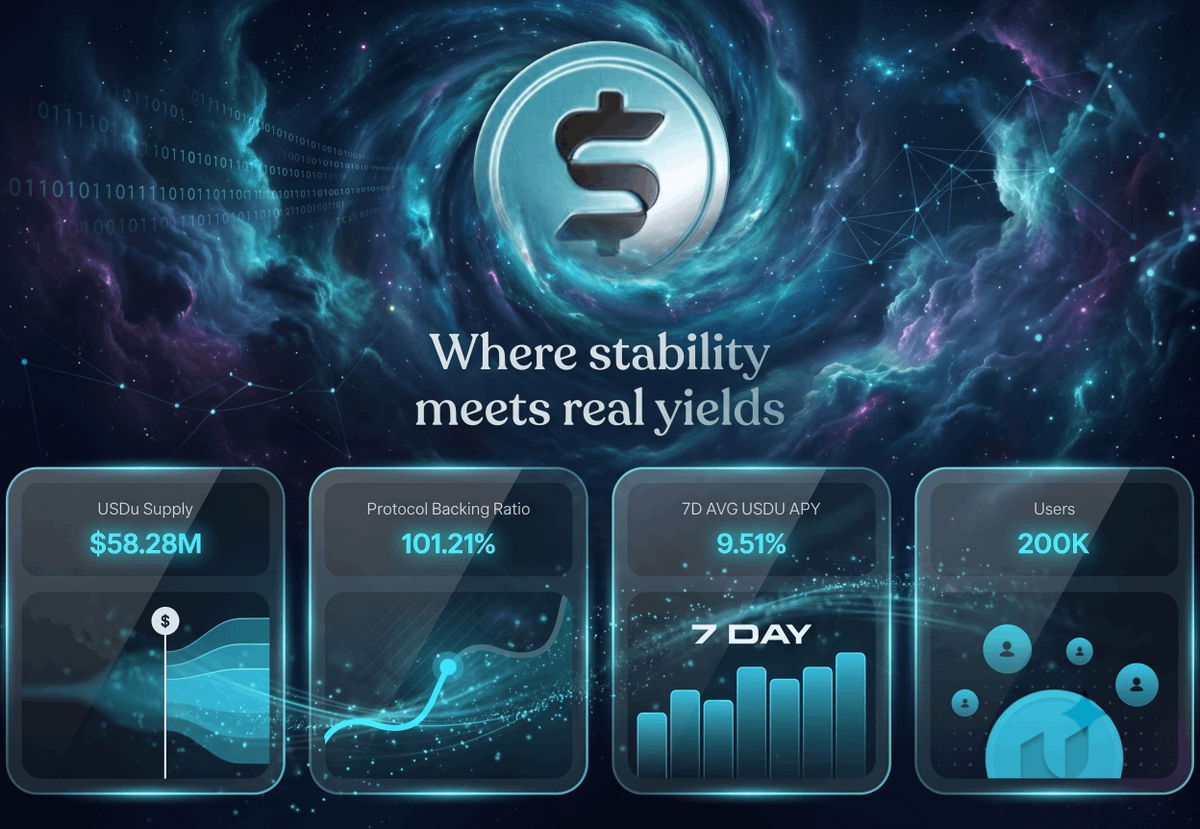
Lastly, let’s talk about the market for $UP. The current TVL is $58 million, with the seven-day average volume and price both hitting historical highs. The market dares to continue pricing it even when BTC is under pressure, indicating that it’s not just hype but that the market is voting on its fundamentals.
In such a crypto-dreary environment, Unitas's product logic makes progress every so often, and every step has practical implementation, from USD income → gold RWA income → US stock perpetual rate income. This kind of rhythm is very rare in the current market.
In my judgment, what’s most worth observing about Unitas is not today’s price, but whether it can scale this cross-asset income framework to a sufficient size.
From Crypto, to gold, to US stocks, if this path is successful and reaches the $1 billion scale where the official fee switch defaults on, the income-bearing asset layer on the BNB Chain will basically be secured by it.
Once this is achieved, the valuation logic of $UP will no longer be a stablecoin project but will transform into an on-chain asset management protocol.
The ceiling difference between the two is something everyone can feel.🧐 So I will keep a close watch on and pay attention to this project for a long time!
免责声明:本文章仅代表作者个人观点,不代表本平台的立场和观点。本文章仅供信息分享,不构成对任何人的任何投资建议。用户与作者之间的任何争议,与本平台无关。如网页中刊载的文章或图片涉及侵权,请提供相关的权利证明和身份证明发送邮件到support@aicoin.com,本平台相关工作人员将会进行核查。


