The truth about trading stable profits: The simpler the system, the easier it is to make money
Many traders fall into a fatal misconception: they always think that the more indicators, the more complex the system, the higher the win rate.
In fact, the trading systems that can achieve long-term stable profits never look at complexity. The core competition is only two points: execution efficiency and mindset adaptability. The more cumbersome the trading system, the easier it is to incur losses; only simple and pure rules are the way of trading.
The majority of complex trading systems on the market cannot escape the fatal problem of conflicting indicators.
Various technical indicators and analysis systems often show completely opposite long and short signals, with different tools giving conflicting directives and no unified judgment standard.
This creates a cycle of losses: the more analytical dimensions stacked, the more chaotic the signals become. Faced with contradictory market signals, one instinctively falls into hesitation and entanglement, unable to dare to enter the market when they should, and unwilling to cut losses when they should, missing the best market points. After that, they may lose their composure and make forceful operations, ultimately leading to missing opportunities or significant losses.
In contrast, an ultra-simple trading system pulls its advantages directly to the maximum, which is also the core reason why advanced traders persist in it for the long term.
The first is the ultimate adaptation to trading mindset. The entire system retains only core judgment criteria, eliminating the need to repeatedly refer to dozens of indicators, allowing one to clearly see trends and identify stop-loss positions at a glance, completely eliminating choice anxiety.
Secondly, trading actions are highly unified. With fewer judgment nodes, emotional interference is greatly reduced. A long-term fixed operation model will slowly form a sense of the market and muscle memory, making trading no longer rely on guessing but entirely on rule execution.
The differences can be seen from real backtest data: the execution completion rate of simple trading systems is extremely high, with stable profit fluctuations and a strong account trend. In contrast, complex systems have a very low execution rate, frequently make mistakes, get entangled repeatedly, have huge profit fluctuations, and extremely unstable accounts.
To excel in trading, one must learn to simplify their trading system. Here’s a set of universal practical methods.
First, streamline the judgment dimensions, retaining only one or two core trading bases; focus on core elements like trends and volume.
Secondly, eliminate all redundant, repetitive, or ineffective filtering conditions, avoiding blind pursuit of multi-cycle and multi-dimensional resonance.
Third, solidify standardized buying and selling rules, clearly define the sole conditions for triggering market entry, profit-taking, and loss-cutting, to ensure adherence to rules.
The reason for advocating simple trading fundamentally lies in understanding the underlying logic of the market and human nature.
Market trends themselves are dynamic and embrace ambiguity; forcibly using complex rules to precisely define every segment of the trend will deviate from the essence of the market, leading to severe distortion in judgment.
From the perspective of human nature, the same applies: simple and fixed rules are easy to form instinctive memories, allowing for mindless execution. In contrast, complex decision-making will continuously consume mental energy, frequently depleting cognition, leading to emotional mistakes.
All top-tier trading systems will ultimately return to simplicity. Data proves that traders using simple trading systems have a long-term survival rate far exceeding those relying on complex systems.
Trading has never been about doing precise mathematical calculations; it does not require covering all aspects. What is emphasized is that the way is profoundly simple and knowing the action aligns. Simplifying and adhering to simple rules is the best trading practice.
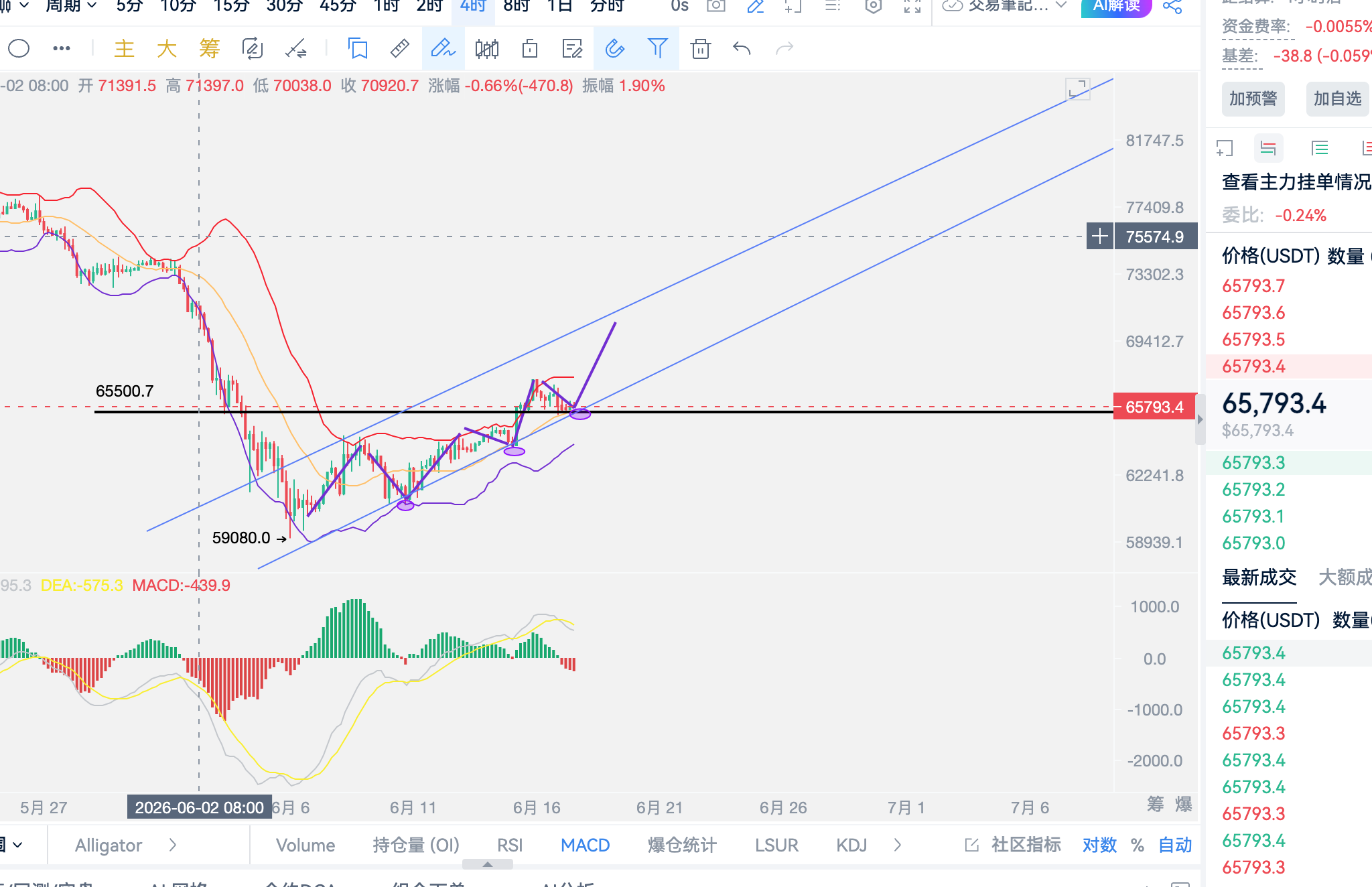
BTC is currently showing a consolidation pattern, and for future bullish trends, it will only rise. No matter how fierce the downturn in between, to make a long story short, look for a bullish return to the 65400-65000 area during the evening session, with a short-term target around 67200.
Follow the public account, "How to Solve Worries, Only Jiang Wei," a treasure analysis blogger with high emotional value, sharing trading teaching for free, bringing stability and clear guidance in the restless trading market, having traversed three rounds of bull and bear markets, with years of practical trading experience and expertise in naked K, trends, Dow theory, Gann, harmonics, CHAN theory, wave theory, and other technical analyses, compiled into unique personal insights.
免责声明:本文章仅代表作者个人观点,不代表本平台的立场和观点。本文章仅供信息分享,不构成对任何人的任何投资建议。用户与作者之间的任何争议,与本平台无关。如网页中刊载的文章或图片涉及侵权,请提供相关的权利证明和身份证明发送邮件到support@aicoin.com,本平台相关工作人员将会进行核查。