Coinbase is the ceiling of compliance for US stock trading in the cryptocurrency field
I've actually thought about this title for a long time, revised it several times, and even spent more time writing the full text than modifying the title. Ultimately, what I want to convey is why US stock trading on Coinbase is described as the ceiling in the cryptocurrency field.
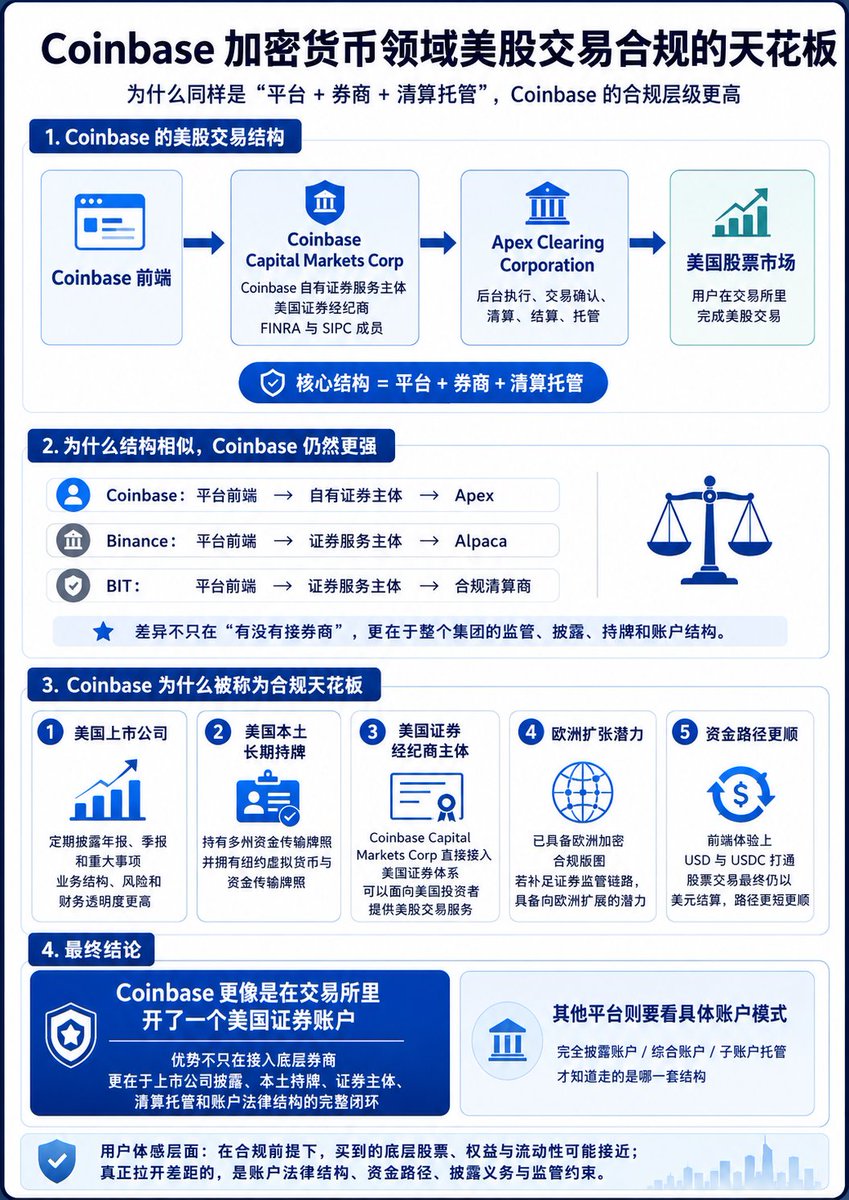
From a practical standpoint, the structure of Coinbase's US stock trading is not complicated. The securities service entity is Coinbase Capital Markets Corp, which is Coinbase's own company, and has already obtained the US broker-dealer license, and is also a member of FINRA and SIPC.
The subsequent backend clearing and custody services are provided by another compliant entity, Apex Clearing Corporation. Apex can be understood as a compliant securities infrastructure company responsible for stock order execution, trade confirmation, clearing, settlement, and custody. In essence, it is the same as Alpaca, which exchanges like Binance use.
Therefore, the overall structure of Coinbase is Coinbase front end + securities services from Coinbase Capital Markets Corp + clearing and custody from Apex Clearing Corporation.
Looking at it this way, many might notice a common point. Yes, in the cryptocurrency field, @binancezh and @BITofficial_CN both use such a structure. Binance also uses its own securities service entity in Dubai to connect to Alpaca, while BIT connects to two compliant clearing firms through the securities service entity of Bhutan.
So, since Coinbase, Binance, and BIT all use the same method, why do I say that Coinbase is the compliance ceiling?
First, Coinbase is a publicly traded company in the US, regularly submitting annual reports, quarterly reports, and disclosures of significant events to US securities regulators. Its business structure, risk factors, financial data, and regulatory risks must be publicly written in the documents, making its information transparency much higher than that of most exchanges.
Second, Coinbase has been operating in the US for many years and holds money transmission licenses in multiple states. New York state approved Coinbase to obtain a virtual currency license and money transmission license as early as 2017, and the regulatory framework in New York is relatively stringent in the cryptocurrency industry.
Third, Coinbase's securities business entity, Coinbase Capital Markets Corp, is itself a US securities broker-dealer and a member of the Financial Industry Regulatory Authority and the Securities Investor Protection Corporation. The securities execution, clearing, and custody are provided by Apex, allowing Coinbase-sold stocks to face US investors. This perfectly combines US stocks with US investors, a service that other exchanges cannot provide.
Fourth, Coinbase has also obtained a crypto assets market license from the EU, allowing it to provide services under the unified regulatory framework of 27 EU countries. Although there are still European broker-dealers connecting, this is not the most difficult part. This means that if Coinbase is willing, its stock business can also directly serve European investors. Thus, the two largest groups of stock investors globally can trade stocks compliantly on Coinbase.
Fifth, which I personally think is the most important, is that USDC and USD are interchangeable on Coinbase without needing any conversion. This means that, in terms of presentation, Coinbase does not involve using stablecoins to purchase stocks (the same applies to cryptocurrencies), so there is no need for any other means to act as an intermediary between stocks and stablecoins; it directly offers stock and USD trading.
Thus, from these five points, structurally, both Coinbase and Binance and BIT can be constructed as "platform + broker + clearing and custody," but Coinbase's compliance is not just based on connection to US broker-dealers; rather, it is more aligned with the mechanisms and compliance requirements of the US and its users.
Ultimately, the conclusion is that Coinbase is more like opening a US securities account within an exchange, while other exchanges must determine whether they operate on a Fully disclosed, Omnibus, or OmniSub basis to establish their model. This is why Coinbase's stock trading represents the current compliance ceiling.
However, this ceiling does not translate to the actual trading experience for users. For users, as long as they are on a compliant exchange, the stocks they purchase are the same, with rights and are transferable stocks, and the liquidity is also the same, with no differences in purchasing prices. (Of course, the fees are definitely different.)
免责声明:本文章仅代表作者个人观点,不代表本平台的立场和观点。本文章仅供信息分享,不构成对任何人的任何投资建议。用户与作者之间的任何争议,与本平台无关。如网页中刊载的文章或图片涉及侵权,请提供相关的权利证明和身份证明发送邮件到support@aicoin.com,本平台相关工作人员将会进行核查。


