Original author: Sleepy
At the end of 2022, shortly after ChatGPT was released, Mao Wenchao borrowed an employee's phone. He typed a question in the chat box: Will Xiaohongshu be disrupted?
According to reports, since then, he asked the team to report on AI progress every two weeks. A report every two weeks indicated that the machine had not provided him with a reassuring answer.
In August 2023, he wrote in an internal letter that he noticed while chatting with foreign friends that many questions people asked on ChatGPT were about life experiences, how to choose products, how to use them, and how to avoid pitfalls, overlapping with Xiaohongshu's business.
But he went on to say that this was due to a lack of accumulated experience overseas, whereas Xiaohongshu has it, and this "moat" is difficult for AI to shake.
The term "moat" was previously something entrepreneurs said to investors, but this time it sounded like he was saying it to his anxious self.
That year, Xiaohongshu just turned ten, with monthly active users exceeding 300 million, turning a profit for the first time with revenue of $3.7 billion and a net profit of $500 million, with expected profits to double the following year, surpassing $1 billion.
In business history, companies can die in two ways: from being poor or from being rich. Countless companies have died from poverty, and there's not much to say about that. Those that die from wealth always make the news; Kodak had money when it died, and Nokia was still the industry leader when it collapsed.
Having a lot of money and living long are two different things. Wealth does not free one from fear; it just turns fear into specific actions.
By 2026, this series of actions became more intense.
On June 8, Xiaohongshu launched RED Skill, allowing a component to be attached beneath notes that could be copied for use by agents.
Earlier, on April 30, the AI department Dots was established, integrating models, infrastructure, and engineering products, reporting directly to the new president Conan.
Even earlier, it acquired the development company behind the AI search product Diandian and obtained a payment license.
On the list of strategic investments, companies like MiniMax, Dark Side of the Moon, and a series of AI hardware companies began to appear.
Over the past thirteen years, hundreds of millions of users have left behind consumption experiences, lifestyle habits, and daily judgments in notes; this is its real treasure. With AI arriving, it needs to reprocess these judgments, first into answers, then into tools, and finally into business. To avoid being disrupted, it must take action itself.
But can experience withstand reprocessing? To answer this question, one must go back to 2013, back to the Chinese version of the Age of Exploration.
Seventy Million People's Age of Exploration
In June 2013, Qu Fang quit her job at a foreign company and, along with Mao Wenchao, founded Xiaohongshu in Shanghai. Their first product was not an app, but a PDF, "Xiaohongshu Outbound Shopping Guide."
That year, China's outbound travel numbers exceeded seventy million, equivalent to all of France collectively taking a trip abroad.
The European Age of Exploration brought back spices, gold, and colonies. The Chinese Age of Exploration brought back beauty products, rice cookers, and guides. Though the items may be small, the intentions are the same: to bring back good things from afar.
The world of goods outside the national borders suddenly opened up, with tourists crowding in front of duty-free store shelves, holding mobile phones, and nobody telling them what was worth buying. The information gap was like a mineral, and whoever could gather the experiences of those who had gone before could become a mine owner.
The PDF went up on the website and was downloaded five hundred thousand times in less than a month. A few months later, it evolved into an app, and a few years later, it was on the phones of hundreds of millions of people.
When encountering events, Chinese people never ask for any manuals; they ask other people.
Fei Xiaotong wrote in "From the Soil: The Foundations of China’s Society" that trust in rural societies does not rely on contracts but on familiarity. Apprentices learn from masters, new wives ask their mothers-in-law, and newcomers to the city seek out fellow villagers. For thousands of years, experiences were passed down from generation to generation—not quickly, but sufficiently.
Sufficient use requires two prerequisites: people living close to each other and life moving slowly. These two prerequisites have progressively been lost over the past few decades. Hundreds of millions of people have left their hometowns, living in neighborhoods where they don't even know each other's surnames. The number of purchasable items has exploded from a few hundred options on cooperative shelves to millions on e-commerce pages. It has become difficult to consult an elder who has never used a robotic vacuum cleaner about which model to buy. The experienced ones haven't had time to catch up.
The internet claimed to solve this problem, but ended up exacerbating it. People invented the internet to gain information, but in the end, there was so much information that nobody dared to trust any of it. Most online information comes from sellers, and the sellers' job is not to help you make judgments but to persuade you to pay. Judgments can only come from those who do not profit from you.
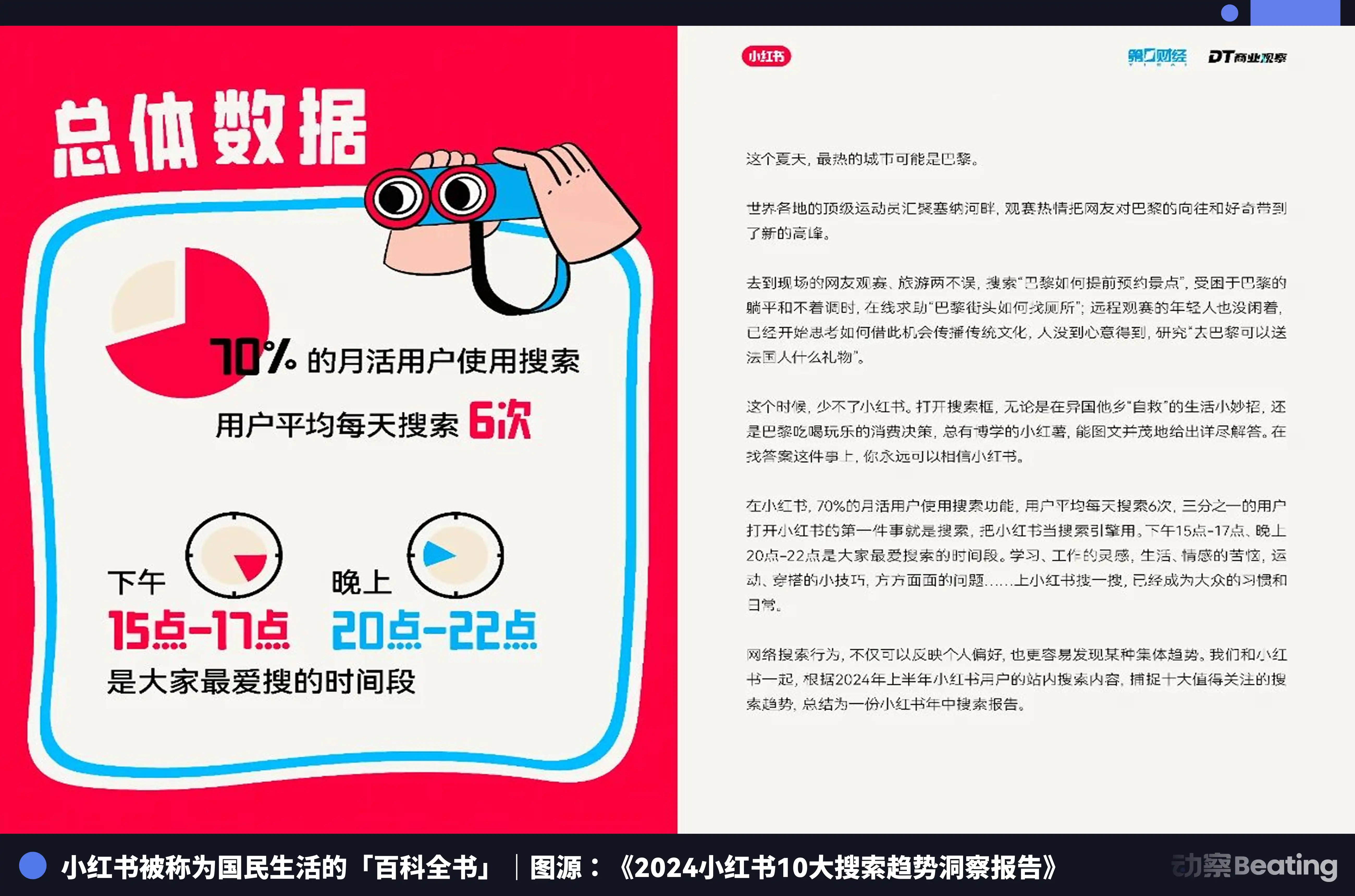
Xiaohongshu gathered the "I’ve tried" experiences scattered among hundreds of millions of strangers. A girl from Guangzhou noted that her oily skin would react poorly to a certain foundation; a young man from Shenyang detailed the eleven pitfalls he encountered while renovating; a mother shared her indecision between two baby foods for several days.
Most of the writers were unknown, not experts, and their writings couldn't be described as rigorous; there might even be promotional content and misjudgments mixed in, but these words had warmth.
Encyclopedias seek definitions, advertisements seek persuasion, but these notes seek nothing; they are merely testimonies—flawed testimonies. The most trustworthy ones in court are precisely these; overly perfect testimonies seem rehearsed. Later, the industry coined a term for this practice: "planting grass."
By the end of 2024, this app's daily search volume reached nearly six hundred million times. What people search for here is rarely knowledge; mostly, it is about life—renovation, essences, travel guides. Search engines provide raw data, while Xiaohongshu provides others' experiences. Of course, there is advertising involved, and it may not always give you the most accurate answers, but people are still willing to look, as many questions in life inherently do not have standard answers.
Behind six hundred million searches is six hundred million instances of hesitation, of people unable to make decisions while holding their phones late at night. This constitutes the entirety of Xiaohongshu’s treasure.
And then AI arrived.
Patience Shortened to its Limits
The thirty-year history of the internet is a chronicle of the erosion of human patience.
During the portal era, information was compiled into directories, and people had to find it themselves. The search engine era turned it into links, where people had to click themselves. By the time of information flow, there was no need to even search, as algorithms fed you information. Each change shortened patience a little; by the AI generation, information was transformed directly into answers, and human patience reached its limits.
This isn’t the users' fault. Humanity’s love for convenience knows no bounds; wheels, elevators, and remote controls were all invented for this reason. Once a person is accustomed to the AI chat box, it’s difficult to return to the days of sifting through posts by themselves.
The difficulty for Xiaohongshu lies in the fact that its most valuable part is the hardest to compress into an answer.
In the past, users would scroll through twenty notes here, compare, hesitate, and ultimately make their own decisions. This process was slow, as you would see three people saying it's good, two regretting it, and one reminding you that while this thing works well, it's also delicate. Someone would write that a hotel had poor soundproofing but great breakfast; this statement is valuable because it comes from a specific person, allowing you to guess what they value, and then decide whether their experience is relevant to you.
AI is like a pre-made meal factory; what comes in is a myriad of life flavors, and what goes out is a standardized formula. Convenience truly saves effort, but what can be sacrificed—hesitations, failures, and prerequisites—happens to be the most valuable part of experience.
Experience always grows from specific individuals; skin type, city of residence, budget—all determine whether a suggestion is useful. The answers provided by machines lack these prerequisites and sound like slogans. Slogans cannot help you choose foundation.
Xiaohongshu understands this peril. Patience cannot be retained, and when that day comes, its six hundred million searches will become the corpus of someone else's model, and it itself will become a mine, open-pit and all, where anyone passing by can take a shovel full.
Thus, it must take action itself. It’s not too late for them to start; since 2023, it has been developing its own model "Little Sweet Potato," launched the AI drawing tool Trik, and internally tested the dialogue product "Da Vinci." Most of these products did not make a splash, but they were not without purpose; they were experimental rounds, as Xiaohongshu needed to understand what AI could actually do for it.
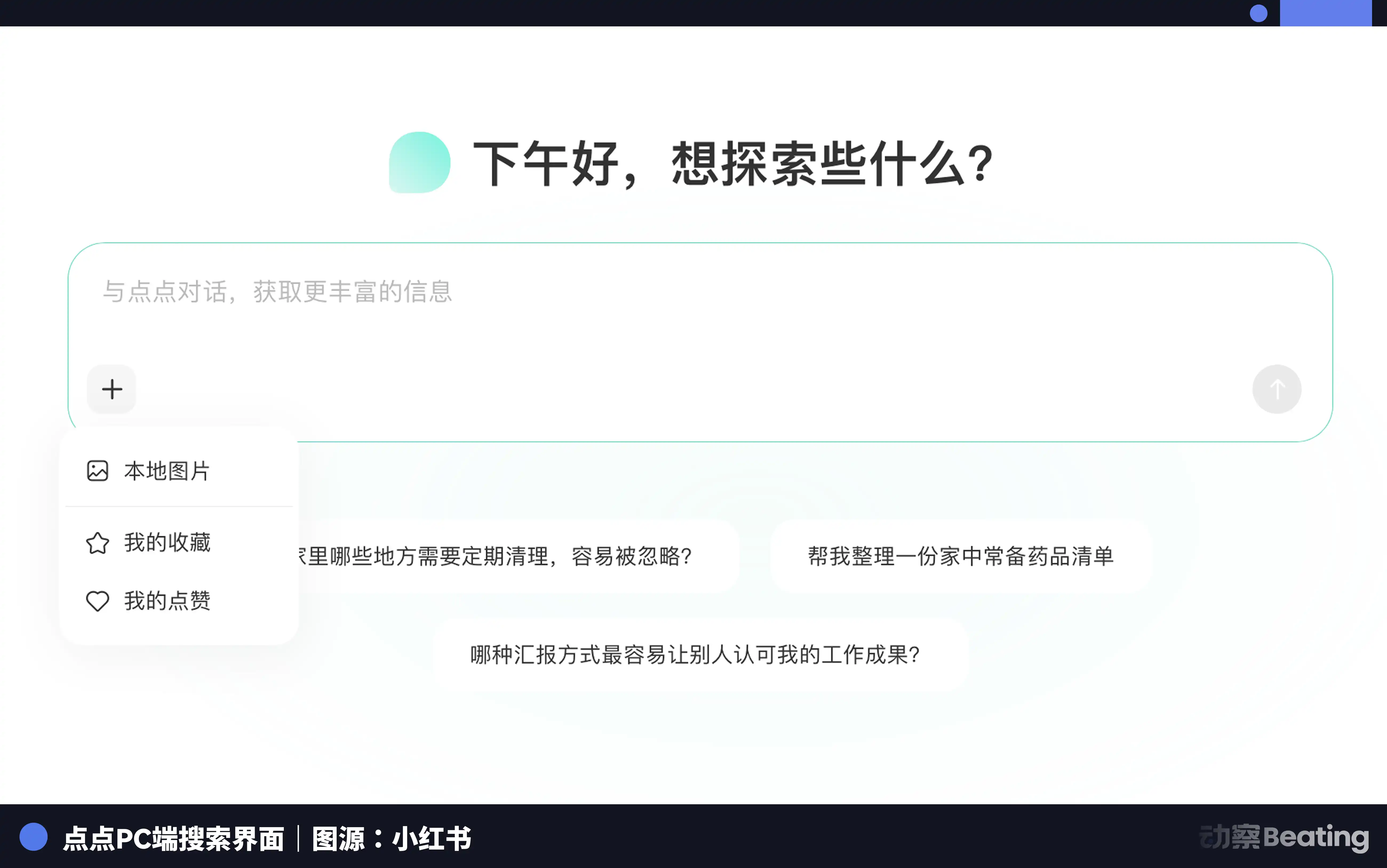
The real exploration of direction came from Diandian. It conducted lifestyle searches, combining internal notes and information from all over the web, allowing both text and voice queries. Later, Xiaohongshu simply acquired the company behind Diandian. Diandian was not a blockbuster product, but the role of a scout is not to take the castle.
It discovered one thing: past searches started from keywords, with users presenting a house number; now inquiries start from contexts, presenting a whole set of troubles. People no longer just search for "Okinawa family trips," but rather ask how to arrange a five-day trip to Okinawa with a three-year-old child, with a budget of fifteen thousand, and a preference for staying close to the sea.
To solve these troubles, Xiaohongshu has progressively released research on multimodal searches and the understanding of queries, open-sourcing the image editing model FireRed and the search agent framework REDSearcher. It has no intention of competing for the positions of universal models with large corporations; while others compete on parameters and rankings, what it needs to do is understand the real experiences scattered across text, images, videos, and comments, break them down, and recombine them into concrete, usable suggestions. This year, with the establishment of Dots, this line transitioned from peripheral experimentation to core business.
Xiaohongshu wants to take over the task of putting together answers that once required the user to scroll through twenty notes. But a single answer can only solve one problem. What it truly desires is to turn experiences into a repeatedly usable capability.
Notes Gained Limbs and Feet
RED Skill does exactly this. It turns experience from content into tools.
After the functionality went live, Xiaohongshu quickly launched support activities and curated lists, with three hundred thousand people starting to write AI Skills. A PPT generation tool made by Guizang had received over ten thousand stars on GitHub and was installed by thousands within just a few days of being listed on Xiaohongshu.
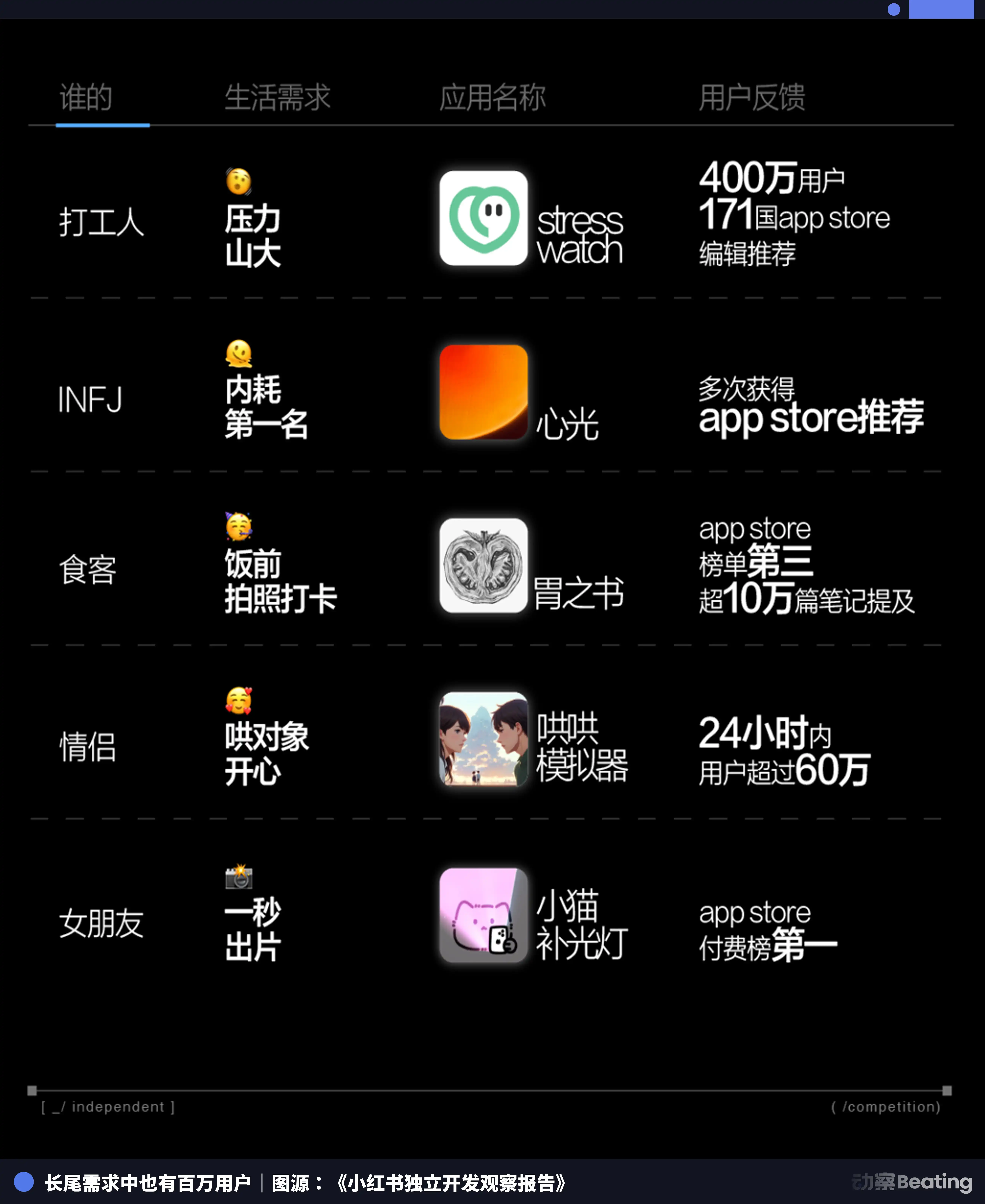
Looking back, last year’s independent developer competition garnered 1,355 projects, and this spring’s first hackathon took place over forty-eight hours of closed development, featuring a fifty thousand yuan prize pool, with sixty percent of participants being post-2000s, the youngest being twelve years old. The notes on the platform about Build in Public have already exceeded one hundred and ten thousand.
These figures, though not yet sufficient to demonstrate that an ecosystem has taken shape, are indicative of Xiaohongshu's ambitions.
In the past, when developers aimed for a product cold start, they often turned to GitHub or Product Hunt. There, there are many peers and investors, but there might not be many ordinary users. Some would give you stars, some would give you valuations, but not necessarily someone would place an order.
Xiaohongshu has identified this gap. Developers write their progress here, users express their needs in the comments, and bloggers write their experiences into notes, with the platform using rankings to attract initial attention. An AI tool, once written, is just the start; it still needs to be trialed, discussed, and translated into something that ordinary people can understand and use.
In making tools, Xiaohongshu may not be the best at it. However, it knows how to integrate tools into life.
Over the past thirteen years, Xiaohongshu’s creators have been more like storytellers, writing vividly, with trustworthy recommendations, accumulating influence slowly; users are willing to listen to you mainly because they trust you as a person. In the AI era, creators are beginning to transform into craftsmen. Famous figures becoming craftsmen may sound like a downgrade, but in reality, it's just a change in measurement. The number of people who install the tools, how many times they are called upon, and how many tasks they effectively accomplish for users begin to determine a creator’s worth.
For those writing notes, in the past, your experience could only be seen; now it can also be called upon. If it can be called upon, then it has the potential for pricing.
Before the Search Terms Appear
In December 2024, Dai Lidang, a partner at Today Capital, joined Xiaohongshu as strategic head to build up the strategic investment team. She has a background in the computer science department at Peking University, worked on Baidu Image Search and Baidu Maps, later went to Harvard for her MBA, and returned to China to join Today Capital. She has traversed technology, products, and capital.
Before she arrived, Xiaohongshu invested mostly in consumer brands, like M Stand Coffee, Moody colored contact lenses, as well as food, trendy toys, and maternal and infant products—investing in the lifestyles of young people, which was also a business she was most familiar with. After her arrival, financial and strategic investments were separated, and the strategic investment team shifted focus toward hard technology and AI. Xiaohongshu appeared on the shareholder list of MiniMax and also in the funding round of over one billion dollars for Dark Side of the Moon.
What it is betting on is not just the AI on the screen.
In the Nanshan Technology Park area of Shenzhen, centered around DJI's headquarters, a group of people making AI hardware are gathered. In the second half of 2025, Xiaohongshu participated in investments in nearly ten startups in this area, often finalizing deals in one or two days, sometimes willing to offer higher valuations to grab market share.
Among those investments, two were completed through its subsidiary "Sweet Potato Energy." One was invested in Yunwang Innovation, a company turning traditional foam rollers into AI massage robots that can sense where the body is sore and adjust pressure and path autonomously; the other was invested in Skyris, which creates companionship robots that float using helium, interacting with people through wings, LED eyes, and voice.
Within the industry, Xiaohongshu is often called "the entry point for life decisions." These eight words look nice on a PowerPoint slide, but pretty phrases have a way of drifting three feet above the ground.
Decision-making is already a late step; when a person begins to search how to use a foam roller, it indicates that the demand has already been voiced. Before it turns into a search term, the need often lacks a name—it may just be that the shoulder has been sore for a while, or that a person has been sitting at home for three hours.
In the past, Xiaohongshu stood downstream, waiting for people to write their life experiences into notes. Now, it intends to move upstream, actively finding those needs that haven’t had time to turn into search terms.
In 2024, Xiaohongshu's parent company also invested in the funds under Shanjing Venture Capital as an LP. Shanjing was an early investor, discovering this company in a startup competition in 2014 and investing the following year. A decade later, the invested has become the investor. Xiaohongshu exchanged a share of the fund for a long-term channel leading to early projects.
Of course, investing early does not equate to having a good eye. AI hardware has yet to prove it can be commercially scaled; mass production, supply chain, after-sales—each of these is arduous work and not a business Xiaohongshu is familiar with. Moreover, there's the complication of data. When does your shoulder ache? The device knows; why does it ache? The platform wants to know that too. Not understanding enough can lead to poor product usability; knowing too much introduces privacy risks.
But it still wants to invest. What it truly worries about is not today, but that the person who cannot make up their mind late at night tomorrow will not open Xiaohongshu to browse notes, but will instead directly pose their questions to another AI.
When Advertisements Reside in Answers
The story of Xiaohongshu cannot escape commercialization.
On this platform, experience and business have always been intertwined. Behind skin care advice are skin care products; behind renovation guides are building material vendors. Users want to take fewer detours, merchants want to be seen, and the platform wants to make money from this interplay—each of these desires is reasonable when viewed separately, but together, it requires a set of rules.
In November 2025, Xiaohongshu obtained a payment license through its subsidiary, completing the final link. AI can recommend products and services to users, but once a recommendation is made, where the order is finalized and how the money flows decides where this business ultimately lands. Xiaohongshu does not want to only be responsible for giving advice; it also wants to keep the transactions within its hands.
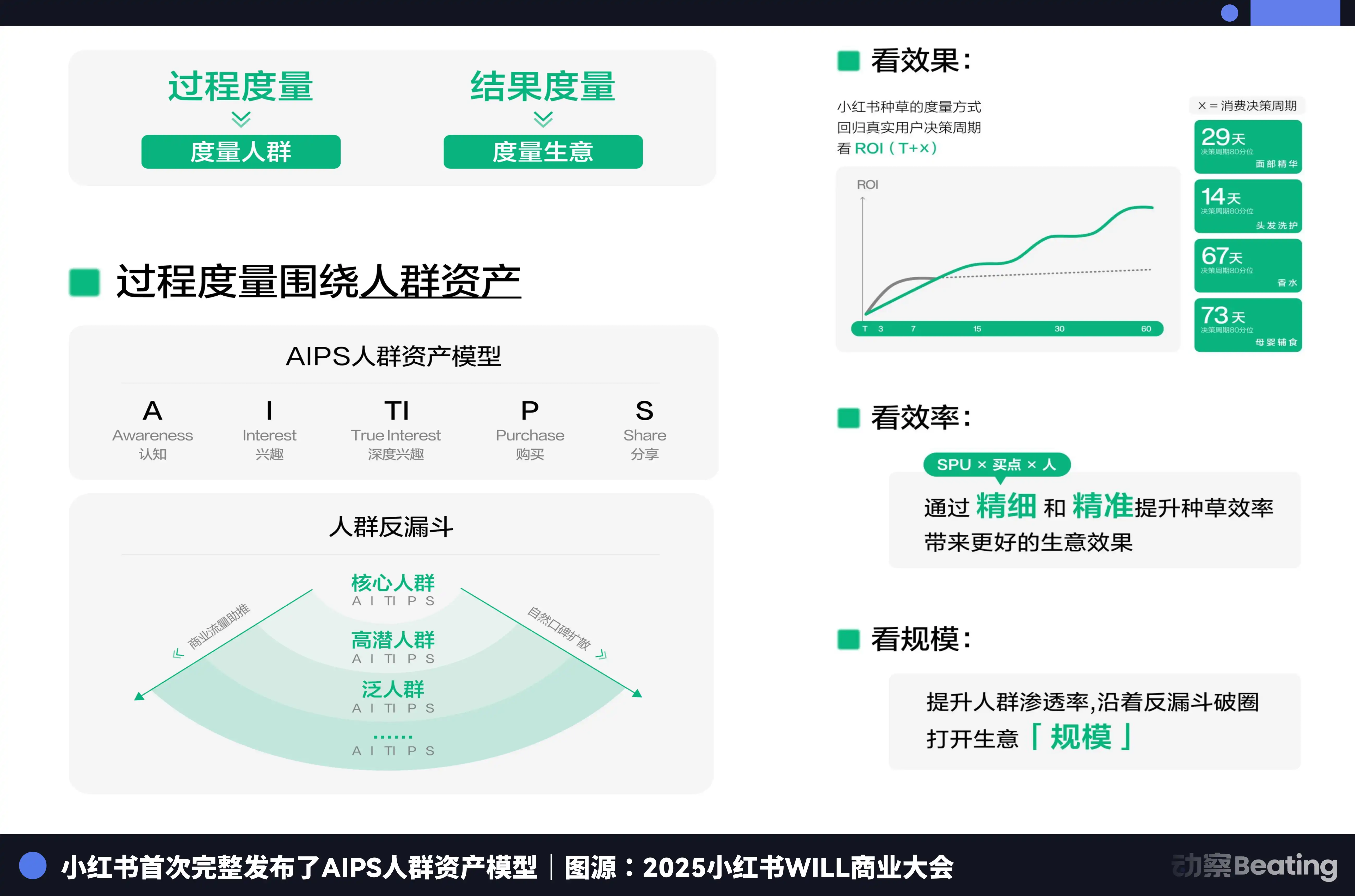
Xiaohongshu began its commercialization efforts earlier. In December 2024, Xiaohongshu released the AIPS crowd asset model at the WILL Business Conference, connecting data from Taobao, JD, and VIP.com through its planting grass alliance, reconciling it with brand-owned data. Two numbers from the launch were particularly interesting. The decision cycle for facial essences is as long as twenty-nine days; for maternal and infant baby food, it exceeds seventy days.
This is precisely the most unclear aspect of the planting grass business. A person views a review today, searches for ingredients ten days later, and then makes a purchase on another platform twenty days later, possibly watching a live stream and asking a friend in between. Ultimately, who brought the money is something the merchant wants to know, but Xiaohongshu has struggled to clarify this in the past. What AIPS aims to do is to clarify this blurred pathway.
What truly holds value for Xiaohongshu is not the traffic. Someone scrolling through short videos might just be killing time, while a person searching for essences and baby food is usually close to making a purchase.
What is most valuable is knowing what people are hesitating about. AI will observe this hesitation more clearly; in the past, the platform only knew what you had watched, but now it also knows what you want to solve. What you put forth is no longer a keyword but an entire context, including budget, preferences, health conditions, and those concerns you're not willing to explicitly state.
The advertising business has always leaned towards human judgment. Initially, it stood by the roadside, a sign that people could glance at and recognize as an ad; if they didn't want to see it, they could simply walk past it. Later, it intertwined with articles, becoming sponsored content and product placements; eventually, it entered information streams, becoming increasingly similar to content one would naturally encounter. With each step forward, advertisements have become harder to detect and closer to human decisions. In the AI era, it has found an even better position, residing within answers.
The Machine Learned "I've Tried"
In February 2026, in accordance with the national "Guidelines for Identifying AI-Generated Synthetic Content," Xiaohongshu required creators to label AI-generated text and videos, with restrictions on distributing unlabeled content. In March, it began cleaning up accounts that were entirely operated by AI, banning those that were entirely generated and published by machines. In April, it announced its AI governance principles for the first time in full, encouraging AI to amplify creativity while opposing the fabrication of life—cloning voices, creating personas, or fabricating experiences are all prohibited.
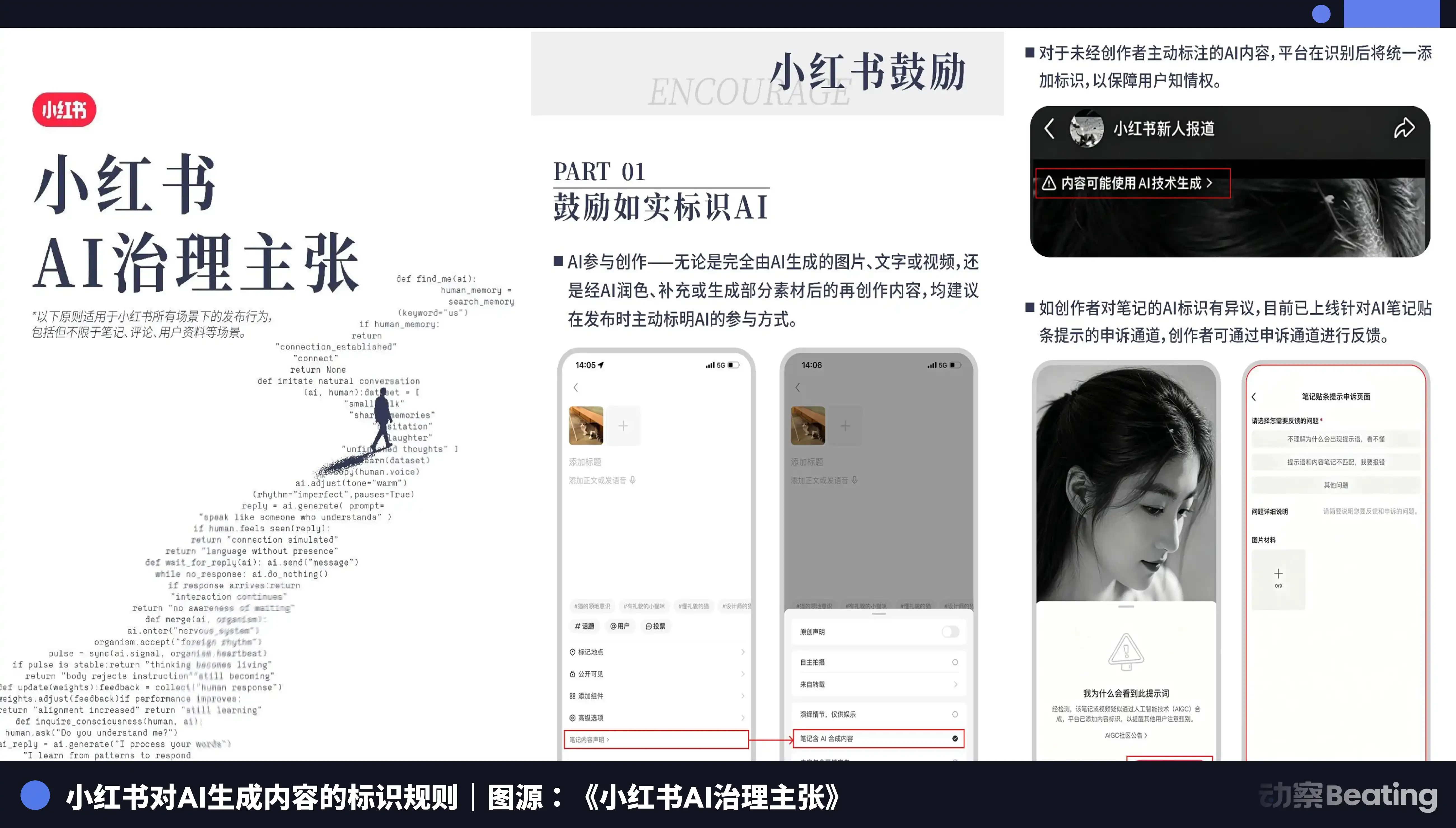
These statements may sound like a declaration but are, in fact, claims for survival.
AI is best at learning from people, and eventually, it even learned "I've tried." This is the phrase it learned the fastest and should never have learned to begin with. The trust that Xiaohongshu has built over thirteen years relies precisely on countless specific "I've tried" experiences. Machines can write ten thousand trial notes, but they have never truly tried even once. Its skin never becomes sensitive, and its wallet never feels the pinch.
If such content proliferates to a certain extent, real human experiences will also depreciate. Xiaohongshu will revert to the very thing it initially sought to replace, becoming those nicely written sales pitches that mimic real human voices.
What comes next hasn't been determined yet. Whether RED Skill can grow a true ecosystem, whether Diandian can enter the main site and whether payments will link to answers—all these must be left to time. But the nature of this matter is already clear: Xiaohongshu is acting as a translator, turning real human experiences into structures that machines can handle, converting judgments from life into tools, and incorporating hesitations into business.
Translation emphasizes faith, conveyance, and elegance; machines have already learned conveyance, while what Xiaohongshu must safeguard is faith.
Borges wrote about an empire obsessed with precision. Their cartography became increasingly refined, with a map of a province as large as a city, and a map of the empire as large as the province. The cartographers felt it was still insufficient; eventually, they decided to create a map the same size as the empire, with every city, road, and piece of wasteland located accurately. Yet once the map is as large as reality, it becomes useless. Later generations stopped caring for it, letting it rot in the wilderness.
AI is drawing such a map for experience—more detailed, faster, and increasingly likely to make people forget that a map is not life itself.
Mao Wenchao wrote in his letter that this moat is difficult for AI to shake. He likely also understands that the real issue isn't the moat, but the city. Xiaohongshu must build an increasingly intelligent machine; otherwise, the experiences accumulated over thirteen years will soon be organized, called upon, and repriced by others; if the voice of the machine drowns out human voices, the city will be empty, and a moat protecting an empty city, no matter how wide, is useless.
It must repair the machine within the city while ensuring that what remains in the city in the end is not just the machine, but also those who are indecisive late at night and those willing to say a word of "I've tried" to them.
This is its true moat and the source of all its current unease.
Conclusion
Before the article was finalized, Bloomberg reported that Xiaohongshu plans to secretly submit an IPO application in Hong Kong by the end of this month, with a valuation that once reached $31 billion and an expected profit of around $3 billion for the full year of 2025.
From a PDF to the Hong Kong Stock Exchange in thirteen years. It has transformed the hesitations of hundreds of millions of people into something profitable; now it’s the capital market’s turn to reprice it.
Stock prices will always rise and fall. But those people who find themselves indecisive late at night, those willing to tell strangers "I've tried," will not disappear from the story just because of stock price fluctuations. Money allows a company to run fast, but running long is another matter.
As for what comes next, that’s left to time.
References:
[1] IT Home | Xiaohongshu officially launched RED Skill feature
[2] 36Kr | Xiaohongshu’s four-year AI journey: FOMO, hesitation, to sudden acceleration
[3] Viewpoint Network | Xiaohongshu fully acquires the developer of the AI search product Diandian
[4] Economic Observer | Xiaohongshu stirs the investment circle
[5] IT Home | Xiaohongshu acquires payment license
[6] Daily Economic News | AIPS crowd asset model, planting grass metrics and commercialization direction
[7] Sina Technology | Xiaohongshu's daily search volume approaches 600 million
[8] Late Point | Dai Lidang joins Xiaohongshu and builds up the strategic investment team
[9] 36Kr | Dark Side of the Moon secures over $1 billion financing, Xiaohongshu appears on the investor list
[10] Sina | Should Xiaohongshu develop a large model?
[11] Webmaster Home | Xiaohongshu PC version launches AI search assistant Diandian
[12] Daily Economic News | Independent Developer Competition and Developer Ecosystem Data
[13] GitHub | FireRed-Image-Edit GitHub project
[14] arXiv | REDSearcher search agent framework
[15] IT Orange | Xiaohongshu takes 100% stake in Sweet Potato Energy Technology
[16] Sina Finance | Yunwang Innovation completes Pre-A round, Xiaohongshu and Zhenge Fund invest
[17] Smart Hardware | Xiaohongshu's subsidiary Sweet Potato Energy invests in SkyrisAI
[18] The Paper | Xiaohongshu strengthens AI-generated synthetic content identification
[19] Legal Daily | Xiaohongshu publishes its AI governance proposals for the first time in full
免责声明:本文章仅代表作者个人观点,不代表本平台的立场和观点。本文章仅供信息分享,不构成对任何人的任何投资建议。用户与作者之间的任何争议,与本平台无关。如网页中刊载的文章或图片涉及侵权,请提供相关的权利证明和身份证明发送邮件到support@aicoin.com,本平台相关工作人员将会进行核查。


