Original | Odaily Planet Daily (@OdailyChina)
Author | Wenser (@wenser2010)

“Are you okay? Are you okay? If you're okay, eat Liu Liu Mei!”
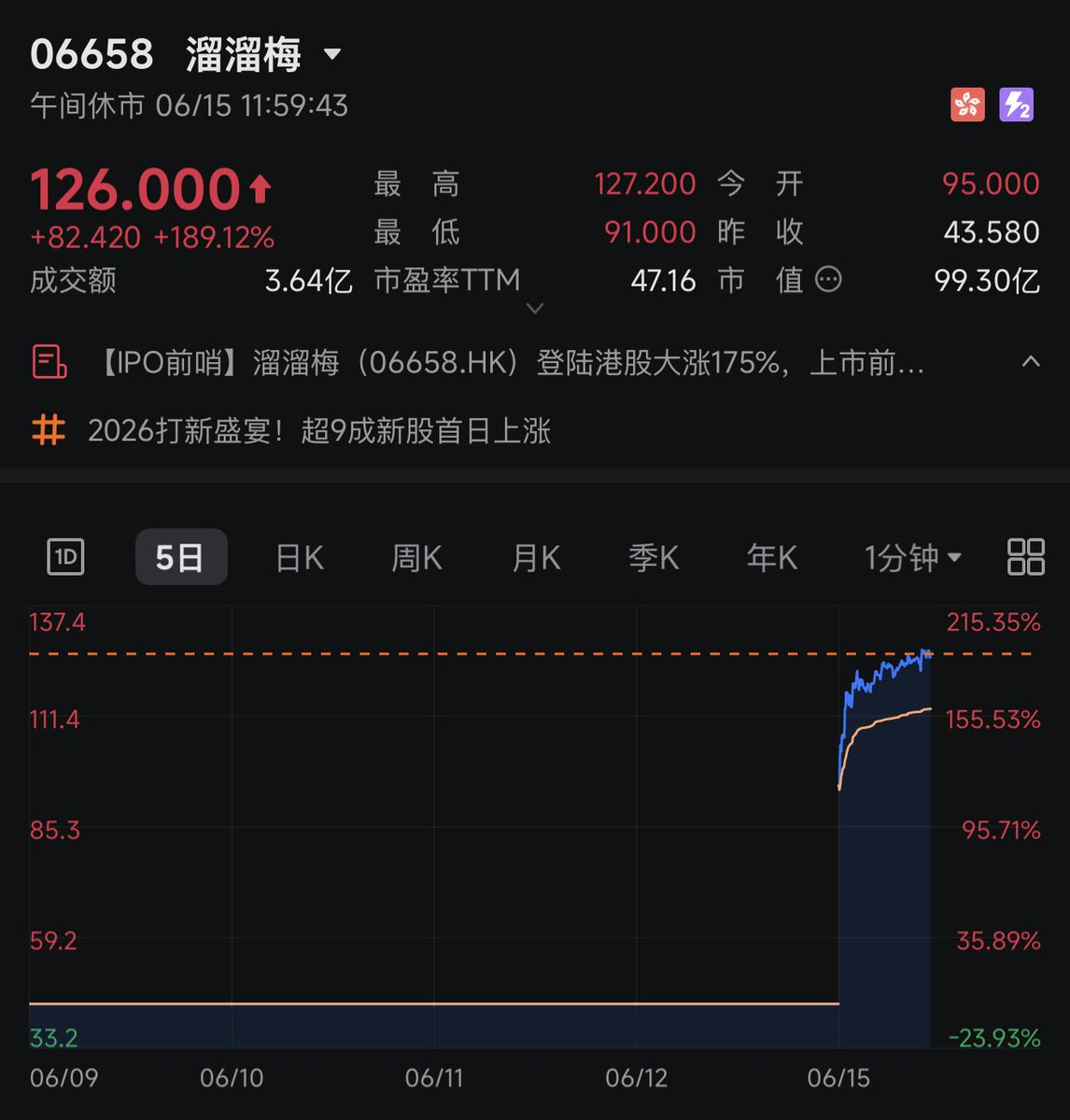
Once upon a time, Yang Mi’s catchy advertisement brought Liu Liu Mei into countless households, and the company behind it has, after decades of accumulation, finally officially listed on the Hong Kong Stock Exchange today, becoming the first stock of "plum snacks" in Hong Kong. It is reported that its issue price was HK$43.58, open price HK$95, rising about 116% compared to the issue price of HK$42; the highest during trading reached HK$127.50, an increase of over 190%; it has now fallen back to HK$125, with an increase still over 186%.
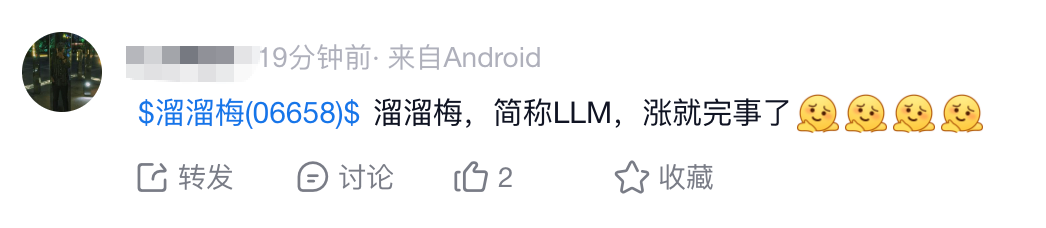
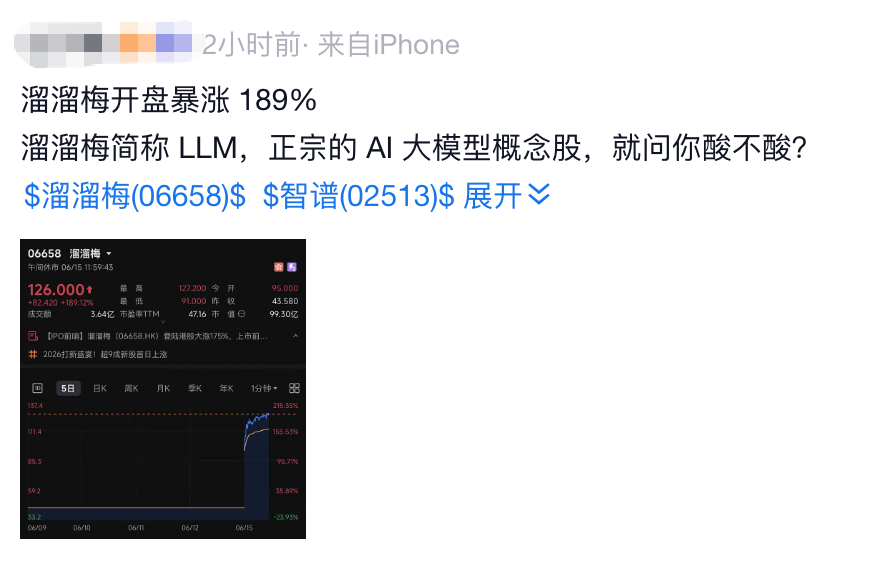
However, contrary to what many anticipated, the stock price of Liu Liu Mei (06658.HK) surged not due to the revival of the concept of "new consumption, new retail, new snacks," but because the acronym with the initials of its name is riding on the heat of “LLM” (large language models), coinciding with today’s surge of 45% in Zhipu (02513).
Many people call it the “authentic AI large language model stock,” and countless hot money has flocked in. Whether we admit it or not, perhaps the global stock market is entering an “Era of Meme Stocks.”
A New Era for Global Stock Markets: When Stocks Collide with Memes
First, let’s talk about the basic situation of Liu Liu Mei’s IPO: this is Liu Liu Mei’s fourth attempt to enter the capital market.
In 2019, Liu Liu Mei attempted to rush into the A-share market but failed; in 2025, it submitted to the Hong Kong Stock Exchange twice which both failed; until May 21 of this year, it updated the application materials for the third time and changed its name from "Liu Liu Mei Group Co., Ltd." to "Liu Liu Mei Co., Ltd.," successfully listing in less than a month. One must say, sometimes the matter of a name is indeed a sort of metaphysics.
According to the allocation results published by the company, this IPO’s public offering recorded about 6586.73 times oversubscription. The final number of shares for public offering was 1.1465 million shares, accounting for about 10% of the global total issuance. A total of about 180,500 valid applications were received, of which about 11,465 applications were accepted, with the allocation ratio for one lot at only 1.5%, indicating an extremely fierce competition; for international placement, Liu Liu Mei was subscribed 2.64 times, and the final number of shares issued internationally was 10.3176 million shares, accounting for 90% of the total issuance. In comparison, the heat of Liu Liu Mei's IPO has already surpassed the "first stock of milk tea store quantity" Mixue Ice City that listed on the Hong Kong Stock Exchange last March, where the public subscription oversubscription ratio was 5258.21 times.
In other words, institutions are not optimistic but account for 90% of the share; retail investors are optimistic but only account for 10%, and the main driving force for the opening rise comes more from the free play of the public market where “retail investors dance with the high rollers.” This is where the energy of “Meme Stocks” lies—transforming the attention attracted by memes into buying power in the capital market.
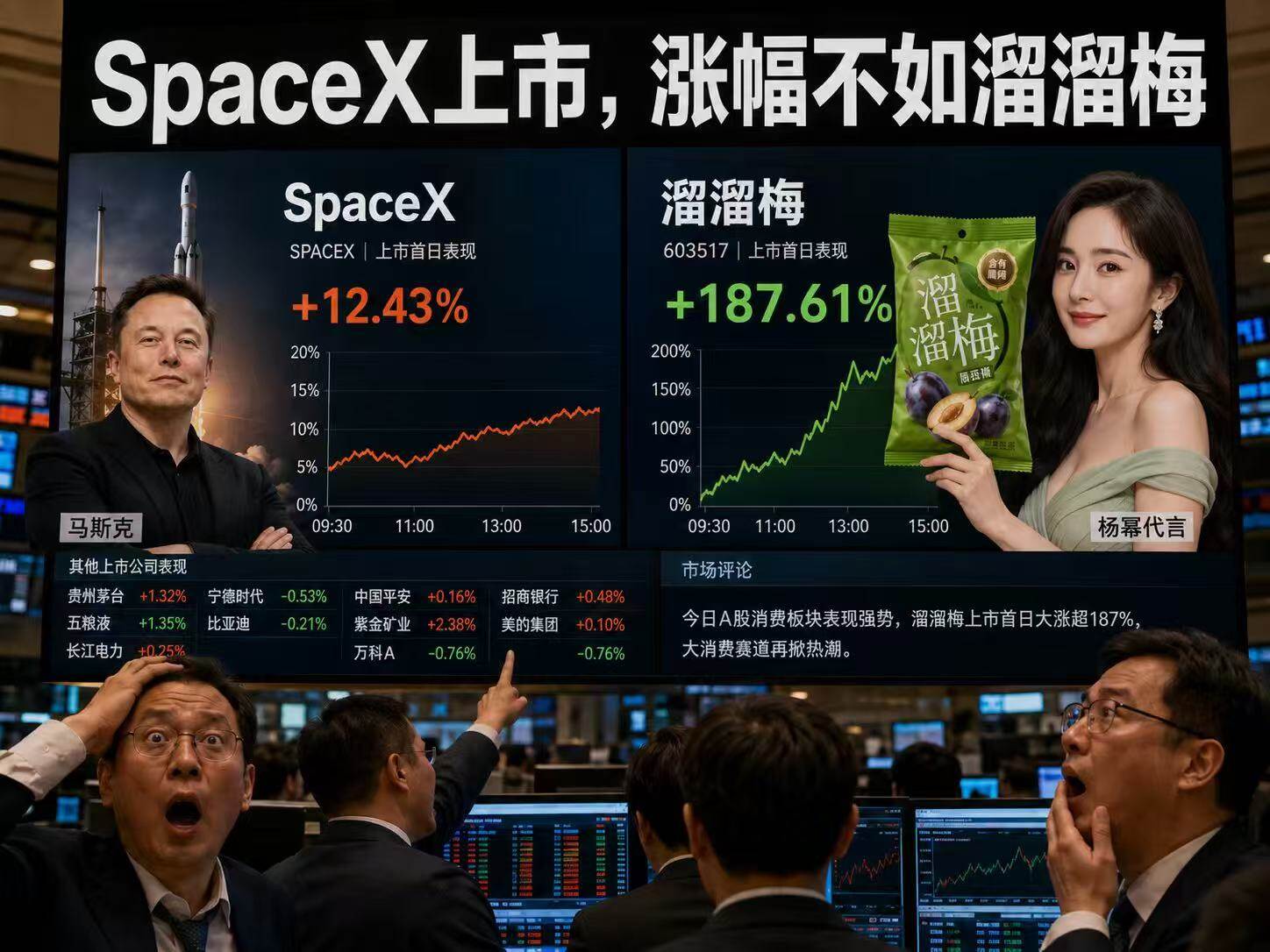
Moreover, some netizens have compared Liu Liu Mei's opening performance to that of SpaceX, where the market gain is far more striking than the latter.
It is worth noting that "Meme Stocks" is not a new term that has emerged recently but rather a category of stocks that objectively exist in major capital markets such as the US stock market, Hong Kong stock market, and A-shares; however, the “Era of Stock Meme-ification” is definitely a new trend that emerged within the last 1-2 years, and the main factors driving this trend do relate to the cryptocurrency market.
The earliest Meme Stocks are untraceable; we will only talk about some representative stocks in recent years.
2021’s Gamestop may be the starting point for many people's enlightenment in US stock memes. Under the leadership of well-known investor Roaring Kitty and others, global retail investors united against Wall Street capital institutions, forcing them to short-squeeze, causing numerous brokerage platforms and exchanges to “cut the line” to avoid trouble; recently, the rumor of Gamestop acquiring eBay led to fluctuations in the market, raising the stock price temporarily.
Tesla and SpaceX, which recently completed its IPO, were also regarded as a sort of meme stock because these two companies and stocks are closely related and deeply bound to the highly topical “global trillionaire” Elon Musk. Before these companies have provided strong performance proof, they have been seen as “story-driven enterprises with extremely high market dream rates.”
In the lead-up to Donald Trump winning the US presidential election in 2024, the A-share market had already shown abnormal movements, with "Zhongguang Zhisheng" frequently topping platform hot lists and even hitting the limit up multiple times; that year, during Trump’s campaign, he was shot and had his ear injured by flying glass, and Goertek (homophonic of "cut ear") also experienced price rises due to this event.
Last year, with deteriorating Sino-Japanese relations, military stocks like Furui experienced a surge in stock price due to the patriotic homophonic joke “capturing Japan”, hitting the limit up for 8 consecutive trading days, with the stock price cumulatively increasing over 100%, becoming one of the short-term “demon stocks” in the A-share market.
In the current capital market, just like the attention-fragmented and emotion-centralized cryptocurrency market, individual stocks and sectors that can spark discussion and capture attention have long become the "attention focal point" stirring funds and liquidity.
The surge of Liu Liu Mei is also a significant example of the "stock meme-ification" era.
The Era of Stock Meme-ification Begins: Homophonic Jokes, Abbreviations, and AI Era Dividends
As OpenAI and Anthropic are valued close to the trillion-dollar scale, companies and stocks related to industries such as optics, communication, materials, and computing power, which are closely linked to the AI industry, have successively ushered in an explosive period:
- NVIDIA became the first publicly traded company in history with a market value exceeding $5 trillion;
- Micron, SanDisk, and others’ stock prices have continuously breached new highs, and institutions have raised their target prices;
- SK Hynix and Samsung Electronics’ stock prices dominate the fluctuations of the Korean KOSPI index;
- NVIDIA founder’s remark “I’m optimistic about Marvell becoming a trillion-dollar giant” led to Marvell (MRVL) stock price rising accordingly;
- The newly listed stock Serenity mentioning Innolight (Zhongji Xuchuang) was misinterpreted due to translation issues as Inno Laser, causing the latter’s stock price to surge 10% due to an influx of $300 million hot money.
In the great tide of the "stock meme-ification" era, being related to AI, riding on the hot wave of "large language models," and having homophonic relationships with popular targets, as well as being mentioned by celebrities, have all become reasons for the market’s attention and a prime stage for the synchronization of attention and funding.
The mentions of “Trump concept stocks,” “US stock government concept stocks,” “TACO-style trading beneficiary targets," etc., are also manifestations of this industry trend. And this is precisely the much-praised “attention-intensive industry” in the cryptocurrency market—the common strategy in the meme coin space.
However, the capital market has changed; the rules of the market have changed; the scale of funds and liquidity cannot be compared with the cryptocurrency market. After all, compared to the trading scales of the US stock market, Hong Kong stock market, A-share market, and Japanese and Korean stock markets, the cryptocurrency market’s total amount of less than $3 trillion seems somewhat disheartening.
SpaceX leaped to become one of the top 10 global asset classes as soon as it was listed; conversely, BTC has already fallen to the 17th place on that list. One must say, the numerical comparison always seems so brutal—the diligent development of the cryptocurrency industry for over a decade cannot compare to the IPO market capitalization of one single company.
Now, the emergence of Meme Stocks, and their increase, may have already become an industry trend. The recent incident of Joyoung producing a corresponding product due to the "Hakimi North and South Mung Beans" hot joke and causing a rise in stock prices demonstrates one thing: for the younger generation and investors in today's society, those investment targets that can trigger emotional fluctuations, attract market attention, and stir liquidity are far more worthy of purchase.
Even if this fleeting chase of emotions is only temporarily hot, for most people, joining in when one cannot beat the trend is the better choice. Of course, objectively speaking, the emergence of Meme Stocks does not mean one-sided benefits, such as wealth creation effects or industry booms; sometimes, this process is also accompanied by negative phenomena like inflated selling, unilateral harvesting, and emotional marketing.
Just like Liu Liu Mei's opening surge, some people angrily criticized it as being for "cutting leeks"; others analyze that perhaps it was Liu Liu Mei’s inclusion in “Stock Connect,” allowing A-share market funds to buy in, which drove its stock price upwards. Whatever the truth, the reasons must be multifaceted and chaotic; for us, perhaps the best we can do is to go with this trend of the times and seek our own path to wealth.
免责声明:本文章仅代表作者个人观点,不代表本平台的立场和观点。本文章仅供信息分享,不构成对任何人的任何投资建议。用户与作者之间的任何争议,与本平台无关。如网页中刊载的文章或图片涉及侵权,请提供相关的权利证明和身份证明发送邮件到support@aicoin.com,本平台相关工作人员将会进行核查。


