Original | Odaily Planet Daily (@OdailyChina)
Author | Asher (@Asher_ 0210)

This World Cup is not only lively on the field.
As the popularity of World Cup-related prediction events heats up, more and more users are starting to participate in trading with real money. Who can win, what will the score be, will there be upsets, will there be red cards, which player can score—these topics that originally belonged to fan chit-chat before the match are now broken down into individual tradable prediction events.
When predictions become transactions, what users need is not just emotion and intuition: changes in odds, team status, injury information, historical confrontations, and market sentiment all become references before trading. In this process, AI models are beginning to be frequently integrated into World Cup prediction scenarios.
Qianwen, ChatGPT, Gemini, Claude, DeepSeek, Qwen, and Copilot are all large models that can not only answer "which team is more likely to win" but also provide score judgments, upset possibilities, red card risks, key player performances, and match trend analyses. For participants in the prediction market, AI's pre-match simulations are becoming another layer of reference beyond odds, news, team data, and market sentiment.
However, predictions ultimately must return to the match itself.
With the World Cup officially underway, the results of the first few matches have come in one after another. The AI analyses that users relied on for pre-match judgment now have answers to compare against: Did the score hit, was the upset seen early, and how many details like red cards, last-minute goals, and match trends were actually captured by the models?
The first model to break out was Qianwen
Without a doubt, the most dramatic show on the first day of the World Cup was Qianwen.
In the opening match between Mexico and South Africa, Qianwen predicted a score of 2:0 in favor of Mexico before the match. After the match ended, the score indeed settled at 2:0. Even more interestingly, three red cards were issued during the entire match, aligning with Qianwen's earlier risk assessment of "South Africa's excessive defensive actions might lead to being a man down early."
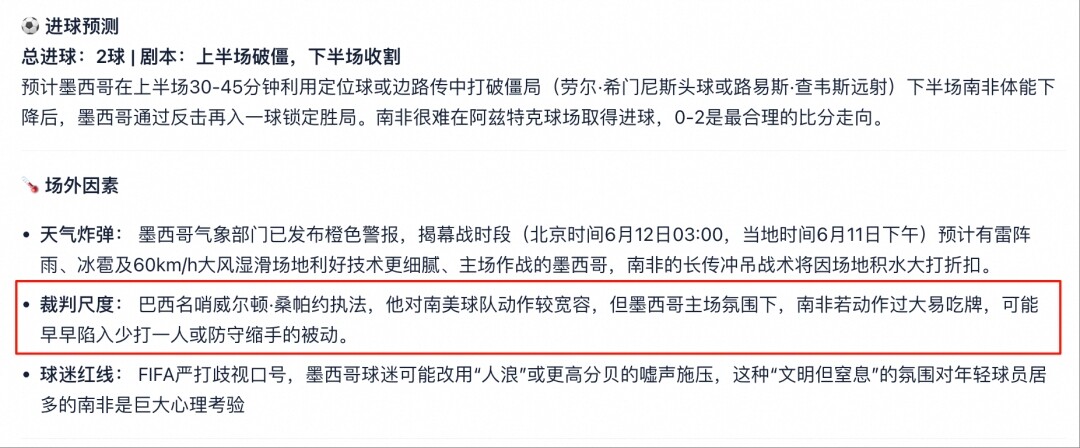
If it were just predicting Mexico's victory, that wouldn't be surprising. As one of the hosts, Mexico was already favored. But Qianwen hit on more specific match details this time: the score of 2:0, the red card risk for South Africa, and the progressively stretched rhythm in the latter part of the match.
Next, for the match between South Korea and Czech Republic, Qianwen again predicted a 2:1 result for South Korea.
This match was not easy to guess beforehand. The Czech Republic had physicality, threats on set pieces, and the perennial big match experience of European teams. The match itself was not one-sided; the Czech Republic took the lead first, South Korea equalized later, and the score was stuck at 1:1 for a long time. It wasn't until the final stage that South Korea scored the winning goal, making the final score 2:1.
At this point, Qianwen's prediction gained a stronger sense of "script." While win/loss judgments can rely on paper strength, score predictions can involve luck, but the details of red cards, comebacks, and winning goals in the final stages truly made one feel like there was "something going on." After two matches on the first day, Qianwen has initially raised the attention on AI predictions for the World Cup.
Copilot: Some brilliant moments, but clear failures
Before the matches, USA Today had Copilot predict all 104 matches of this World Cup. From the matches that have concluded so far, this prediction has highlights as well as clear misses.
Among them, three matches stood out with notable predictions.
In the opening match between Mexico and South Africa, Copilot predicted Mexico 2:0, and the final score matched perfectly. For South Korea against the Czech Republic, it predicted South Korea 2:1, which was also consistent with the result. When it came to Brazil against Morocco, Copilot made a 1:1 prediction, and Brazil indeed ended up being held to a draw by Morocco.
Especially the Brazil 1:1 Morocco match carries significant weight. Brazil is a traditional powerhouse, with a lineup and attention at the top level. Although Morocco reached the semifinals in the last World Cup, directly predicting a draw against Brazil before the match was not a particularly safe choice. When the match concluded, Brazil did not secure a winning start, and Morocco continued its resilience in major tournaments; Copilot's prediction for this match was indeed "a stroke of genius."
However, Copilot's issues quickly became apparent.
It predicted Canada would defeat Bosnia 2:1, but the match ended in a 1:1 draw; it predicted Switzerland would narrowly win against Qatar 1:0, but Switzerland was also held to a draw; it predicted the U.S. would outpace Paraguay 2:0, which was on the right track, but the actual score was 4:1, with the attacking intensity clearly underestimated.
More obvious failures surfaced in matches featuring upsets and strong teams being held back.
In the match between Turkey and Australia, Copilot predicted Turkey 2:1, but the result was a surprise 2:0 win for Australia. For Ecuador against Ivory Coast, it predicted Ecuador 2:1, but the result was Ivory Coast 1:0 victory. For Netherlands against Japan, it predicted Netherlands 2:1, but Japan equalized twice, resulting in a final score of 2:2. For Sweden against Tunisia, it predicted a 1:1 draw, while Sweden went on to win 5:1.
Copilot's ability to hit specific scores for Mexico, South Korea, and Brazil indicates that it is not just giving answers in favor of popular teams. However, its judgments on upsets like Australia defeating Turkey, Qatar drawing with Switzerland, and Japan tying with the Netherlands still reveal it being overly conservative when assessing underdogs and draws.
ChatGPT: Comprehensive analysis, but misses on upsets
Compared to Copilot's comprehensive match predictions, ChatGPT feels more like a "pre-match analysis type of player."
In its opening match prediction, ChatGPT predicted Mexico 2:0 against South Africa, which was ultimately correct. Its reasoning was also quite complete, incorporating factors like Mexico's home advantage, recent form, South Africa's attacking weakness, as well as the high altitude and home atmosphere of Mexico City. In this prediction, ChatGPT not only provided a result but also aligned its underlying judgment logic with the match outcome.
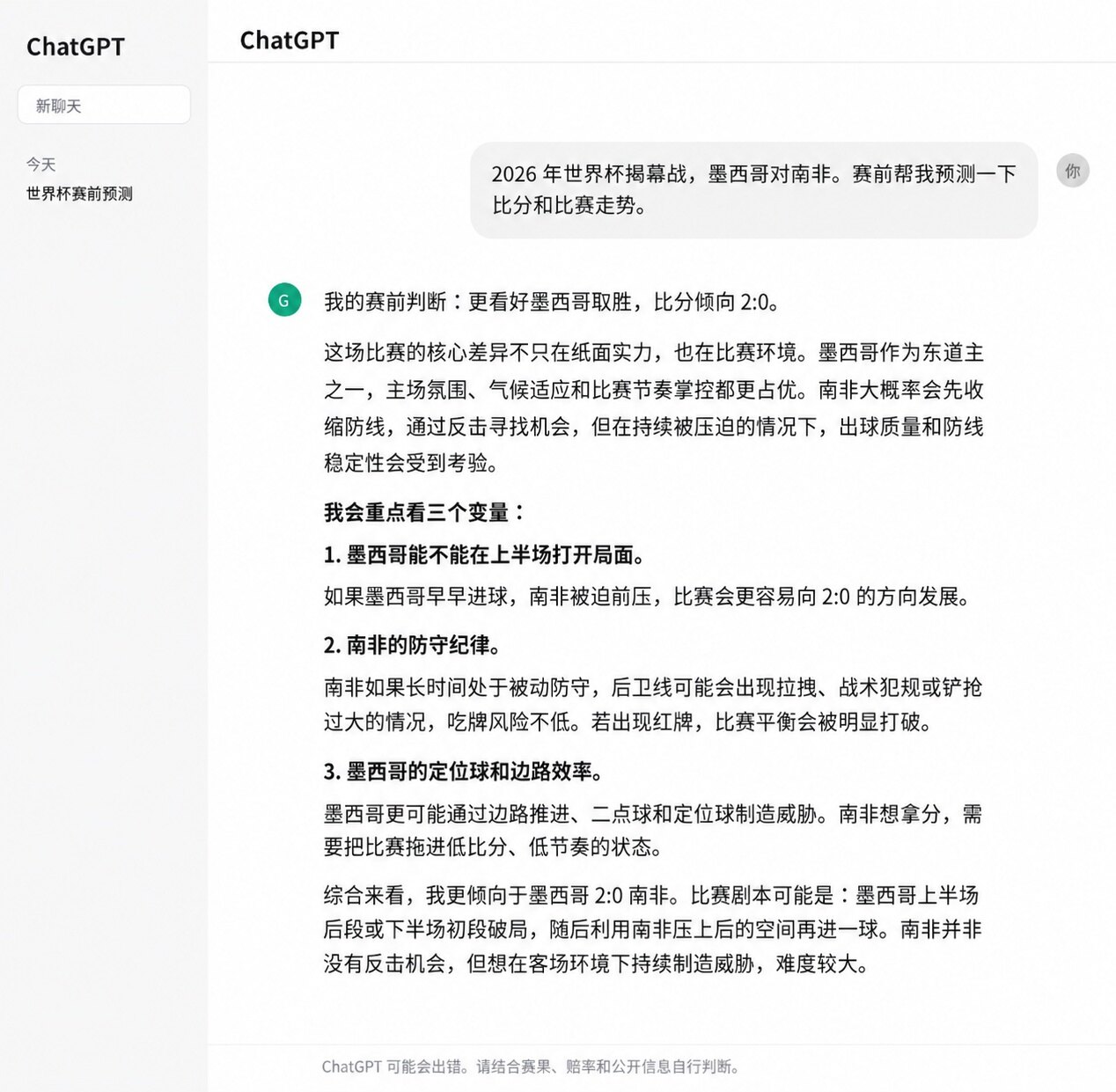
However, when it came to predicting the entire World Cup schedule, ChatGPT's consistency was not as strong. Although it correctly predicted Mexico 2:0 against South Africa and Brazil 1:1 against Morocco, and also identified the win/loss direction for several matches including Scotland, Germany, and Sweden, in matches like South Korea 2:1 Czech Republic, Qatar 1:1 Switzerland, Australia 2:0 Turkey, and Japan 2:2 Netherlands, ChatGPT's judgments leaned towards favoring teams with stronger paper strength. For example, it assumed that Switzerland should beat Qatar, Turkey should beat Australia, and Netherlands should narrowly win against Japan.
ChatGPT is not without predictive capability; it can clarify a team's strength, home environment, and recent form very clearly and can hit scores in some matches. But based on the current results, it is more adept at explaining "why a popular team is more reasonable," rather than identifying in advance which matches might deviate from the expected storyline.
Gemini, Grok, Claude: Different models, different scripts for the same match
In addition to Qianwen, Copilot, and ChatGPT, some social media users have tested the same match by feeding multiple models for pre-match predictions.
Taking the opening match between Mexico and South Africa as an example, a blogger simultaneously tested ChatGPT, Gemini, Grok, and Claude for pre-match predictions. The results showed that both ChatGPT and Gemini predicted Mexico 2:0 South Africa, which turned out to be correct; Grok predicted Mexico 2:1, while Claude predicted Mexico 3:1. While both predicted Mexico's victory, neither hit the specific score.
This prediction for the opening match yielded three different "scripts" from different models. ChatGPT Go and Gemini Pro were closer to the actual match: Mexico had the advantage, and South Africa struggled in attack, eventually being shut out. Grok provided a more open scoreline, suggesting that South Africa might find success in counterattacks. Claude Sonnet raised the offensive expectations for Mexico higher, offering a more open-ended result of 3:1.
Conclusion
As the currently retrievable AI prediction samples are still limited, it is not yet possible to directly determine which model "understands the game" the best.
However, just from the few matches that have concluded, differences have already begun to emerge. Qianwen currently stands out, accurately predicting Mexico 2:0 South Africa and Korea 2:1 Czech Republic on the first day, while also hitting on the red card risks and match trends, representing a highlight performance within the small sample. However, whether it can continue to hit accurately needs further match validation.
Both Copilot and ChatGPT have highlighted specific scores, but both have exposed a common issue—when faced with unexpected outcomes like Australia defeating Turkey, Qatar drawing with Switzerland, and Japan tying with the Netherlands, their judgments still lack sensitivity.
As for models like Gemini, Grok, and Claude, the publicly available samples are more focused on single matches or social media comparisons, which have reference value but are not suitable for direct ranking.
AI can already serve as a layer of reference for users in the World Cup prediction market, but it is still far from being the definitive answer. In the future, Odaily Planet Daily will continue to collect pre-match predictions from various models and review as matches progress: which models were simply lucky at the start, and which models can truly withstand the test of match results in more fixtures.
免责声明:本文章仅代表作者个人观点,不代表本平台的立场和观点。本文章仅供信息分享,不构成对任何人的任何投资建议。用户与作者之间的任何争议,与本平台无关。如网页中刊载的文章或图片涉及侵权,请提供相关的权利证明和身份证明发送邮件到support@aicoin.com,本平台相关工作人员将会进行核查。


