It seems necessary to popularize the importance of stock compliance!
Introduction: The difference between compliance and non-compliance is like heaven and earth. If the stock source of SpaceX is real, then even so, the biggest difference between compliant exchanges and MSX lies in this point! This is the biggest pain point for non-compliant exchanges, almost without exception.
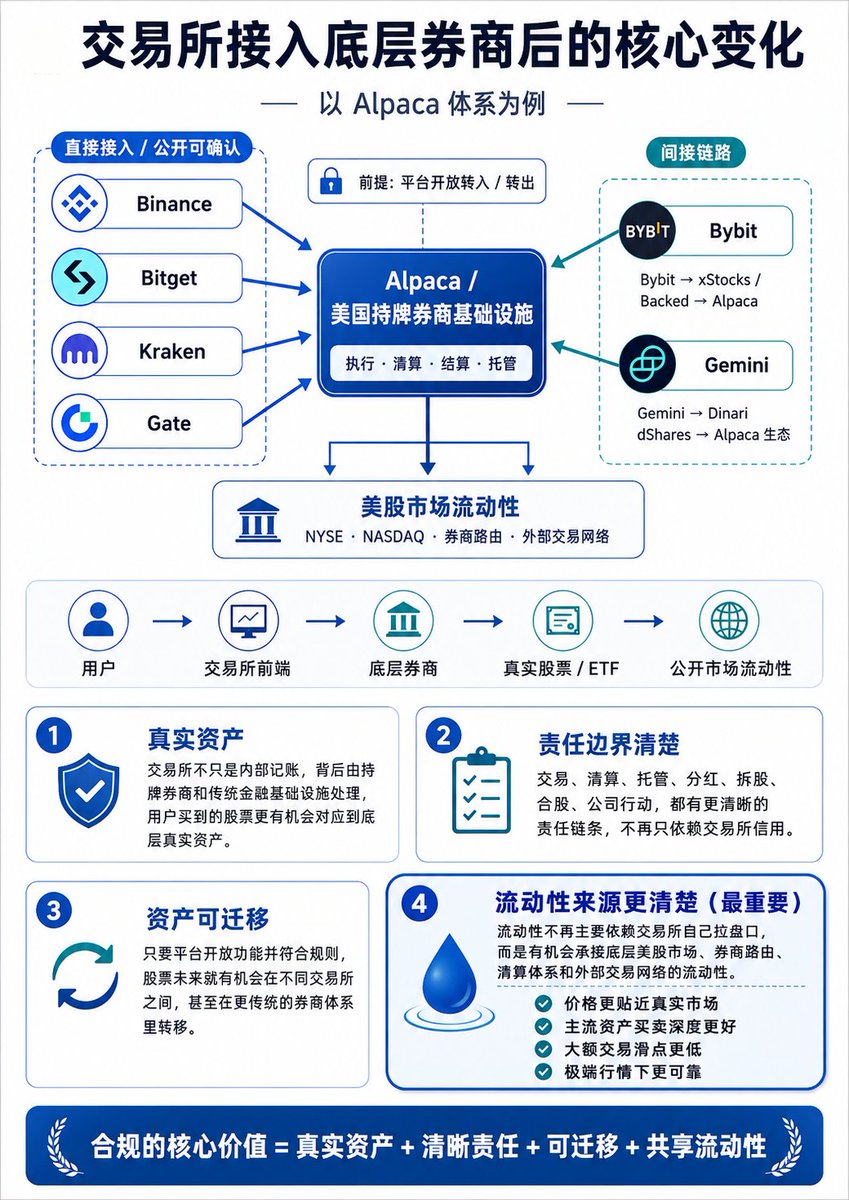
After major exchanges have integrated compliant underlying brokers, the stocks in these compliant exchanges theoretically have a basis for mutual transfer.
Especially Binance and Bitget, because both have connected to infrastructures of licensed U.S. brokers like Alpaca, as long as the exchanges are willing to open up transfer in and out, the stocks held by users have the opportunity to be transferred between different platforms.
Furthermore, as long as these exchanges use real U.S. brokers, clearing, and custody systems rather than just internal bookkeeping, stock assets will have the opportunity to be transferred within the traditional broker system in the future.
That's why compliance is so important.
First, after compliance, users’ assets are no longer just placed on the exchange's own platform.
The exchanges serve more as front-end entrances, while the actual order execution, clearing, settlement, and custody are handled by licensed brokers and traditional financial infrastructures. This way, the stocks users purchase have the opportunity to correspond to the underlying real assets rather than just a price mapping provided by the platform.
Second, after compliance, the boundaries of responsibility become clearer.
Who is responsible for trading, who is responsible for clearing, who is responsible for custody, who handles dividends, stock splits, mergers, and corporate actions—these matters follow traditional financial system processes.
If an exchange simply issues a so-called stock Token on its own, users ultimately rely on the exchange's credibility. However, if the underlying connects to real brokers, users can at least trace back to the underlying brokers, custody, and clearing chains.
Third, after compliance, asset migration becomes possible.
Traditional brokers can already do stock transfers for custody; in the future, if cryptocurrency exchanges all connect to compliant broker systems, users won’t necessarily be locked into a single platform. For example, with the recent developments from Tiger, Futu, and ChangQiao, users do not need to sell all their stocks but can transfer them to other brokers instead.
In the cryptocurrency field, it’s actually even more interesting. Do you guys know which exchanges are using Alpaca's solution? Let me count for you:
A. Binance
B. Bitget
C. Kraken
PS: You might not know, Kraken's U.S. stock ETF trading is launched in collaboration with Alpaca, and xStocks also uses Alpaca as its underlying stock partner.
D. Gate
E. Bybit
F. Gemini
PS2: Gemini’s tokenized stocks are provided by Dinari dShares, and Alpaca's ITN launch partners include Dinari. So, Gemini’s supply chain may be involved with the Alpaca system through Dinari.
So, as I mentioned at the beginning, right now exchanges are still in the early stages of stocks. If exchanges are willing to open up, at the very least, those using Alpaca as the underlying can be mutually transferable.
Fourth, after compliance, the sources of liquidity will be clearer (the most important point).
Once the U.S. stock broker system is genuinely integrated, liquidity will no longer solely depend on the exchange’s internal order book nor the platform's own market-making, but rather have the opportunity to tap into the underlying U.S. stock market, broker routing, clearing systems, and external trading networks' liquidity.
For publicly traded assets like NVDA, TSLA, VOO, QQQ, or even the just-listed SpaceX, the core advantage lies here, as the underlying assets themselves have mature markets, real transactions, and continuous quotes—platforms simply connect this liquidity access to cryptocurrency users.
Put simply, once compliant exchanges integrate with underlying brokers, liquidity is no longer provided solely by the exchange, but is shared including traditional counterparts that are very likely trading on the Nasdaq like the New York Stock Exchange.
The benefits are obvious:
First, prices are more likely to reflect the real market, avoiding becoming the exchange's self-set prices.
Second, the depth of buying and selling large assets will improve, especially with mainstream U.S. stocks and ETFs, without needing to rely entirely on the exchange to pull the market.
Third, there will be lower slippage for users during large trades because it connects to mature market liquidity.
Fourth, in extreme market conditions, the real market quotes, transactions, and clearing systems are more reliable than internal market-making on a single platform.
Anyone claiming to be a trader should understand these four points; this is crucial! If you can’t recognize this point, honestly, don’t call yourself a trader because you don’t even understand liquidity.
The difference from MSX becomes clear. MSX deals with Pre-IPO assets, selling the point of being early, allowing users to participate in popular companies like SpaceX, OpenAI, or ByteDance that haven't gone public yet.
However, the biggest problem with such products is that what users obtain is usually not stocks in their own names but rather some SPV, contractual structures, platform certificates or economic rights. The most critical aspect is not whether there is a Token but who holds the underlying shares, where the custodial proof is, whether the issuing company recognizes it, how to exit in the future, and whether genuine redemption is possible.
Of course, many don’t care about this; they only care about getting their money, which is understandable, but products like MSX's Pre-IPO assets are inherently non-compliant; all stocks are tokens issued by themselves. Even without the risk of running away, liquidity is built on their own.
As long as the platform doesn’t provide liquidity, or there aren’t enough buy orders, it can be difficult for users to sell assets regardless of their value. Those involved with MSX need not to be told; just compare the liquidity of SpaceX in MSX with other compliant exchanges, and waiting until the Nasdaq opens on Monday will make the liquidity gap between them very clear—it’s the biggest difference between compliant and non-compliant.
I remember someone said my tweets led them to buy less of SpaceX’s shares in MSX, resulting in lower profits. So, I want you to take a look at the liquidity of SpaceX in MSX now and tell me, if you bought $1 million of SpaceX stock, could you sell it? How much could you sell it for??
So the core value of compliant stock solutions like Binance and Bitget integrating with Alpaca is standardization, custodianship, clearing, and future transferability. The core value of Pre-IPO RWA products like MSX is early opportunity, great stories, and scarce quotas, but risks are concentrated in complex structures, difficult verification, and uncertain exit. One focuses on the underlying brokers, custodianship, and clearing system while the other looks at SPVs, asset proof, and redemption capabilities.
In the future, when looking at exchange stock businesses, don't just ask if you can buy and don't just consider if it’s popular names like SpaceX or OpenAI. What truly matters is to know who the underlying broker is, where the stocks are held, whether users are getting standard securities or platform certificates, and if assets can be transferred out or recognized by the external financial system.
This is the value of compliance. Ju Coin serves as a warning; it initially attracted many investors by offering discounts, indeed making money for many, but people are driven by greed—while you seek returns, Ju Coin seeks your principal.
I have never said that MSX will follow the old path of Ju Coin, but at the very least, one should understand the composition of MSX’s funds. Recently, many have been digging into addresses, knowing why certain exchanges are sacrificed each cycle? It’s because these exchanges are non-compliant, using users' assets for other purposes, leading to insufficient funds for user withdrawals—FTX fell because of this kind of situation.
The money is yours; it’s none of my business. I never blame any exchanges for their mistakes in innovation, non-compliance is okay, but non-compliance should be called out rather than pretending to be compliant to deceive people.
免责声明:本文章仅代表作者个人观点,不代表本平台的立场和观点。本文章仅供信息分享,不构成对任何人的任何投资建议。用户与作者之间的任何争议,与本平台无关。如网页中刊载的文章或图片涉及侵权,请提供相关的权利证明和身份证明发送邮件到support@aicoin.com,本平台相关工作人员将会进行核查。


