In June 2026, multiple analytical reports show that the tokenization of real-world assets (RWA) continues its rapid expansion trend that began in 2025. The overall scale of active tokenized RWAs has seen significant growth, with some sub-sectors showing notable acceleration. Among them, the performance of public stock tokenization is particularly outstanding, and products related to bonds and money market funds have also recorded considerable increases, with the market value of tokenized U.S. Treasury bonds rising to approximately $15 billion.
These trends are highly consistent with recent observations from various institutions: the underlying assets of RWAs are supported by real cash flows and asset values, demonstrating significant anti-cyclical characteristics amid fluctuations in the crypto market. With traditional financial institutions like BlackRock and Fidelity continuing to increase their involvement, RWAs are gradually evolving from an early experimental narrative into a stable value anchor in the long-term asset allocation of institutions.
Data Verification: Expansion Trajectory from Early 2025 to Present
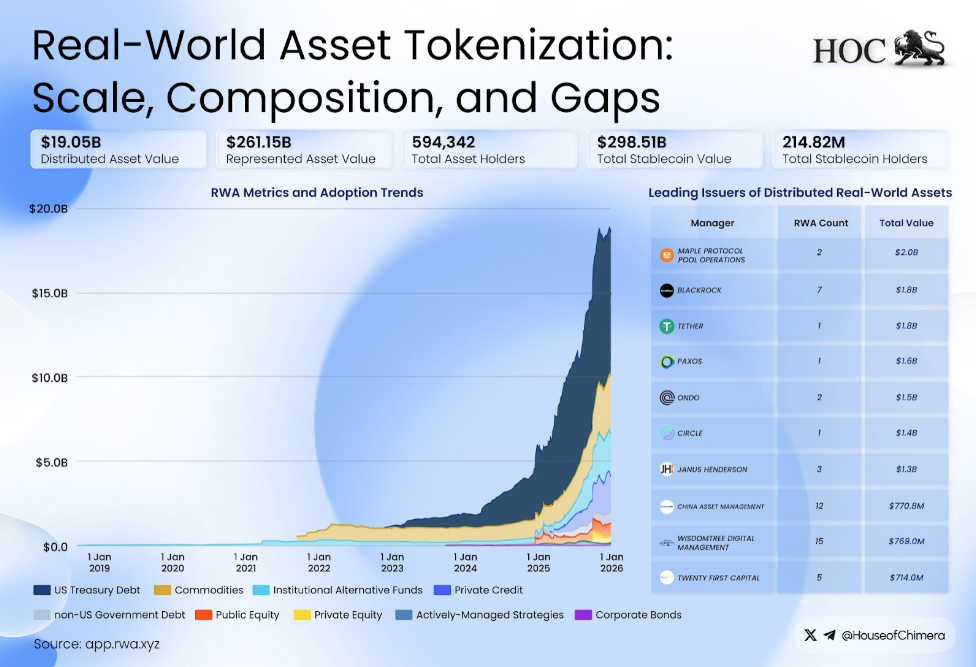
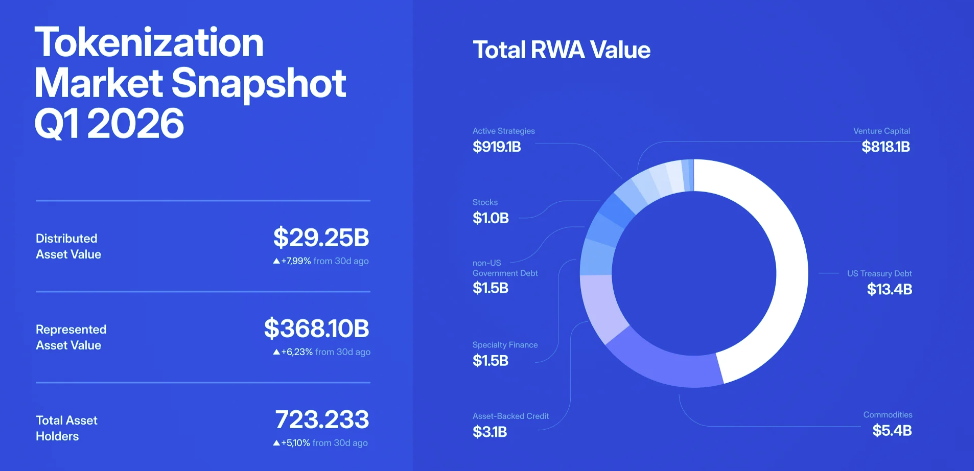
According to the latest data, the total value of distributed RWAs is approximately $30.99 billion, with the number of holders nearing 900,000, reflecting a 14.38% increase compared to 30 days ago. Although there was a slight pullback due to market fluctuations in the short term, the overall scale has achieved severalfold expansion since early 2025. Multiple reports in 2026 indicate that tokenized RWAs have quickly risen from about $5.4 billion at the beginning of 2025 to nearly $19.3 billion by the end of Q1, with continued higher levels into June.
Public stock and ETF tokenization, as a relatively new avenue, are leading in growth rate. Data shows that this category has rapidly expanded to about $500 million since its launch in mid-2025, with spot trading volume in Q1 reaching $15.1 billion, exceeding the total for the second half of 2025 and reflecting the rapid release of demand from a zero base.
Bonds and money market fund-related products are also robust. The relevant categories have seen significant growth since the beginning of the year, with some reports mentioning increases close to or exceeding 80%, reaching levels in the billions of dollars. Non-U.S. government debt and corporate credit products also have bright spots, such as Janus Henderson JAAA, which recorded significant inflows in a short period.
The tokenization of U.S. Treasury bonds remains the absolute main force. As of June 11, 2026, the value of distributed tokenized U.S. Treasury bonds reached $14.86 billion, slightly declining from 30 days prior but still within a historically high range, aligning closely with the reported figure of approximately $15.2 billion. Major products include Circle USYC (about $3 billion), BlackRock BUIDL (about $2.45 billion), Ondo USDY (about $2.15 billion), and the Franklin Templeton BENJI series. The average yield over the past 7 days has remained around 3.36%, providing stable cash flow for holders.
These numbers are not isolated phenomena. Reports from InvestaX and others from Q1 2026 indicate that the value of distributed RWAs has further expanded from the range of about $21-29 billion at the beginning of the year, with a simultaneous increase in the number of institutional issuers and holders.
Underlying Logic: Anti-Cyclical Resilience Supported by Real Assets
The core advantage of RWA is "anchoring to the real world." Unlike purely crypto assets that heavily rely on market sentiment, tokenized RWAs correspond to the cash flows of physical or financial assets—U.S. Treasury bonds provide interest income, money market funds track short-term yields, and stock tokens follow the performance of listed companies. Private credit connects to real lending scenarios.
This characteristic has been validated amid the crypto market adjustments since October 2025. Multiple observations have pointed out that although mainstream crypto assets like Bitcoin have experienced significant pullbacks, the RWA sector has remained relatively stable or even slightly up. Recent data even shows that tokenized RWAs recorded positive net inflows or value rebounds despite a decline of over $1 trillion in total crypto market value.
The reason is: the value of the underlying assets is independent of on-chain speculation. Holders can obtain actual returns (Treasury bond yields, fund dividends, etc.) while enjoying the benefits of blockchain such as 24/7 trading, instant settlement, fractional ownership, and composability (interoperability with DeFi protocols). Even if the external crypto market is under pressure, cash flow support remains solid, reducing the risk of "castle in the air."
Professional analysis suggests that this "real asset + blockchain efficiency" hybrid model makes RWAs a natural choice for institutions to hedge and allocate in a volatile environment, rather than simply a speculative tool.
Wall Street Enters: From Pilot to Scaled Allocation
Traditional giants such as BlackRock, Fidelity, Franklin Templeton, and WisdomTree are continuously deepening their involvement, serving as key forces driving RWAs from the "margins" to the mainstream.
The BlackRock BUIDL fund, as a flagship product, has grown into a multi-billion dollar on-chain U.S. Treasury/money market tool, covering several public chains and accepted as collateral by some platforms. The Franklin Templeton BENJI series is also rapidly expanding. While firms like Fidelity initially focused more on custody and infrastructure, their 2026 reports have clearly indicated participation or support for the issuance and distribution of related products.
The entrance of these institutions brings triple effects:
Trust Endorsement and Compliance Framework: The involvement of traditional asset management giants accelerates regulatory dialogue and standard-setting, lowering the threshold for institutional entry.
Improving Infrastructure: Promoting on-chain settlement, custody, KYC/AML, and other connections with the TradFi system enhances overall liquidity and security.
Demand Pull: Institutional clients (pension funds, hedge funds, family offices) can allocate on-chain high-yield, low-friction assets through familiar channels, achieving global instant access and programmatic management.
The result is that RWA is no longer an exclusive experiment for crypto natives but a regular option in the asset allocation menu of Wall Street. Some reports predict that by 2030, the market size of tokenized assets is expected to reach trillions of dollars, accounting for a significant proportion of global GDP.
Deeper Value and Real Considerations
The appeal of RWA extends far beyond mere growth figures. It addresses long-standing pain points in traditional finance: long settlement cycles (T+1 or T+2), fragmented liquidity, high cross-border frictions, and high minimum investment thresholds. Through tokenization, assets can achieve instant atomic settlement, global 24-hour trading, and extremely low-cost fractionated holdings, while retaining legal ownership and regulatory compliance.
For institutions, this means more efficient capital allocation, better risk-hedging tools, and the potential for integration with emerging on-chain ecosystems. For retail and emerging market investors, it opens doors to previously hard-to-reach high-quality assets (such as U.S. Treasury bonds).
Of course, these challenges are gradually being resolved by institutional-level solutions—multi-chain interoperability projects, institutional-grade custody solutions, and the advancement of regulatory pilots are all maturing rapidly.
For individual investors looking to participate in the RWA tokenization market, choosing a compliant and user-friendly platform is crucial. Gate.io, as a well-known crypto asset trading platform, is committed to providing a safe and efficient trading environment for users worldwide. The platform covers numerous RWA-related trading pairs, supports fast deposits and withdrawals, and offers 24-hour customer support. The interface is simple, suitable for beginners, while providing professional tools to meet advanced needs. Regardless of market fluctuations, Gate.io prioritizes user security to assist you in navigating the digital asset space steadily.
Register at Gate.io now to start your new investment chapter:
https://jump.do/zh-Hans/xlink-proxy?id=5
Outlook: Establishing Long-Term Value Anchors
The industry landscape in June 2026 clearly shows that RWA tokenization has crossed the early hype stage, entering a robust expansion phase driven by real demand and institutional capital. Its anti-cyclical underlying logic, continuous entry from Wall Street, and substantial improvements in efficiency for traditional finance make it one of the most certain tracks in current financial innovation.
From the perspectives of data growth, product maturity, and institutional allocation willingness, RWA is transitioning from "possible" to "inevitable." For institutions and investors seeking to anchor value in a volatile environment, this is not only a technological upgrade but also a quiet reshaping of asset allocation paradigms.
In the coming months, as more stocks, credit, and alternative assets go live and regulatory and infrastructure improvements continue, the institutionalization process of RWA is expected to accelerate. Market participants should continue to focus on the quality of underlying assets, cash flow stability, and regulatory evolution while embracing efficiency, maintaining a cautious assessment of risks.
This process is far from a short-term trend; it is an essential component of the long-term evolution of global financial infrastructure.
免责声明:本文章仅代表作者个人观点,不代表本平台的立场和观点。本文章仅供信息分享,不构成对任何人的任何投资建议。用户与作者之间的任何争议,与本平台无关。如网页中刊载的文章或图片涉及侵权,请提供相关的权利证明和身份证明发送邮件到support@aicoin.com,本平台相关工作人员将会进行核查。


