Original|Odaily Planet Daily(@OdailyChina)
Author|Wenser(@wenser2010)
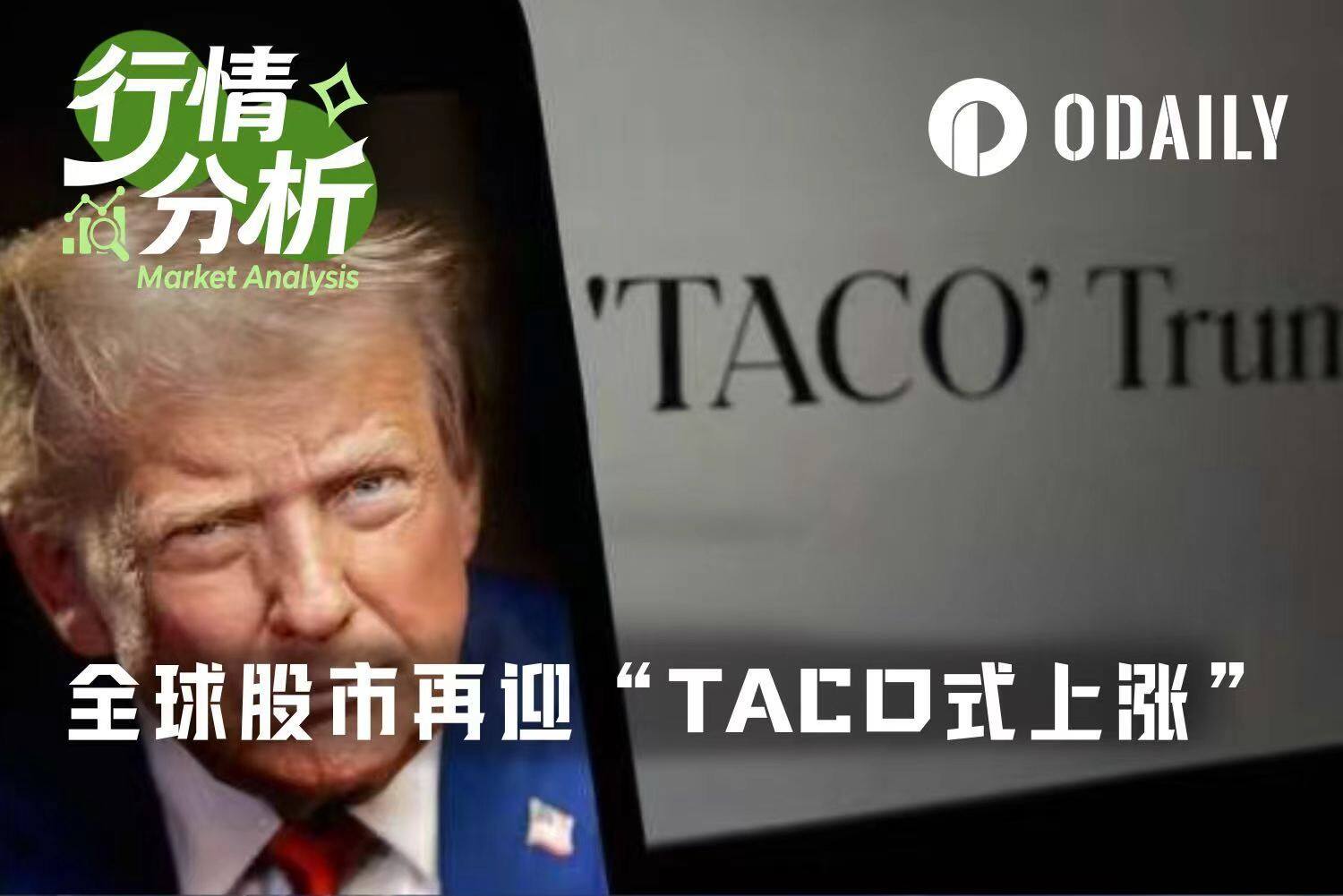
After the U.S. military launched a surprise attack on Iran and Trump threatened to take "tough measures against Iran" only to cancel again, Trumpshouted for the 38th time that "a final agreement is about to be reached," and the global financial markets, including the U.S. stock market, awakened as if from a dream to welcome another "TACO-style rise."
This morning, the three major U.S. stock indices rose collectively, with the Dow up 1.90%, the Nasdaq up 3.42%, and the S&P 500 index up 1.73%; cryptocurrency concept stocks rose broadly, with COIN rising 4.99% during the day and HOOD rising 7.40%. The Japanese and South Korean stock markets opened high, with South Korea's KOSPI index opening up by 519.25 points, an increase of 6.69%, reporting 8283.2 points and triggering a trading halt, with later gains expanding to 8%; the Nikkei 225 index opened up 880.53 points, an increase of 1.37%, reporting 65097.80 points. Possibly influenced by this news, oil prices plummeted by 4.3%, and gold prices rebounded by 3.1%.
As the U.S.-Iran conflict enters its fourth month, global financial markets, especially the U.S. stock market, are pricing in the favorable outcome of war ending in advance, leading to a recent series of "news-based boosts" gaining momentum.
Macro Background: Trump "Negotiates for Change," U.S. CPI Data Hits Three-Year High, Fed Rate Hike Expectations Fade
In summary, the macro background for today's stock market rise mainly includes the arrival of peace talks in the war situation, the publication of the U.S. CPI index, and the fading expectations of Fed rate hikes.
Trump's Remarks Again Show "TACO Power"
According to the latest news last night and this morning, Trump first canceled the planned strikes and bombings against Iran; he then stated that relevant consultations had been submitted to Iran's top leadership and were approved; the final terms (whether in overall conception or specific details) have been approved by all relevant parties, including the U.S., Israel, Saudi Arabia, the UAE, Qatar, Turkey, Pakistan, Bahrain, Kuwait, Jordan, Egypt, etc. Although Iran and Israel subsequently denied this, the market accepted it.
Additionally, Trump stated regarding the Iran issue that "an excellent agreement has been reached," noting that the relevant documents have entered the final drafting stage, are expected to be finalized within the next few days, and will soon be signed. He also mentioned that the agreement might be signed in Europe, possibly this weekend, with U.S. Vice President Pence in attendance. And "once Iran signs the agreement, the Strait of Hormuz will be open." Although negotiations with Iran have "taken too long," the financial market has chosen to "believe first."
U.S. Core CPI Year-on-Year Data Hits Three-Year High
This Wednesday, the U.S. released May CPI data, which included:
- Seasonally adjusted monthly CPI of 0.5%, expected 0.50%, previous value 0.60%.
- U.S. May seasonally adjusted core CPI monthly rate of 0.2%, expected 0.30%, previous value 0.40%.
- U.S. May unadjusted CPI year-on-year of 4.2%, expected 4.20%, previous value 3.80%, hitting a new high since April 2023.
- U.S. May unadjusted core CPI year-on-year of 2.9%, expected 2.90%, previous value 2.80%, a new high since September 2025.
Some analysts believe that with U.S. inflation levels returning to the "4-range," the peak of war-related inflation may have passed; the CPI has risen significantly for the third consecutive month, highlighting the increasing pressure on households' spending, as there are signs that more consumers are tapping into savings to cover expenses. After the data release, the probability of the Fed maintaining interest rates in June was 96.3%, significantly easing previous expectations of Fed rate hikes. Trump responded to this data by stating loudly, "I love inflation."
Federal Reserve Rate Hike Expectations Significantly Eased
After the release of the CPI data, latest news shows that the market no longer fully accounts for the expectation of Fed rate hikes this year.
Seema Shah, Chief Global Strategist at Principal Asset Management, noted that "the U.S. inflation rate remains at an unsettling high of 4%, but the core data being weaker than expected has indeed alleviated some pressure. As energy prices are the main driving factor, and housing costs have alleviated, we have yet to see clear signs of a broader second-round effect, which should allow the Fed to remain patient."
Afonso Borges, an analyst at Balyasny Asset Management, also pointed out that the moderate rebound led by short-term treasury bonds after the CPI report release on Wednesday is "reasonable," since better-than-expected inflation data should reduce the risk of the Fed raising rates later this year.
Korean and Japanese Markets: Retail Investors Borrow to Buy the Dip, Yen Continues to Depreciate
Shifting focus to the Japanese and South Korean stock markets, after declines in the previous two days, they are currently in a substantial rebound phase.
On June 10, according to reports from Yonhap News, affected by negative news from the U.S. stock market and the sharp decline of semiconductor stocks, South Korea's composite stock price index (KOSPI) experienced intense adjustments over two days. During this period, the overdraft account balances of major commercial banks increased by over 600 billion Korean won (about 26.7 billion RMB). Analysts believe this is due to retail investors, expecting a market rebound after the sharp decline, beginning to utilize overdraft accounts for "borrowed investments."
According to Nikkei news, the Bank of Japan (BoJ) is expected to raise its short-term policy rate from 0.75% to 1.0% in its monetary policy meeting on June 15-16, marking the highest policy rate level since 1995. Possibly influenced by this news, the dollar against the yen (USD/JPY) rose 0.2% during the day, with the current exchange rate at 160.168.
Overall, the volume of funds in the Japanese and South Korean stock markets is still steadily increasing, but the BoJ's interest rate hike may gradually tighten the liquidity in Japan's capital markets. Bank of America analyst Shusuke Yamada stated that if the BoJ takes a hawkish stance in next week's meeting, it is expected to support the yen. He pointed out that the market has already priced in the expectation of rate hikes.
Outlook: Uncertain War Situation, Institutions Warn of Deep Corrections, Stock Markets Face Major Liquidity Tests
Despite today’s stock market rises spurred by Trump's unpredictable "good news," a closer look at various dynamic factors shows that market sentiment remains cautious and vigilant against deep corrections.
No Turning Point in U.S.-Iran Situation
Ali Akbar Dareini of the Tehran Strategic Research Center stated that although Trump announced the cancellation of strikes against Iran, there has been no change in the situation. From Iran's perspective, before any negotiations begin and before Iran is ready to discuss nuclear issues, the U.S. must first take trust-building measures, which have not occurred. The reality shows that the U.S. has not taken any steps to ease tensions. Iran's position is one that will not compromise under coercion.
Institutional Bulls Shift, Caution Against Deep Corrections
Alex Altmann, the global equity strategy head at Barclays, who has repeatedly called for "holding stocks steady" amid market volatility and accurately timed rebounds, rarely issued a cautious warning recently, stating that due to the technical overbought conditions, excessively heated sentiment, and macro environmental pressures, he has turned bearish on the short-term outlook for U.S. stocks. He believes that the current U.S. stock market is at the "midway point" of a structural correction, and the biggest concern currently is the significant disconnect between retail sentiment and macro reality. He even stated, "The S&P 500 index may face a total adjustment of 6%-7%."
Recently, the American Association of Individual Investors (AAII) sentiment survey data shows that the bearish sentiment among investors has surged to 47.7% in the past week, nearing the year's highest level of 52% (on March 18), far exceeding the historical average of 31%.
In addition, several institutions have recently expressed bearish views: Previously, BofA Securities stated that investors should be cautious about U.S. stocks, as an increasing number of bear signals indicate that the market is approaching a peak.
The team of strategists led by Savita Subramanian wrote in a report dated June 5 that approximately 70% of bear market signals have been triggered, consistent with the historical average level observed at market peaks. The S&P 500 index shows statistical overvaluation in 17 out of 20 valuation metrics, with 8 metrics exceeding levels from the tech bubble period. Moreover, high P/E ratio stocks have significantly outperformed low valuation stocks, which strategists believe is a sign of excessive speculation. Within the technology sector, the gap between the best and worst performing quintiles has widened to the highest level since February 2000.
Of course, this view has been firmly opposed by the "new stock god" Serenity, who believes that one should cautiously regard Bank of America's bearish arguments, as the appearance of numerous negative messages typically arises from institutions needing liquidity.
In the South Korean stock market, on June 10, the open interest in put options for the KOSPI 200 index has recently surged compared to call options, now approaching levels that have previously indicated an impending market drop. As of the last trading day's close, the ratio of protective put options for hedging against declines to speculative call options has approached 2.5 times, reaching a five-year high. This indicator has only touched this threshold a few times before. Notably, South Korean retail investors sold over 1 trillion won of overseas stocks in the first week of June, which may signal that domestic investors are returning to their home stock market.
SpaceX IPO Approaching, U.S. Stock Market Faces Liquidity Test
The latest news states that retail subscription amounts for SpaceX's U.S. IPO have exceeded $100 billion. Combined with previous news that "SpaceX plans to raise $75 billion, with 30% of the shares offered to individual investors," the current retail subscription ratio has exceeded four times the initial offer.
U.S. investment manager Jim Chanos stated that investors are pricing for grand narratives rather than realistic profit prospects, and SpaceX's valuation multiples have far exceeded Tesla (TSLA.O). Additionally, institutions such as Franklin Templeton, as well as Saudi and Kuwaiti sovereign wealth funds, have joined in the IPO subscription frenzy. According to foreign media reports, multiple institutional investors have placed orders for about $10 billion or more in stocks each. Two days ago, the SpaceX IPO attracted over $250 billion in investment demand, surpassing its planned $75 billion raise, with oversubscription nearing four times; following market trends, by this Friday before the official listing, the oversubscription ratio is expected to rise to ten times.
Tom Lee, the "Wall Street oracle" and chairman of Bitmine, commented that at this stage, U.S. stock investors are actively selling their existing stocks to raise cash to participate in this significant IPO, with the funds diversion effect continuing to ferment, possibly the culprit behind the recent weakness in the U.S. stock market. Christophe Boucher, Chief Investment Officer at ABN Amro Investment Solutions under Dutch Bank, also stated that participating in the SpaceX IPO is akin to buying cryptocurrency about 15 years ago; one could either lose all invested capital or achieve exponential returns.
Although the SpaceX IPO has sparked concerns about a liquidity crunch in the market, market news suggests that the S&P Dow Jones Indices believe SpaceX qualifies for rapid inclusion in certain indices. At that time, SpaceX may become a "phenomenal giant" in the U.S. stock market.
In summary, the global stock markets will still face influences from liquidity of funds, domestic market policies, and changes in global situations such as the U.S.-Israel conflict; in the short term, be vigilant against Trump potentially playing out a scenario of "threatening bearishness" and "TACO-style bullishness" in market manipulation.
免责声明:本文章仅代表作者个人观点,不代表本平台的立场和观点。本文章仅供信息分享,不构成对任何人的任何投资建议。用户与作者之间的任何争议,与本平台无关。如网页中刊载的文章或图片涉及侵权,请提供相关的权利证明和身份证明发送邮件到support@aicoin.com,本平台相关工作人员将会进行核查。


