TL;DR
- Oracle delivered strong earnings and cloud business guidance, but fell by more than 10% in after-hours trading, as the market worries that AI infrastructure is too costly.
- Demand has not disappeared; the question is how much free cash flow remains after orders pass through data centers, GPUs, electricity, and financing costs.
Related stocks: ORCL, NVDA, MSFT, AMZN, GOOG, META, QQQ, as well as potential IPOs OpenAI, Anthropic, SpaceX.
This Oracle earnings report is practically everything that AI bulls want to see.
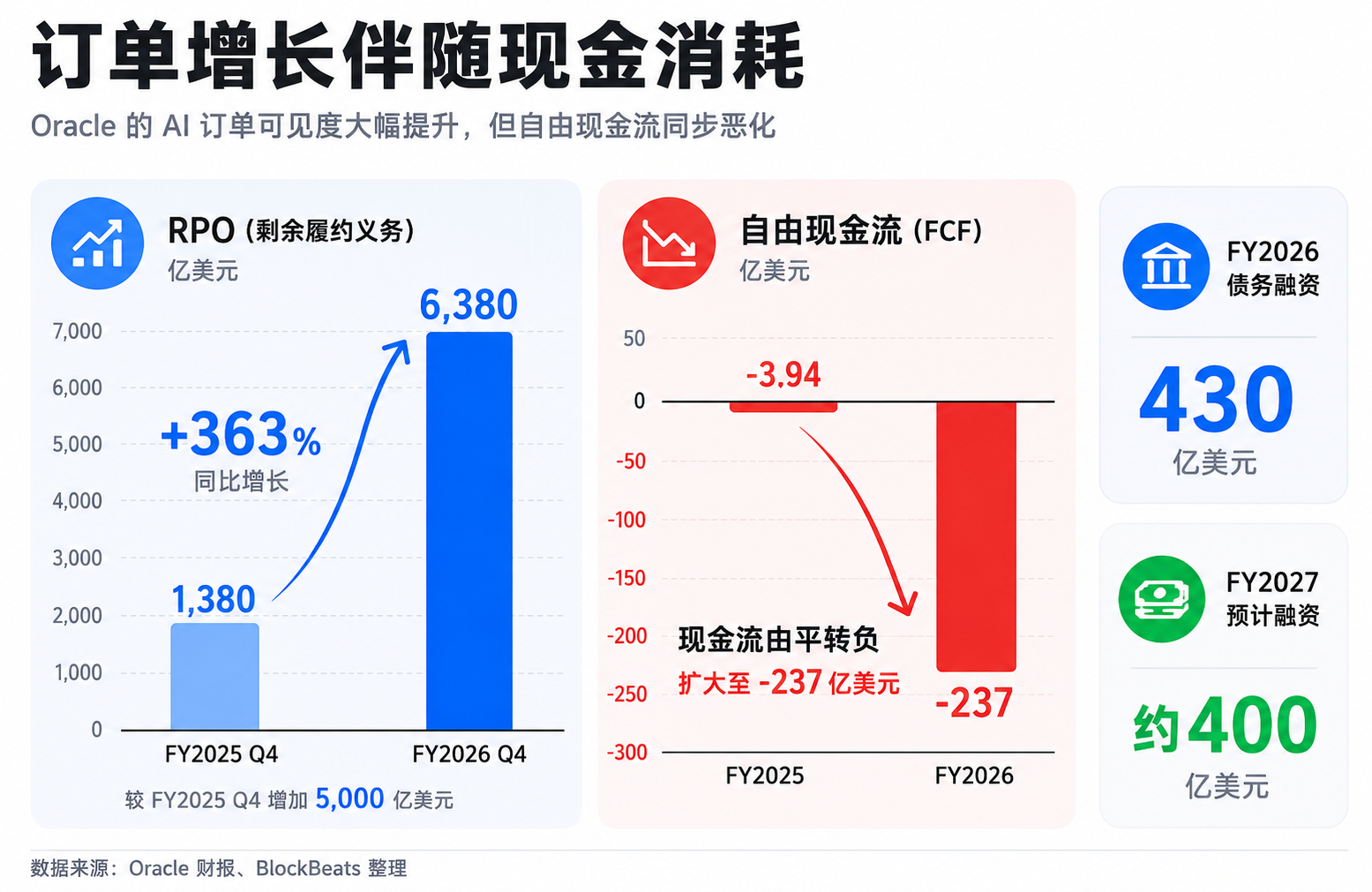
According to Oracle's official earnings report, Q4 fiscal year 2026 revenue was $19.2 billion, cloud revenue was $9.9 billion, IaaS (Infrastructure as a Service) revenue was $5.8 billion, a year-on-year increase of 93%. Remaining performance obligations (RPO, signed but unconfirmed revenue) increased from $553 billion to $638 billion. The guidance provided for Q1 fiscal year 2027 is also strong, with total revenue expected to grow 27% to 29% year-on-year, and cloud revenue expected to grow 57% to 63% at constant currency. The annual revenue guidance is set at $90 billion.
However, the market's initial reaction was not to reward but to sell off. Market data shows that Oracle, after extended trading, reached as low as $177.52 from a previous price of approximately $205.11, a maximum drop of about 13.5%.
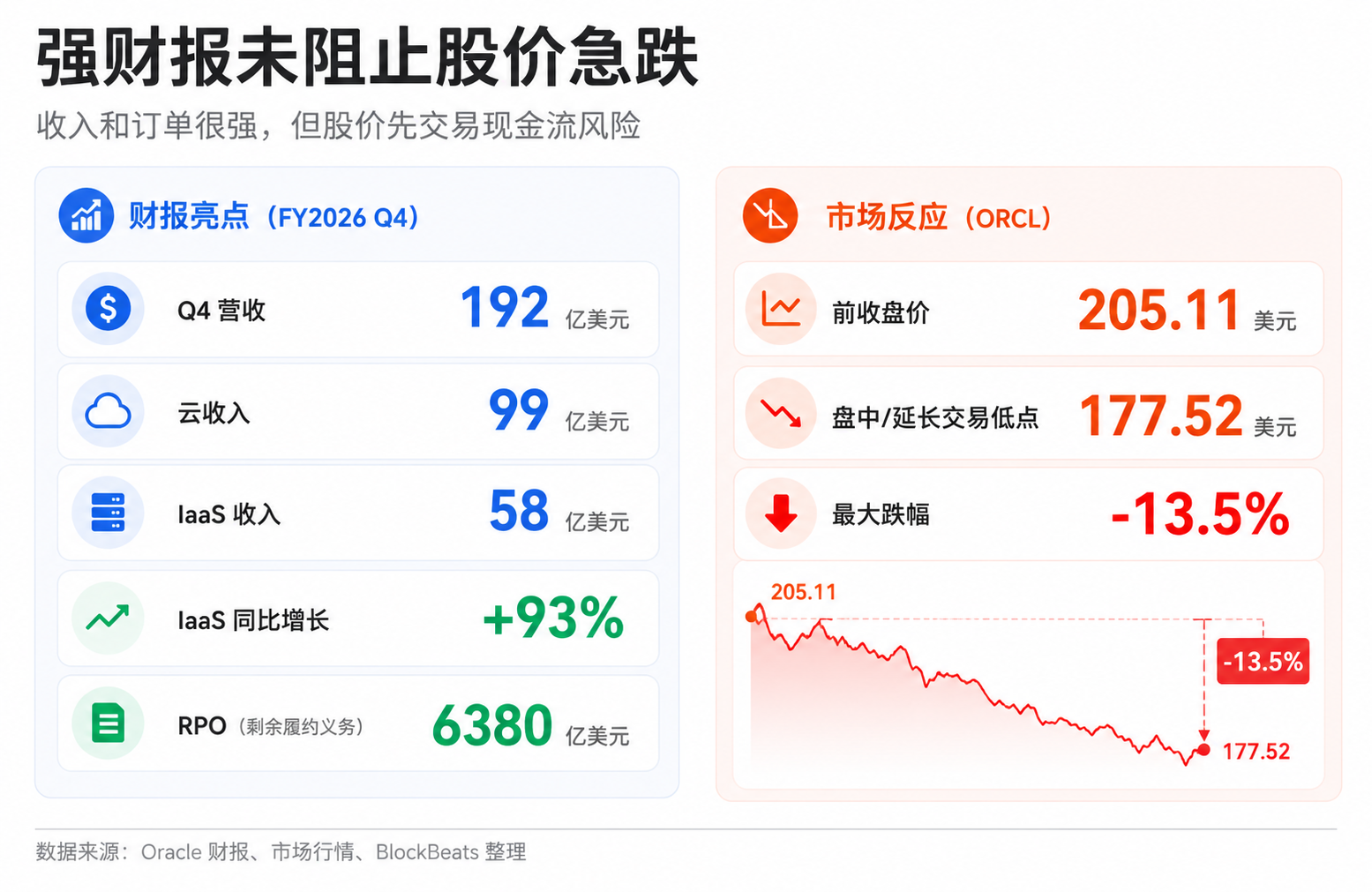
The most notable change in this round of AI trading is that the company speaks of growth while the stock price questions the return on investment.
In the past two years, the market was willing to pay a premium for "how large AI demand is." Growth in cloud revenues, compute orders, GPU procurement, and partnerships with model companies have all been reasons for upward revisions in valuation. Oracle's reaction this time indicates that the same set of good news is being recalculated by the market using a different formula: How much cash does the company need to spend upfront to secure orders? How much does it need to borrow? Does it need to issue stock? How long after the data center delivers will it be fully loaded? When will gross margins and free cash flow catch up?
AI demand still exists, but AI trading is shifting from "who gets the orders" to "who can manage the numbers."
Good earnings trigger financing concerns
From the revenue perspective, Oracle does not appear to be a company in trouble.
Fourth-quarter revenue exceeded market expectations, cloud revenue continued to expand, and IaaS growth was particularly strong. RPO showed significant growth, enhancing visibility for future revenues. For a company transitioning to AI cloud infrastructure, such data should support the narrative that "demand is real."
The company's guidance is equally aggressive. Revenue and cloud business are expected to maintain high growth in the next fiscal quarter, with a total revenue target of $90 billion for fiscal year 2027. Earnings calls and press releases also mentioned large AI infrastructure contracts, data center delivery progress, and collaboration leads with customers like OpenAI. Customers have not stopped placing orders, and demand for AI computing has not suddenly disappeared.
The market is now looking not only at the size of orders but also at the capital consumed behind those orders.
AI cloud is not a light asset software business. For Oracle to meet the demands of leading model companies and large enterprise customers, it needs to build data centers, procure or access GPUs, configure networks, electricity, cooling systems, and invest a significant amount of cash before customer revenue is fully confirmed. The larger the order, the more visible the future revenues, and the heavier the initial investment.
This is why good news has turned into a reason to sell. RPO growth indicates there is work to be done in the future but requires the company to build out capacity. High growth in cloud revenue proves strong demand while reinforcing market expectations for continued increases in capital expenditures. Investors begin to translate the same set of data into another question: Does this company need to use a heavier balance sheet to achieve this growth?
Oracle officially disclosed that free cash flow for fiscal year 2026 was -$23.7 billion. The company completed $43 billion in debt financing and $5 billion in equity financing during fiscal year 2026. For fiscal year 2027, the company expects to raise about $40 billion through debt and equity financing, including an announced $20 billion ATM equity issuance plan, and mentioned that no further debt issuance is expected for the calendar year 2026.
Here, there is also a reverse signal that needs to be integrated into the valuation framework. The company stated that in large AI contracts, the portion where customers prepay or self-source GPUs totals $75 billion, which can reduce the scale of capital Oracle needs to self-source. In other words, the pressure is not that "all the money must be advanced by Oracle," but that the market needs confirmation: after deducting customer prepayments and self-sourced hardware, are the remaining financing, depreciation, and operating burdens still too heavy?
Growth still has value, but the market is beginning to demand proof that the value of growth exceeds its cost.
AI infrastructure looks more like a power plant, not a software subscription
The most misleading aspect of AI infrastructure for investors is treating it like traditional software growth.
The ideal model for software companies is that once the product is completed, the marginal cost from new customers is low, and revenue growth can quickly translate into profits. AI cloud resembles a combination of power plants, highways, and warehouses. Before customers truly use the service, the company needs to have facilities, chips, power, and networks. After customers start using the service, it must also bear depreciation, operations, energy consumption, and upgrade costs.
This creates a time mismatch: cash flow pressure appears first, and profits are realized later.
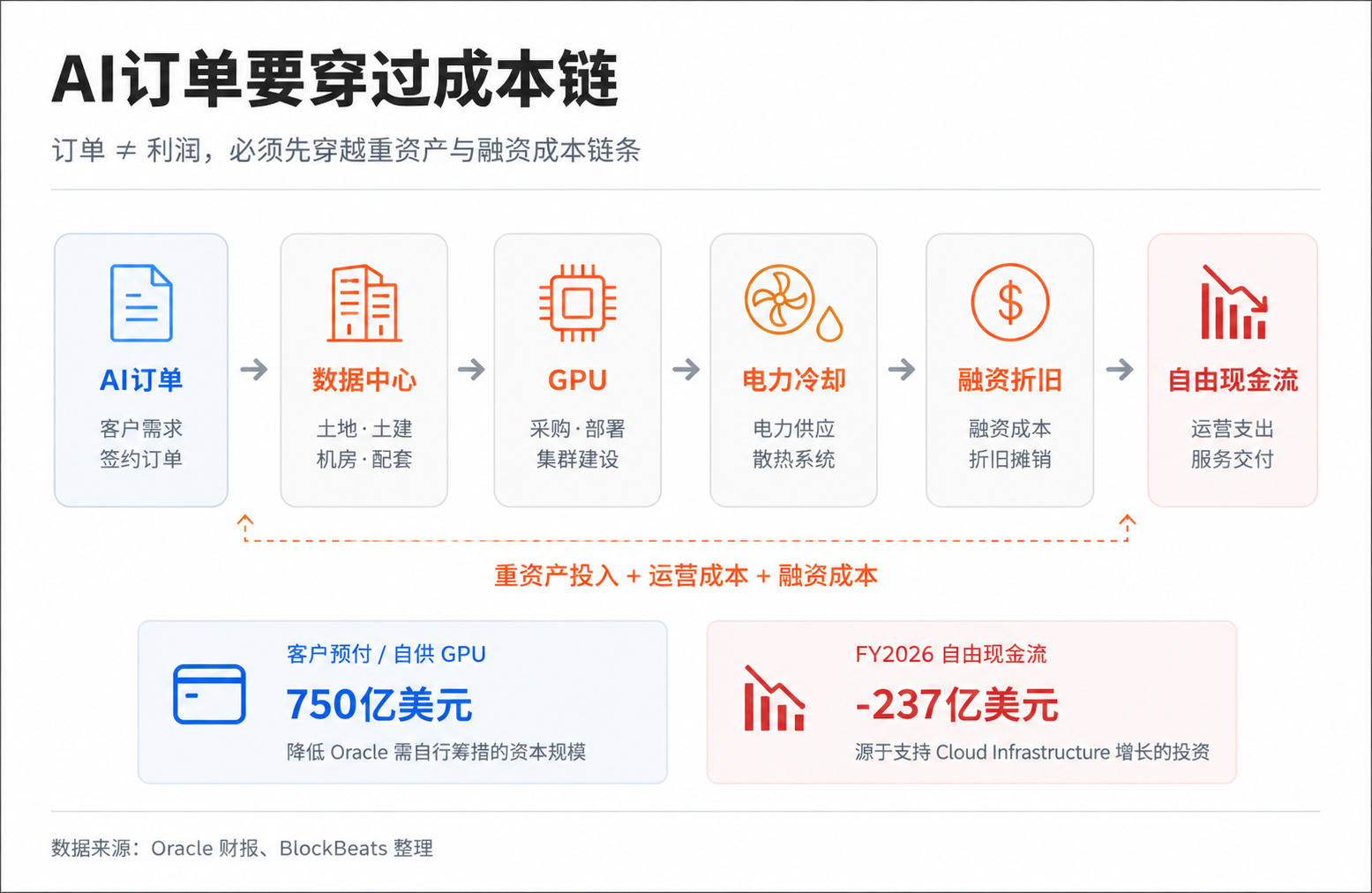
It can be understood as a restaurant receiving a large number of reservations and deciding to open more locations. Reservations indicate strong demand, but opening stores requires renting space, renovating, buying equipment, and hiring staff first. The more reservations there are, the faster the expansion, and the tighter the initial cash flow. Only when the new stores are filled, turnover rates stabilize, and per-customer spending covers rent and labor can those reservations turn into profits.
AI data centers follow a similar logic, just with larger amounts, longer cycles, and higher uncertainty.
Oracle is facing leading model companies and large enterprise customers. Their computing needs may be very real and could grow long-term. However, infrastructure providers must bet in advance: how many GPUs to buy, how much capacity to build, how much power to lock in, and at what price to sign long-term contracts. If future utilization ramps up slower than expected, or cloud service prices decline, or power and hardware costs exceed expectations, seemingly attractive orders today may not quickly convert into high-quality cash flow.
This is also why the market is particularly sensitive to capital expenditures.
Capital expenditures themselves are not a bad thing. For cloud vendors, expanding capacity is a necessary condition to capture AI demand. Nvidia, Microsoft, Amazon, Google, and Meta are all on the same chain: some sell chips, some build clouds, some train models, and some embed models into products. In the past, investors were willing to believe that the entire chain would benefit from an expansion due to AI demand.
However, as capital expenditures increase, the market will begin to distinguish between "spending money for growth" and "spending money for profits."
If a company's data center is quickly full, customers renew contracts steadily, cloud gross margins improve, and free cash flow rebounds, high capital expenditures are a way to lock in future profits in advance. Conversely, if a company continues to increase investments but needs ongoing financing to support expansion, and profits are consumed by depreciation, interest, and operational costs, high growth will be discounted.
Oracle's decline this time essentially reflects the market shifting its view of AI infrastructure from the "revenue story" back to the "return on asset" framework.
The public market begins to weigh AI assets more heavily
Oracle is not an isolated case; it is merely exposing a larger issue ahead of time: the public market is reassessing the quality of AI assets.
In the past, AI trading had a relatively simple ranking system. Those closest to computing power, closest to models, who could capture enterprise AI spending, should enjoy valuation premiums. Nvidia became a key player due to GPU demand, cloud vendors were reevaluated for taking on training and inference demand, while software companies told stories around raising prices for AI functions and subscriptions.
Now the ranking is becoming more nuanced. Investors are no longer just asking "who has the AI story," but "who can retain AI demand in the income statement and cash flow statement."
For Nvidia, the market will look at whether customer capital expenditures are sustainable since chip demand ultimately comes from the budgets of cloud vendors and model companies. For Microsoft, Amazon, Google, and Meta, the market will examine whether AI investments can translate into cloud revenue, advert efficiency, subscription growth, or cost reductions. For infrastructure expanders like Oracle, the question becomes more direct: Can data center investments yield sufficiently high utilization and returns?
This is also why potential large IPOs will have an impact.
Large private companies like SpaceX, OpenAI, and Anthropic, if they enter the public market in the future, may not simply "draw away" liquidity from the Nasdaq; historically, large IPO windows have not provided stable patterns for tech stock performance. However, they will bring a real pressure: the public market will see a group of extraordinarily valued, strongly narrative-driven AI or tech assets whose paths to profitability still need to be verified.
When these assets are placed on the same shelf, investors will reassess. Buying established cloud vendors means acquiring more certain cash flows and platform capabilities. Buying model companies means investing in leading technology narratives and application entry points. Buying infrastructure companies means acquiring certainty in computing demand while also bearing capital expenditure pressure. Buying Nvidia means betting on the continued longevity of the entire AI investment cycle.
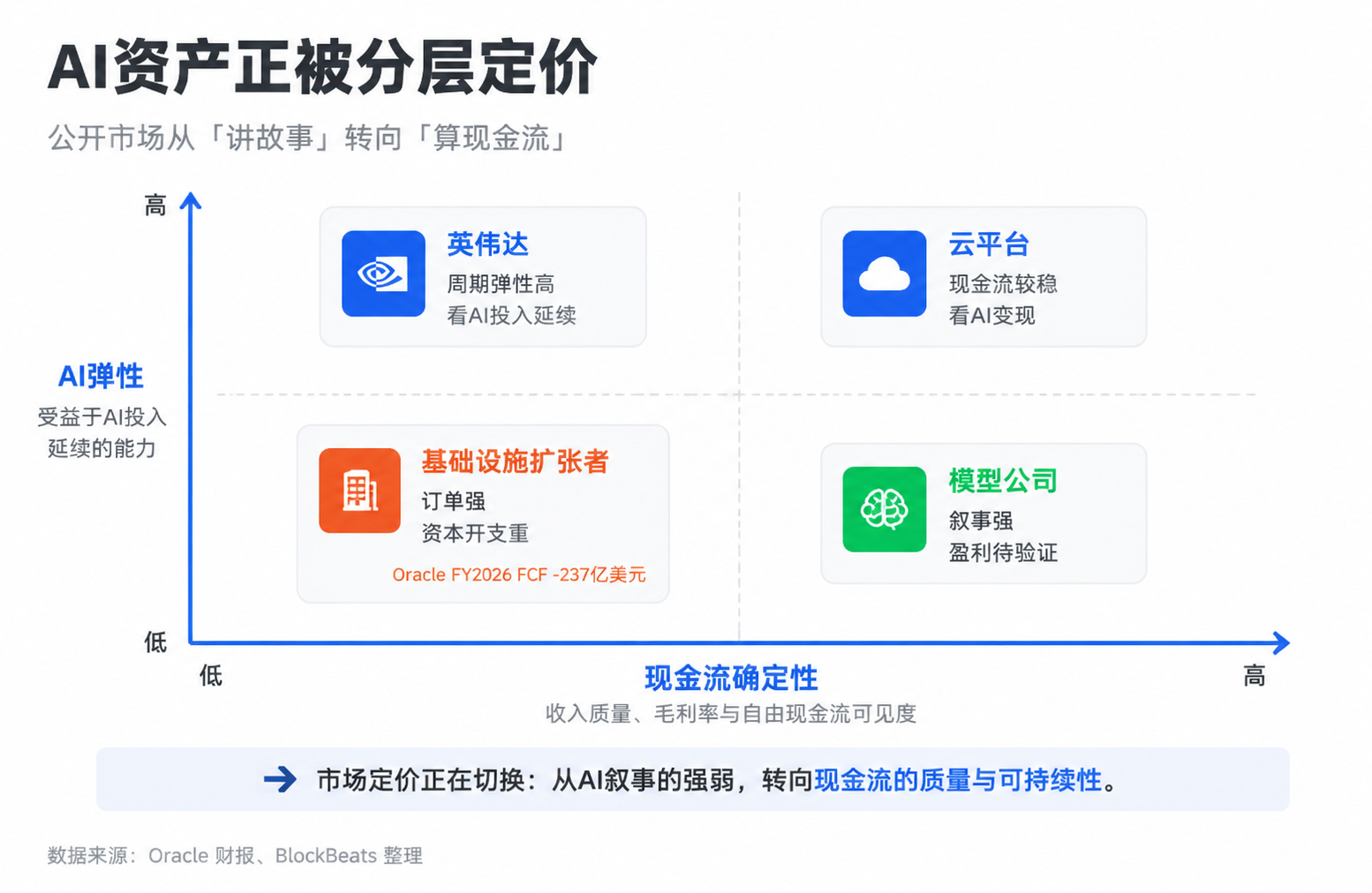
If risk appetite is very high, investors may buy all AI assets at once, believing they are on the same growth curve. Once interest rates, financing costs, or profit expectations change, the market will become more selective. Whoever has higher revenue certainty, more stable gross margins, faster cash flow improvements, will find their valuations easier to hold onto.
Oracle's counterintuitive drop occurs precisely during this transition. AI trading is not over, but the indiscriminate raising of valuations has become more fragile.
The next step is to watch data center utilization
Oracle's sell-off cannot directly imply that the AI bubble has burst. Demand-side data remains strong; cloud revenue, RPO, customer collaborations, and company guidance all indicate that enterprises and model companies still demand computing power. A more accurate statement is that the market is beginning to price demand and returns separately.
The most important variable going forward is the utilization and profitability of data centers after delivery.
If relevant projects are delivered as planned, customer usage ramps up quickly, cloud revenue continues to materialize, and gross margins are not significantly consumed by power, depreciation, and operation costs, the market's concerns about high capital expenditures will be alleviated. Today's drop could simply be a phase of reevaluation: investors are asking for higher risk premiums first and will reassess valuations once cash flows prove themselves.
However, if subsequent earnings reports show that revenue growth remains dependent on larger-scale capital expenditures, financing needs continue to rise, free cash flow improves slowly, or equity financing causes dilution pressure, Oracle will not just be a stock issue, but a sample of changes in the valuation framework for AI infrastructure.
Investors now need to look not at whether AI orders continue to increase, but how much cash flow remains after orders pass through data centers, GPUs, electricity, and financing costs.
免责声明:本文章仅代表作者个人观点,不代表本平台的立场和观点。本文章仅供信息分享,不构成对任何人的任何投资建议。用户与作者之间的任何争议,与本平台无关。如网页中刊载的文章或图片涉及侵权,请提供相关的权利证明和身份证明发送邮件到support@aicoin.com,本平台相关工作人员将会进行核查。


