On June 8, the AI sector in the U.S. stock market collectively soared, with core stocks such as Nvidia, Microsoft, and Google leading the rise, once again validating that the market's enthusiasm for artificial intelligence continues to grow.
As the stock prices of centralized AI giants keep reaching new highs, a long-discussed decentralized AI project in the crypto market—Bittensor (TAO)—has once again entered the purview of some investors.
When traditional AI companies see a surge in stock prices, will decentralized AI infrastructure attract renewed attention? Today, let’s discuss this topic.
1. The Rise of AI Stocks: Demand for Computational Power is Accelerating
The increase on June 8 was not an isolated event but rather a continuation of the high growth in AI capital expenditures over the past two years. The demand for computational power for training and inference of mainstream large models is still rapidly growing, prompting leading tech companies to increase their investments in GPUs, data centers, and more.
This demand has two sides:
- On one hand, it drives up the valuation and revenue expectations of centralized AI companies;
- On the other hand, it exposes cost pressures and efficiency bottlenecks in the current model—centralized computational resources are concentrated, expensive, and there are concerns about data privacy and censorship in some scenarios.
This provides a long-term potential demand space for decentralized computational networks. The higher the market's enthusiasm for AI, the more likely the demand for smarter infrastructure that is lower in cost, more open, and resilient against censorship will be ignited.
2. Current Data and Core Mechanism of Bittensor (TAO)
Bittensor is a decentralized machine intelligence network that utilizes a subnet (Subnet) economic model, allowing different participants to contribute computational power, models, or data for specific AI tasks, incentivized through the TAO token for value capture.
According to on-chain and market data monitoring (as of early June 2026):
- TAO price range is approximately $212-252, with a market capitalization of about $2.03-2.33 billion;
- Circulating supply is around 10.99 million tokens (total supply of 21 million tokens);
- The number of active subnets has maintained between 128-129, with plans to expand to 256;
- Top subnets (such as computational class Chutes and agent training class Ridges) have accumulated significant TAO stake value.
The core design of TAO lies in the traffic-based emission mechanism: the emission weight obtained by subnets is primarily determined by net TAO inflow. This makes it easier for better-performing subnets to attract stake and resources, forming a positive feedback loop. Currently, the network covers multiple AI verticals, including computation, model training, agent collaboration, and data validation.
Bittensor (TAO) Subnet Ecosystem Expansion and Market Data Insight (Original)
3. The Potential Connection Between the Surge in AI Stocks and TAO
The rise of centralized AI giants is not simply a zero-sum game with decentralized AI projects; there may be a demand overflow and narrative resonance.
1. Logic of Computational Demand Overflow
When companies like Nvidia see a sharp increase in stock prices, it reflects the market's high recognition of the demand for AI computational power. However, centralized computational resources face inherent limitations in cost, scalability, and flexibility in some application scenarios. Some developers, startup teams, and decentralized projects actively seek alternative or supplementary solutions. The Bittensor subnet network can theoretically provide distributed, low-cost intelligent computation and model services, forming a complement.
2. Narratives and Fund Rotation
The sustained strength of the AI theme in the U.S. stock market often enhances the overall market’s risk appetite for the "artificial intelligence" concept. After a significant short-term rise in the centralized AI sector, some funds may look for targets with greater flexibility and updated narratives. As a relatively early-stage sector with still abundant imaginative space, decentralized AI often becomes a focus for funds. As one of the most representative projects in the decentralized AI sector, TAO’s subnet economic model and long-term scarcity design may be re-evaluated in this environment.
3. Differences in Infrastructure Positioning
U.S. AI companies mainly address issues at the "application layer" and "model layer," while Bittensor attempts to build the underlying "intelligent market"—enabling intelligent production, verification, and trading within a decentralized network. The two are not in direct competition but may form a mixed architecture of "centralized models + decentralized execution and verification."
Of course, these connections currently remain primarily logical deductions, and actual fund flows and adoption will require time for verification.
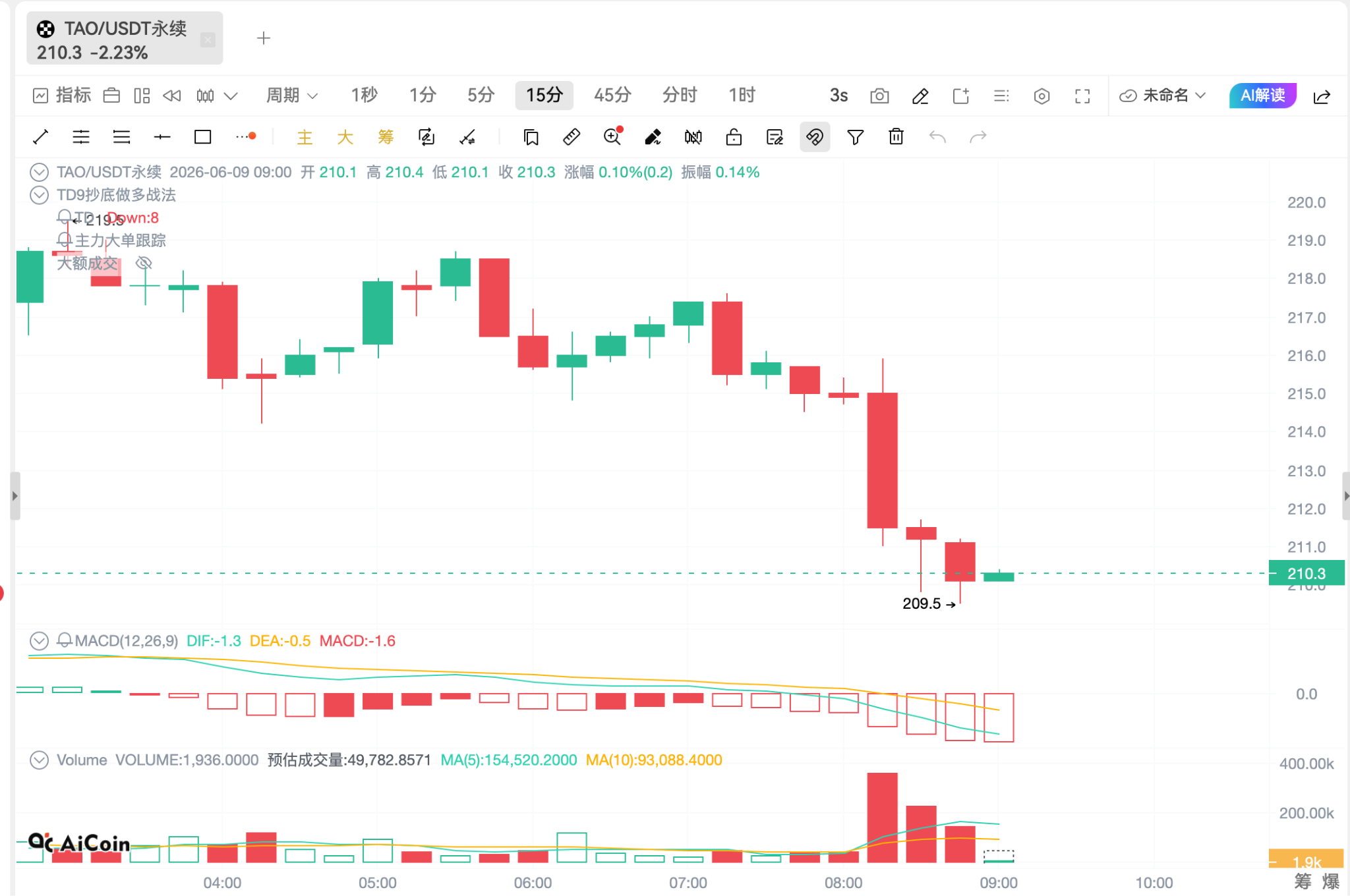
(AiCoin K-line chart, price alert can be set)
New users are recommended to register through the following two links (exclusive benefits link for AiCoin):
1. Binance link:
https://jump.do/zh-Hans/xlink-proxy?id=3
Invitation code: aicoin668 ($500+ returns 10%)
2. OKX link:
https://jump.do/zh-Hans/xlink?checkProxy=true&proxyId=2
Invitation code: aicoin20 (permanent return of 20%)
4. Risks to Pay Attention To
Any asset related to the AI theme has high volatility; TAO is no exception:
- Subsidy Dependency: Currently, the growth of some subnets still heavily relies on TAO emission incentives, and the ongoing increase in external real payment income remains to be observed;
- Intensified Competition: As limits on subnets are gradually relaxed, competition between projects will become fiercer, and it will take time to prove which subnets can stand out in the long run;
- Price Volatility: The price of crypto assets is greatly affected by market sentiment, and significant pullbacks may occur in the short term;
- Execution Risk: The actual landing effect of the subnet mechanism and user adoption speed still carry uncertainties.
Inexperienced investors should strictly control their positions, only invest idle funds, and prepare for long-term holding mentally.
U.S. AI stocks surged, how to use AiCoin tools for market data analysis?
1. Core Analysis Logic
The rise of U.S. AI stocks usually reflects the market's sustained optimism regarding the demand for computational power and the application of AI. This optimistic sentiment may be transmitted to the crypto market through the following paths:
- Enhancing overall risk appetite, driving funds to flow toward high-elasticity thematic assets;
- Strengthening the "AI infrastructure" narrative, providing external catalysts for decentralized AI projects;
- Encouraging some funds to rotate from centralized AI sectors to crypto AI assets with greater elasticity.
To determine whether this transmission is effective, the core lies in distinguishing between short-term sentiment-driven and true capital inflow. This requires simultaneous observation of price performance and on-chain fundamental data.
2. Practical Framework for Analysis Using Professional Data Platforms
Taking AiCoin and other on-chain and market data analysis tools as examples, analysis can proceed in the following steps:
Step 1: Monitor Overall Performance of AI Concept Sector
- In AiCoin, locate "Market" - "Sector" - AI concept sector
- Check the thematic coins for rise and fall ranking, net fund inflows, changes in trading volume
- Key observation: whether TAO, RENDER, FET, VVV, NEAR, etc., have risen in sync
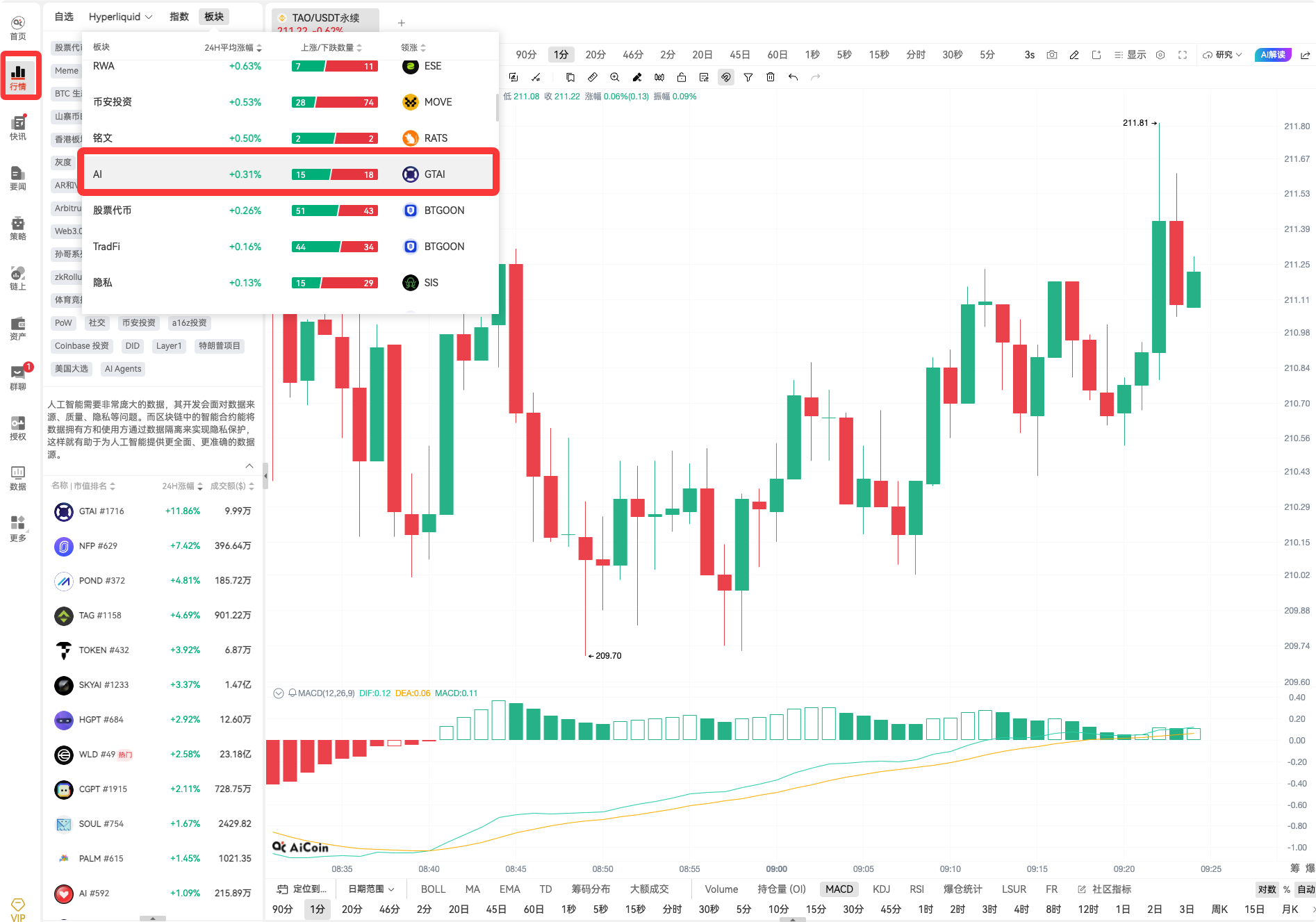
Key Indicators:
- 24h rise of the sector vs the market (BTC/ETH)
- Whether there has been a surge in trading volume for related projects
Step 2: Deep Dive into Bittensor (TAO) On-Chain Data
This is where AiCoin has relative advantages:
Capital Flow Data:
- Monitoring large TAO transfers (whether institutions/whales are continuously buying)
- Net inflow/outflow data from exchanges
- Changes in the distribution of holding addresses (whether long-term holding addresses have increased)
Step 3: Combine Price and Volume Technical Analysis
Pay attention to the following in AiCoin’s K-line charts:
- Whether the TAO price has experienced a volumetric breakout or a volume retracement
- The correlation with the U.S. AI sector (can manually compare the trajectory of Nvidia)
- Key support/resistance levels (combined with historical halving cycles or important nodes)
Step 4: Cross-Verify Sentiment and News Data
- Search in AiCoin’s news module for “AI crypto,” “Bittensor,” “decentralized AI”
- Check the heat of community discussions (if there is a related feature)
- Observe if there are discussions or reports on “the rise in U.S. AI driving crypto AI”
3. Example of Practical Analysis Framework (After the Surge in U.S. AI Stocks)
Scenario Hypothesis: On June 8, the U.S. AI sector surged, with Nvidia achieving significant gains.
Using AiCoin’s Analysis Path:
1. First Step: Open AiCoin → Check AI concept sector → Confirm whether TAO has risen and if there has been volumetric growth.
2. Second Step: Enter the TAO detail page → View the net inflow of funds over 24 hours, indicating real capital is being deployed into decentralized computational power.
3. Third Step: Compare historical data → Look at how TAO performed on-chain and its price response during the last substantial rise in the U.S. AI sector for reference.
4. Fourth Step: Comprehensive judgment:
- If price rises + significant on-chain movements + increased volume → High resonance probability, could serve as a medium-term focus signal.
- If only price rises but there are no noticeable improvements in on-chain data → More likely sentiment-driven, sustainability should be approached with caution.
4. Advanced Analysis Suggestions
- Multi-time Dimension Comparison: Look not only at daily charts but also check weekly/monthly charts to assess whether it’s short-term sentiment or a medium-term trend.
- Linkage with Traditional Markets: Open comparison charts for BTC, ETH, and TAO in AiCoin, observing whether characteristics of “BTC stagnation, AI concept leading” emerge in sector rotations.
- Risk Alert Settings: Using AiCoin’s price alerts and large transfer alerts to capture unusual fund movements promptly.
- Regular Review: Weekly or biweekly, organize a comparison table of “U.S. AI performance vs TAO on-chain data” using AiCoin to build your own database.
5. Important Notes
- Correlation does not equal causation: The rise of U.S. AI is merely an external catalyst; the actual adoption and revenue growth of TAO subnets ultimately determines the outcome.
- Data Lag: On-chain data is usually lagging compared to price and requires a multi-dimensional information assessment.
- Risk Control: Any theme-based analysis carries a high degree of uncertainty; it is recommended to strictly control positions and implement stop-loss disciplines.
Risk Warning:
1. The prices of crypto assets are highly volatile and there is a risk of capital loss. The above content is for informational reference and logical analysis only, and does not constitute any investment advice. Please make independent decisions based on your own risk tolerance and financial situation, and conduct thorough research (DYOR).
2. Investing in U.S. stocks also requires
免责声明:本文章仅代表作者个人观点,不代表本平台的立场和观点。本文章仅供信息分享,不构成对任何人的任何投资建议。用户与作者之间的任何争议,与本平台无关。如网页中刊载的文章或图片涉及侵权,请提供相关的权利证明和身份证明发送邮件到support@aicoin.com,本平台相关工作人员将会进行核查。