When getting divorced, the court cannot forcibly divide assets outside of mainland China, so the money in the Hong Kong account will not be divided during the divorce? What about cryptocurrencies?? Here's a bit of useless knowledge +1
Today I saw someone seriously introducing to others that as long as the funds are stored outside of mainland China, they cannot be divided during marriage, even suggesting to keep it in Hong Kong to avoid property division.
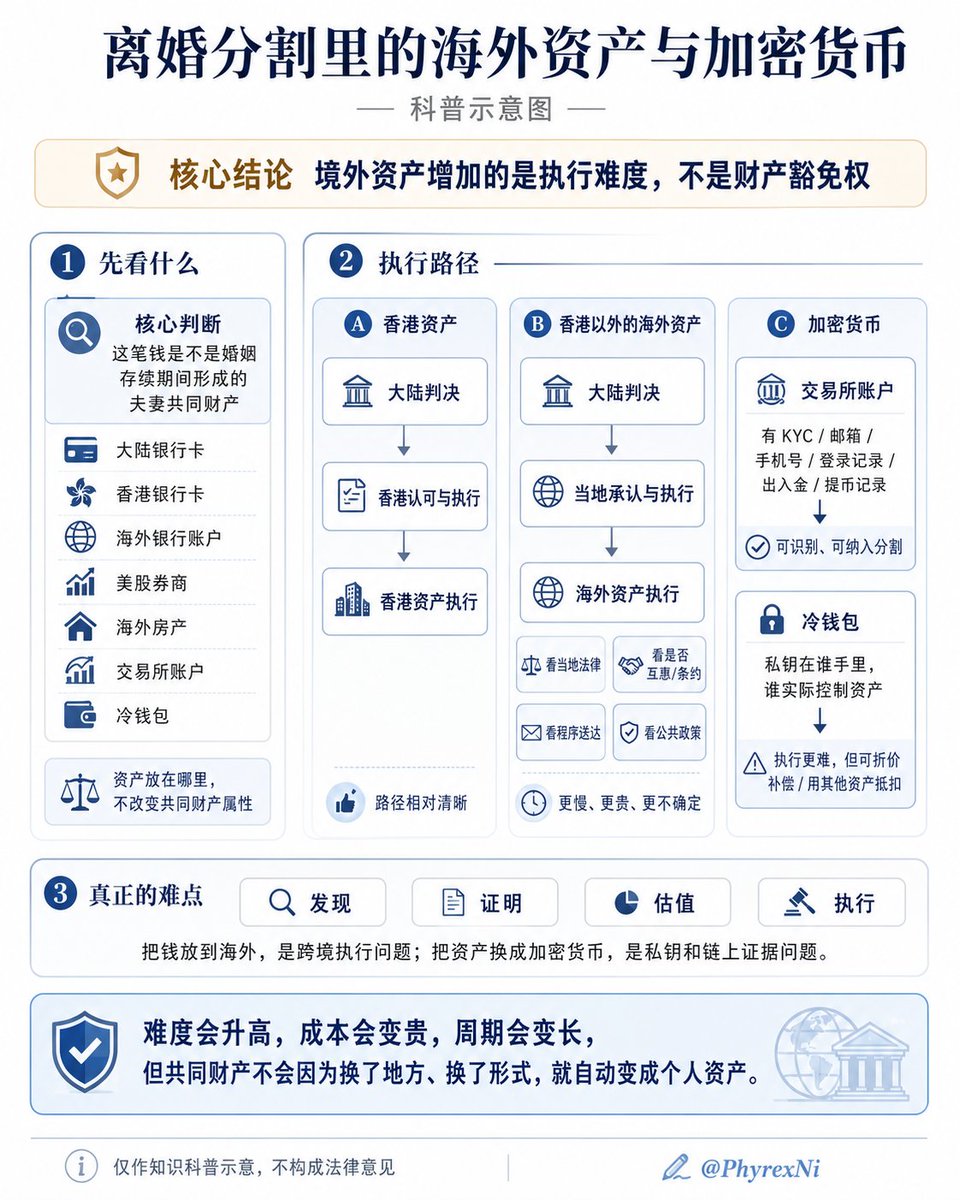
Firstly, even without considering morality, this reasoning is incorrect; overseas assets increase the difficulty of enforcement, not asset exemption rights.
The division of assets in a divorce does not depend on where the money is located, but rather whether this money is joint property of the couple. Whether the money is in a mainland bank account, a Hong Kong bank account, a Singapore bank account, a US brokerage account, or even held in exchanges or cold wallets, it is essentially the same. As long as it can be proven that this is joint property created during the marriage, it is possible to include it in the division.
In the past, many people thought overseas accounts were secure because mainland courts cannot directly freeze bank accounts in Hong Kong as they do with mainland bank accounts. But this does not mean that Hong Kong accounts will not be divided.
Mainland courts can confirm in their judgment that this money belongs to the joint property of the couple, and they can also require one party to compensate, return, or reduce their share, or even not divide it at all.
To put it simply, if you have 1 million yuan in mainland China and 1 million HKD in Hong Kong, then you can use your yuan portion to offset the assets that need to be divided in Hong Kong.
More importantly, as early as February 15, 2022, the arrangement for mutual recognition and execution of matrimonial and family civil case judgments between the mainland and Hong Kong has already taken effect, and Hong Kong also has corresponding Chapter 639 regulations. This means that mainland marriage and family judgments, under qualifying conditions, can be applied for recognition and execution in Hong Kong.
I estimate that some people may have thought about this: If I don’t keep a single cent in mainland China, or only keep very little, then the overseas assets cannot be enforced, but this thought is only half correct.
Indeed, overseas assets outside of Hong Kong are more complicated. Hong Kong has specialized arrangements for mutual recognition and execution of marriage and family judgments, and the paths are relatively clear. When it comes to places like Singapore, the United States, Switzerland, Dubai, Japan, and Europe, it depends on the local laws, the attitude of local courts, whether there are treaties, whether there is reciprocity, whether the judgment has already taken effect, whether the procedure for delivery is compliant, and whether it will touch upon local public policy.
Beijing courts indeed cannot directly freeze Singapore bank accounts, cannot directly take stocks from US brokerages, and cannot directly order Dubai’s property registration authority to transfer ownership of properties. However, mainland courts can first determine in the divorce judgment that this part of overseas assets belongs to the joint property of the couple, and then order the holder to compensate the other party at a discount. Whether the money can actually be obtained later enters the cross-border enforcement phase.
The differences in cross-border enforcement vary greatly. For example, in Singapore under common law, qualifying foreign judgments can be enforced through separate litigation as judgment debts, usually under conditions such as jurisdiction by the foreign court, the judgment being final, and the amount being clear.
The United States is more complicated; there is no unified federal foreign judgment recognition system, and it usually depends on state law. Additionally, many states’ rules for recognizing foreign monetary judgments exclude or provide special treatment for divorce, support, alimony, and family-related judgments.
Now let's talk about cryptocurrencies.
If the coins are placed on overseas exchanges, like Coinbase, Kraken, Binance, OKX, Bitget, HashKey, they essentially function similarly to an overseas financial account. Exchange accounts have KYC, email, phone number, login IP, device records, deposit and withdrawal records, bank card inflows and outflows, OTC chat records. As long as these clues can link the account to the individual, these coins may fall within the range of asset division.
If the coins are stored in a cold wallet, it is indeed more difficult. The private key is in whose hands, that person effectively controls the asset. However, the court can recognize that holding these coins can be assigned a discounted value at a certain time point, can require compensation to the other party, and can also offset against other assets such as real estate, deposits, equity, and vehicles.
Additionally, many people believe that on-chain is anonymous, but in reality, where is there 100% anonymity? Transaction records from exchanges, deposit records, wallet screenshots, photos of mnemonic phrases, records of purchasing hardware wallets, bank records for buying U, OTC records, chat records, email records, tax records, DeFi interaction records can all link an address back to the person behind it.
Finally, placing assets outside of Hong Kong turns the division into a cross-border enforcement issue. Converting assets into cryptocurrency makes it a matter of private keys and on-chain evidence. The difficulty does indeed increase, but joint property ultimately needs to be proven during the duration of the marriage, especially from a moral perspective. Of course, if it is the fault of the other party, that is another matter.
免责声明:本文章仅代表作者个人观点,不代表本平台的立场和观点。本文章仅供信息分享,不构成对任何人的任何投资建议。用户与作者之间的任何争议,与本平台无关。如网页中刊载的文章或图片涉及侵权,请提供相关的权利证明和身份证明发送邮件到support@aicoin.com,本平台相关工作人员将会进行核查。


