TL;DR
- Last Friday, the global semiconductor sector experienced a sharp decline, causing a circuit breaker in the Korean stock market on Monday, with Samsung Electronics and SK Hynix leading the market downturn.
- However, over the weekend after the plunge, Jensen Huang made a high-profile visit to Korea to strengthen collaborations with the Korean AI supply chain, leading the market to reevaluate whether this marked the peak of the AI cycle or just a clearing of crowded trades.
- Related stocks: 000660.KS (Korea), 005930.KS (Korea), NVDA (US), MU (US), AVGO (US), EWY (Korean ETF), SOXX (US ETF)
The Korean stock market has just experienced the most severe plunge this year.
After the market opened on Monday, the KOSPI dropped nearly 9% at one point, triggering a circuit breaker. Both Samsung Electronics and SK Hynix suffered heavy losses, and discussions began about whether the AI bull market has reached a turning point.
But at the same time as the market was in a panic and selling off, another event was unfolding in Seoul.
Jensen Huang began his trip to Korea over the weekend, meeting not only with SK Group Chairman Chey Tae-won but also announcing a new multi-year cooperation agreement between Nvidia and SK Hynix to jointly develop next-generation memory products for AI data centers. He also engaged intensively with Korean tech companies like Samsung Electronics, LG, and NAVER, emphasizing that the construction of AI infrastructure is still in its early stages.
This created a stark contrast in the market.
On one side, Korean AI leaders faced concentrated selling; on the other, the core clients of the AI industry chain were continuing to strengthen their binding relationship with the Korean supply chain.
If AI demand were really beginning to collapse, Jensen Huang would not need to make a special trip to Seoul to reinforce cooperation.
This is why new discussions began to emerge in the market today.
Is the Korean market reflecting a peak in the AI cycle ahead of time, or is it experiencing a typical high-level deleveraging?
Korea Becomes One of the Most Sensitive Markets for Global AI Transactions
This drop occurred in Korea, but the trigger did not come from Korea.
Last Friday, the US semiconductor sector faced significant sell-offs. The Philadelphia Semiconductor Index recorded one of its largest single-day declines in recent years, with companies related to AI infrastructure like Broadcom and Micron also pulling back. Subsequently, the market began to reassess the risk exposure of overvalued tech stocks.
Korea became the most directly affected market.
Over the past year, the core driving force behind the rise of the Korean stock market has not been the local economy, but rather the construction of AI data centers, increased demand for HBM, and Nvidia's supply chain expansion.
Samsung Electronics and SK Hynix together hold a significant weight in the Korean market. When global funds want to bet on AI infrastructure, Korea is one of the most convenient entry points; conversely, when funds begin to reduce their AI positions, Korea naturally becomes the easiest market to sell off.
As a result, the decline in the Korean market was far greater than that of the US market itself.
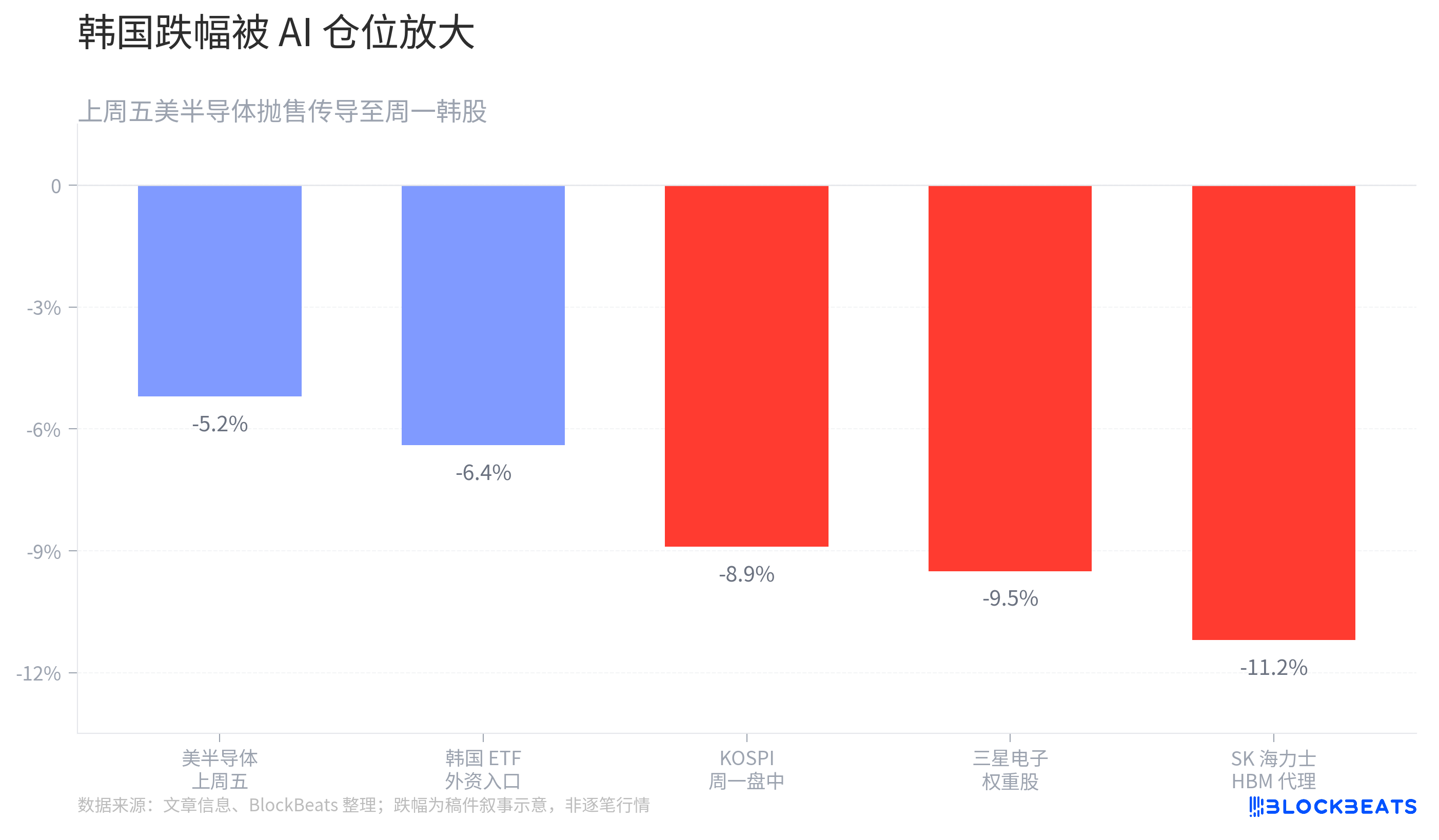
In a sense, Korea has become not just a national index but more like a large AI memory ETF.
Jensen Huang's Visit to Korea Creates a Sharp Contrast with Market Panic
If the market panic stems from valuations, then the biggest good news over the weekend came from the industry chain itself.
The core goal of Jensen Huang's visit to Korea is clear: to further strengthen Nvidia's cooperation with the Korean AI supply chain. The most notable aspect is the announcement of a new multi-year cooperation agreement between Nvidia and SK Hynix. Over the past two years, HBM has become one of the most critical components for AI servers, and SK Hynix is currently one of the biggest beneficiaries.
This is why the market is paying close attention to this cooperation.
In recent months, as the scale of AI infrastructure construction has continued to expand, the market has begun to worry whether the growth rate of HBM demand will gradually peak. But Jensen Huang's visit to Korea actually released a contrary signal. If Nvidia believed that the construction of AI data centers was nearing its end, there would be no need to continue strengthening long-term partnerships with suppliers at this time.
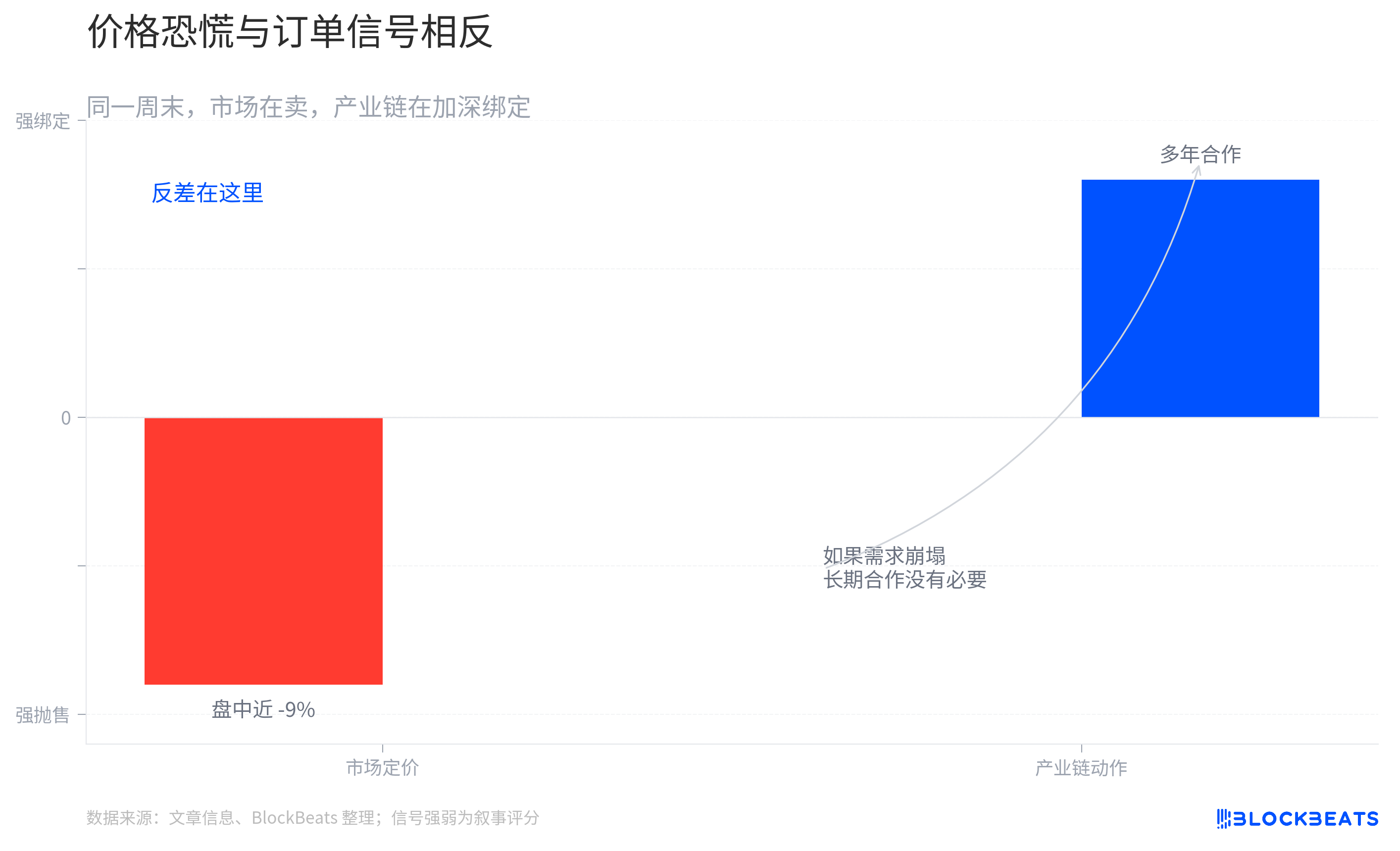
From an industry chain perspective, there is still no evidence that AI demand suddenly disappeared.
The most interesting aspect of the past two days lies here. The capital market is using stock prices to express concerns about AI sector valuations, while the core companies in the industry chain are still discussing expansion and cooperation plans for the coming years. There remains a significant temperature difference between the prices the market offers and the signals released by the industry chain.
The AI Bull Market Begins to Enter Profit Pool Revaluation Phase
This is also where the biggest divergence currently lies.
In the past year, the market has traded on a very simple logic: AI demand growth. Thus, Nvidia, Micron, SK Hynix, and Samsung Electronics all rose; as long as it was related to AI, almost all companies could gain valuation increases.
However, as the gains in the sector continued to expand, the market has entered a second phase.
Investors are no longer satisfied with the story "AI will grow," and have started to ask another question: Who ultimately benefits from the profits generated by AI growth? In recent months, from memory adjustments in the Rubin cabinet system to market reactions following Broadcom's earnings report, to this plunge in the Korean market, it essentially reflects the same issue— the market is beginning to deconstruct the AI profit pool.
SK Hynix benefits from HBM, Samsung Electronics is involved in HBM, DRAM, and advanced packaging, while Micron benefits more from the overall memory upgrade in AI servers. Although all are part of the AI industry chain, the corresponding sources of profit and pricing power are not the same.
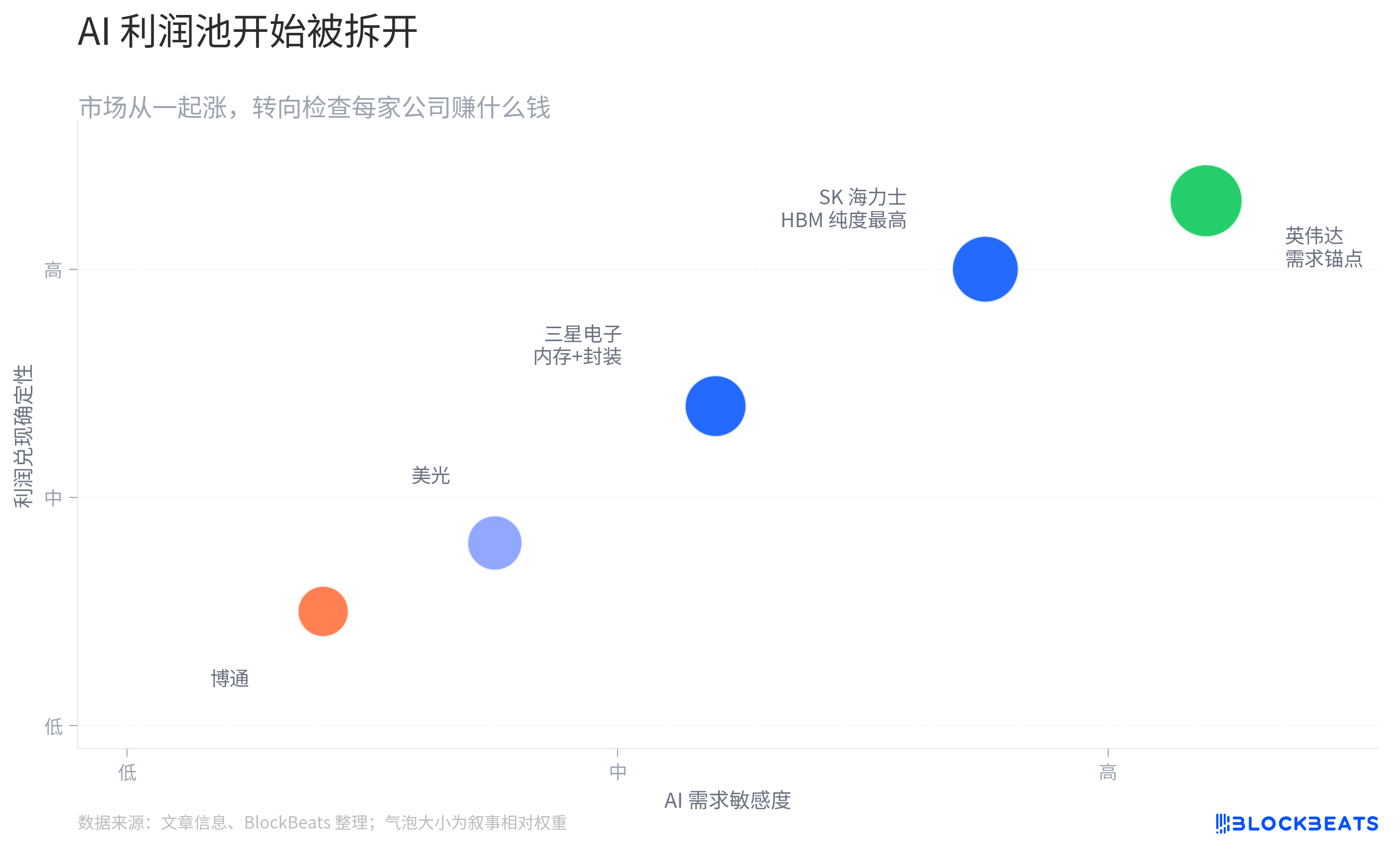
In the past, the market was willing to grant valuation expansion to the entire sector together, while now funds are beginning to check whether these profits can truly materialize one by one.
This is also why a supply chain message, a financial report guidance, or even a capital expenditure adjustment can trigger significant volatility across the entire sector. The focus of market trading has changed: compared to whether AI will continue to grow, investors are more concerned with whose financial statements will ultimately reflect that growth.
The Direction of Korean Stocks is Not Determined by Korea
In the coming weeks, what truly determines the direction of the Korean market will still be Nvidia's orders, HBM supply and demand, and capital expenditures from cloud vendors.
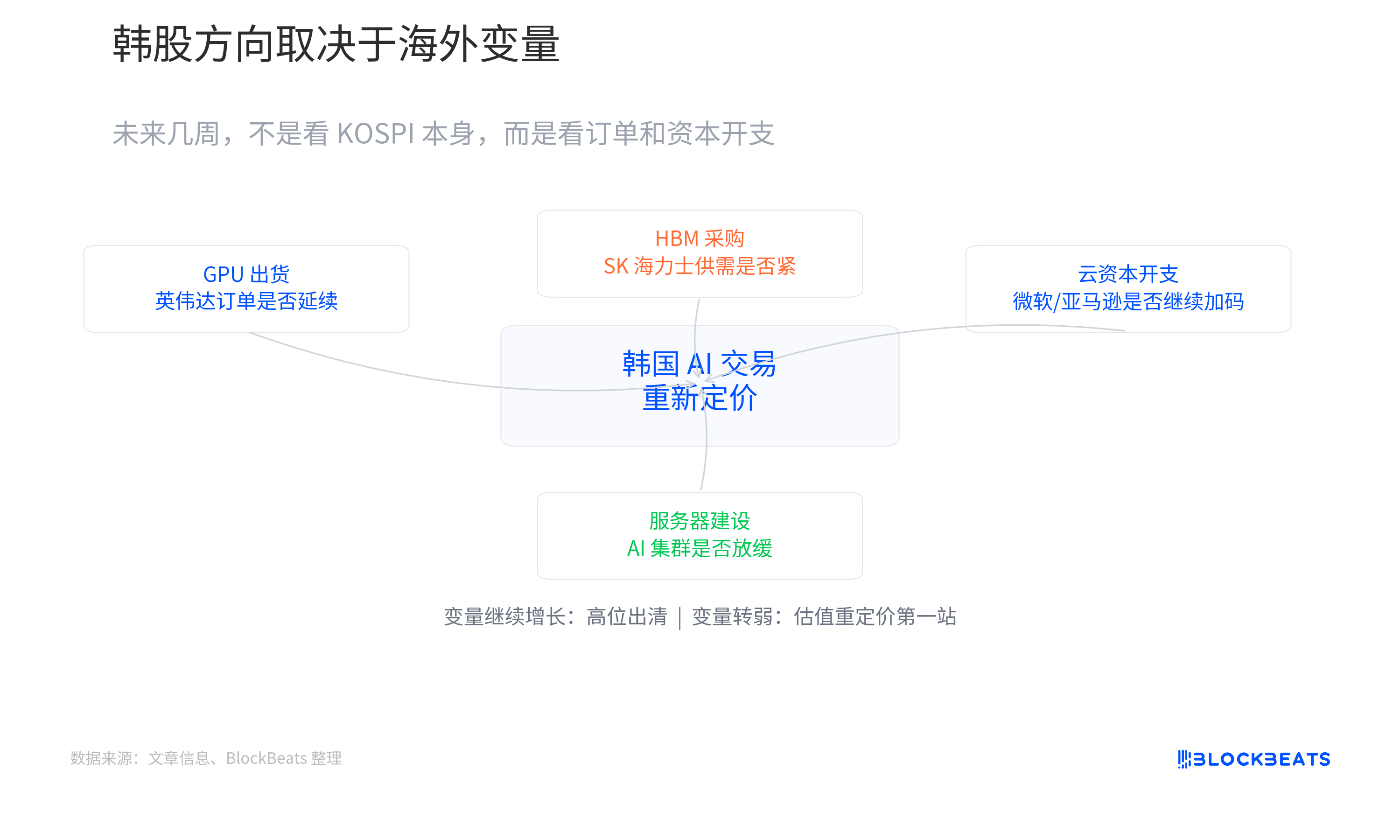
If these data begin to weaken, then this plunge may only be the beginning of a larger-scale valuation adjustment.
But if data center construction, GPU shipments, and HBM procurement continue to maintain high growth, then Monday's circuit breaker is more like a concentrated clearing of a crowded trade.
At least for now, the prices the market offers and the signals released by the industry chain are not completely aligned.
On one side, Korean AI leaders faced the most intense sell-off in recent years; on the other side, Jensen Huang was in Seoul discussing next-generation AI infrastructure with supply chain partners.
Whose judgment is closer to reality may soon have an answer.
免责声明:本文章仅代表作者个人观点,不代表本平台的立场和观点。本文章仅供信息分享,不构成对任何人的任何投资建议。用户与作者之间的任何争议,与本平台无关。如网页中刊载的文章或图片涉及侵权,请提供相关的权利证明和身份证明发送邮件到support@aicoin.com,本平台相关工作人员将会进行核查。


