Original Title: A16Z's Global Mission
Original Author: a16z
Original Translator: Peggy
Editor's Note: This article documents the entire process of Trump reemerging publicly after disappearing for over a week. Faced with external questioning about his health, military actions in Iran, and internal party rifts, he needed to use this appearance to demonstrate control. However, his entire speech continually drifted away from the core issues: from the renovation of the reflecting pool at the National Mall, to comparisons with the crowd size of Martin Luther King’s rally, to attacks on reporters, Democrats, and various American cities. The 43-minute press conference gradually turned into a political performance filled with resentment and anxiety.
The article focuses on two levels. First, it reveals Trump's personal state and style of power. The author presents a portrait of an out-of-control, restless, and highly defensive president through Trump’s humiliation of reporters, attacks on cities and political opponents, and the rapid clearing of the room by staff after abruptly ending the event. Second, it discusses the institutional changes surrounding Trump. The text mentions that the executive orders he signed will weaken job protections for senior federal employees, making it more likely for experienced civil servants to be replaced due to political stance or disobedience. This means that professional judgment and institutional constraints within the government are being pressured by stronger logic of personal loyalty.
The latter half of the article extends the discussion to the media. The author argues that Trump’s attacks on CNN reporters, along with the emerging crisis of editorial independence within mainstream media like CBS, show that American news organizations are under dual pressure from political power and commercial interests. When mainstream media starts to compromise with power, independent journalists and creators become important forces in maintaining public facts. This is also why the author repeatedly calls for support of independent media.
This article has a strong tone, with obvious political alignment and mobilization sentiment, but the questions it raises are of realistic significance: When power continually attacks reporters, weakens the civil service system, rewards loyalty, and punishes dissent, can the public still obtain sufficiently reliable information? When the commercial interests of media organizations are intertwined with political pressure, how long can journalistic independence last? Trump’s appearance provided a window for observation, reflecting the deepening institutional tensions in American politics: the expansion of personal power, the loss of media trust, the pressure on the civil service system, and the ongoing shrinkage of the space for public facts.
The original text is as follows:
At 3:50 PM this afternoon, after disappearing from public view for more than a week, the President of the United States suddenly reappeared. Prior to this, since his visit to Walter Reed Medical Center, he had not attended any public events. Now, with bad news piling up and growing doubts surrounding his deteriorating health, Donald Trump had to come out. In 43 minutes, Trump and his supporters attempted to present an image of a strong leader in control. But what the world saw was a paranoid person: he praised an authoritarian leader as “my friend, a good guy”; he attacked a reporter as “a young, pretty woman who never smiles,” saying she had “hate in her eyes”; while desperately maintaining the illusion that everything was still under control.
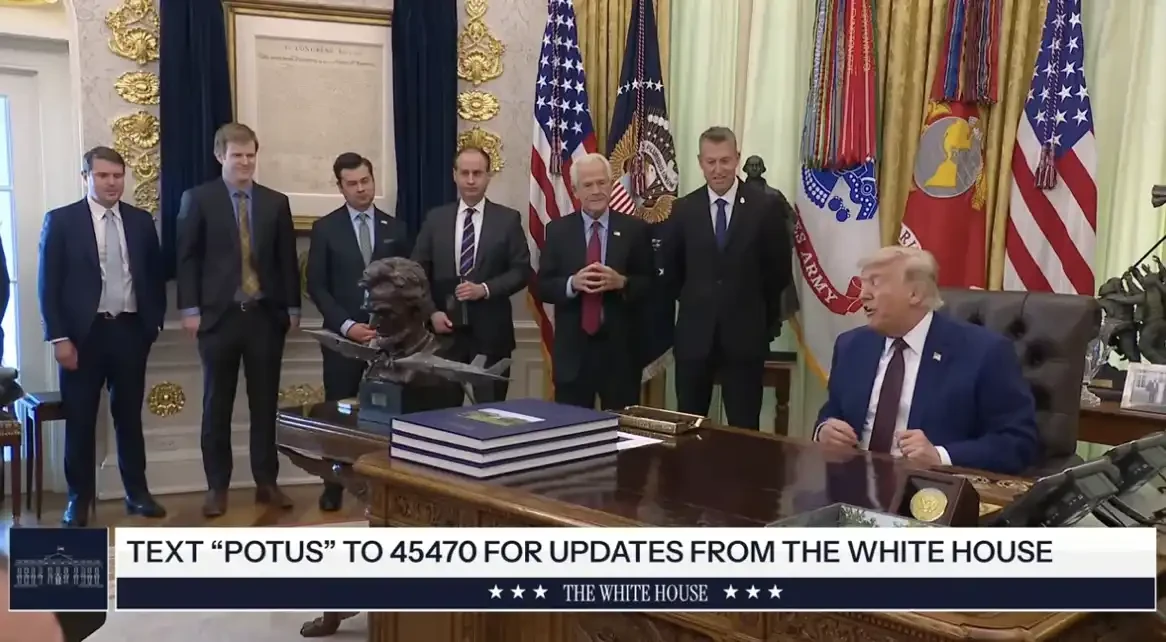
This strange beginning was marked by Trump’s current favorite subject: the reflection pool. Before signing any documents or answering any questions, the president spent a few minutes discussing the reflection pool at the National Mall. He described its length, had staff bring pictures, and compared it to some of the tallest buildings in the world. He talked about the Empire State Building, the World Trade Center, and the Sears Tower, as if a flat pool could stand up like a skyscraper. He told the camera that this pool would turn “American flag blue” and boasted about how many truckloads of trash had been cleaned out from it. The person who had disappeared from public view for more than a week chose to first talk about a pool instead of his disappearance, his health, or the crises facing the country.
Then, his rambling shifted to the truly nauseating and most telling part. He began to describe the location of Martin Luther King's delivery of one of the most important speeches in modern American history and claimed that his crowd was larger than King's. “They say he had 1 million people, while I only had 25,000,” he said, insisting that when comparing two photos, “my people are larger. They are denser. My people are denser.”
For Trump, everything is a competition, stemming from insecurity. Faced with the reflection pool—where Dr. King spoke of justice, equality, and the unfulfilled promises of American democracy—the first thing Trump thought of was crowd size. Not the speech, not the movement, and not the courage needed to stand there in 1963 demanding that America live up to its ideals. All he could think about was how he looked bigger. The people around him simply nodded, smiled, and agreed.
Serious matters were buried beneath this absurdity. He signed two executive orders. One reshaping the customs enforcement system, and another eliminating long-held job protections for about 8,000 senior federal employees, allowing them to be dismissed arbitrarily. Such protections existed to ensure that government officials obey the law, the Constitution, and the public interest, rather than simply following the personal orders of the president. After removing these protections, competence would no longer be more important than obedience; dissent would become grounds for dismissal; and those who should be speaking the truth within the government would soon realize that their jobs depended on whether they told leaders what they wanted to hear.
Afterwards, everything returned to his personal grievances. He attacked the judge who ruled against his “anti-weaponization fund,” claiming the judgment came from “radical left judges.” He repeatedly portrayed himself as a victim, especially when discussing the search of his residence, seeking sympathy. When a reporter asked about the $1.776 billion “slush fund,” he simply said, “I like it. I think it’s very important.”
Then he began to repackage his war in Iran. After launching strikes against Iran without congressional approval, he wanted people to believe that it wasn't really a war. “It’s no big deal for us,” he said, “we have a strong military. This isn’t a big deal for us.” Meanwhile, he guaranteed that the stock market was soaring, retirement accounts were growing, and costs were going down. The war was insignificant, and the economy was perfect. If your food bills did not reflect that, you clearly should doubt your eyes.
Next, his topic drifted to communism. Earlier today, he had just posted related content on Truth Social and was evidently quite pleased. The first post read, “Have you ever seen a happy communist?” The second post was longer: “Communists are always popular among voters in the early stages, or in their words, popular with the ‘people’! But eventually, this country, state, or city will go to hell!” When a reporter read his own words back to him, he became excited. “That’s what I just wrote,” he said, “do you like it? Do you think it’s well written?” He eagerly sought praise. For a president, this moment was an embarrassment visible to the entire world.
Then came the familiar routine. He labeled New York, Los Angeles, and parts of California as communism. He performed as if he were a first-person character playing an imagined communist instigator: “You’ll never have to pay rent again.” “I’ll end your mortgages.” “I’ll give you free food.” “Follow me, you’ll live the greatest life.” He acted like the villain in a one-man show. He called the governor of Illinois a “lazy man” and the mayor of Chicago a “low IQ person.” He disparaged the cities he led one after another, listing those he claimed were failing, only to once again portray himself as the only one who could save them.
Then, in the midst of all this, he suddenly stopped. No conclusion, no natural wrap-up. He was still speaking, still wandering through one grievance after another, and then suddenly said, “Thank you very much, everyone.” Almost immediately, his staff sprang into action. “Thank you media. Thank you media.” Journalists were asked to leave the room, and the venue was cleared. Trump remained seated behind the desk, his expression blank, shoulders slumped, as if he had sunk into the chair.
We have seen this process before. Some kind of shift occurs, and the event ends abruptly. The room is cleared, staff act swiftly, and the same phrases are repeated almost like a rehearsed signal. We do not know what triggered it. It could be a physical issue, or a cognitive problem. But we know this is not how a normal news event ends, nor is it how a president typically concludes a public appearance. And this situation occurs frequently enough that those around him seem fully aware of what to do once it appears.
In that long rant, CNN reporter Kaitlan Collins stood there doing her job while he directed his ire at her. He called CNN “utterly deceitful,” a “very corrupt organization,” and labeled the network garbage. He looked at her and said she “never smiles,” describing her as “a young, pretty woman” standing there with “hate in her eyes.” When she tried to speak, he interrupted, “Wait, quiet.” He told her, “You should be ashamed of yourself.” He repeatedly referred to Democrats as “the stupid party.” Then he said something I cannot forget. Speaking of Democrats, and of her, he said, “They have problems. You have problems too.”
As he claimed others had problems, he sat there, holding his left hand with his right and pressing it down. His face was swollen, his right eye sometimes so puffy it barely opened while walking. He spoke in a constantly slurred manner and then suddenly regained clarity. He would erupt, then revert to a flat, monotone delivery, and then erupt again. As a person, it was hard not to feel embarrassed for him watching that scene. But as an American, it was more distressing: thinking of all those who have fought for this country, and realizing that the leader we are presenting to the world after nearly 250 years of democratic self-governance is like this.
We must ask why. In the face of continuous bad news, with his own party members publicly breaking ties with him, and increasing doubts about his health every hour, why did he spend time attacking a reporter for not smiling during his first public appearance in over a week? The answer is actually quite simple. He is trying to discredit those whose job it is to tell us the truth because what is happening is too unfavorable for him. If he can make us stop trusting the media, then what the media reports no longer matters. That is the whole game.
We must understand this game because it goes far beyond a reporter and a bad afternoon. When an authoritarian can no longer reliably deliver his propaganda, when this person begins to stumble over words, their thoughts drifting, and is hastily escorted out of a room, the machine surrounding him does not stop demanding propaganda. It merely requires someone else to take up the propaganda for him. Thus, it will reach out to seize those institutions that rightfully belong to everyone. It will take over the media.
We saw this scene this week at CBS. Scott Pelley, who had worked for the network for 37 years, was fired. Just the day before, at an employee meeting, he accused the new management of “murdering this program”—referring to the show “60 Minutes,” known for its accountability journalism. He then released a written statement confirming many of our worst fears. He said the new management had requested that he include false content and bias in a politically sensitive report. He said he was asked to include unverified claims, which, until now, he had refused to do. He said politicians were being invited to choose which reporters could interview them. He also noted that the network’s new owners were sidelining this program, in his words, to “please the Trump administration temporarily.”
CBS is no longer what it was. Its independence and credibility have vanished. We may also lose CNN. They will not stop. We will continue to lose these mainstream media outlets one by one because those who own them have already done the math. Telling people what strongmen want them to hear is easier to monetize than telling them the truth. There are no oligarchs backing the truth, while lies have bottomless pockets. These corporate heads have seen how this president rewards loyalty while punishing others, so they have decided to take as much as they can while they still can, even if they do not believe this will last. They do not care whether it can last; they only care about the present.
Thus, this work will increasingly fall on those without deep pockets. Independent journalists, investigative reporters, writers, and creators—especially in dark days—who still show up every day and often pay a real price for it. Our country cannot continue to survive after these voices are silenced, because a country where the people do not know what they are facing is not a free country. You can already see what a lack of understanding can cause. Many people around us have no real concept of what is actually happening. And those who actively seek the truth are increasingly only able to find the versions fed to them by others who are being paid.
When I started writing these articles, I made a promise: that every time this government attacks the media, attacks the First Amendment, attacks the right of the American people to speak the truth to power, I would call it out by name. Today, Trump did just that. And I am calling it out. This is an attack on our right to be informed, an attack on our right to understand how this government is destroying the country. He sent a direct message to all reporters and media members: I will come after you too. To the public, he was saying: you cannot trust anything the media tells you. Our response must be that we will not back down, we will support those who still have a voice and who still report the truth.
The way to navigate this historical moment is to let our money follow our voices. Whenever this government attacks the First Amendment, we respond by funding those who defend it. This is the most direct form of resistance we can take right now. Independent media is the way to keep the truth alive when all other systems are captured. I have been writing every night for a year without corporate support and without sponsorship money. No one can reach into my articles and change a single word. Every article I write is free for everyone because the truth should not be locked behind a paywall. But all of this is possible because some people choose to support this work through paid subscriptions, because they understand what is happening and choose to support it. Thank you for standing with me in this resistance.
Tonight, I ask you again, do not just think of my voice. Think of every writer, journalist, podcaster, and independent media member you will turn to when you need the truth. Think of those who are still facing relentless attacks in their inboxes, while also bearing greater pressure from the federal government. Think of those who continue to speak out even though it may come at a huge cost. Because what this government is trying to build requires our silence. And our most powerful action right now is to ensure those who refuse to be silent can continue to stand. Every paid subscription to independent voices is a vote against the words and actions of Trump and his supporters.
And the reason Trump is growing increasingly desperate is that on this very day, on the same day the president attacked a reporter and the network she works for, the House passed a war powers resolution demanding he end the war in Iran. The vote was 215 to 208. Four Republicans crossed the aisle to support the resolution.
It still needs to go through the Senate. Procedurally, it is largely symbolic. But the point is not here. The point is that members of his own party are finally breaking ranks publicly and voting against him. This is Trump’s greatest fear: disloyalty. Someone saying no. Someone realizing that they should fear their voters more than they fear him. That is what made this person so agitated in today’s event.
Because this is exactly what he is doing. He is pushing people over the tipping point. This person’s cruelty, paranoia, and increasing intolerance for any hint of disloyalty are causing him to lose those who once protected him. They watch him speaking in a muddled manner, his thoughts drifting, attacking everywhere, and they too are beginning to calculate their gains and losses. One by one, they are starting to back away. This is why I still have hope for America. You should too.
免责声明:本文章仅代表作者个人观点,不代表本平台的立场和观点。本文章仅供信息分享,不构成对任何人的任何投资建议。用户与作者之间的任何争议,与本平台无关。如网页中刊载的文章或图片涉及侵权,请提供相关的权利证明和身份证明发送邮件到support@aicoin.com,本平台相关工作人员将会进行核查。


