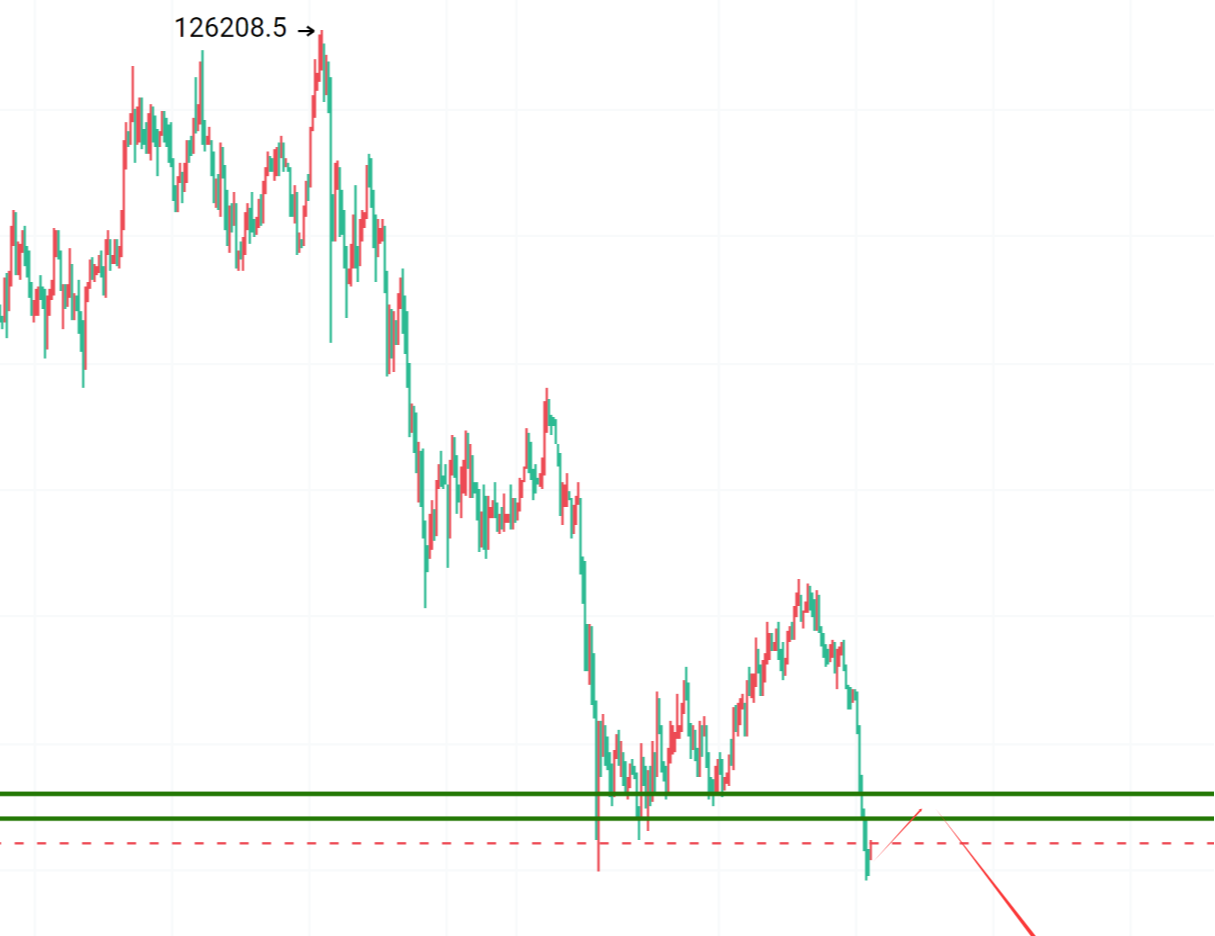
As of June 7, 2026, on-chain statistics have revealed a striking figure: Analyst Darkfost estimates that since Bitcoin peaked last October, holders have cumulatively realized losses of approximately $174 billion, indicating that a substantial amount of capital was offloaded at higher price ranges. Meanwhile, the Coinbase Bitcoin premium index, which represents the strength of U.S. spot demand, has remained in negative territory for about 20 consecutive days, with the latest value around -0.0467%, meaning that Coinbase's pricing is overall lower than the global spot average, reflecting weakened buying interest in the U.S. market, dominant selling pressure, and a decline in risk appetite. Under the combined signals of significant realized losses on-chain and the continuous negative premium in the U.S. market, it is crucial to determine what stage this current downward cycle has entered— Is it in the deep waters of a bear market yet to reach the true bottom, or just a mid to late stage adjustment of the previous cycle's extreme "pain" that hasn't been repeated? This is the core question the current market needs to address.
From $2.4 billion to $174 billion: Amplifying Bear Market Losses
If we place the current realized losses of about $174 billion back on the historical coordinate axis for comparison, it becomes very illustrative. During the 2014 bear market, the cumulative realized losses on-chain for Bitcoin were about $2.4 billion, while the total market capitalization of the entire network was only around $6–8 billion; however, in this current cycle, according to Darkfost's calculations, since the peak last October, the cumulative realized losses have expanded to about $174 billion, an absolute amount that far exceeds the $2.4 billion from earlier cycles. On the surface, this represents a leap from "2.4 billion" to "174 billion" across two orders of magnitude, easily interpreted as an unprecedented "severity" in this bear market.
However, from the perspective of indicator definitions and market cap expansion, this straightforward comparison has a naturally amplifying effect. Realized losses are calculated in U.S. dollars and fundamentally represent the total negative difference between selling prices and historical purchase prices across all sell transactions; as the total market capitalization of Bitcoin has expanded from tens of billions to its current scale, even a price retracement similar to historical levels would result in a multiplied average loss per coin when measured in U.S. dollars, thus the overall amount of dollar-denominated losses naturally amplifies as market cap rises. Historically, each bull market tends to push total market capitalization to new highs, and the subsequent bear market phases see on-chain realized losses in U.S. dollars showing a trend of "growing larger" across cycles. Although the current $174 billion is numerically far above the $2.4 billion from 2014, public information indicates that this size has not yet surpassed the peak loss level of the previous cycle's bear market. Concluding that this bear market is "unprecedented" based solely on absolute loss amounts lacks rigor in statistical standards and cycle comparisons.
Losses Still Below Previous Peak Signal Weakness
According to Darkfost's data, since the peak last October, the cumulative realized losses on-chain are about $174 billion, but public information confirms that this scale has not yet exceeded the peak loss levels of the last bear market cycle. Historically, the peak loss segment of the previous bear market usually corresponds to a phase where prices have already experienced deeper retracements, and panic sentiment is concentratedly expressed, whereas the current loss intensity in this cycle evidently has not replicated that extreme scenario.
This suggests that from the on-chain "pain" indicators, this adjustment is closer to a relatively mid to late stage deep adjustment period, rather than the ultimate point of expression where "everyone can't hold on." Multiple media outlets qualify the current phase only as a "deeper adjustment period" and do not conclude that "the cycle's bottom has been confirmed." For readers, viewing this drop simply as a completed bottom construction while the on-chain loss intensity has not yet replicated the previous peak, and sentiment has not manifested extreme panic consistently does not necessarily place risk-return on the favorable side.
Coinbase Negative Premium Falls for 20 Consecutive Days
In parallel with the expanding on-chain losses, the Coinbase Bitcoin premium index, representing compliant spot demand in the U.S., has remained in negative territory for about 20 consecutive days. According to Coinglass, this index measures the degree to which the BTC price on Coinbase deviates from the global spot average: the most recently published value is about -0.0467%, indicating that at the same moment, the BTC price that U.S. investors purchase on Coinbase is below the global average, creating a slight discount. A daily negative premium of -0.0467% is not exaggerated, but the fact that this value has been negative for nearly three weeks rather than oscillating around zero signals a structural price pressure rather than mere noise.
Multiple media outlets citing Coinglass's interpretation point out that when the Coinbase premium index is positive, it often implies a more aggressive U.S. local spot buying sentiment, with Coinbase prices exceeding the global average, reflecting a higher risk appetite for U.S. capital; conversely, when this indicator continues to be negative like now, it is typically seen as weak U.S. market spot demand, heavier selling pressure, and a retreat in risk appetite. Given Coinbase's representativeness in the U.S. market, the continuous negative premium suggests that even though in the global context some funds are still buying on dips, compliant U.S. funds are more inclined to sell at a discount rather than chase prices, supporting the characterization of the "deeper adjustment period" and making the question of "whether U.S. spot demand will strengthen again" a necessary variable to track when assessing the bear market position.
Cooling of U.S. Risk Appetite and Global Dislocation
From the indicator itself, the Coinbase Bitcoin premium index measures the degree of deviation of BTC prices on the Coinbase platform from the global spot average: a positive index indicates that U.S. Coinbase prices exceed the global average, usually corresponding to more aggressive U.S. buying, willing to pay a premium for capital; when the index turns negative, it means that Coinbase's pricing is below global levels, with the U.S. market at that moment appearing more like the "discount selling" side. Currently, this index has been negative for about 20 consecutive days, with the latest published value around -0.0467%, reflecting a continuous rather than momentary discount state, indicating that despite the global average being formed collectively by multiple exchanges, local U.S. pricing has remained long-term suppressed beneath the average line, reflecting a significant cooling in risk appetite.
In this structure, it is even more concerning to note the dislocation in regional sentiment: at the same time, if U.S. compliant market prices are below the global average while the global average has not dropped synchronously to "U.S. prices," it can be reasonably inferred that "the U.S. has cooled first, while other regions are relatively resistant to drops." In other words, marginal selling pressure is more concentrated in U.S. accounts, while marginal buying forces may be distributed across other platforms and regions, providing a certain buffer against the discounts on the global average. This brings about a redistribution of capital flows: some U.S. funds choose to continue selling on compliant platforms like Coinbase, transferring capital to other global exchanges and OTC buyers; some prefer to remain on the sidelines, reducing local market transaction activity; and others may attempt to engage in trading through platforms in other regions, bypassing the cooler pricing environment in the U.S. This dislocation characterized by discounts in the U.S. and resistance to declines overseas will directly influence who leads price discovery in the future and whether emotional recovery will first be completed in the U.S. during this bear market.
Script of the Second Half of the Bear Market Depicted by Data
By viewing the on-chain realized losses of $174 billion alongside the Coinbase premium index, which has been negative for about 20 days and is currently around -0.0467%, it can be fairly safely concluded that this downturn has entered a "deeper adjustment period," with absolute losses far exceeding early cycle levels, but still significantly below the extreme loss peak of the previous bear market. U.S. spot sentiment is also only in a phase of rising risk aversion rather than extreme panic, indicating more of the main declines and repeated handovers in the second half of the bear market rather than a confirmed absolute bottom of the cycle. It is crucial to emphasize that both realized losses and the premium index are retrospective statistics; historically, they tend to approximate phase bottom points over time but have never provided precise single-point signals for accurate "bottom fishing." Investment decisions must still integrate constraints such as macro environments, regulatory trends, individual leverage, and tolerance for retracement. What is truly worth monitoring continuously is whether the accumulated realized losses continue to expand and approach or even surpass the previous peak, whether the Coinbase negative premium can narrow and turn positive again, and how media and institutions qualitatively assess this combination of signals—whether it transitions from a "deeper adjustment period" to a "bottom region." These changes will determine whether the current script leads to a more extreme liquidation phase or proceeds into a prolonged bottom consolidation after gradually completing emotional recovery.
Join our community, let's discuss and grow stronger together!
Exclusive Hyperliquid benefits for AiCoin: https://app.hyperliquid.xyz/join/AICOIN88
Exclusive Aster benefits for AiCoin: https://www.asterdex.com/zh-CN/referral/9C50e2
On-chain Telegram community: https://t.me/AiCoinWhaleData
On-chain community: https://www.aicoin.com/link/chat?cid=N6OVMor5g
AiCoin on-chain Twitter: https://x.com/aicoinwhaledata
免责声明:本文章仅代表作者个人观点,不代表本平台的立场和观点。本文章仅供信息分享,不构成对任何人的任何投资建议。用户与作者之间的任何争议,与本平台无关。如网页中刊载的文章或图片涉及侵权,请提供相关的权利证明和身份证明发送邮件到support@aicoin.com,本平台相关工作人员将会进行核查。