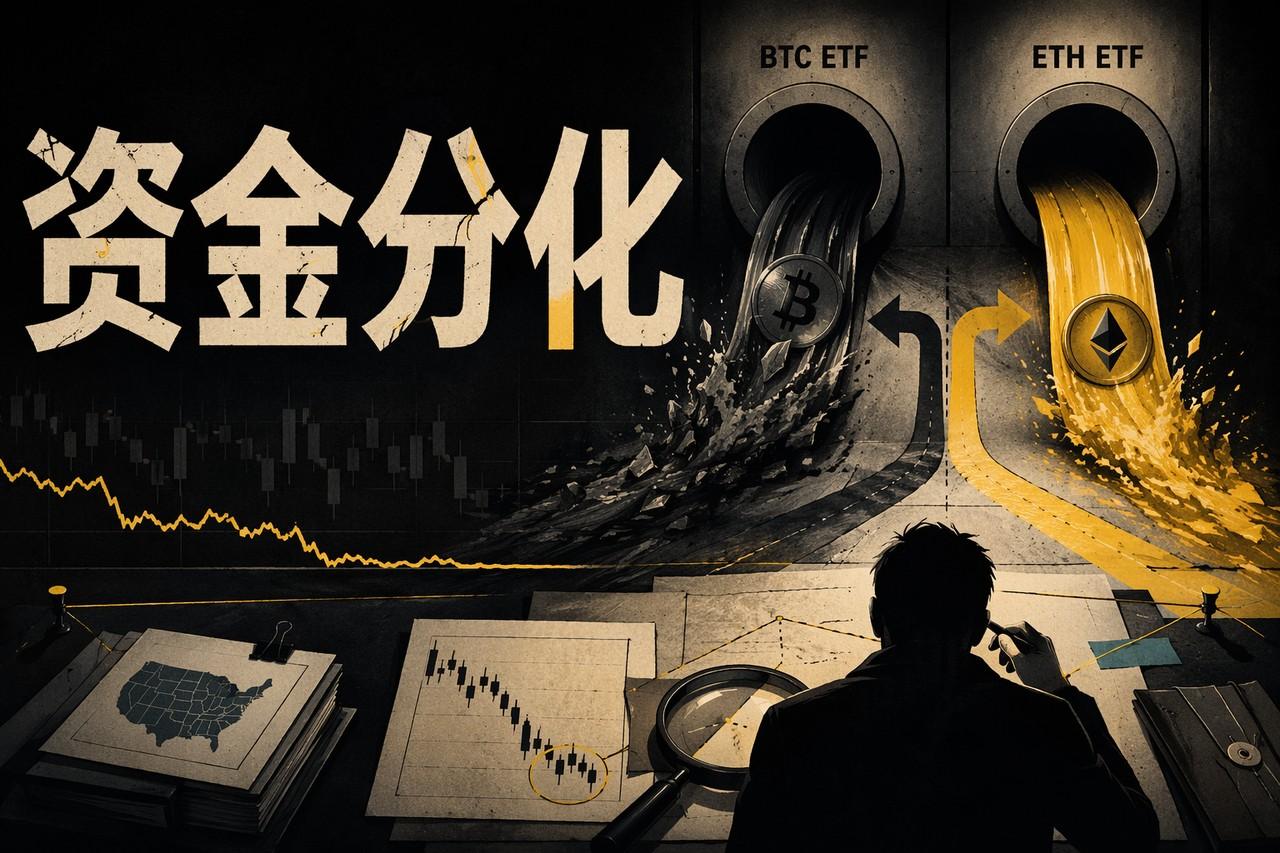
On June 6, 2026, the cryptocurrency fear and greed index published by Alternative.me fell to 12, categorized as "extreme fear" within a range of 0–100. This reading stems from its weighted calculation of multidimensional data such as price volatility, trading volume, and social media heat, yet there has been almost no independent verification of its model by external organizations. At the same time, on-chain monitoring account Lookonchain disclosed the balance sheet performance of leading institutions, quantifying this sentiment indicator into measurable loss figures: Bitmine, seen as related to Tom Lee, held approximately 5.42 million ETH, with a market value of about $10.03 billion based on the then-current price, but floating loss estimates on this position varied as high as $9–10.3 billion from various data sources; another entity linked to Michael Saylor, known for accumulating Bitcoin over the long term called Strategy, publicly reported holding about 844,000 BTC, which various assessments estimated to have a floating loss of about $7.6–12.7 billion. The extreme low sentiment index and the simultaneous magnification of floating loss figures for these two iconic bullish giants rendered the “fear index 12” no longer just an abstract score, but an intuitive gauge reflecting institutional pressure and market confidence dynamics. In this context, discussions around whether “extreme fear indicates a temporary bottom” and whether “when sentiment and losses approach extremes, it has already reflected most bad news” rapidly heated up, yet still had to search for answers between data and uncertainty.
Fear Index 12: The Shadow of Historical Bottoms?
The so-called fear and greed index is a sentiment indicator calculated by Alternative.me, with a value range of 0–100, where a lower value indicates greater fear. It compresses multidimensional data such as price volatility, trading volume, social media heat, market surveys, Bitcoin market cap percentage, and search heat into a single score. On June 6, 2026, this index recorded a value of 12, officially categorized as "extreme fear," indicating that in their model, most observable dimensions were simultaneously signaling risk aversion.
Looking back in history, low ranges of the fear and greed index often appear after significant declines, and markets typically regard such readings as reference coordinates for extreme emotions. However, the assertion that “an index reaching 12 must rebound” has not been systematically validated in terms of facts. More critically, the weighting of various sub-indicators in the model and the specific algorithms are disclosed only by Alternative.me, lacking independent verification from multiple parties, making it difficult for outsiders to precisely determine which dimension is driving the change behind the score of 12. Thus, while it may be reasonable to view it as a sentiment thermometer, treating it as an accurate bottom-buying button carries considerable risk; the current score of 12 is more like a reminder that sentiment is in an extreme range, rather than a declaration that the market has achieved a definitive bottom confirmation.
Bitmine Deeply Entrapped with 5.42 Million ETH Floating Loss
During the same period when the fear index dropped to 12, on-chain data concretized the extreme sentiment into the balance sheets of leading bulls. According to multiple on-chain accounts and monitoring statistics, Bitmine gradually established a position of about 5.42 million ETH before June 2026. Based on current prices, this position's market value is approximately $10.03 billion, enough to place it among the core Ethereum bulls in the market. Tracking data revealed by accounts like Lookonchain before and after June 2026 indicates that around these 5.42 million ETH, Bitmine's current estimated floating loss ranges from $9–10.3 billion, with specific figures varying according to real-time ETH prices and statistical time points, and discrepancies in cost pricing from different institutions also widening this range.
It is important to emphasize that this $9–10.3 billion scale remains at the level of “floating loss”; public reports generally consider Bitmine as a long-term bullish holder, and no authoritative information indicates that it has significantly liquidated core positions, meaning that the loss has not yet converted into realized losses. Some commentators even label Bitmine as a “Ethereum treasury-type” company, but this label and its underlying target holding ratio remain to be verified, making it difficult to infer its exact risk tolerance limit. For the market, the presence of 5.42 million ETH, a market value in the tens of billions, and nearly tens of billions in floating losses collectively create a typical sentiment amplifier: if the price continues to decline, the unrealized losses of this position will be further magnified on the balance sheet; and under the absence of comprehensive cost and leverage information, it is challenging for outsiders to determine whether Bitmine has enough time and flexibility to absorb this floating loss or whether it will be forced to adjust positions at some yet-unknown pressure point.
Strategy Bearing 844,000 BTC Drawdown
On the Bitcoin side, with Bitmine on the Ethereum side, the emotional anchor naturally fell on Strategy. Based on published statistics and data from on-chain monitoring accounts such as Lookonchain, this institution, seen as related to Michael Saylor, currently holds about 844,000 BTC, generally considered one of the most typical Bitcoin institutional bulls. Various estimates indicate that this position's floating loss is in the range of about $7.6–12.7 billion, with divergences primarily arising from Bitcoin price fluctuations at different statistical time points, as well as varying assumptions about the cost from different institutions. It is crucial to highlight that publicly available information has not disclosed the precise timeline and average cost basis for this batch of BTC, making it difficult for outsiders to provide a single, accurate floating loss figure, and discussions can only occur at the range level regarding this drawdown.
In such an uncertain cost backdrop, a widely recognized long-term bullish holder absorbing tens of billions of dollars in floating drawdown has a direct impact on market sentiment and risk appetite. On one hand, in the mainstream narrative, the “long-term bulls” are still seen as not having large-scale liquidated core positions, and their losses remain largely on the balance sheet; during the extreme fear period when the fear and greed index dropped to 12, this provided a reference frame for some participants that “they can still hold.” On the other hand, when even symbolic institutional bulls like Strategy are enduring unrealized losses in the range of hundreds of millions, the risk appetite itself is lowered, leading more funds to reassess Bitcoin's medium to short-term path using “how long can they hold” rather than “how much can they earn.”
The Convergence of Fear and Floating Losses
With the fear and greed index dropping to 12, pressing overall sentiment down to the “extreme fear” low, and the floating losses endured by leading bulls like Bitmine and Strategy on ETH and BTC amounting to approximately $9–10.3 billion and $7.6–12.7 billion respectively, a dual pressure both psychologically and numerically is formed. On one hand, the index reading reflects the overall market's risk aversion: transactions become more conservative, sentiment expectations more pessimistic; on the other hand, the substantial floating losses disclosed on-chain render this sentiment more concrete—investors no longer abstractly discuss “drawdowns,” but visually see tens of billions in unrealized losses still sitting on the balance sheets of leading institutions. For participants, “extreme fear” is no longer just a range label but is emotionally anchored to specific positions and specific floating loss data.
On a mechanical level, there remains a clear dividing line between floating losses and actual sell-offs: as long as Bitmine and Strategy have not been forced to reduce positions and large-scale passive liquidations have not occurred, these losses remain just recorded on the balance sheet rather than locked-in outcomes, indicating that they still have room to bear under the conditions of cash flow and risk appetite. The issue is that the widespread panic represented by the index of 12 exhibits an asymmetrical behavioral constraint on retail and institutional actors: retail participants tend to base their decision-making on short-term drawdowns and liquidation risks, easily selecting panic sell-offs under the dual stimuli of sharp price fluctuations and substantial floating loss news; while institutions generally viewed as long-term bullish are more likely to choose to continue holding or extend their holding periods in the absence of liquidity crises and strong liquidation pressures. This produces a misalignment between sentiment data and holding behaviors: on one side of the market during price declines, panic positions are rapidly liquidated, while on the other, substantial floating losses remain on the balance sheets, this misalignment amplifies emotional volatility and makes “who can bear it, and for how long” a core variable in observing subsequent risk transmission pathways.
Opportunities and Misjudgment Risks Under Extreme Fear
The characteristics of the current scenario are quite clear: on June 6, 2026, the fear and greed index given by Alternative.me fell into the 12 “extreme fear” range, compressing risk appetite to low levels, while Bitmine and Strategy collectively endured tens of billions in floating losses on ETH and BTC. This combination of “extreme sentiment + massive institutional losses,” while special, is not an anomalous value that has never occurred in market history. The potential paths that might follow are not singular: one is sentiment repair, with the index recovering from extremes like 12 while institutions choose to continue bearing the floating losses; the second is continued panic, with the index lingering at low levels for an extended period, leading to sawtooth price consolidation; the third is if external liquidity or internal risk control constraints change, causing institutions to be forced to reduce positions, converting part of the floating losses into realized losses and amplifying volatility. However, the probabilities of any of these paths lack definitive points of certainty. It is important to emphasize that the fear and greed index is weighted based on volatility, trading volume, social media heat, and other multidimensional data by a single platform, and its composition and weighting are not fully transparent. Historically, there have been cases of rebounds following very low readings and also instances where low levels were maintained far longer than expected. Therefore, simplifying “index = 12” to merely mean “inevitably nearing a bottom” lacks sufficient statistical support. Adding to this, the floating loss ranges of Bitmine and Strategy vary due to differences in cost baselines and statistical timing. In the absence of key information such as average position costs, leverage ratios, and potential staking yields, deriving the extreme conclusion of “this is definitely an opportunity” or “institutions will inevitably not hold” solely based on a sentiment indicator or a set of floating loss numbers poses a misjudgment risk that should be approached with caution.
Join our community to discuss and become stronger together!
Exclusive Hyperliquid benefits for AiCoin: https://app.hyperliquid.xyz/join/AICOIN88
Exclusive Aster benefits for AiCoin: https://www.asterdex.com/zh-CN/referral/9C50e2
On-chain Telegram community: https://t.me/AiCoinWhaleData
On-chain community: https://www.aicoin.com/link/chat?cid=N6OVMor5g
AiCoin on-chain Twitter: https://x.com/aicoinwhaledata
免责声明:本文章仅代表作者个人观点,不代表本平台的立场和观点。本文章仅供信息分享,不构成对任何人的任何投资建议。用户与作者之间的任何争议,与本平台无关。如网页中刊载的文章或图片涉及侵权,请提供相关的权利证明和身份证明发送邮件到support@aicoin.com,本平台相关工作人员将会进行核查。