I understand the demand for electricity by AI in the United States
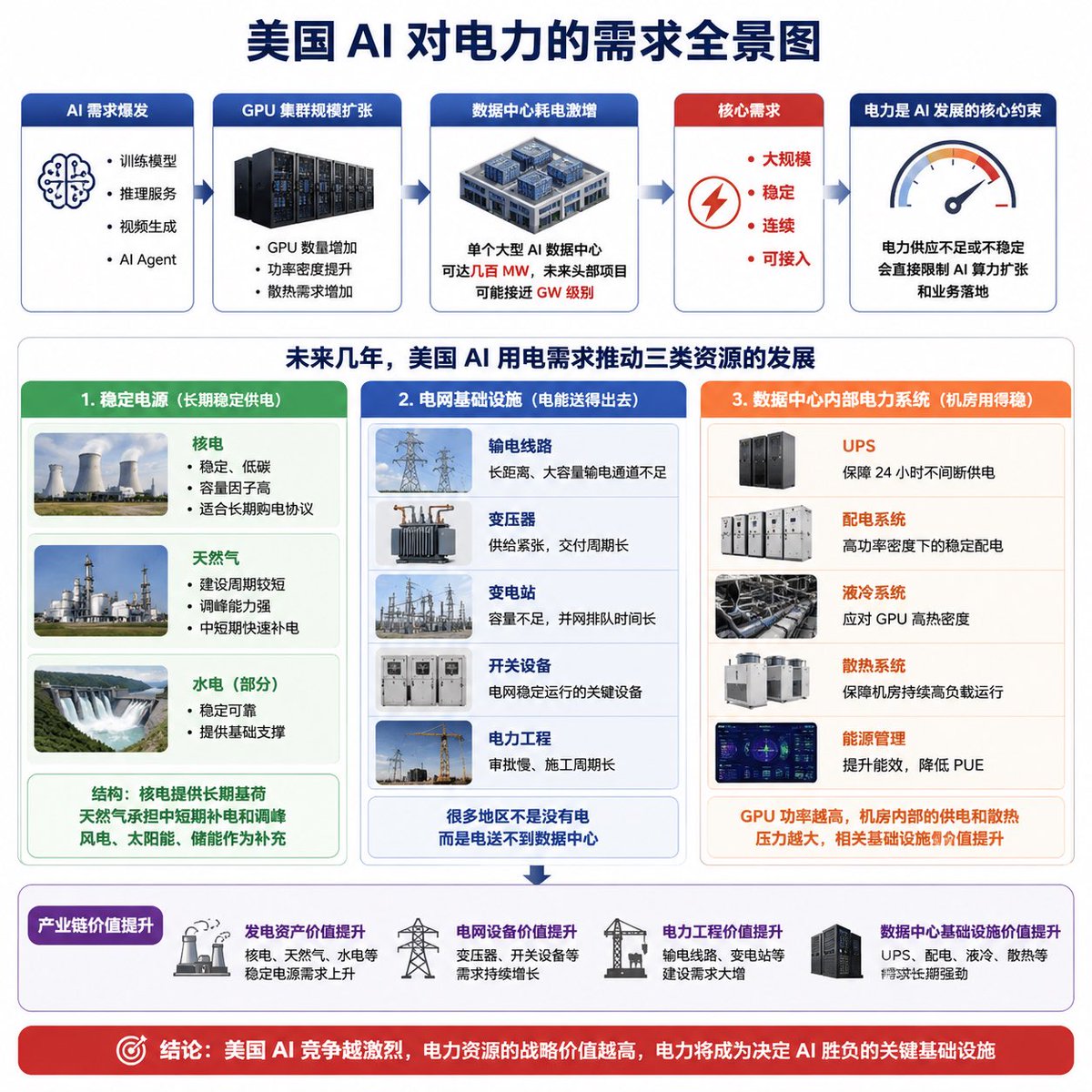
The core demand for electricity by AI in the United States, in my personal view, is large-scale, stable, continuous, and accessible power supply.
The power consumption intensity of AI data centers is far greater than that of traditional data centers. Previously, data centers mainly ran cloud computing, storage, web, and APP services, which already consumed a significant amount of power. Now, AI data centers operate GPU clusters, training models, providing inference services, generating videos, and applications for intelligent agents, which keep servers in a high-load state for extended periods. The more GPUs there are, the higher the power consumption, and the more challenging it is to dissipate heat, leading to increased electricity requirements for the entire data center.
A large AI data center can consume several hundred megawatts of electricity, and leading projects in the future may even approach the gigawatt level. This concept is very important because it is close to the electricity consumption of a small city. When AI companies expand their computing power, on the surface, they are buying GPUs, building data centers, and deploying servers, but underneath, they are actually consuming more electricity.
Therefore, the electricity requirements for AI are very specific. They need stable power, continuous power, and electricity that can be locked in for the long term. Data centers need to operate 24 hours a day; they cannot run only during the day, nor can they operate only when electricity prices are low. Training models require stable computing power, and inference services must respond to user requests at any time. Once the power supply becomes unstable, it will affect server operations, customer services, cloud business, and overall delivery capabilities.
From the perspective of energy types, nuclear power best meets the long-term needs of AI data centers. Nuclear power is stable, low-carbon, has a high capacity factor, can provide continuous electricity, and is suitable for large tech companies to sign long-term power purchase agreements. Companies like Microsoft, Amazon, and Meta are willing to sign long-term contracts for nuclear power resources, essentially locking in a stable computing power foundation for the future.
However, the problems with nuclear power are also very real; the construction cycle is too long. From approval, construction to grid connection, new nuclear power plants take many years. Therefore, in the short term, it is difficult for the electricity gap of AI in the United States to be completely resolved by new nuclear power. The sources of electricity that can be fast-tracked in the coming years are likely still natural gas. Natural gas power plants have relatively shorter construction cycles and stronger peak-load capacity, allowing them to meet the electricity demand growth of data centers more quickly.
Thus, the structure of electricity consumption for AI in the United States will likely consist of nuclear power providing a long-term stable base load, natural gas taking on short to medium-term supplementary power and peak-load management, with wind power, solar energy, and energy storage serving as supplements to help reduce overall electricity prices and meet green energy goals.
Currently, the real tension in electricity in the United States is on the grid side. Many areas are not completely devoid of generation capacity, but the issue lies in the inability to deliver electricity to data centers. There are insufficient transmission lines, transformers, substations, and grid connection capacity, and the approval and construction cycles are also very long. AI companies can quickly purchase GPUs, build data centers, and deploy servers, but grid expansion cannot be completed quarterly.
Therefore, I personally judge that in the coming years, the electricity demand for AI in the United States will drive the development of three types of resources:
The first type is stable power sources, including nuclear power, natural gas, and some hydropower. AI data centers need long-term stable power supply, and the value of stable power sources will be increasingly recognized.
The second type is grid infrastructure, including transmission lines, transformers, switchgear, substations, and electrical engineering. The ability to deliver electricity to data centers will directly determine whether data centers can be established.
The third type includes internal power systems for data centers, including UPS, distribution systems, liquid cooling, heat dissipation, and energy management. The higher the GPU power, the greater the internal supply and cooling pressure, and the importance of these infrastructures will continue to rise.
Therefore, I believe that in the coming years, the main focus of electricity for AI in the United States will significantly increase the value of stable power sources, grid equipment, electrical engineering, and data center infrastructure. The more intense the AI competition, the higher the strategic value of electricity resources.
#Bitget is here to VIP! Crypto, US stocks, CFD, global first-mover layout in one station
免责声明:本文章仅代表作者个人观点,不代表本平台的立场和观点。本文章仅供信息分享,不构成对任何人的任何投资建议。用户与作者之间的任何争议,与本平台无关。如网页中刊载的文章或图片涉及侵权,请提供相关的权利证明和身份证明发送邮件到support@aicoin.com,本平台相关工作人员将会进行核查。


