The Pizza Festival series of events has entered its final sprint phase. As multiple tracks gradually reach their conclusion, the competition in team tournaments has also clearly intensified. Whether it is the individual trading volume leaderboard, the PnL leaderboard, or the tug-of-war rankings between teams, the overall pace has started to become tighter and more aggressive. Many participants are also readjusting their strategies at this stage; some are increasing their trading frequency to sprint for rankings, some are returning to a conservative approach to control drawdowns, and others are starting to manage team rhythms more meticulously, hoping to achieve a ranking leap in the final phase.
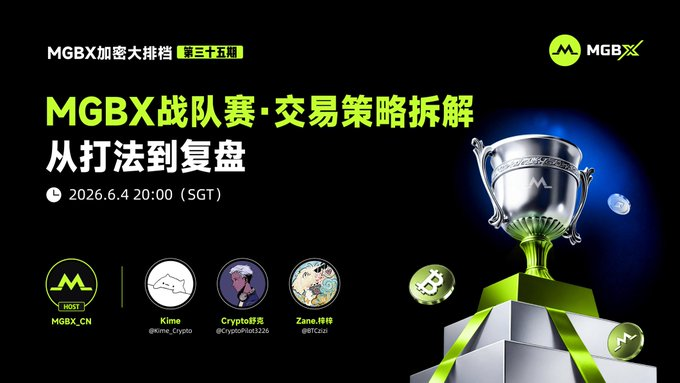
In tonight's Space, several guests participating in the competition also mentioned a common feeling: the closer to the end, the more one should not focus solely on short-term fluctuations, but rather look at the overall structure. Kime mentioned in the discussion that many people, upon reaching the sprint phase, fall into "trading volume anxiety," but what truly makes a difference is often not frequency, but stability. His words were quite direct: "The leaderboard looks at results, but results are built by every stable execution. You can do less, but you cannot do it chaotically." In his view, a ranking sprint is not simply about amplifying trades, but about consistently delivering effective trading under manageable risk.
When discussing team collaboration, Shuke's perspective is more "systematic." He believes the biggest change after taking the lead is not in the technical aspects, but in rhythm management. "A team is not just a group of people trading; it is a rhythmic system. If everyone's rhythm is inconsistent, even the best strategy will become fragmented." In this competition, he made a clear adjustment by providing low volatility strategies to more members while concentrating high volatility positions at core execution points. From the results, the overall stability and leaderboard efficiency of the team have significantly improved. He concluded that the competition in team tournaments is not about who is more aggressive, but rather who can unify the overall rhythm better.
In discussions about sudden market fluctuations, zane. Zizi's viewpoint is more rational and restrained. He mentioned that when geopolitical news causes rapid fluctuations in oil prices, the first reaction is often not opportunity, but risk. "Many people want to jump in when they see volatility, but real opportunities usually come after emotions cool down." He recalled that he also went through a phase of trading based on news in the early days, experiencing both profits and drawdowns, but the phrase that ultimately shaped his system was: "The market will not reward your impulsiveness, it will only reward your patience." In this competition, he did not change his core strategy, but slightly increased trading frequency within acceptable risk limits, using volatility to optimize rhythm rather than being led by it.
Zizi also mentioned an easily overlooked point when reviewing the entire team tournament: many people focus all their attention on the leaderboards, neglecting the stable accumulation throughout the process. He believes that what truly determines the outcome is often not a specific trade, but the quality of continuous decision-making. "Trading is not about an explosion, but about long-term correct accumulation." In his view, basic actions such as spreading positions, controlling rhythm, and setting take-profit and stop-loss orders are in fact the easiest factors to widen the gap during the sprint phase.
From an overall discussion perspective, this round of team tournaments in the Pizza Festival event has transitioned from the early strategy exploration phase to a typical "system confrontation phase." Initially, the competition was about strategy design, then about execution consistency, and now at this stage, it is more about risk control and patience with rhythm. Especially in an environment where event-driven and high-volatility situations frequently arise, market opportunities and risks are almost synchronized, and whether traders can remain steady does not depend on whether they are correct in direction, but on whether they can still execute according to the system.
The guests ultimately reached a relatively unified conclusion: what truly determines ranking is never the quality of a single trade, but the system's stable output capability under high pressure. Strategy determines the upper limit, execution determines the lower limit, and discipline determines whether you can reach the end.
Currently, the Pizza Festival-related activities are still ongoing but have entered the final stage. Whether in the team tournaments or other tracks, the ranking windows are continuously tightening, with the final changes often occurring in the shortest possible time. For users still participating, this is no longer a trial-and-error phase but an execution phase—direction is not important; what matters is whether the strategy can be fully completed.
The event is still ongoing, but time for the sprint is running out.
👉 Go to the official website to download MGBX: https://mgbx.com/
Company: MGBX
Official Business: @MGBXVIP
Risk Warning: Digital assets and leveraged trading carry high risks, and market volatility may lead to capital loss. Please make rational judgments and prudent decisions.
免责声明:本文章仅代表作者个人观点,不代表本平台的立场和观点。本文章仅供信息分享,不构成对任何人的任何投资建议。用户与作者之间的任何争议,与本平台无关。如网页中刊载的文章或图片涉及侵权,请提供相关的权利证明和身份证明发送邮件到support@aicoin.com,本平台相关工作人员将会进行核查。