Have you heard the term "cutting meat"?
In the trading circle, "cutting meat" means stopping losses. The term itself carries a bloody pain. So many people would rather bear it, wait, or drag it out, than "cut meat". They feel that stopping losses means admitting they were wrong, means losing money, means failing.
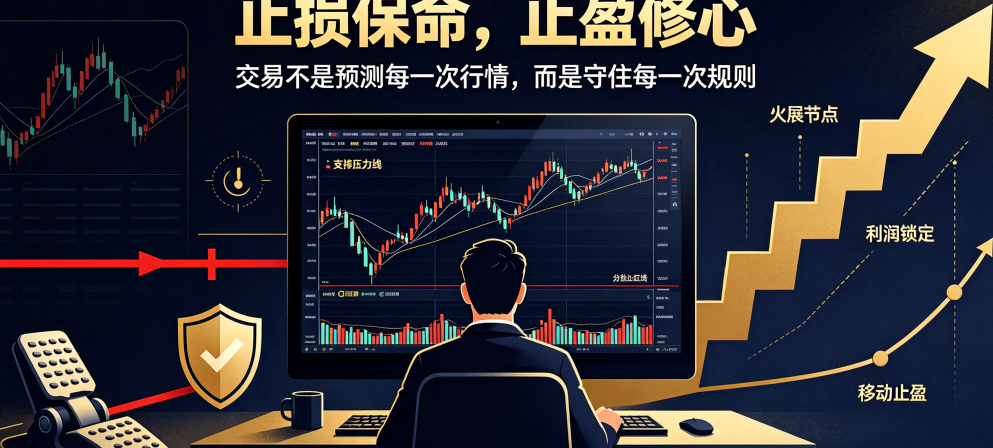
But do you know, in the eyes of true professional traders, stopping losses is never "cutting meat".Stopping losses is buying life - buying the chance for you to stay in the game, buying the opportunity for you to fight again tomorrow.
This lesson is more important than any technical indicator. Unfortunately, 90% of people can’t learn it.
1. Why are you reluctant to "cut meat"?
Because you treat losses as failures
When you hold onto your position, what are you thinking?
"Just wait a bit, it will come back soon." "I've already lost so much, leaving now is too much of a loss." "I just don’t believe it will keep falling." Have you said these words?
Your reluctance to stop losses isn’t because you don’t understand, but because you equate "stopping losses" with "giving up". Your pride can't handle it, you don’t want to admit you were wrong.
But have you calculated the numbers?
If you control each loss within 2% of your total capital, a single stop loss only injures a finger. You can lose ten fingers and still be alive. But if you hold on to your position and lose 20% or 30% at once, that’s not just a finger - it’s cutting off an entire arm. Hold on one more time, and you’re dead.
The pain of stopping losses is temporary; the pain of not stopping losses is lifelong. The former is a surface wound; the latter is amputation.
2. How do you truly "buy life"?
Let’s look at a real comparison.
Trader A sets a 2% stop loss for each trade. He goes long on rebar, and when the price drops, it hits the stop loss line and automatically closes the position. He loses 2000 yuan (assuming a total capital of 100,000). He feels a sting, but quickly adjusts his mindset and looks for the next opportunity. A week later, he catches a trend and earns 5000 yuan. He nets 3000.
Trader B also goes long on rebar, but when the price drops, he doesn’t set a stop loss, thinking “it will come back if I just hold on”. The price continues to drop; he adds to his position to average down. As the market plummets, he ends up losing 20,000 before he is forced to cut losses. To recover that 20,000, he has to take on even greater risks, and his mindset collapses.
Tell me, whose life is worth more? A spent 2000 yuan to "buy" an opportunity to continue trading. B saved 2000 yuan on "stop loss fees" but lost 20,000 in "medical fees".
Stopping losses isn’t cutting meat; it’s spending a small amount to buy life. Not stopping losses isn’t saving money; it’s saving a small amount and losing a big life.
3. Why can’t 90% of people learn this lesson?
Because stopping losses goes against human nature. Think about it: stopping losses forces you to admit defeat when you "haven't lost much yet". That inner voice says, “Wait a bit, maybe it will come back.” This voice comes from millions of years of evolutionary instinct - primitive people wouldn’t run away from a beast immediately, they would first observe, because running too early wastes energy. But in trading, this instinct is poison.
The market specifically targets those who say "just wait a bit". Because after "just wait a bit", it often becomes "can’t wait anymore". By the time you can't wait anymore, your losses have become unbearable.
Learning to stop losses isn’t about learning a technical action; it’s about combating your millions of years of instincts. That’s why 90% of people can’t learn it.
4. How to learn to "buy life"?
Three practical steps
Step One: Tie "stop loss orders" to "opening orders".
When opening a position, a conditional stop loss order must be placed at the same time. No stop loss, no opening. This is a hard rule with no exceptions.
You don’t need the ability to "manually stop losses"; you only need the ability to "place orders".Let the system execute for you, so you don’t have to fight with your own human nature.
Step Two: Rename "stop loss".
Stop calling it "cutting meat". Call it "insurance fee" or "rent". If you open a store and pay rent every month, would you consider that a loss? No, that’s a necessary cost.
Each stop loss is the rent you pay to "stay alive" in this market. If you can afford the rent, you can open up for business. If you can't, you're kicked out.
Step Three: Do "desensitization training" with small stop losses.
Take a very small account (or a demo account), and deliberately set the stop loss very tight for each trade, say just 0.5% of the total capital. Then force yourself to repeatedly experience the feeling of "being stopped out".
You’ll find that after stopping losses, the sky doesn’t fall; your account still has 99.5%. Do it continuously for 50 times, 100 times, until you become completely numb to stopping losses.
A true story of "learning to buy life"
Xiao Yang has been trading stocks for five years, and his biggest flaw is "reluctance to cut losses". When he buys a stock, it drops from 10 to 9 yuan, and he doesn’t sell; drops to 8 yuan, he adds to his position; drops to 6 yuan, he becomes desperate and cuts losses. Then the stock bounces back to 7 yuan, and he regrets it. After several such instances, his account shrinks by more than half.
Later, he attended a trading training camp. The mentor asked him to do one thing: every time he buys in, he must set a stop loss at 8%. When he set a stop loss for the first time, his hands trembled. As a result, the stock dropped by 7% and then rebounded; he wasn’t stopped out and made money. He tasted the sweetness. The second time, the stock really hit the stop loss line, and the system automatically sold for him. He was upset for an afternoon but found that the account only lost 8%, not the previous 20% or 30%.
Half a year later, Xiao Yang told me: “Now when I stop losses, I tell myself ‘insurance fee paid’, and then carry on as usual. I used to want to save that little insurance money, but ended up spending all my savings on one major illness. Now I know, spending a small amount to buy life is worth it.”
Stopping losses isn’t cutting meat; it’s buying life. Cutting meat is forced, painful, and bloody. Buying life is active, conscious, and spending a small amount to protect a large amount. Every stop loss you actively set is saying to yourself: “I want to continue playing this game; I don’t want to exit now.”
Trading is an infinite game. You can lose countless small battles, but as long as you’re alive, there’s always a chance to turn things around. But if you’re reluctant to spend that little money to buy life, the market will one day take your life away at once.
From today onward, erase the words "stop loss" from your dictionary and replace them with "buy life". Before placing any order, ask yourself: Am I willing to pay this "life money"?
If willing, then do it. If not, just watch.
Your account will thank you for every "buy life" decision.
How much did you ultimately lose percentage-wise the last time you were “reluctant to stop loss”?
Write that number in the comments, then tell yourself: Next time, I’ll buy life.
For more informative content, follow: Da Niu Says Market Trends
免责声明:本文章仅代表作者个人观点,不代表本平台的立场和观点。本文章仅供信息分享,不构成对任何人的任何投资建议。用户与作者之间的任何争议,与本平台无关。如网页中刊载的文章或图片涉及侵权,请提供相关的权利证明和身份证明发送邮件到support@aicoin.com,本平台相关工作人员将会进行核查。