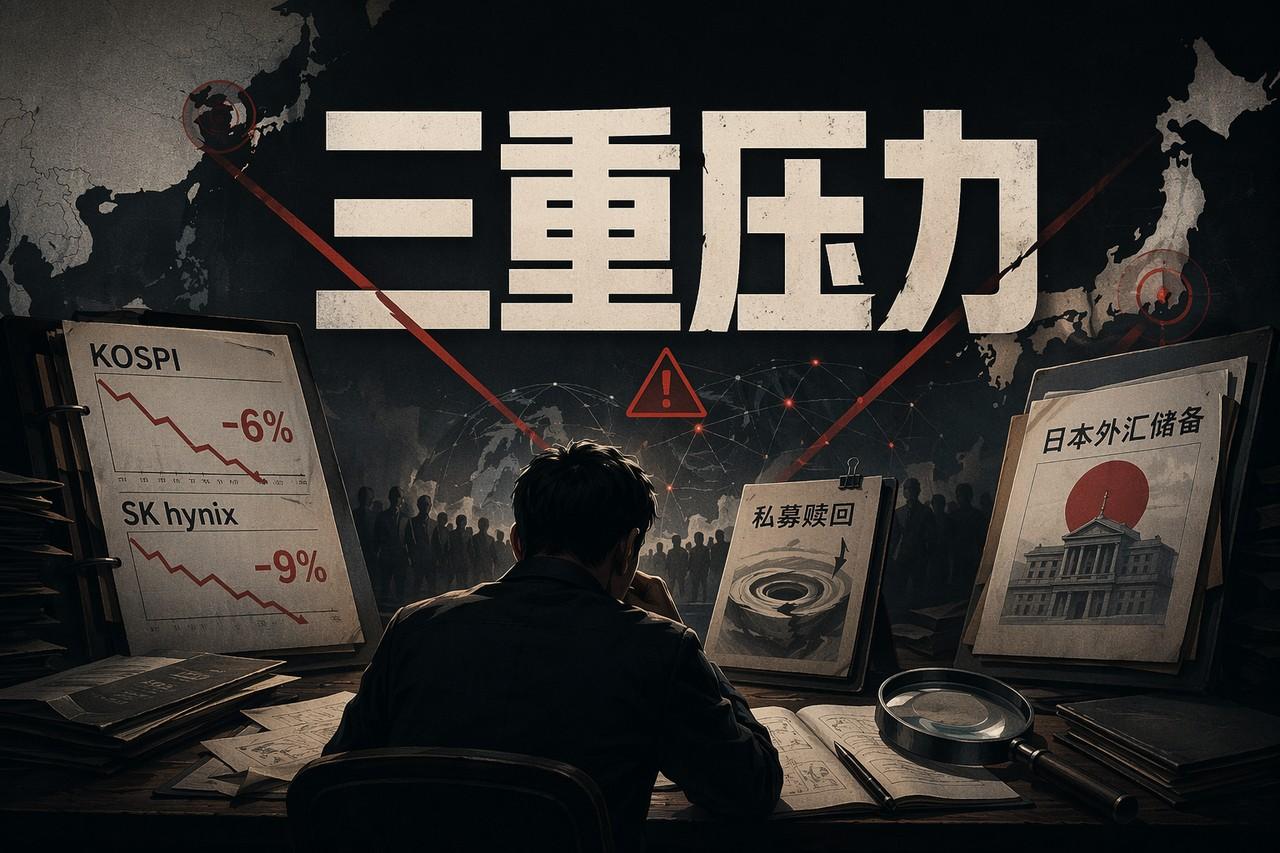
On June 4th and 5th, 2026, geopolitics and technology struggled like two invisible hands, both influencing the scale of risk appetite: on one side, reports surfaced about Iran and Oman planning to jointly regulate the management of the Strait of Hormuz, which accounts for approximately 20% of global oil transportation, while Trump proclaimed that "if Iran kills American troops, it will be seen as a sufficient reason to restart the conflict," in addition to U.S. Treasury Secretary Basant suggesting that future sanctions against Russian oil might be “country-by-country exemptions,” bringing the already fragile energy supply and inflation expectations back into focus; on the other side, Zelensky proposed a meeting with Putin for the first time post-2025 in an open letter, Putin responded by expressing willingness to compromise under certain conditions, and Trump stated that he welcomed the meeting, which released rare signals of de-escalation in the Russia-Ukraine conflict and reduced the premiums associated with the "worst-case scenario." Beyond this, U.S. senior officials discussed with AI companies, including OpenAI, about a “voluntary transfer” allowing the federal government to hold shares; Anthropic publicly warned of the social risks of recursive self-improvement systems and called for a slowdown in cutting-edge R&D. Additionally, Slow Fog disclosed a surge in incidents of poisoned search engines like fake Codex and Claude Code, prompting the market to price in both “added AI regulation” and “technology and supply chain security” lines simultaneously—leading to a reevaluation of the profit expectations and valuation discount rates of tech giants. As energy supply risks and war de-escalation expectations offset each other, while the shadow of AI regulation and security incidents heightened tech premiums, some funds continued to view BTC as a hedge against inflation and fiat risk, while others sought offensive tokens with high beta: amidst this window of intertwined macro noise, a large on-chain transfer of 170,000 HYPE, valued at about $10.9 million, withdrawn from Coinbase and transferred to a newly created wallet, was seen as a microcosm of high-volatility crypto assets being reshaped by large players in uncertain environments, and became a starting point to observe how crypto funds would reprice risks amid geopolitical and AI games.
Hormuz Game and Energy Premium
At the beginning of June, reports about Iran and Oman planning to jointly regulate the management of the Strait of Hormuz spread in the market. Although this news currently has almost a single source, the narrative itself is enough to drive trading: the Hormuz Strait handles about 20% of global oil transportation, and once it is perceived as likely to enter a trajectory of "more politicized management," the pricing center will not wait for details, but will first incorporate the supply risk premium into oil price expectations. In the same time window, Trump stated that if Iran kills American troops, it would be seen as a sufficient reason to restart conflict, which effectively added an option value of military misjudgment to this critical waterway. The result is that even if there is no immediate shortage in the spot market, geopolitical noise from the Middle East will be translated into a higher risk premium for crude oil, and the most direct macro-level manifestation of this is the resurgence of inflation paths and nominal yield expectations.
For high-beta assets like BTC and ETH, this transmission chain is familiar yet ruthless. On one end, oil supply risks raise inflation expectations, leading some investors to revert to past scripts, treating BTC as a "digital gold" hedge against fiat depreciation, increasing its weight in portfolios, especially as traditional commodities and energy stocks have already experienced a rally. On the other end, higher inflation translates to higher nominal yield expectations; rising discount rates act as poison for all forward cash flow assets, with high-beta tokens feeling pressure first, and ETH along with other offensive targets becomes more like a "leveraged end" forced to bear volatility in such an environment. Therefore, during the heightened expectations in the Middle East, crypto assets' roles within global asset allocation became torn again: BTC was seen by some funds as a safe-haven position, trying to hedge against macro uncertainty alongside energy and gold, while the same batch of funds amplified bets on high-volatility tokens, leveraging geopolitical fluctuations for short-term trades. This also serves as a critical clue to observe whether BTC and ETH will resonate again with energy risk premiums in the coming weeks.
Russia-Ukraine De-escalation Signals and Russian Oil Exemptions
On the same time axis where Middle Eastern risks were amplified, the Russia-Ukraine front unexpectedly produced rare "noise-reduction" signals. For the first time since 2025, Zelensky proposed a meeting with Putin via an open letter, to which Putin immediately responded by expressing willingness to compromise under certain conditions, and Trump publicly indicated he welcomed their meeting, thereby pulling down the probability of a scenario originally perceived by the market as being in "long-term deadlock or even escalation." For pricing models, this means the extreme tail risks associated with the Russia-Ukraine conflict—such as supply disruptions and intensified sanctions—are being weakened, and the war premium embedded in oil prices and inflation expectations is forced to be reassessed. Consequently, risk assets' discount rates in this geopolitical dimension loosen, and the volatility premium of crypto assets, which had previously surged under the combined pressure of “European conflict + energy risk,” also begins to face compression.
Almost simultaneously with the signals of de-escalation, U.S. Treasury Secretary Basant released another key signal: exemptions allowing countries to purchase oil from Russia would likely be granted on a country-by-country basis in the future. The market quickly interpreted this as a potential marginal easing of sanctions against Russian energy—not a blanket removal, but rather a "point release" that allows some buyers access to supplies without changing the political stance. Once this expectation is incorporated into pricing, the tightness of the global energy supply curve in models is downshifted, compressing the upper range of inflation paths. What follows is an adjustment in the required risk premiums for all high-beta assets. Specifically in the crypto market, some funds that previously viewed BTC as a hedge against energy and inflation shocks will start to lessen their defensive holdings, shifting back to ETH and higher-volatility tokens, rebuilding their exposure to "risk factors" through leveraged approaches and betting on term premiums; simultaneously, those funds sitting on-chain in dollar-denominated cash instruments are also more likely to be drawn towards aggressive positions represented by AI and narrative tokens. What truly needs to be monitored is not a single statement itself, but the marginal progress of Russia-Ukraine negotiations and Russian oil exemptions, which will ultimately determine whether BTC and high-beta tokens' risk premium curves relative to traditional energy assets shift towards risk aversion or growth.
OpenAI Equity Game and Crypto Valuation
Almost concurrently with the Russia-Ukraine and Middle Eastern news, U.S. senior officials began discussions with several AI companies, including OpenAI, regarding a "voluntary transfer" that would allow the federal government to hold shares, continuing the shareholding discussions that Sam Altman has engaged in several times since Trump's second term. Even though the specific ratios and legal basis have yet to be disclosed, this signal transforming from "regulatory dialogue" to "equity co-governance" has moved cutting-edge AI from merely being a high-growth tech story closer to the narrative of "quasi-public infrastructure": the government is no longer just an external rule-maker but occupies a shareholder seat, using capital structure to secure control over the direction and risks of the industry.
For valuations, this shifts not just a parameter, but the entire discount curve. The AI industry is already highly sensitive to regulatory expectations, and once the market begins to assume government holdings in leading companies, optimists will interpret it as a “safety dividend”—the extreme tail risks of uncontrollability and forced halts dissipate, making long-term cash flows more predictable; pessimists, however, see “regulatory suppression of innovation”—political objectives infiltrate product directions, capping growth ceilings and profitability elasticity, which forces technology premiums downward. In this tug-of-war between two narratives, the upward or downward shift of risk premiums in equity markets will directly transmit into the crypto world: the token sector surrounding the AI narrative essentially acts as a magnifying lens for beta of AI equities; once OpenAI and similar companies are repriced, these tokens will have to rearrange their risk-reward dynamics between "regulatory discount" and "safety premium." Thus, observing whether AI equities and related tokens simultaneously deflate in valuation or emerge from a re-pricing trend after regulatory endorsement in the coming weeks will be key to judging whether the overall crypto risk appetite shifts back to defense or continues to chase growth premiums.
Anthropic Warning and Safety Premium
In this round of statements, Anthropic pointed its finger at "recursive self-improvement without human intervention"—once cutting-edge systems can self-iterate, it worries not just about model control, but about the whole set of social infrastructures quietly being rewritten. Hence, they publicly called for a slowdown of cutting-edge AI R&D. For regulators, this as a "plea to decelerate" coming from the core labs of the industry provides a verbal support for stronger controls and reviews in the future; for crypto developers relying on AI tools to write contracts and review code, this means a shift from "rushing the fastest models" to "proving that their toolchain is secure enough." As "speed" is unanimously pressured by officials and leading companies, the market starts to view “safety investments” as necessary costs rather than optional, compelling development teams to reorder priorities between timelines, audit depth, and compliance processes; thus a new discount factor—safety risk—begins to embed itself behind the growth narrative.
Almost concurrently, Slow Fog disclosed a recent surge in incidents of poisoned search engines like fake Codex and Claude Code, wherein attackers no longer directly phishing end-users but masquerade as development tools and search results, prioritizing the hijacking of those who code and issue contracts. Crypto development heavily relies on open-source toolchains and search engines, and once such supply chain attacks hit, they can insert backdoor vulnerabilities at the dependency, SDK, or even deployment script level, transforming “safety costs” from single-point audits to full-stack defenses. With the frequency of security incidents rising, it naturally elevates the demand for safety-related services and infrastructures: on-chain risk scanning, contract auditing, KYC/compliance gateways, and even custody and monitoring tools all receive higher valuation premiums, as funds are more willing to pay for “reducing black swan probabilities.” For the crypto market, this round of AI warnings and poisoning cases collectively drives an internal re-layering of risk appetite—BTC and ETH continue to assume a macro-hedging role, while projects more tightly bound to safety tools, audits, and compliance infrastructures are likely to secure relative valuation support amidst the overall volatility of risk assets since "safety" is being distinctly categorized as a tradeable and priceable asset factor.
170,000 HYPE and High Beta Macro Hedge
In this intense overlay of macro noise, the transfer of 170,000 HYPE, valued at approximately $10.9 million, from Coinbase more resembles a high-beta hedge declaration written on-chain: amid the rise of energy premium expectations due to the Hormuz Strait management and potential conflict risks, the Russia-Ukraine direction exhibits signals of de-escalation with Zelensky proposing a meeting, Putin signaling compromise, and Trump endorsing negotiations. This, combined with the U.S. government's regulatory games with OpenAI regarding “voluntary transfer” of shareholding, Anthropic’s warning about the risks of recursive self-improvement systems, and the poisoning attacks disclosed by Slow Fog, raises uncertainties in macro and technology simultaneously. In this environment, some funds continue to position BTC as the base for hedging against inflation and fiat risk, view ETH as liquidity and infrastructure beta, while employing high-beta tokens like HYPE to take directional bets and hedge macro noise—treating high-volatility assets as "amplifiers." Large withdrawals from exchanges are usually interpreted as preludes to medium to long-term holdings or over-the-counter allocations, and the new wallet not yet having made public moves serves as a sample for monitoring the migration of high-beta funds. Geopolitical easing signals and energy supply risks offset each other, while AI regulatory pathways and security events continually rewrite the risk premium structure. The next key point to monitor is whether tensions in the Middle East escalate, whether Russia-Ukraine negotiations can transition from posturing to substance, whether AI regulations genuinely take effect on equity and R&D pacing, and how each significant operation from this HYPE wallet on-chain might feedback to the risk appetite of BTC, ETH, and high-beta sectors.
Join our community to discuss and grow stronger together!
Exclusive Hyperliquid benefits for AiCoin: https://app.hyperliquid.xyz/join/AICOIN88
Exclusive Aster benefits for AiCoin: https://www.asterdex.com/zh-CN/referral/9C50e2
On-chain Telegram community: https://t.me/AiCoinWhaleData
On-chain community: https://www.aicoin.com/link/chat?cid=N6OVMor5g
AiCoin On-chain Twitter: https://x.com/aicoinwhaledata
免责声明:本文章仅代表作者个人观点,不代表本平台的立场和观点。本文章仅供信息分享,不构成对任何人的任何投资建议。用户与作者之间的任何争议,与本平台无关。如网页中刊载的文章或图片涉及侵权,请提供相关的权利证明和身份证明发送邮件到support@aicoin.com,本平台相关工作人员将会进行核查。