On June 4, 2026, Bitcoin continued its recent downward trend, dropping 4.7% within 24 hours and accumulating a decline of over 13% for the week, with a market value shrinking to $1.27 trillion. This round of correction has plunged the market into another "bottom contention": Has BTC reached its bottom? Or is the cyclical bear market still continuing?
Current Market Data Overview: Bear Market Signals Are Obvious
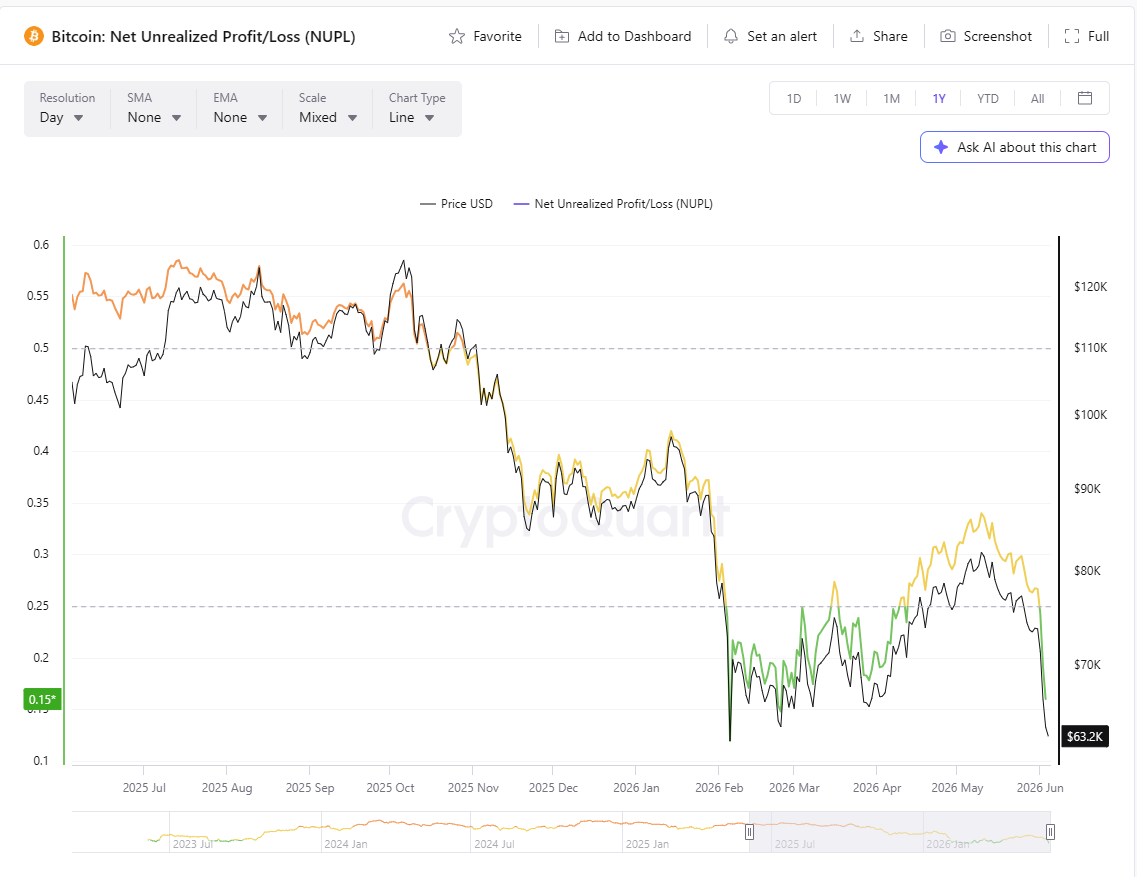
Real-time data shows that Bitcoin has significantly retreated from its 2025 peak, and the Net Unrealized Profit/Loss (NUPL) metric has dropped to relatively low levels, indicating that the overall profit space in the market is being squeezed, and the chip structure is undergoing severe cleansing, with the Fear and Greed Index (FGI) deeply entrenched in the "fear" zone.
Compared to historical bear markets, the speed of this round of adjustment has clearly accelerated. The "supply halving effect" brought about by the halving in April 2024 led to a historical peak in October 2025, but with the drastic reversal of the macro environment, the speed of profit realization far exceeds previous periods. Although the bullish sentiment ratio in social sentiment remains at an inflated state of 2.23:1, the divergence between "bullish sentiment" and "actual capital outflow" suggests a behavioral rift between retail and institutional investors.
Historical Cycle Perspective: The Four-Year Halving Theory Is Not Dead, 2026 Q4 May Welcome a "Durable Bottom"
Although some believe that the involvement of institutions has changed the underlying volatility logic of BTC, the statistical four-year halving cycle theory still has extremely high reference value.
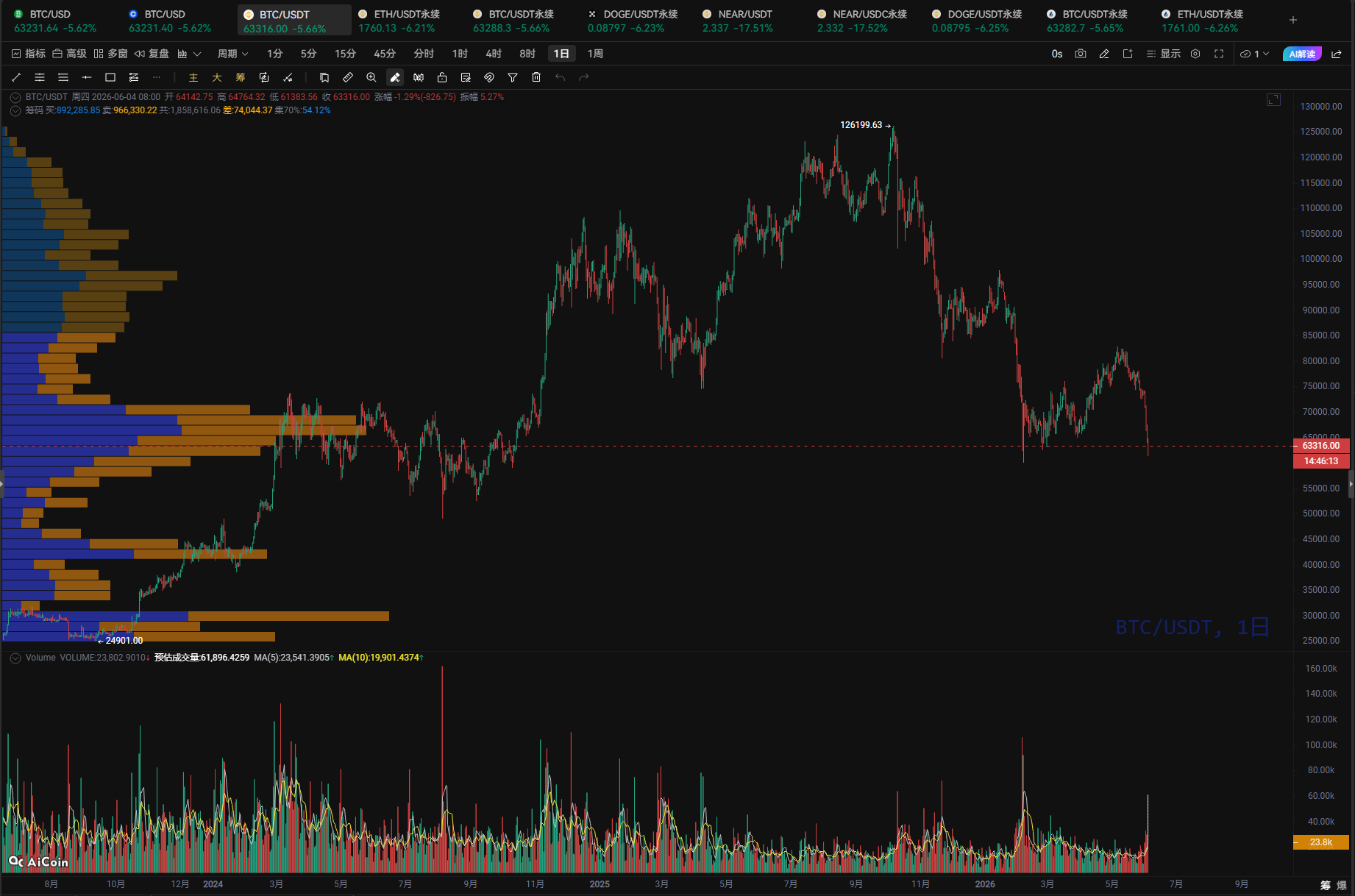
- Historical Pattern Deduction: A review of the previous three cycles shows that bull market peaks usually occur 12 to 18 months after a halving, followed by a systematic correction lasting 12 to 13 months. This cycle saw a halving in April 2024, with a peak in October 2025, perfectly aligning with historical rhythms. If this pattern continues, the final bottom of this cycle is likely to be formally determined in the fourth quarter of 2026 (around October).
- Midterm Election Year Effect: Senior analyst Benjamin Cowen and others point out that 2026, being a midterm election year in the U.S., often sees a temporary low in June, but the ultimate bottom may fall around October, with the price range possibly between $50,000 and $60,000.
Capital Flow Changes: ETF Net Outflows Under Pressure, but Long-Term "HODL" Structure Remains Unchanged
Institutional funds, being the largest variable in this cycle, are evolving from a "pure bullish booster" to a "bi-directional volatility amplifier."
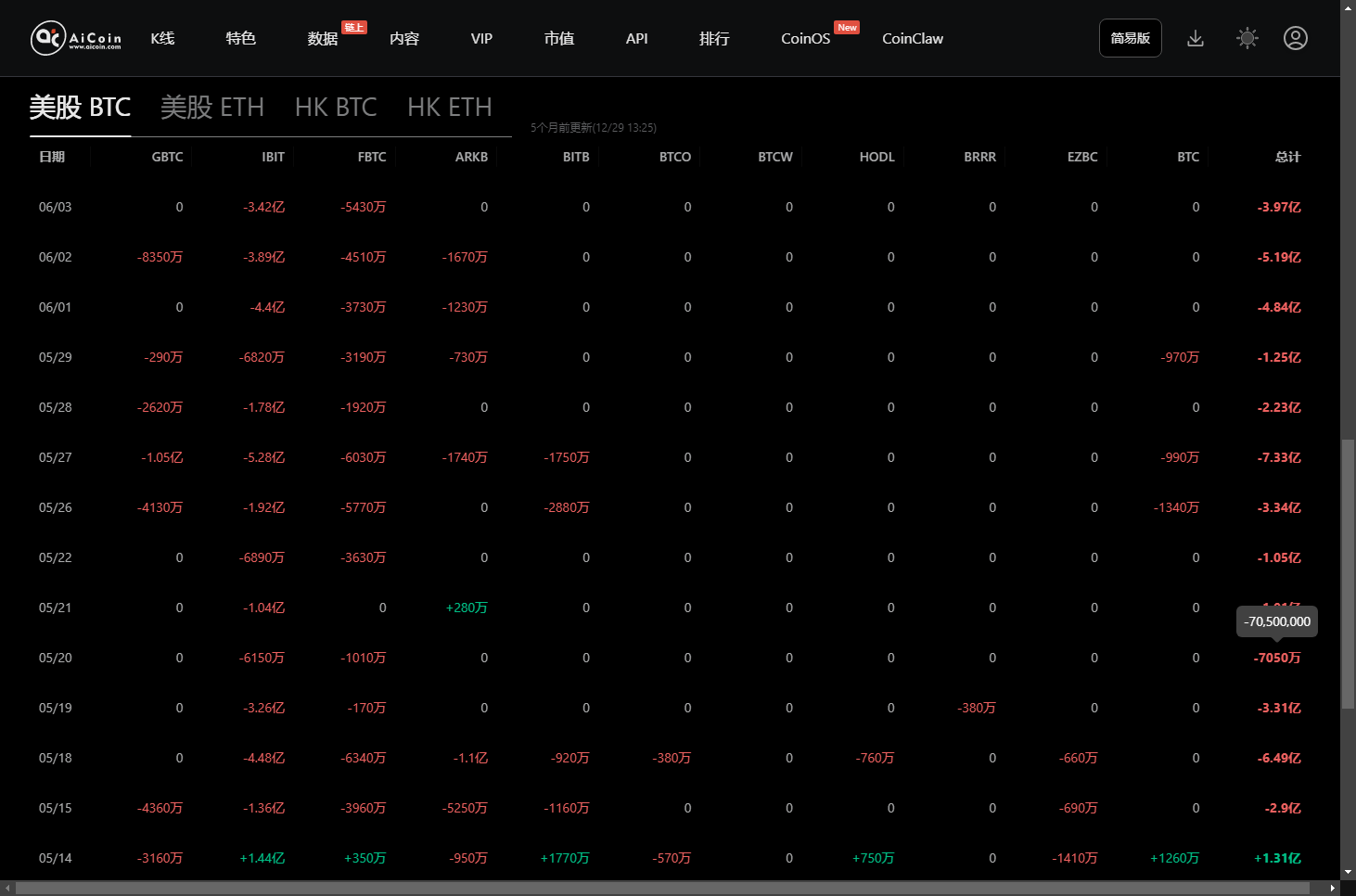
Since the approval of the U.S. spot Bitcoin ETF in January 2024, there has been a cumulative net inflow of over $50 billion, but during the period from May to June 2026, institutions showed significant temporary capital withdrawal:
- May Performance: A net outflow of about $2.3 billion in a single month.
- Early June Performance: A net outflow of $1.67 billion within just one week.
- Main Actions: A cumulative withdrawal of over $4.2 billion within three weeks, where BlackRock's IBIT faced profit-taking and Grayscale's GBTC continued to experience redemption waves due to high fee issues.
However, the outflows reflect a cyclical rebalancing rather than a structural abandonment. The total assets under management for ETFs remain around $94 billion to $100 billion, with institutions holding approximately 24.5% of this. In the long run, ETFs still play the role of a liquidity reservoir at market bottoms. Coupled with data from CryptoQuant showing that miner outflow metrics are stabilizing and exchange token reserves are continuously declining, it indicates that the trend of "long-term holders (LTH)" HODLing has not wavered.
Macroeconomic and Geopolitical Factors: Uncertainty Dominating Federal Reserve Monetary Policy Remains a Key Variable.
From a macrofinancial perspective, the Federal Reserve's monetary policy path is still the main burden in suppressing the risk appetite of the crypto market.
Entering 2026, U.S. inflation is significantly higher than market expectations, interest rate cut expectations have been repeatedly delayed, and the elevated risk-free rate continues to siphon off speculative capital. Meanwhile, the frequency of geopolitical conflicts has not triggered Bitcoin's "safe-haven attributes," but rather intensified institutions' risk asset reductions between May and June.
Technical indicators on the daily chart show that the RSI is in oversold territory, the MACD death cross persists, but trading volume has not seen panic-driven expansion. The psychological barrier of $60,000 and the turning support level from the 2021 peak (transforming around $70,000) form a potential bottom range. If the market replicates the seasonal rebound pattern from historical midterm election years in June, BTC is expected to undergo a technical recovery in the current oversold environment, testing resistance in the $68,000-$70,000 range. Conversely, if it falls below $61,000, it may further explore the $55,000 support level.
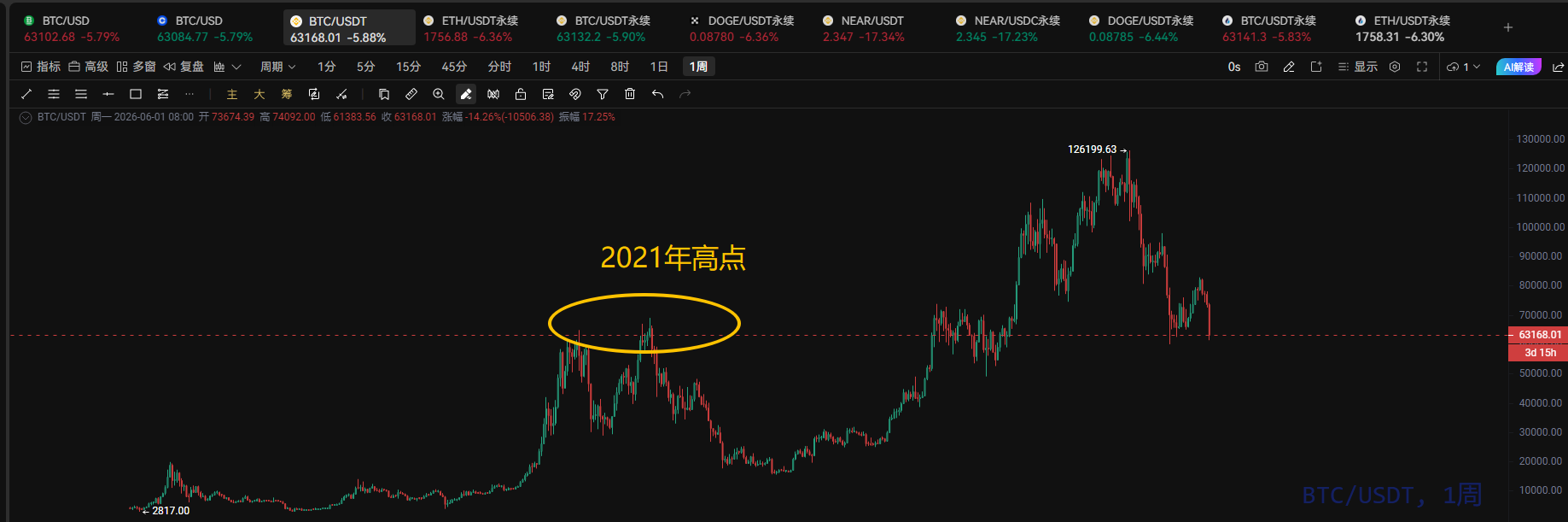
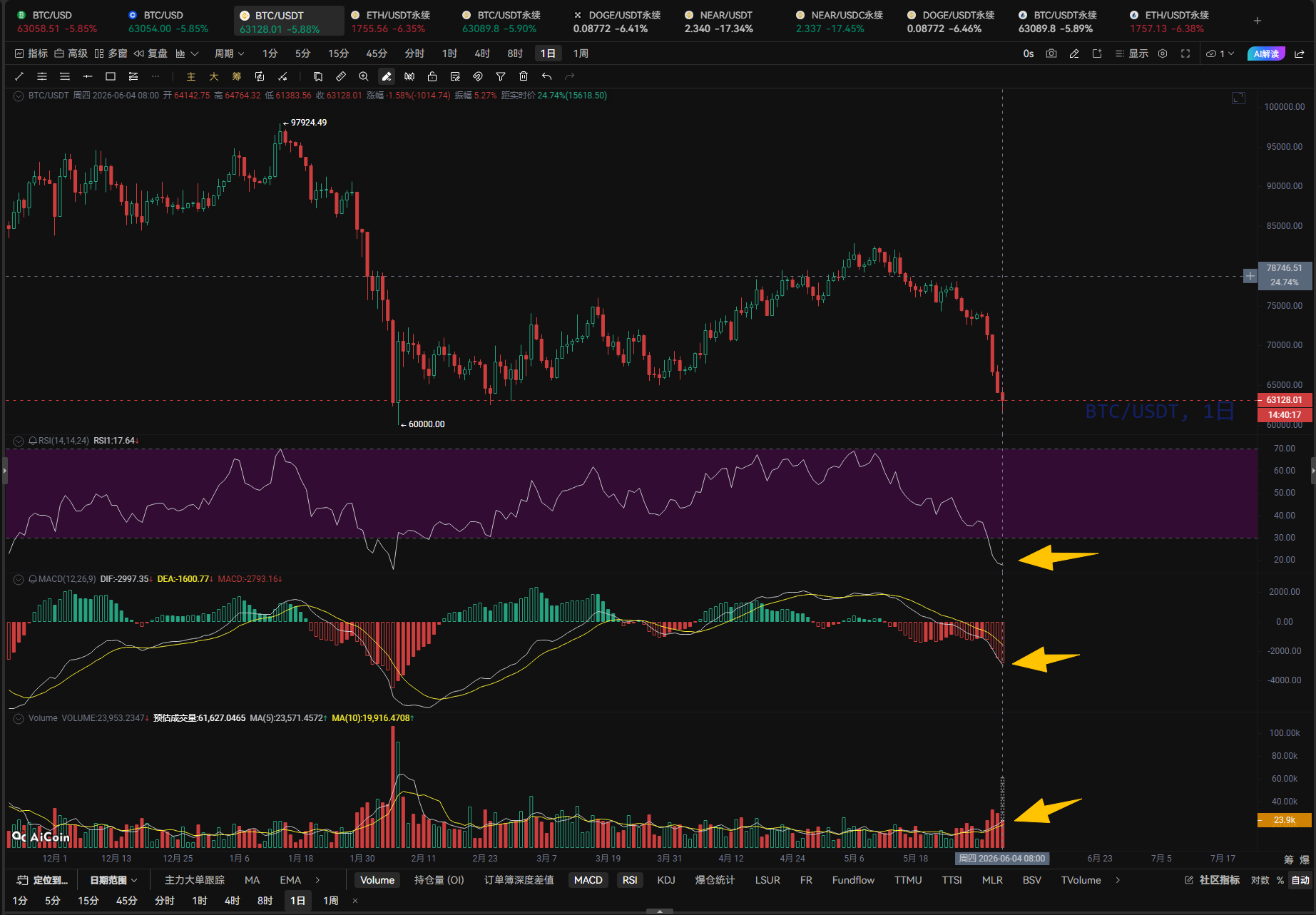
Risks Remain: If ETF outflows continue into the fourth week, or if macro data worsens again, it will be difficult to say "this is the bottom" in the short term. However, unlike in 2022, this round features a mature ETF ecosystem and deep institutional participation, significantly reducing the probability of an extreme collapse. The area around $63,000 is already a deeper correction position, making it potentially a reasonable range for moderately risk-tolerant investors to gradually accumulate.
The market is changing rapidly, for reference only, not investment advice.
Stay updated with on-chain data, ETF weekly reports, and Federal Reserve dynamics at AiCoin open data API:
https://www.aicoin.com/zh-Hans/opendata
免责声明:本文章仅代表作者个人观点,不代表本平台的立场和观点。本文章仅供信息分享,不构成对任何人的任何投资建议。用户与作者之间的任何争议,与本平台无关。如网页中刊载的文章或图片涉及侵权,请提供相关的权利证明和身份证明发送邮件到[email protected],本平台相关工作人员将会进行核查。