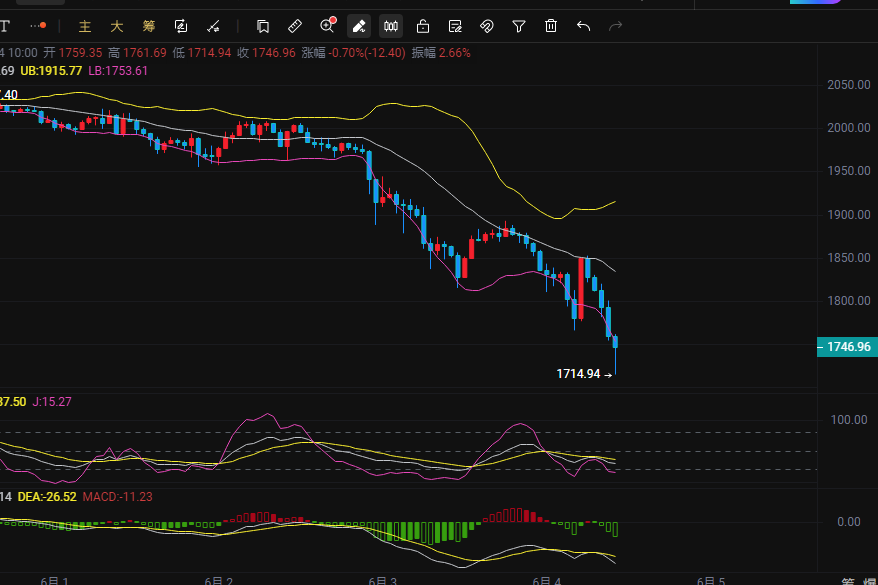
On June 4, 2026, Bitcoin fell below the critical level of approximately $63,000 during trading hours, and the moment the price broke out triggered a chain reaction on-chain. According to on-chain monitoring, Garrett Jin, an agent regarded as the "1011 insider whale," saw an unrealized loss of over $17 million on a 5x BTC long position under his account during this downturn, clearly revealing the true pressure on high-leverage longs in this price range. Almost at the same time, security firm PeckShield pointed out that the apxUSD, pegged to $1 with STRC as the sole collateral asset, dropped to about $0.94, a decline of approximately 4.6% from par value. This price deviation emerged during the simultaneous contraction of collateral asset value, causing a pegged token that should have closely aligned with $1 to exhibit significant decoupling. The immense unrealized losses of high-leverage whales and the price deviation of the pegged token under a single-collateral structure were both highlighted around the $63,000 mark, representing two sides of the same market pressure. The following sections will focus on the leverage squeeze and collateral decoupling above this price point, examining what vulnerabilities in the current market structure are being exposed in advance.
Break of $63,000: Double Alarm Rings Out
According to AiCoin data, when BTC fell below about $63,000 on June 4, the market's real pain was not just a long shadow on the candlestick chart, but rather two completely different risk systems being pushed to a critical point simultaneously. On one side, high-leverage longs were detected on-chain: Garrett Jin, seen as the "1011 insider whale" agent, had seen over $17 million in unrealized losses on his 5x BTC long after the price fell below $63,000, as margin buffers were rapidly compressed. With each step down in price, there were more break points in the leverage chain.
On the other side, the apxUSD, which used STRC as the sole collateral asset and was aimed at pegging to $1, was noted by PeckShield to have its price drop to about $0.94 during the same time window, which is a drop of approximately 4.6% from par value. Public information can only confirm that the value of the collateral asset contracted in sync with this round of declines, and specific collateral scale and parameters have yet to be disclosed. However, this was enough to illuminate the structural vulnerability of "single collateral + correlation exposure." The triggering of both the whale's unrealized losses and the apxUSD decoupling occurred near the $63,000 mark, thus this price point became the "stress test line" of the current cycle. Each subsequent approach to or break below this level would lead the market to instinctively correlate the profits and losses of whale positions with the performance of apxUSD and its collateral assets, treating $63,000 as a key observation coordinate for the tension level and whether systemic risk would rise again.
$17 Million Unrealized Loss: Whale Longs Backfire
When BTC fell below the $63,000 line on June 4, Garrett Jin, regarded as one of the "1011 insider whales," became the most intuitive sample beneath this "stress test line." On-chain monitoring tools and market materials revealed that he had not merely held spot for the long term but chose to open a 5x leveraged BTC long position during this round, and after the price broke below $63,000, the unrealized losses on this position enlarged to over $17 million, with the pace of loss amplification nearly synchronous with the price decline that day. This was not a small retracement in book value but a demonstration of how typical high-leverage longs are instantly "amplified" by the market during a single day's reverse volatility.
The leverage multiplier itself is an amplifier: the same price drop under 5x leverage sees losses expanding far faster than with no leverage position. The closer an account approaches the liquidation range, the harder it is for decision-makers to remain calm under psychological pressure. More critically, the exposure of such whale positions under pressure being made public can quickly reverse its effect on market sentiment—retail investors witnessing the "insider whale agent" encountering an eight-figure unrealized loss will instinctively reassess their safety boundaries for opening leverage, viewing each fluctuation near the $63,000 mark as a public examination of "who is holding the position, and who is being forced to reduce leverage."
apxUSD Falls to $0.94: Concerns of Single Collateral
When Bitcoin fell below $63,000 and the overall market sentiment shifted to defense, those seemingly "as solid as a rock" pegged assets began to reveal structural weaknesses. The apxUSD is a typical example—it relies solely on STRC as collateral, differing from multi-asset and diversified collateral designs by essentially tying its stability to the performance of STRC alone. According to PeckShield and market data, during the same phase on June 4, the apxUSD price briefly fell to about $0.94, with a decline of around 4.6% from its $1 peg. Although numerically it is not catastrophic, it does illustrate that when the market value of the sole collateral shrinks alongside the overall market, the apxUSD has almost no buffer space.
In an environment where BTC weakens and the value of its highly correlated STRC also faces downward pressure, the price deviation of apxUSD is not a "black swan," but rather an inevitable exposure of the single collateral logic in a systemic downturn. The collateral asset itself bears market β risk and is used to generate "seemingly low volatility" pegged coins, and once market conditions reverse, the revenue logic is overtaken by correlation propagation, and the pegged coin price becomes a window that magnifies this impact. The incident of apxUSD dropping to $0.94 pressures the market to reassess the "single collateral + yield asset" model: in a favorable market, they package the same risk into a yield story, but in adverse conditions, they may hinge the resilience of the entire pegged system solely on the movement of one asset, which is precisely the risk-reward balance point that current participants need to reevaluate.
From Whales to Pegged Coins: The Same Risk Echoes on-Chain
If we pull the timeline back to the moment Bitcoin fell below approximately $63,000 on June 4, according to AiCoin data, the 5x BTC long associated with Garrett Jin expanded unrealized losses to over $17 million at the same price level, while the apxUSD pegged to $1 with STRC as its sole collateral was monitored by PeckShield to slid down to about $0.94 in the same downturn. On the surface, one is the personal gamble of high-leverage longs, while the other is a dollar-pegged token under the narrative of "single collateral + yield assets," with different subjects and mechanisms entirely. However, what is being hit at the core is actually the same fragile foundation: when risk asset prices decline, amplified leverage and concentrated collateral lose buffer space simultaneously within the same price range. Breaking through critical price points triggers a synchronous resonance of margin pressure and collateral shrinkage, reflecting the former in the fear of forced liquidation of whales and the latter in the rapid compression of the apxUSD peg bandwidth, both scenarios exposed within the same environment of cooling risk appetite.
Therefore, these two on-chain events occurring near the $63,000 mark are interpreted through various materials, with the market naturally viewing them as different nodes on the same chain: price decline—tightening leverage margin—shrinking buffer space for collateralized pegged tokens—participants beginning to doubt "how much longer this structure can hold." This "echo effect" on-chain, which is simultaneously amplified, turns what could be seen as isolated incidents for individual accounts or projects into a window to observe the resilience of the entire market structure, forcing all participants still using high leverage or relying on single collateral assets to reassess how close they are to the trigger point of this chain reaction.
Three Things to Watch Next
Going forward, the first thing to watch is Bitcoin itself: according to AiCoin data, the $63,000 level has become a psychological and risk dividing line in this downturn. Whether BTC can regain and stabilize above this level will directly determine the pressure of liquidation on leverage longs and the run on various collateral positions, serving as the primary signal of whether it will “decrease” or “continue to tighten.” The second thing is to continuously monitor the on-chain movement related to Garrett Jin—whether it is reducing positions, increasing positions, or adjusting leverage multiples, it will leave clear records on-chain. In the current context where precise position scale and liquidation price information are lacking, these real transaction paths reflect this type of whale's risk preference better than any rumors can. The third thing is to track whether the price of the apxUSD can gradually return to near $1, as well as whether the market performance of STRC and the project side will publicly introduce buffering or repair mechanisms: if the apxUSD stays long-term around $0.94 or further deviates and no widely recognized countermeasures are introduced at the project level, it means that the systemic pressure of this "single collateral chain" has not genuinely relieved, it has only temporarily hit the pause button.
Join our community to discuss and grow stronger together!
AiCoin exclusive Hyperliquid benefits: https://app.hyperliquid.xyz/join/AICOIN88
AiCoin exclusive Aster benefits: https://www.asterdex.com/zh-CN/referral/9C50e2
On-chain Telegram community: https://t.me/AiCoinWhaleData
On-chain community: https://www.aicoin.com/link/chat?cid=N6OVMor5g
AiCoin on-chain Twitter: https://x.com/aicoinwhaledata
免责声明:本文章仅代表作者个人观点,不代表本平台的立场和观点。本文章仅供信息分享,不构成对任何人的任何投资建议。用户与作者之间的任何争议,与本平台无关。如网页中刊载的文章或图片涉及侵权,请提供相关的权利证明和身份证明发送邮件到support@aicoin.com,本平台相关工作人员将会进行核查。