Iran, Hezbollah, and Israel are back on the path to war.
Written by: Michael Snyder
Translated by: Peggy
Editor's note: Peace expectations regarding Iran had recently warmed up again over the past few weeks. However, the judgment given in this article is entirely the opposite: the author believes that the collapse of US-Iran negotiations signals the re-escalation of conflict in the Middle East, rather than merely being a diplomatic setback.
The article revolves around three risk points: first, dialogue between Iran and the United States has stagnated, and Tehran will make Israel's withdrawal from Lebanon and the cessation of military actions against Gaza and Lebanon a precondition for resuming negotiations; second, Hezbollah’s attacks on northern Israel continue, while Israel retains the option to strike Beirut; third, Iran and its allies are beginning to include key global energy and shipping routes such as the Strait of Hormuz and the Strait of Mandeb in their retaliation toolbox, making regional conflicts potentially spill over into risks for the global supply chain.
It is noteworthy that the original text carries a strong apocalyptic and war prophecy tone, as the author directly asserts that "World War III has arrived." This judgment is obviously highly subjective and requires careful discernment by readers. However, the article is worth paying attention to as it observes scattered conflict events within the same chain: the breakdown of negotiations, proxy wars, Israeli military actions, the restoration of Iran’s missile capabilities, and the threat to key straits are collectively forming a more dangerous risk structure in the Middle East.
In other words, it is not necessarily a specific ceasefire failure that should be truly alarming, but rather that all parties are simultaneously bringing negotiations, military deterrence, energy corridors, and regional proxy forces to the table. Once conflicts continue to escalate, the impacts of the Middle Eastern battlefield will extend beyond regional security and could potentially rewrite global energy prices, shipping costs, and the pricing of risk in great power games.
The following is the original text:
The Middle Eastern war has now lasted for more than two and a half years, but the vast majority of people still do not truly understand the significance of this conflict. This is not yet another transient Middle Eastern crisis. The fact is, this is the real big conflict. In recent weeks, mainstream media has been assuring us that a permanent agreement with Iran is just around the corner, and the Middle East will finally greet peace; while I have been warning that a permanent agreement is simply impossible. In fact, just last week, I wrote that achieving a permanent agreement with Iran had become impossible. Many thought I was very wrong, but now, negotiations between the US and Iran have completely broken down.

When President Trump first learned that Iran had halted peace negotiations, his response was that he "didn't care" because the talks had "become very boring."
On Monday, President Donald Trump downplayed the potential collapse of peace negotiations with Iran in an interview with CNBC, stating, "To be honest, I don't care if they end."
Trump said in a phone interview with CNBC's Eamon Javers on Monday afternoon, "I really don't care. Not at all." He also mentioned that the lengthy negotiations had "started to become very boring."
But it is clear that President Trump actually cares, as he soon got on the phone with leaders of Israel and Hezbollah.
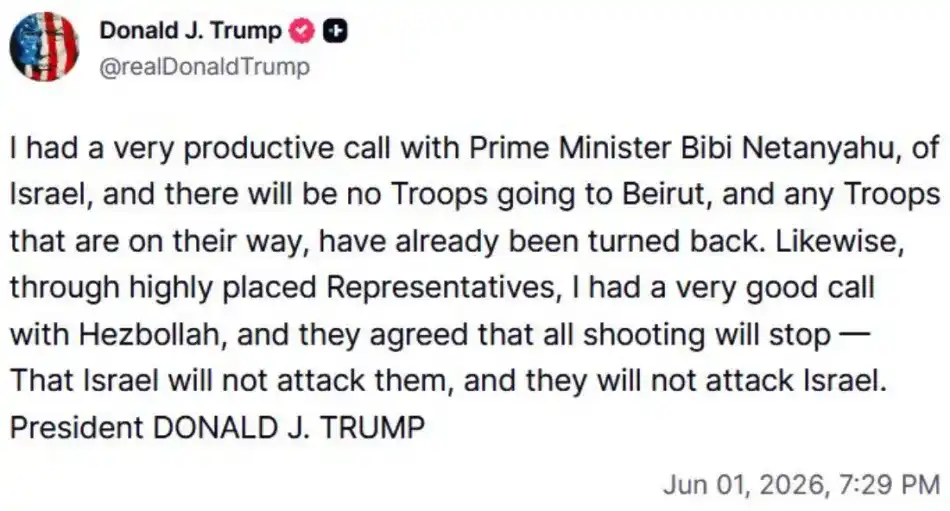
When Trump announced this news, everyone cheered.
However, shortly thereafter, reports emerged that Hezbollah had launched more rockets into northern Israel.
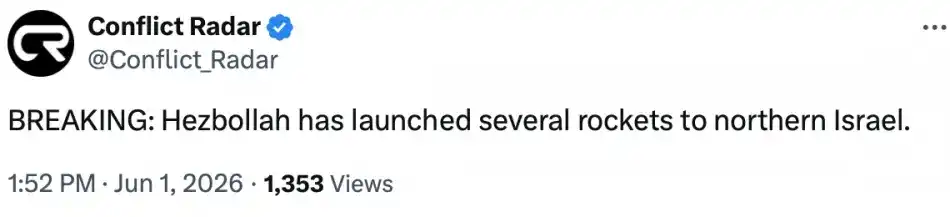
Hezbollah will not stop, and Iran does not want them to stop.
In fact, the Iranian Revolutionary Guard has apparently been secretly encouraging Hezbollah to ramp up its attacks.
According to Axios on Monday, citing a Lebanese official, the Revolutionary Guard has been urging Hezbollah to escalate the war against Israel so that Tehran can gain leverage in negotiations with the US.
If rockets and drones continue to fall on northern Israel, consequences will inevitably follow.
At Trump’s request, Israeli Prime Minister Netanyahu canceled a planned attack on Beirut. However, after speaking with Trump, he warned that if Hezbollah does not stop launching rockets and drones, Israel would proceed with its planned strikes on Beirut.
Israeli Prime Minister Benjamin Netanyahu stated that if Hezbollah does not stop its attacks on northern Israel, Israel will carry out previously planned strikes on Beirut. Earlier, President Trump had stated that the Israeli Defense Forces would not enter the Lebanese capital, and that Israel and Hezbollah would cease attacks on each other.
Netanyahu said in a Hebrew statement, "Tonight I spoke with President Trump and told him that if Hezbollah does not stop attacking our cities and civilians, Israel will strike the terrorist targets in Beirut. Our position has not changed."
He also stated, "Meanwhile, the Israeli Defense Forces will continue operations in southern Lebanon as planned."
This is completely unacceptable to the Iranians.
They are telling us that there will be no negotiations with the US until every Israeli soldier is completely withdrawn from Lebanon.
According to Tasnim, "There will be no dialogue until Israel fully withdraws from the occupied territory in Lebanon and ceases all attacks on Lebanon and Gaza."
The report adds, "Moreover, the resistance front and Iran have decided to fully blockade the Strait of Hormuz and initiate other fronts, including the Strait of Mandeb, to punish Zionists and their supporters."
Iran has also warned that if Israel ultimately attacks southern Beirut, the residents of northern Israel will face great danger.
The Iranian Revolutionary Guard warned residents of northern Israel that if Israel carries out its threatened attack on southern Beirut, they should evacuate their homes.
The Iranian semi-official media outlet Fars News, closely related to the Revolutionary Guard, stated on the X platform that this powerful paramilitary force is warning residents of "the northern region and military settlements on occupied territories" that they should leave the area if they do not want to be harmed.
Will Iran soon launch ballistic missiles at Israeli cities again?
This is possible.
The Iranians are now in a state of combat readiness, and they clearly are not afraid to pull the trigger.
On Monday, Iran launched several missiles and drones at a US military base within Kuwait.
Before the ceasefire collapsed, Iran had launched missiles and drones at a US Air Force base in Kuwait in retaliation for US airstrikes on Iranian radar and drone command facilities. Washington claimed these airstrikes were "defensive strikes" against the Iranian regime's radar and drone command facilities.
Additionally, Iran recently struck a commercial ship with a cruise missile in response to a prior attack on a commercial vessel heading for Iranian territory.
免责声明:本文章仅代表作者个人观点,不代表本平台的立场和观点。本文章仅供信息分享,不构成对任何人的任何投资建议。用户与作者之间的任何争议,与本平台无关。如网页中刊载的文章或图片涉及侵权,请提供相关的权利证明和身份证明发送邮件到support@aicoin.com,本平台相关工作人员将会进行核查。


