On May 29, Elio Cui, head of BIT Brokerage business, was invited to participate in the BEYOND Expo 2026—Web2+3 Wealth Forum roundtable discussion held in Macau, to discuss the real growth path for Web3's next stage with fellow guests. The roundtable theme: "How can Web3 reach a market value of $10T?".
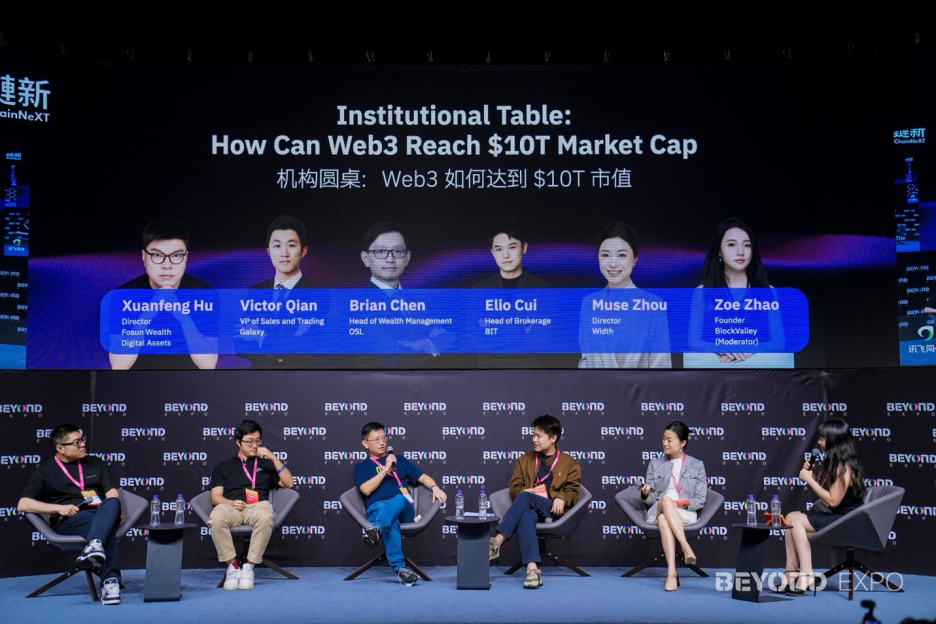
This roundtable discussion gathered top executives from the Web3 and traditional finance sectors to explore the institutional path of the crypto market, new asset classes, and regulatory milestones. Guests sharing the stage with Elio Cui included Xuanfeng Hu, Director of Digital Assets at Fosun Wealth, Victor Qian, Vice President of Sales and Trading at Galaxy, Brian Chen, Head of Wealth Management at licensed digital asset platform OSL in Hong Kong, and Muse Zhou from infrastructure provider Width. The guests held an in-depth and lively discussion on topics such as "the real thresholds for institutional funds to enter, who can support the next trillion with RWA and derivatives, and the path to achieving from 4T to 10T".
Core viewpoints from Elio Cui, head of BIT Brokerage business, during his speech include:
1. BIT (formerly Matrixport) is an industry-leading one-stop digital asset service platform, established in 2019. In February of this year, it took the lead in introducing an innovative direct-connect brokerage model for U.S. stocks in the industry, allowing users to transfer funds into BIT securities accounts with stablecoins for instant deposits, enabling the purchase of real U.S. stock assets instead of the commonly used tokenized U.S. stock price mappings in the industry. We made a very firm choice on this even when we were preparing the product at the end of last year. This choice actually stems from the company's seven-year history of serving institutional and high-net-worth clients and a long-term value orientation.
The direct-connect brokerage model of BIT's U.S. stock products is achieved through compliance structures and partnerships:
- Achieving stablecoin and fiat currency exchange according to applicable regulatory requirements
- Holding a financial services license from Bhutan to support users' compliance and secure purchases and holdings of securities assets
- Connecting with licensed financial partners like clearing brokers in the U.S.
2. Regarding how Web3 can achieve a market value of 10 trillion, Elio believes that the first question is "how to enable institutions to compliantly purchase these assets."
"This issue was actually discussed back in 2017, when Bitcoin was still widely questioned. At that time, people said that if all sovereign funds and pension funds in the world could invest one-thousandth or even one-hundredth, the price of Bitcoin would see drastic growth. We all thought it was a fantasy, even industry insiders felt this idea was too ahead of its time. But in less than a decade, seven or eight years later, we really saw: the market for ETFs like IBIT has reached hundreds of billions, and many sovereign funds, pensions, and compliant capital channels have entered Web3.
So, how to reach 10 trillion? My judgment is the same as it was ten years ago—if there are compliant channels that allow more people to purchase and hold these assets, the market value will naturally rise."
3. Currently, Web3 assets face the following difficulties in attracting a large amount of funds
1) Customer trading preferences
From the perspective of individual investors, our recent business data shows that the funds and users using stablecoins to buy U.S. (U.S. stock) assets are significantly more than those using fiat currency to enter and purchase Crypto Altcoins. Currently, due to the wealth effect of the U.S. stock market, individual investors are rapidly entering the market, with a shift occurring in wealth hotspots and paradigms.
2) Institutions find it difficult to enter
From an institutional viewpoint, crossing traditional and digital asset Portfolio Management remains a pain point in the industry. The custodian systems, management institutions, and settlement rules of the two types of assets are entirely different, resulting in low funding efficiency for cross-category allocation, and leveraging and position management are also difficult to coordinate and unify—many institutions are essentially managing the assets of the same client using two completely independent infrastructures. This structural barrier redefines the real moat: Companies that can connect traditional finance and digital assets, integrating both infrastructures, do not derive their barriers from stacking product functionalities but from the accumulation of many years of compliance structures and institutional service capabilities.
4. As Web3 assets transition from 4T to 10T, two main types of assets are crucial
1) Stablecoins act as a bridge, facilitating the transfer of funds between traditional finance and digital asset markets. In the process of connecting traditional finance with Web3, stablecoins will be heavily utilized, with their issuance scale and liquidity rising, thereby increasing Web3's size and market value.
2) RWA: The RWA transformation of a large number of U.S. stocks, especially in the AI sector, allows ordinary individual investors who originally could not obtain investment opportunities to purchase and hold stocks that possess scarcity, liquidity, and wealth effects. Investors can complete their investments in AI through tokenized stocks.
Investors can use the first method to utilize stablecoins to allocate both digital and traditional financial assets, or configure assets by holding tokenized stocks. The expansion of market value in these two major asset categories will fill the growth gap from 4 trillion to 10 trillion. It is important to note that, although both methods use stablecoins to trade U.S. stocks, the underlying nature differs: the first method uses stablecoins as a bridge to purchase and hold U.S. stocks within the traditional financial system while enjoying almost all shareholder rights. However, the current RWA U.S. stocks can primarily satisfy trading U.S. stock prices. Price exposure can meet trading demands, but real asset holding requires brokers, custodians, rights, and compliance frameworks.
5. Value creation is the driving force behind the healthy rise of assets
Disruptive innovations enhance human productivity; the existence of creation leads to good assets, and trading these assets with stablecoins can lead to a healthy rise in asset prices. It is well known that we need to hold assets rather than cash to outperform inflation.
6. Long-term perspective and risk
To make long-term value and investment judgments, short-term bubbles and fluctuations are small bumps in long-term rises; holding quality assets long-term can outperform inflation. As the saying goes: "If you don't drink bubbles, you can't have beer."
About BIT
BIT (formerly Matrixport) was established in 2019 and is a leading global digital asset financial services group. The group is headquartered in Singapore and has offices in seven countries and regions worldwide, connecting traditional finance with the digital asset market through a robust governance system, technological capabilities, and compliant operations.
BIT provides comprehensive digital asset services for global institutions and professional investors, covering trading, custody, asset management, liquidity, and financing services, and supports the on-chain introduction and application of real-world assets (RWA). Its entities hold corresponding licenses and are regulated locally in Singapore, Hong Kong, Switzerland, the UK, the US, and Bhutan, including a large payment institution license (MPI) in Singapore and a collective asset management license issued by the Swiss FINMA.
The group's current assets under management exceed $6 billion, with monthly trading volumes exceeding $7 billion, a total interest payment to clients of over $2 billion, and a valuation exceeding $1 billion, having been listed in the "2024 Hurun Global Unicorn List" and the "2025 Singapore Fintech Unicorn List."
Disclaimer:
This content is for reference only and does not constitute investment advice, an investment offer, or an invitation to purchase any financial products. The information contained in this article should not be regarded as a recommendation for any specific investment strategy or product.
免责声明:本文章仅代表作者个人观点,不代表本平台的立场和观点。本文章仅供信息分享,不构成对任何人的任何投资建议。用户与作者之间的任何争议,与本平台无关。如网页中刊载的文章或图片涉及侵权,请提供相关的权利证明和身份证明发送邮件到support@aicoin.com,本平台相关工作人员将会进行核查。


